
2 Step Tb Test PDF Template

2 Step Tb Test PDF Template

The 2 Step TB Test form is a record used to document the Mantoux tuberculin skin test, which is a requirement for all new volunteers at Raritan Bay Medical Center in New Jersey. This form captures essential information about the test, including the administration details and results, ensuring compliance with state regulations. To begin your volunteer journey, please fill out the form by clicking the button below.

Article Guide

The 2 Step TB Test form serves a crucial role in ensuring the health and safety of both volunteers and patients at Raritan Bay Medical Center. This form is a requirement under New Jersey State regulations, mandating that all new volunteers undergo a two-step Mantoux tuberculin skin test prior to their assignment. The process involves administering two injections, spaced two weeks apart, to accurately assess exposure to tuberculosis. Essential information is collected on the form, including the volunteer's name, address, and contact details, which helps maintain a comprehensive record. The form also captures specific test details, such as the name of the administrator, the date and time of the injections, and the arm on which the test was administered. Furthermore, it requires documentation of the PPD solution's manufacturer, expiration date, and lot number, ensuring traceability and compliance with health standards. After the test is read, the results, measured in millimeters of induration, must be recorded along with any comments on adverse reactions, if they occur. Although side effects are rare, the form allows for the documentation of any reactions, providing a thorough overview of the volunteer's health status. This systematic approach not only facilitates compliance with health regulations but also promotes a safe environment for everyone involved.

2 Step Tb Test Preview

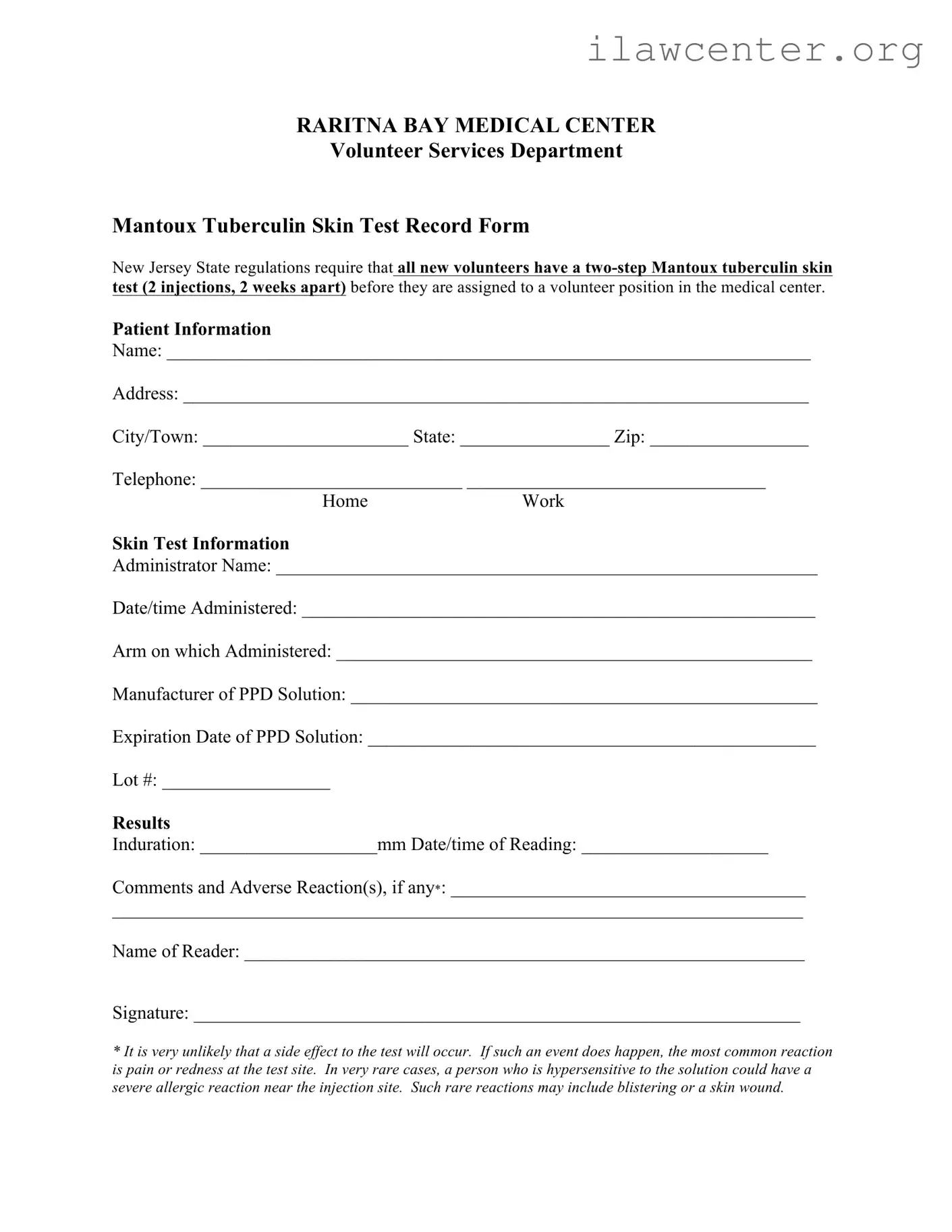
RARITNA BAY MEDICAL CENTER
Volunteer Services Department
Mantoux Tuberculin Skin Test Record Form
New Jersey State regulations require that all new volunteers have a two-step Mantoux tuberculin skin
test (2 injections, 2 weeks apart) before they are assigned to a volunteer position in the medical center.
Patient Information
Name: _____________________________________________________________________
Address: ___________________________________________________________________
City/Town: ______________________ State: ________________ Zip: _________________
Telephone: ____________________________ ________________________________
Home Work
Skin Test Information
Administrator Name: __________________________________________________________
Date/time Administered: _______________________________________________________
Arm on which Administered: ___________________________________________________
Manufacturer of PPD Solution: __________________________________________________
Expiration Date of PPD Solution: ________________________________________________
Lot #: __________________
Results
Induration: ___________________mm Date/time of Reading: ____________________
Comments and Adverse Reaction(s), if any*: ______________________________________
__________________________________________________________________________
Name of Reader: ____________________________________________________________
Signature: _________________________________________________________________
* It is very unlikely that a side effect to the test will occur. If such an event does happen, the most common reaction
is pain or redness at the test site. In very rare cases, a person who is hypersensitive to the solution could have a
severe allergic reaction near the injection site. Such rare reactions may include blistering or a skin wound.

File Properties

Fact Name Details
Purpose The 2 Step TB Test is designed to screen for tuberculosis in new volunteers at Raritan Bay Medical Center.
Regulatory Requirement New Jersey state regulations mandate that all new volunteers complete a two-step Mantoux tuberculin skin test before beginning their volunteer roles.
Test Procedure The test involves two injections of the PPD solution, administered two weeks apart.
Patient Information Volunteers must provide personal details such as name, address, and contact information on the form.
Results Documentation The form requires documentation of the induration measurement, which indicates the test result.
Adverse Reactions While side effects are rare, the form includes a section for comments on any adverse reactions experienced by the volunteer.
Signature Requirement The form must be signed by both the administrator of the test and the reader of the results, ensuring accountability.

Instructions on Utilizing 2 Step Tb Test

Completing the 2 Step TB Test form is essential for new volunteers at Raritan Bay Medical Center. After filling out the form, the next step involves submitting it to the Volunteer Services Department for review and processing. Ensure all information is accurate to avoid any delays in your volunteer assignment.

  1. Begin by entering your Name in the designated space.
  2. Fill in your Address, including street, city/town, state, and zip code.
  3. Provide your Telephone number, including both home and work numbers if applicable.
  4. In the Skin Test Information section, write the name of the administrator who performed the test.
  5. Record the Date/time Administered of the test.
  6. Indicate the Arm on which Administered (left or right).
  7. List the Manufacturer of PPD Solution used for the test.
  8. Write down the Expiration Date of PPD Solution.
  9. Enter the Lot # for the solution.
  10. Measure and record the Results Induration in millimeters.
  11. Document the Date/time of Reading when the results were checked.
  12. If there are any Comments and Adverse Reaction(s), note them in the provided space.
  13. Lastly, write the Name of Reader who evaluated the results and provide their Signature.

Important Facts about 2 Step Tb Test

What is the purpose of the 2 Step TB Test?

The 2 Step TB Test, specifically the Mantoux tuberculin skin test, is designed to detect whether an individual has been exposed to the tuberculosis bacteria. New Jersey State regulations mandate that all new volunteers at Raritan Bay Medical Center complete this test before they begin their volunteer work. The two-step process involves administering two injections, spaced two weeks apart, to ensure accurate results.

How is the 2 Step TB Test administered?

The test consists of two separate injections of a purified protein derivative (PPD) solution. A healthcare professional will administer the first injection in the forearm. After two weeks, a second injection will be given in the same manner. It is essential that the readings of both tests be documented accurately on the Mantoux Tuberculin Skin Test Record Form, including details such as the administrator's name and the date of administration.

What should I expect after receiving the TB Test?

After each injection, it is normal to experience some mild reactions, such as redness or pain at the injection site. These reactions typically resolve quickly. A healthcare provider will read the results of the test 48 to 72 hours after each injection. It is important to note that severe allergic reactions are extremely rare, but if they occur, they may include blistering or skin wounds at the injection site.

What information do I need to provide on the TB Test form?

The Mantoux Tuberculin Skin Test Record Form requires several key pieces of information. You must provide your name, address, and contact details. Additionally, the form requires specifics about the test, including the name of the administrator, the date and time the test was given, the arm used for the injection, and details about the PPD solution, such as the manufacturer, expiration date, and lot number. Finally, the results of the induration measurement and the name and signature of the reader must also be included.

Common mistakes

When filling out the 2 Step TB Test form, individuals often make several common mistakes that can lead to delays or complications in the volunteer process. One frequent error is failing to provide complete patient information. Omitting critical details such as the name, address, or telephone number can hinder the ability to contact the volunteer for follow-up or clarification.

Another mistake involves neglecting to accurately record the date and time the skin test was administered. This information is essential for ensuring that the two tests are spaced appropriately, as they must be given two weeks apart. Inaccurate dates can lead to scheduling issues and may require the volunteer to repeat the testing process.

In addition, some individuals overlook the importance of noting the arm on which the test was administered. This detail is crucial for the reader to assess the results accurately during the follow-up reading. Not specifying the arm can lead to confusion and potential errors in interpreting the test results.

Many volunteers also fail to include the manufacturer's name and expiration date of the PPD solution. This information is necessary to confirm that the test was conducted using a valid and effective product. Omitting these details can raise questions about the reliability of the test results.

Another common oversight is not providing the lot number of the PPD solution. This information is important for tracking purposes and ensuring that the correct batch of the solution was used. Incomplete information can complicate record-keeping and accountability.

Some individuals do not accurately record the induration measurement, which indicates the size of the reaction to the test. This measurement is critical for determining whether the test result is considered positive or negative. Failure to provide this measurement can lead to misinterpretation of the results.

Additionally, volunteers may neglect to include comments or report any adverse reactions, if they occurred. While side effects are rare, documenting any reactions is important for medical records and future reference. Not providing this information can prevent proper assessment and care if complications arise.

Finally, forgetting to sign the form can result in delays in processing. A signature is required to validate the information provided and to confirm that the volunteer has understood the testing process. Without a signature, the form may be considered incomplete, leading to further complications in the volunteer application.

Documents used along the form

When preparing to volunteer at a medical center, it's essential to complete various forms to ensure compliance with health regulations. Alongside the 2 Step TB Test form, several other documents are often required to provide a comprehensive health record. Below is a list of these forms, each serving a specific purpose in the volunteer onboarding process.

  • Health History Questionnaire: This form collects information about the volunteer's medical history, including any past illnesses, allergies, and current medications. It helps assess the individual's fitness for volunteering in a healthcare environment.
  • Volunteer Agreement: This document outlines the expectations and responsibilities of the volunteer. It includes details about the volunteer's role, hours of service, and adherence to hospital policies, ensuring clarity for both the volunteer and the organization.
  • Immunization Record: This record provides proof of the volunteer's vaccinations, including those for measles, mumps, rubella, and influenza. Keeping this information up-to-date is crucial for maintaining a safe environment for both patients and staff.
  • Confidentiality Agreement: Volunteers often have access to sensitive patient information. This agreement emphasizes the importance of maintaining confidentiality and outlines the legal obligations to protect patient privacy.

Completing these forms accurately and promptly is vital for a smooth onboarding experience. Each document plays a crucial role in ensuring that volunteers are healthy, informed, and prepared to contribute effectively to the medical center's mission.

Similar forms

The 2 Step TB Test form is essential for documenting the Mantoux tuberculin skin test required for volunteers. Several other documents share similarities with this form in purpose and structure. Below are six such documents:

  • Vaccination Record Form: This document tracks a person's vaccination history, including dates and types of vaccines received. Like the TB test form, it requires personal information and details about the administration of each vaccine.
  • Health Screening Questionnaire: This form collects health-related information from individuals before they participate in programs or services. Similar to the TB test form, it includes personal details and may require signatures for consent.
  • Medical History Form: Used by healthcare providers, this document gathers comprehensive health information from patients. It parallels the TB test form by requesting specific medical details and documenting interactions with healthcare professionals.
  • Consent for Treatment Form: This form is signed by patients to authorize medical procedures. It shares similarities with the TB test form in that both require signatures and include information about the procedure being performed.
  • Patient Registration Form: This document collects basic information about patients when they first visit a healthcare facility. It resembles the TB test form in its focus on personal data and essential contact information.
  • Emergency Contact Form: This form lists individuals to be contacted in case of an emergency. Like the TB test form, it requires personal information and is often used in conjunction with other medical documentation.

Dos and Don'ts

When filling out the 2 Step TB Test form, it’s important to ensure accuracy and completeness. Here are some essential do's and don'ts to keep in mind:

  • Do provide your full name and contact information clearly. This helps in identifying you easily.
  • Do ensure that the administrator's name and the date/time of the test are filled out accurately. This information is crucial for record-keeping.
  • Do double-check the expiration date of the PPD solution. Using expired materials can lead to inaccurate results.
  • Do report any adverse reactions, no matter how minor they may seem. This ensures your health and safety are prioritized.
  • Do keep a copy of the completed form for your records. Having a personal copy can be useful for future reference.
  • Don't leave any sections blank. Incomplete forms can delay your volunteer application process.
  • Don't use abbreviations or nicknames. Clarity is key when providing your information.
  • Don't forget to sign the form. Your signature confirms that all information is accurate and complete.
  • Don't ignore instructions regarding the test site. Make sure the correct arm is indicated to avoid confusion.
  • Don't hesitate to ask questions if you’re unsure about any part of the form. It’s better to clarify than to guess.

By following these guidelines, you can help ensure that your TB test form is filled out correctly, making the process smoother for both you and the medical center. Your attention to detail is appreciated!

Misconceptions

Understanding the 2 Step TB Test form is essential for new volunteers at medical centers. However, several misconceptions can lead to confusion. Here are eight common misconceptions explained:

  • Only one test is required. Many believe that only a single TB test is necessary. In fact, the two-step Mantoux tuberculin skin test involves two separate injections administered two weeks apart.
  • The test is only for people with symptoms. Some think the TB test is only for those showing symptoms of tuberculosis. However, it is a precautionary measure required for all new volunteers, regardless of symptoms.
  • Results are immediate. There is a common belief that results from the TB test can be read immediately. In reality, results must be read 48 to 72 hours after the test is administered.
  • Anyone can administer the test. Some may assume that any staff member can perform the test. In truth, only trained healthcare professionals are authorized to administer and read the TB test.
  • The test is painful. Many fear that the test is painful. While there may be slight discomfort, most individuals report only minor pain or redness at the injection site.
  • All reactions are severe. There is a misconception that any reaction to the test is serious. In reality, adverse reactions are rare and typically mild, such as temporary pain or redness.
  • Previous TB tests exempt you from retesting. Some believe that if they have had a TB test in the past, they do not need to be retested. However, the two-step testing is specifically required for new volunteers.
  • The test is not necessary if you have had the BCG vaccine. There is a belief that individuals who received the BCG vaccine do not need to be tested. However, even those vaccinated are required to undergo the two-step TB test.

By dispelling these misconceptions, new volunteers can better understand the requirements and ensure a smooth onboarding process at the medical center.

Key takeaways

When filling out and using the 2 Step TB Test form, it’s essential to keep the following key points in mind:

  • Two-Step Requirement: New Jersey regulations mandate that all new volunteers receive two Mantoux tuberculin skin tests, administered two weeks apart.
  • Accurate Information: Ensure that all patient information, including name, address, and contact details, is filled out completely and accurately.
  • Test Administration: Record the name of the administrator, the date and time the test was given, and the arm used for the injection.
  • PPD Solution Details: Document the manufacturer, expiration date, and lot number of the PPD solution to ensure validity and traceability.
  • Results and Reactions: Clearly note the induration measurement, the date and time of reading, and any comments regarding adverse reactions, even if they are unlikely.

Following these guidelines will help ensure a smooth process for volunteering at the medical center.