
5 Minute Personality Test PDF Template

5 Minute Personality Test PDF Template

The 5 Minute Personality Test is a quick and insightful way to understand your personality traits. By ranking words that describe you, this test identifies your dominant and sub-dominant personality types, helping you gain clarity on your natural inclinations. Discover what drives you by filling out the form below.

Article Guide

Understanding oneself can be a transformative journey, and the 5 Minute Personality Test offers a quick yet insightful way to explore personal traits. This test consists of ten lines, each featuring four descriptive words. Participants assign scores from 1 to 4, indicating how well each word describes them. The resulting scores are tallied into four distinct categories, represented by the letters L, O, G, and B. Each letter corresponds to a specific personality type: Lions, Otters, Golden Retrievers, and Beavers. The dominant type, indicated by the highest score, reveals a person's primary characteristics, while the second highest score provides additional insights into their personality. This framework not only highlights individual strengths and weaknesses but also offers a relatable analogy by likening each personality type to an animal. By understanding these categories, individuals can gain clarity on their natural inclinations and how they might respond in various situations, fostering personal growth and improved interpersonal relationships.

5 Minute Personality Test Preview

qÜÉ=“RJjfkrqb=mboplk^ifqv=qbpqÒ=
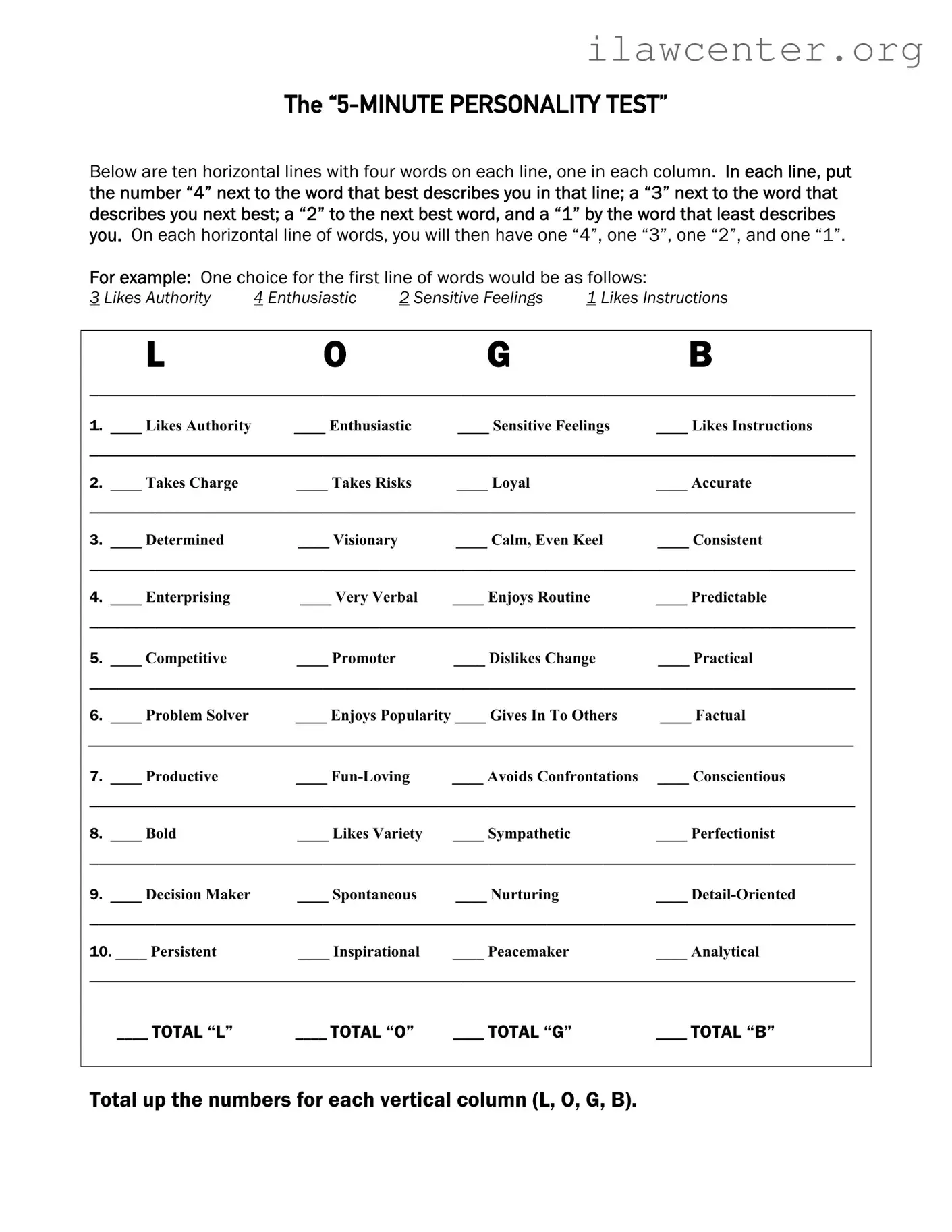
Below are ten horizontal lines with four words on each line, one in each column.
In each line, put
the number “4” next to the word that best describes you in that line; a “3” next to the word that
describes you next best; a “2” to the next best word, and a “1” by the word that least describes
you. On each horizontal line of words, you will then have one “4”, one “3”, one “2”, and one “1”.
For example: One choice for the first line of words would be as follows:
3
Likes Authority 4 Enthusiastic 2 Sensitive Feelings 1 Likes Instructions
L O G B
__________________________________________________________________________________
1. ____ Likes Authority ____ Enthusiastic ____ Sensitive Feelings ____ Likes Instructions
__________________________________________________________________________________
2. ____ Takes Charge ____ Takes Risks ____ Loyal ____ Accurate
__________________________________________________________________________________
3. ____ Determined ____ Visionary ____ Calm, Even Keel ____ Consistent
__________________________________________________________________________________
4. ____ Enterprising ____ Very Verbal ____ Enjoys Routine ____ Predictable
__________________________________________________________________________________
5. ____ Competitive ____ Promoter ____ Dislikes Change ____ Practical
__________________________________________________________________________________
6. ____ Problem Solver ____ Enjoys Popularity ____ Gives In To Others ____ Factual
__________________________________________________________________________________
7. ____ Productive ____ Fun-Loving ____ Avoids Confrontations ____ Conscientious
__________________________________________________________________________________
8. ____ Bold ____ Likes Variety ____ Sympathetic ____ Perfectionist
__________________________________________________________________________________
9. ____ Decision Maker ____ Spontaneous ____ Nurturing ____ Detail-Oriented
__________________________________________________________________________________
10. ____ Persistent ____ Inspirational ____ Peacemaker ____ Analytical
__________________________________________________________________________________
____ TOTAL “L” ____ TOTAL “O” ____ TOTAL “G” ____ TOTAL “B”
Total up the numbers for each vertical column (L, O, G, B).
tÜ~í=ÇçÉë=~ää=çÑ=íÜáë=ãÉ~å\=
=
Now that you’ve taken the survey, what does it all mean? Each letter (L, O, G, B) stands for a particular personality
type. The column with the highest score is your dominant personality type, while the column with the second highest
number is your sub-dominant type. While you are a combination of all four personality types, the two types with the
highest scores reveal the most accurate picture of your natural inclinations, strengths and weaknesses, and how you
will naturally respond in most situations.
The four personality types can be likened to animals to make them easier to understand and remember. Below are
complete descriptions of each one.
L = Lions
Lions are leaders. They are usually the bosses at work…or at least they think they are! They are decisive, bottom line
folks who are observers, not watchers or listeners. They love to solve problems. They are usually individualists who
love to seek new adventures and opportunities.
Lions are very confident and self-reliant. In a group setting, if no one else instantly takes charge, the Lion will.
Unfortunately, if they don’t learn how to tone down their aggressiveness, their natural dominating traits can cause
problems with others. Most entrepreneurs are strong lions, or at least have a lot of lion in them.
Natural Strengths Natural Weaknesses
Decisive Impatient
Goal-oriented Blunt
Achievement driven Poor listener
Gets results Impulsive
Independent Demanding
Risk-taker May view projects more important than people
Takes charge Can be insensitive to the feelings of others
Takes initiative May “run over” others who are slower to act or speak
Self-starter Fears inactivity, relaxation
• Persistent • Quickly bored by routine or mechanics
Efficient
Competitive
• Enjoys challenges, variety and change
• Driven to complete projects quickly and effectively.
Basic Disposition: Fast-paced, task oriented
Motivated by:
Results; challenge, action, power, and credit for achievement
Time Management: Lions focus on NOW instead of distant future. They get a lot more done in a lot
less time than their peers. Hate wasting time; and like to get right to the point.
Communication Style: Great at initiating communication; not good at listening (one way communicator)
Decision Making: Impulsive; makes quick decisions with goal or end result in mind. Results-focused.
Needs very few facts to make a decision.
In Pressure or Tense Situations: The lion takes command and becomes autocratic.
Greatest Needs: The lion needs to see results, experience variety, and face new challenges. He
needs to solve problems and wants direct answers.
What the Lion Desires: Freedom, authority, variety, difficult assignments, opportunity for advancement.
O = Otters
Otters are excitable, fun seeking, cheerleader types who love to talk! They’re great at motivating others and need to
be in an environment where they can talk and have a vote on major decisions. The otters’ outgoing nature makes
them great networkers—they usually know a lot of people who know a lot of people. They can be very loving and
encouraging unless under pressure, when they tend to use their verbal skills to attack. They have a strong desire to
be liked and enjoy being the center of attention. They are often very attentive to style, clothes, and flash. Otters are
the life of any party; and most people really enjoy being around them.
Natural Strengths Natural Weaknesses
Enthusiastic Unrealistic
Optimistic Not detail-oriented
• Good Communicator Disorganized
• Emotional and Passionate • Impulsive
• Motivational and Inspirational Listens to feelings above logic
Outgoing Reactive
Personal Can be too talkative
Dramatic Excitable
Fun-loving
Basic Disposition: Fast-paced. People-oriented.
Motivated by:
Recognition and approval of others
Time Management: Otters focus on the future and have a tendency to rush to the next exciting thing.
Communication Style: Enthusiastic and stimulating, often one-way; but can inspire and motivate others.
Decision Making: Intuitive and fast. Makes lots of “right calls” and lots of wrong ones.
In Pressure or Tense Situations: The otter ATTACKS. Can be more concerned about their popularity than about
achieving tangible results.
Greatest Needs: The otter needs social activities and recognition; activities that are fun, and
freedom from details.
What the Otter Desires: Prestige, friendly relationships, opportunity to help and motivate others, and
opportunities to verbally share their ideas.
G = Golden Retrievers
One word describes these people: LOYAL. They’re so loyal, in fact, that they can absorb the most emotional pain and
punishment in a relationship and still stay committed. They are great listeners, incredibly empathetic and warm
encouragers. However, they tend to be such pleasers that they can have great difficulty being assertive in a situation
or relationship when it’s needed.
Natural Strengths Natural Weaknesses
Patient Indecisive
Easy-going Over-accommodating
Team player May sacrifice results for the sake of harmony
Stable • Slow to initiate
Empathetic Avoids confrontation even when needed
• Compassionate • Tends to hold grudges and remember hurts
• Sensitive to feelings of others inflicted by others
Tremendously loyal Fears change
• Puts people above projects
Dependable
Reliable
Supportive
Agreeable
Basic Disposition: Slow-paced, people-oriented
Motivated by:
Desire for good relationships and appreciation of others.
Time Management: Golden Retrievers focus on the present and devote lots of time to helping others
and building relationships.
Communication Style: Two-way communicator; great listener and provides empathetic response.
Decision Making: Makes decisions more slowly, wants input from others, and often yields to the input
In Pressure or Tense Situations: The Golden Retriever gives in to the opinions, ideas, and wishes of others. Often
too tolerant.
Greatest Needs: The Golden Retriever needs security; gradual change and time to adjust to it; an
environment free of conflict.
Desires: Quality relationships; security; consistent known environment; a relaxed and
friendly environment; freedom to work at own pace.
B = Beavers
Beavers have a strong need to do things right and by the book. In fact, they are the kind of people who actually read
instruction manuals. They are great at providing quality control in an office, and will provide quality control in any
situation or field that demands accuracy, such as accounting, engineering, etc. Because rules, consistency and high
standards are so important to beavers, they are often frustrated with others who do not share these same
characteristics. Their strong need for maintaining high (and oftentimes unrealistic) standards can short-circuit their
ability to express warmth in a relationship.
Natural Strengths Natural Weaknesses
Accurate Too hard on self
• Analytical • Too critical of others
Detail-oriented Perfectionist
Thoroughness Overly cautious
Industrious Wont make decisions without “all” the facts
Orderly Too picky
• Methodical and exhaustive • Overly sensitive
• High standards
Intuitive
Controlled
Basic Disposition: Slow-paced, task-oriented
Motivated by:
The desire to be right and maintain quality.
Time Management: Beavers tend to work slowly to make sure they are accurate.
Communication Style: Beavers are good listeners, communicate details, and are usually diplomatic.
Decision Making: Avoids making decisions; needs lots of information before they will make a decision
In Pressure or Tense Situations: The beaver tries to avoid pressure or tense situations. They can ignore deadlines.
Greatest Needs: The beaver needs security, gradual change and time to adjust to it.
What the Beaver Desires: Clearly defined tasks, stability, security, low risk, and tasks that require precision
and planning.

File Properties

Fact Name Fact Description
Test Purpose The 5 Minute Personality Test is designed to help individuals identify their dominant and sub-dominant personality traits based on a scoring system.
Scoring System Participants score themselves on ten lines, assigning numbers 1 through 4 to words that best describe them, leading to a total for each personality type.
Personality Types The test categorizes individuals into four personality types: Lions, Otters, Golden Retrievers, and Beavers, each with unique characteristics.
Interpretation of Results The column with the highest score indicates the dominant personality type, while the second highest reveals the sub-dominant type, providing insights into behavior and preferences.
State-Specific Forms Some states may require specific adaptations of the test form to comply with local laws regarding personality assessments.
Governing Laws In California, for example, the test must comply with the California Consumer Privacy Act (CCPA), ensuring data protection and privacy.
Applications This personality assessment can be utilized in various settings, including workplaces, personal development, and team-building exercises.

Instructions on Utilizing 5 Minute Personality Test

Completing the 5 Minute Personality Test form is a straightforward process that allows you to reflect on your personality traits. By following the steps below, you'll assign values to various descriptors that align with your personal characteristics. Once you finish, you’ll have a clearer understanding of your dominant and sub-dominant personality types.

  1. Begin with the first line of words. You will see four descriptors: "Likes Authority," "Enthusiastic," "Sensitive Feelings," and "Likes Instructions."
  2. Next to each word, assign a number from 1 to 4 based on how well each word describes you. Place a “4” next to the word that fits you best, a “3” next to the second-best word, a “2” for the next best, and a “1” for the word that describes you the least.
  3. Repeat this process for all ten lines, ensuring that each line has one “4,” one “3,” one “2,” and one “1.”
  4. After completing all lines, you will have a total for each vertical column labeled "L," "O," "G," and "B."
  5. Finally, sum up the numbers in each column to find your total scores for "L," "O," "G," and "B."

Once you have your totals, you can interpret your results to understand your personality type better. This information can provide insights into your natural inclinations, strengths, and areas for improvement.

Important Facts about 5 Minute Personality Test

What is the purpose of the 5 Minute Personality Test?

The 5 Minute Personality Test is designed to help individuals gain insight into their personality traits. By ranking words that describe you, the test identifies your dominant and sub-dominant personality types. This understanding can assist you in recognizing your strengths and weaknesses, ultimately guiding you in personal and professional situations.

How do I complete the test?

To complete the test, you will see ten horizontal lines, each containing four words. For each line, assign a number from 1 to 4 next to each word. Use “4” for the word that describes you best, “3” for the next best, “2” for the next, and “1” for the word that least describes you. After filling out all lines, total the numbers for each vertical column labeled L, O, G, and B to identify your personality types.

What do the letters L, O, G, and B represent?

The letters correspond to four distinct personality types: L for Lions, O for Otters, G for Golden Retrievers, and B for Beavers. Each type has unique characteristics and strengths. For instance, Lions are natural leaders, while Otters are outgoing and fun-loving. Understanding which types resonate with you can provide valuable insights into your behavior and interactions with others.

How can I use the results of the test?

Once you have identified your dominant and sub-dominant personality types, you can reflect on how these traits influence your daily life. This knowledge can improve your relationships, enhance your communication skills, and help you make more informed decisions. By recognizing your natural inclinations, you can also work on areas that may need development, leading to personal growth and better interactions with others.

Common mistakes

Filling out the 5 Minute Personality Test form can be a revealing experience, but many people make common mistakes that can affect their results. One frequent error is not reading the instructions carefully. The form requires participants to rank four words on each line with numbers from 1 to 4. Skipping this step or misunderstanding the ranking system can lead to inaccurate scores and misinterpretation of personality traits.

Another mistake is being inconsistent in how they assign values. For instance, some may assign a “4” to multiple words on the same line. This violates the requirement to have one of each number (4, 3, 2, 1) per line. This inconsistency can skew the final results, making it difficult to determine the dominant personality type accurately.

People often underestimate the importance of self-reflection when selecting their rankings. Choosing words based on how one wishes to be perceived rather than how they genuinely feel can lead to misleading outcomes. It’s essential to be honest and introspective to get a true sense of one’s personality traits.

Additionally, individuals might overlook the total scoring section at the end of the test. After ranking the words, participants need to total the scores for each column (L, O, G, B). Failing to do this step means missing out on understanding their dominant and sub-dominant personality types, which are crucial for interpreting the results.

Lastly, neglecting to consider the context of the test can lead to confusion. The test is designed to reflect natural inclinations and strengths, not how one performs in specific situations. Focusing too much on recent experiences or external pressures can distort the results. Understanding that the test is about inherent traits rather than situational behaviors will yield more accurate insights into personality.

Documents used along the form

When utilizing the 5 Minute Personality Test form, several other documents and forms may complement the process, enhancing understanding and application of the results. Here’s a brief overview of those additional documents:

  • Personality Type Overview Sheet: This document provides a concise summary of each personality type represented by the test. It highlights key traits, strengths, and potential weaknesses, helping individuals better understand their results.
  • Team Dynamics Assessment: This form evaluates how different personality types interact within a team setting. It can help identify potential conflicts and synergies, guiding team-building efforts.
  • Personal Development Plan: A structured template that encourages individuals to set personal growth goals based on their personality test results. It outlines actionable steps to leverage strengths and address weaknesses.
  • Feedback Form: This form allows peers or supervisors to provide constructive feedback on an individual’s behavior and performance, offering insights that align with the personality traits identified in the test.
  • Communication Style Guide: A reference document that outlines preferred communication styles for each personality type. This can help improve interactions among team members by fostering understanding and respect for different approaches.
  • Conflict Resolution Strategies: A guide that provides tailored strategies for managing conflicts based on the various personality types. It helps individuals navigate disagreements more effectively.
  • Career Pathway Guide: This document suggests potential career paths that align with the strengths of each personality type, helping individuals make informed decisions about their professional journeys.
  • Workshop Registration Form: A form for individuals interested in participating in workshops focused on personal development, team dynamics, or communication skills, which can further enhance their understanding of personality types.
  • Goal-Setting Worksheet: A practical tool for individuals to outline specific, measurable goals related to their personal and professional development, based on insights gained from the personality test.
  • Reflection Journal: A personal space for individuals to document their thoughts and feelings about their personality test results, track their progress, and reflect on their development journey.

These documents serve as valuable resources that can enhance the insights gained from the 5 Minute Personality Test. By integrating these tools, individuals can better understand themselves and others, leading to improved personal growth and more effective teamwork.

Similar forms

The 5 Minute Personality Test form shares similarities with several other well-known personality assessment tools. Each of these documents helps individuals understand their characteristics, preferences, and behaviors. Here are five such documents:

  • Myers-Briggs Type Indicator (MBTI): This assessment categorizes individuals into 16 personality types based on four dichotomies. Like the 5 Minute Personality Test, it aims to help people gain insights into their natural inclinations and how they interact with others.
  • DISC Assessment: The DISC model focuses on four primary personality traits: Dominance, Influence, Steadiness, and Conscientiousness. Similar to the 5 Minute Personality Test, it emphasizes understanding behavior in social and work environments, allowing individuals to recognize their strengths and weaknesses.
  • Enneagram: This model identifies nine distinct personality types, each with its own motivations and fears. Like the 5 Minute Personality Test, the Enneagram encourages self-reflection and personal growth by highlighting how different types respond to challenges and relationships.
  • StrengthsFinder: This tool identifies an individual’s top strengths out of a list of 34 themes. It shares the goal of the 5 Minute Personality Test in that it helps people focus on their natural talents, fostering a greater understanding of how to leverage those strengths in various situations.
  • Big Five Personality Traits: This model assesses individuals based on five dimensions: openness, conscientiousness, extraversion, agreeableness, and neuroticism. Like the 5 Minute Personality Test, it provides a framework for understanding personality and behavior, allowing for deeper insights into personal and professional interactions.

Each of these assessments offers valuable insights into personality, helping individuals navigate their personal and professional lives more effectively.

Dos and Don'ts

When filling out the 5 Minute Personality Test form, there are several best practices to keep in mind. Here is a list of things you should and shouldn't do:

  • Do: Take your time to reflect on each word before making a choice.
  • Do: Be honest with yourself about your feelings and behaviors.
  • Do: Read all the words on each line carefully before assigning numbers.
  • Do: Consider how you typically respond in various situations.
  • Do: Use the full range of numbers (1-4) for accurate results.
  • Don't: Rush through the test; thoughtful responses yield better insights.
  • Don't: Choose words based on what you think others want to hear.
  • Don't: Overthink your choices; go with your first instinct.
  • Don't: Skip any lines; each one is important for your overall assessment.
  • Don't: Forget to total your scores accurately at the end.

Misconceptions

Understanding the 5 Minute Personality Test can be quite enlightening, but several misconceptions can cloud its effectiveness. Here’s a breakdown of ten common misunderstandings surrounding this personality assessment.

  1. It’s Just a Fun Quiz - Many people view the test as merely a casual activity. In reality, it provides insights into personality traits that can influence personal and professional relationships.
  2. Results Are Fixed - Some believe that the results are set in stone. However, personality can evolve over time due to experiences and personal growth.
  3. Only One Personality Type Applies - A common misconception is that individuals fall into a single personality type. The test actually reveals a combination of traits, showcasing a spectrum of characteristics.
  4. It’s Only for Professionals - While the test can be beneficial in workplace settings, anyone can gain valuable insights about themselves and their interactions with others.
  5. It’s Scientifically Validated - Some assume that the test is backed by extensive scientific research. While it offers useful insights, it should not be considered a definitive psychological assessment.
  6. It Can Predict Future Behavior - Many think the test can accurately forecast how someone will act in every situation. Instead, it provides a general overview of tendencies, not absolutes.
  7. All Results Are Equal - Some may believe that every personality type holds the same value. Each type has unique strengths and weaknesses, and understanding these can lead to personal development.
  8. It’s Only About Work - People often think the test is solely for career purposes. In truth, it can enhance personal relationships, communication styles, and self-awareness.
  9. It Requires Extensive Time - The name suggests a quick assessment, yet some assume it demands hours of reflection. In reality, it takes only a few minutes to complete.
  10. It’s a One-Time Assessment - Lastly, many believe that taking the test once is sufficient. Regularly revisiting the test can provide fresh insights as one’s life circumstances change.

By dispelling these misconceptions, individuals can better appreciate the value of the 5 Minute Personality Test and use it as a tool for personal growth and improved interactions with others.

Key takeaways

Here are some key takeaways regarding the 5 Minute Personality Test form:

  • The test consists of ten horizontal lines, each containing four descriptive words.
  • Participants assign a number from 1 to 4 next to each word, indicating how well it describes them.
  • A score of "4" indicates the word that best describes the individual, while "1" is for the least descriptive word.
  • After completing the lines, individuals total their scores for each column labeled L, O, G, and B.
  • The column with the highest score represents the dominant personality type.
  • The second highest score indicates the sub-dominant personality type.
  • Understanding these personality types can reveal natural strengths and weaknesses.
  • The four personality types are associated with animals: Lions, Otters, Golden Retrievers, and Beavers.
  • Each type has distinct traits, communication styles, and decision-making approaches.

Using this test can help individuals gain insight into their behaviors and interactions with others.