5 Year Fire Sprinkler Inspection PDF Template

5 Year Fire Sprinkler Inspection PDF Template

The 5 Year Fire Sprinkler Inspection form is a crucial document that outlines the inspection, testing, and maintenance requirements for fire sprinkler systems in compliance with California regulations. This form ensures that all components of the fire sprinkler system are thoroughly evaluated and maintained to protect lives and property. It is essential to complete this form accurately to ensure your building meets safety standards; click the button below to fill out the form.

Article Guide

The 5 Year Fire Sprinkler Inspection form plays a crucial role in ensuring the safety and reliability of fire sprinkler systems in buildings. This comprehensive document is designed to capture essential information about the property and the fire protection equipment installed. It includes sections for property details, contractor or licensed owner information, and specific riser data. The form outlines a series of inspections, tests, and maintenance tasks that must be completed over a five-year period, as mandated by California regulations. Each item is marked with a status of Pass, Fail, or Not Applicable, providing clear insights into the condition of the system. The form also details various components such as control valves, waterflow alarm devices, and backflow preventers, ensuring that all critical aspects of the fire sprinkler system are thoroughly evaluated. Additionally, it emphasizes the importance of maintaining accurate records, including comments on any deficiencies found during inspections. By adhering to the guidelines set forth in this form, property owners can help ensure their fire sprinkler systems remain effective and compliant with safety standards.

5 Year Fire Sprinkler Inspection Preview

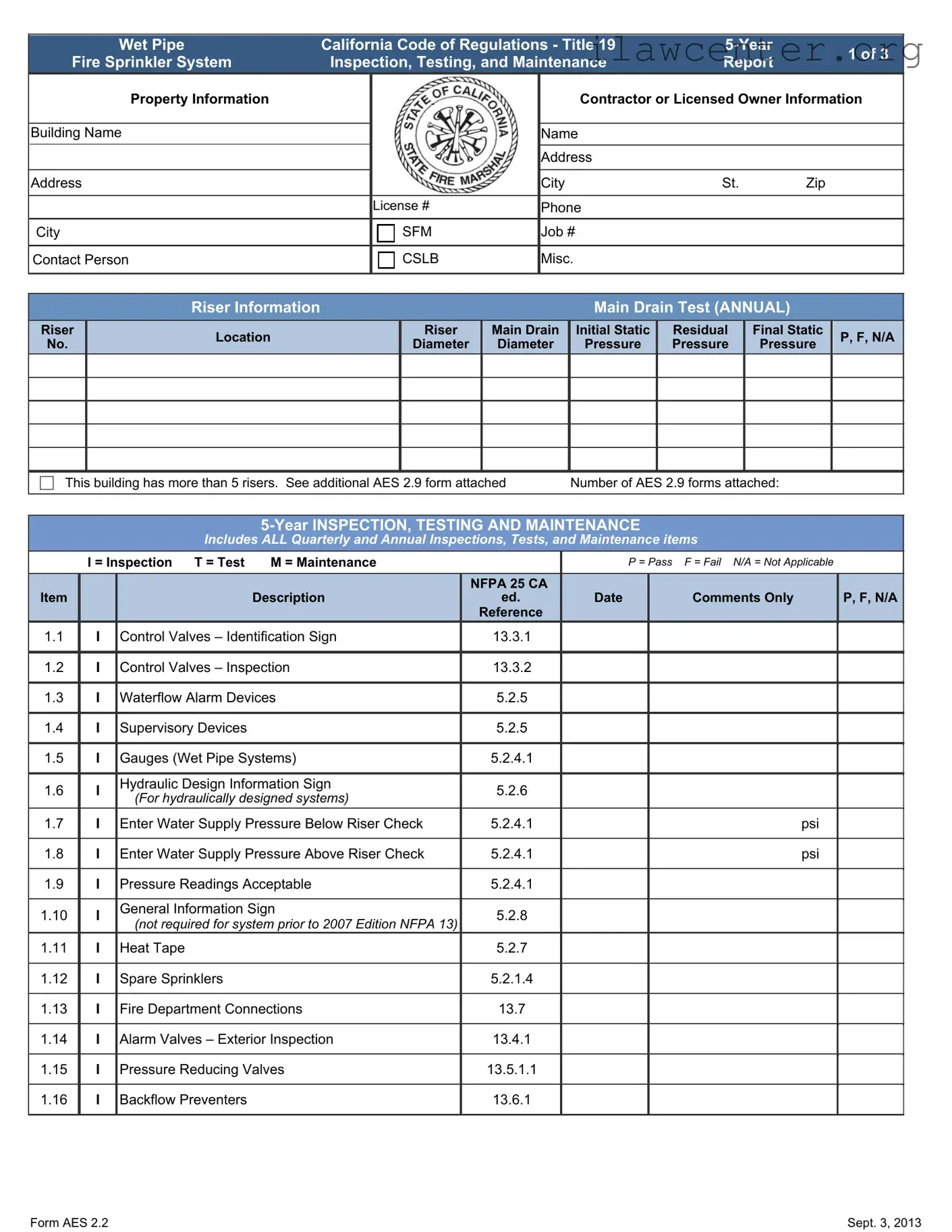
Wet Pipe
Fire Sprinkler System
California Code of Regulations - Title 19
Inspection, Testing, and Maintenance
5-Year
Report
1 of 3
Property Information Contractor or Licensed Owner Information
Building Name
Name
Address
Address City St. Zip
City
License #
Phone
Contact Person
SFM Job #
CSLB Misc.
Riser Information Main Drain Test (ANNUAL)
Riser
No.
Location
Riser
Diameter
Main Drain
Diameter
Initial Static
Pressure
Residual
Pressure
Final Static
Pressure
P, F, N/A
This building has more than 5 risers. See additional AES 2.9 form attached Number of AES 2.9 forms attached:
5-Year INSPECTION, TESTING AND MAINTENANCE
Includes ALL Quarterly and Annual Inspections, Tests, and Maintenance items
I = Inspection T = Test M = Maintenance
P = Pass F = Fail N/A = Not Applicable
Item Description
NFPA 25 CA
ed.
Reference
Date Comments Only P, F, N/A
1.1 I Control Valves – Identification Sign 13.3.1
1.2 I Control Valves – Inspection 13.3.2
1.3 I Waterflow Alarm Devices 5.2.5
1.4 I Supervisory Devices 5.2.5
1.5 I Gauges (Wet Pipe Systems) 5.2.4.1
1.6 I
Hydraulic Design Information Sign
(For hydraulically designed systems)
5.2.6
1.7 I
Enter Water Supply Pressure Below Riser Check
5.2.4.1 psi
1.8 I
Enter Water Supply Pr
essure Above Riser Check 5.2.4.1 psi
1.9 I
Pressure Readings Acceptable
5.2.4.1
1.10 I
General Information Sign
(not required for system prior to 2007 Edition NFPA 13)
5.2.8
1.11 I Heat Tape 5.2.7
1.12 I Spare Sprinklers 5.2.1.4
1.13 I Fire Department Connections 13.7
1.14 I Alarm Valves – Exterior Inspection 13.4.1
1.15 I Pressure Reducing Valves 13.5.1.1
1.16 I Backflow Preventers 13.6.1
Form AES 2.
2
Se
p
t. 3, 2013
Wet Pipe
Fire Sprinkler System
California Code of Regulations - Title 19
Inspection, Testing, and Maintenance
5 Year
Report
2 of 3
Property Information Contractor or Licensed Owner Information
Building Name Name
Address Job #
City
ANNUAL INSPECTION, TESTING, AND MAINTENANCE
Include ALL Quarterly Inspections (See AES 2.1)
I = Inspection T = Test M = Maintenance
P = Pass F = Fail N/A = Not Applicabl
e
Item Description
NFPA 25 CA ed.
Reference
Date Comments Only P,F,N/A
1.17 I Small Hose Connections - Hose Valve*
5.1.6, 13.5.2
13.5.5.1
1.18 I PRV – Fire Sprinkler Systems 13.5.1.1
1.19 I Buildings (Freeze Protection) 4.1.1.1 Owner’s Responsibilit
y
1.20 I Sprinklers 5.2.1
1.21
I Sprinklers - Accessible Concealed Space 5.2.1.1.6
1.22
I Pipe and Fittings 5.2.2
1.23
I Pipe and Fittings - Accessible Concealed Space 5.2.2.3
1.24 I Hangers 5.2.3
1.25 I Hangers - Accessible Concealed Space 5.2.3.3
1.26 I Seismic Braces 5.2.3
1.27 I Seismic Braces - Accessible Concealed Space 5.2.3.3
1.28 I Unsprinklered Areas CFC 901.4 Yes No
2.1 T
Field Service Test Required
Send Report to Fire Code Official
5.3.1
If REQUIRED, Enter 'F' until
results are returned from Lab
2.2 T
Recalled Sprinklers
If not present = Pass; If present = Fail
Title 19
904.1(c)
2.3 T
Water Flow Alarm Devices
90 secs max. Enter time
5.3.3
13.2.6
sec.
2.4 T
Main Drain Test
(Enter data on Page 1 of this form)
13.2.5
13.3.3.4
2.5 T Control Valve - Position 13.3.3.2
2.6 T Control Valve – Operation 13.3.3.1
2.7 T Supervisory Devices 13.3.3.5
2.8 T Backflow Preventer Assemblies 13.6.2
2.9 T
Small Hose Connections*
w/PRV Hose Valves – Partial Flow Test
13.5.2.3
13.5.3.3
2.10 T PRV – Fire Sprinkler Systems 13.5.1.3
2.11 T Pressure Gauges - Calibration 5.3.2
2.12 T
Small Hose Connections
*
13.5.6.2.2
* Small hose connections are hose valves and optional hose supplied by the fire sprinkler system. They do not include Class I, II, or III
standpipe systems.
Form AES 2.
2
Se
p
t. 3, 2013
Wet Pipe
Fire Sprinkler System
California Code of Regulations - Title 19
Inspection, Testing, and Maintenance
Property Information Contractor or Licensed Owner Information
Building Name Name
Address Job #
City
ANNUAL INSPECTION, TESTING, AND MAINTENANCE
include ALL Quarterly Inspections (See AES 2.1)
I = Inspection T = Test M = Maintenance P = Pass F = Fail N/A = Not Applicable
Item Description
NFPA 25 CA ed.
Reference
Date Comments Only P,F,N/A
3.1 M Check Valves - Internal inspection 13.4.2
3.2 M Control Valves 13.3.4
3.3 M FDC - Backflush
14.3.2.3
14.3.2.4
3.4 M
Internal Pipe Inspection - See Deficiencies and
Comments Section for Results.
14.2
Yes
No
3.5 M
Obstruction Inv
estigation Required. If "Yes", see
Deficiencies and Comments Section for Results
14.3
3.6 M System Returned to Service 4.5.3
Yes
No
D = Deficiency C = Comment (Indicate type )
Item Date Riser D C
Deficiencies and Comments
Indicate all equipment, devices and parts that were repaired or replaced
Check here if additional Deficiencies and Comments are listed on Form AES 9
See Correction Form AES 10 for corrected deficiencies.
Number attached:
Number attached:
I hereby certify that the fire protection equipment listed above has been fully inspected, tested, and maintained on this date by
the company indicated above, in accordance with CCR, Title 19, Sections 901 to 906 and that the equipment is fully operable
except as noted in the “Deficiencies and Comments” section of this form.
Print Name
Signature Date
Form AES 2.
2
Se
p
t. 3, 2013
5
Year
Report
3 of 3

File Properties

Fact Name Description
Governing Law The 5 Year Fire Sprinkler Inspection form is governed by the California Code of Regulations, Title 19.
Inspection Frequency Inspections must occur every five years, including all quarterly and annual tests and maintenance items.
Inspection Components The form includes various inspection components, such as control valves, waterflow alarm devices, and backflow preventers.
Documentation Requirement Inspectors must document their findings, noting any deficiencies and comments, and certifying the equipment's operability.
Additional Forms If a building has more than five risers, additional AES 2.9 forms must be attached to the inspection report.

Instructions on Utilizing 5 Year Fire Sprinkler Inspection

Completing the 5 Year Fire Sprinkler Inspection form is essential for ensuring compliance with safety regulations. This process involves gathering specific information about the property, the contractor, and the fire sprinkler system itself. Following these steps will help you accurately fill out the form.

  1. Start by entering the Property Information section. Fill in the Building Name, Address, City, State, and Zip Code.
  2. In the Contractor or Licensed Owner Information section, provide the Name, Address, City, Phone, and License #.
  3. Record the Job # and Contact Person in the designated fields.
  4. For the Main Drain Test, indicate the Riser Location and fill in the Diameter and Pressure readings for Initial Static, Residual, and Final Static pressure.
  5. If the building has more than 5 risers, note the number of AES 2.9 forms attached.
  6. Proceed to the 5-Year INSPECTION, TESTING AND MAINTENANCE section. For each item listed, mark whether it was inspected, tested, or maintained, and indicate if it passed, failed, or was not applicable.
  7. In the ANNUAL INSPECTION, TESTING, AND MAINTENANCE section, repeat the process for each item, ensuring you accurately fill in the Date and any Comments as needed.
  8. For the Deficiencies and Comments section, indicate any equipment or devices that were repaired or replaced. If there are additional comments, check the box and attach Form AES 9.
  9. Finally, certify the inspection by providing your Print Name, Signature, and Date at the bottom of the form.

Important Facts about 5 Year Fire Sprinkler Inspection

What is the purpose of the 5 Year Fire Sprinkler Inspection form?

The 5 Year Fire Sprinkler Inspection form is designed to document the inspection, testing, and maintenance of fire sprinkler systems in accordance with California regulations. This form ensures that all necessary inspections and tests are performed to confirm that the system is functioning properly and meets safety standards. It covers various components of the system, including control valves, alarm devices, and water supply pressures, among others.

Who is responsible for completing the 5 Year Fire Sprinkler Inspection form?

The responsibility for completing the form typically falls on a licensed contractor or the property owner. It is essential that the person filling out the form is knowledgeable about fire sprinkler systems and familiar with the relevant regulations. Proper documentation is critical to ensure compliance and safety, and it must be signed by the individual who performed the inspection.

What information is required on the form?

The form requires several key pieces of information, including the building name, address, contractor or licensed owner's name, and contact details. Additionally, it includes specific inspection items with corresponding pass/fail indicators, comments, and references to the applicable NFPA standards. The form also captures data from tests such as the main drain test and pressure readings, which are vital for assessing the system's performance.

How often should the inspection be conducted?

Inspections must be conducted at least every five years, as mandated by California regulations. However, annual inspections are also required to ensure ongoing compliance and safety. Quarterly inspections are recommended for certain components of the fire sprinkler system. Regular maintenance and testing help identify potential issues before they become serious problems, ensuring that the system remains reliable in case of an emergency.

Common mistakes

Completing the 5 Year Fire Sprinkler Inspection form can be straightforward, but common mistakes can lead to complications. One frequent error is failing to provide complete property information. Omitting details such as the building name, address, or city can cause delays in processing and may result in non-compliance.

Another mistake involves incorrect or missing contractor information. It is essential to ensure that the contractor's name, license number, and contact details are accurately filled in. Incomplete or inaccurate contractor information can hinder communication and affect accountability.

People often overlook the importance of the main drain test results. This section requires specific pressure readings. Not entering these values or providing incorrect figures can lead to misunderstandings about the system's performance and reliability.

Additionally, individuals sometimes fail to check the number of attached AES 2.9 forms when the building has more than five risers. This oversight can create confusion and may result in an incomplete assessment of the fire sprinkler system.

Using the correct codes and references is crucial. Some may neglect to verify that they are referencing the most current NFPA standards. This can lead to non-compliance and potential safety issues.

Comments sections are often underutilized. Providing detailed comments about inspections, tests, or maintenance can clarify the condition of the system. Leaving this section blank may lead to questions about the thoroughness of the inspection.

Another common error is misclassifying items as "Not Applicable" (N/A) when they should be marked as "Pass" or "Fail." Proper classification ensures that all components are evaluated correctly, which is vital for maintaining safety standards.

Finally, failing to sign and date the form can invalidate the inspection. A signature confirms that the inspection was completed and that the information provided is accurate. Neglecting this step can lead to issues with regulatory compliance.

Documents used along the form

When managing fire safety systems, several important forms and documents complement the 5 Year Fire Sprinkler Inspection form. Each of these documents plays a vital role in ensuring compliance with safety regulations and maintaining the integrity of fire protection systems. Below is a list of commonly used forms that you may encounter.

  • Annual Inspection Report: This document details the annual inspection of the fire sprinkler system. It includes findings from tests and maintenance performed throughout the year, ensuring that all components are functioning properly.
  • Quarterly Inspection Checklist: Used to record quarterly inspections, this checklist helps ensure that regular maintenance is performed on the fire sprinkler system. It focuses on key components and their operational status.
  • Hydraulic Calculation Report: This report provides detailed calculations of the hydraulic design of the fire sprinkler system. It ensures that the system is capable of delivering adequate water flow and pressure during a fire emergency.
  • Backflow Prevention Device Test Report: This document records the testing of backflow prevention devices, which are essential for preventing contamination of the water supply. It verifies that these devices are functioning correctly.
  • Deficiency and Correction Report: If any issues are identified during inspections, this report outlines the deficiencies and the corrective actions taken. It ensures that all problems are documented and resolved in a timely manner.
  • Fire Department Connection Inspection Report: This report focuses on the inspection of fire department connections. It confirms that these connections are accessible and operational for emergency responders.
  • System Maintenance Log: A comprehensive log that tracks all maintenance activities performed on the fire sprinkler system. It serves as a historical record and can be crucial for compliance audits.
  • Test and Maintenance Certification: This certification verifies that the fire protection equipment has been tested and maintained according to regulatory standards. It is often required for compliance with local fire codes.
  • Emergency Contact Information Form: This form lists emergency contacts for the building, including maintenance personnel and contractors. It ensures that the right people can be reached quickly in case of an emergency.
  • Equipment Replacement Log: This log tracks any equipment that has been replaced or repaired. It helps maintain an accurate inventory of the system's components and their status.

Each of these documents serves an essential purpose in maintaining fire safety standards. By keeping thorough records and ensuring compliance, you contribute to a safer environment for everyone. Make sure to familiarize yourself with these forms to effectively manage your fire sprinkler system.

Similar forms

  • Annual Fire Alarm Inspection Report: This document outlines the inspection, testing, and maintenance of fire alarm systems. Similar to the 5-Year Fire Sprinkler Inspection form, it includes details on inspections, tests, and maintenance items, ensuring compliance with safety regulations.

  • Fire Extinguisher Inspection Report: This report details the inspection and maintenance of fire extinguishers. Like the sprinkler inspection form, it requires information on the condition and functionality of the equipment, ensuring that safety measures are upheld.

  • Emergency Lighting Inspection Report: This document verifies that emergency lighting systems are operational. It shares a similar structure with the sprinkler inspection form, focusing on testing and maintenance to ensure readiness in case of an emergency.

  • Smoke Control System Inspection Report: This report assesses the functionality of smoke control systems in buildings. It parallels the 5-Year Fire Sprinkler Inspection form by documenting inspections and tests to confirm compliance with safety standards.

  • Backflow Prevention Device Inspection Report: This document ensures that backflow prevention devices are functioning correctly. It resembles the sprinkler inspection form in its focus on detailed inspection and testing protocols to prevent contamination of water supply.

  • Building Fire Safety Compliance Report: This report summarizes a building's compliance with fire safety regulations. It is similar to the sprinkler inspection form in that it includes various inspections and maintenance checks to ensure overall safety.

  • Hazardous Materials Management Plan: This document outlines the management of hazardous materials in a facility. It shares the need for thorough documentation and compliance checks, akin to the detailed nature of the sprinkler inspection form.

  • Fire Safety Plan: This plan provides guidelines for fire safety procedures in a building. Similar to the 5-Year Fire Sprinkler Inspection form, it requires regular updates and inspections to ensure that safety protocols are effective and adhered to.

  • Sprinkler System Maintenance Log: This log records ongoing maintenance activities for sprinkler systems. It parallels the 5-Year Fire Sprinkler Inspection form by documenting routine inspections and tests to maintain system integrity.

  • Fire Department Connection Inspection Report: This document focuses on the inspection of fire department connections. It mirrors the sprinkler inspection form in its aim to ensure that critical fire safety equipment is accessible and functional.

Dos and Don'ts

When filling out the 5 Year Fire Sprinkler Inspection form, attention to detail is crucial. Here are four important dos and don'ts to keep in mind:

  • Do ensure all property information is complete and accurate. This includes the building name, address, and contractor details.
  • Do clearly indicate the results of each inspection item using the correct codes (P, F, N/A) as specified in the form.
  • Don't leave any sections blank. If an item is not applicable, mark it as N/A to avoid confusion.
  • Don't forget to sign and date the form. This certification is essential for validating the inspection process.

Misconceptions

Misconceptions about the 5 Year Fire Sprinkler Inspection form can lead to confusion and oversight. Here are eight common misunderstandings:

  • All inspections are the same. Many believe that every inspection is identical. In reality, the 5 Year form includes specific tests and maintenance items that differ from annual and quarterly inspections.
  • The form is optional. Some think that completing the form is not mandatory. However, it is required by California regulations to ensure fire safety compliance.
  • Only the contractor needs to fill it out. It’s a misconception that only licensed contractors are responsible for the form. Building owners also play a crucial role in providing accurate information.
  • Passing the inspection means everything is fine. A pass does not mean there are no issues. It simply indicates that the system meets minimum requirements at the time of inspection.
  • Deficiencies can be ignored. Some may think that deficiencies noted on the form can be overlooked. In fact, they must be addressed promptly to maintain safety standards.
  • All comments are optional. While some may feel comments are not necessary, they provide essential context and details that can help in future inspections.
  • Only the main system is inspected. It’s a common belief that only the main fire sprinkler system is evaluated. The form also covers various components, including alarms and valves.
  • Inspection frequency is flexible. Some assume that the inspection schedule can be adjusted at will. However, California regulations set specific timelines for inspections to ensure safety.

Understanding these points can help ensure compliance and enhance fire safety in your building.

Key takeaways

Filling out and using the 5 Year Fire Sprinkler Inspection form is crucial for maintaining fire safety standards. Here are four key takeaways to keep in mind:

  • Accurate Information is Essential: Ensure that all property and contractor information is filled out correctly. This includes the building name, address, and contact details. Mistakes can lead to compliance issues.
  • Comprehensive Inspection Required: The form covers various aspects of the fire sprinkler system, including control valves, waterflow alarms, and backflow preventers. Each item must be inspected, tested, and maintained according to the specified codes.
  • Documentation of Results: Record the results of each inspection clearly. Use the designated codes (P, F, N/A) to indicate whether items passed, failed, or were not applicable. This documentation is vital for future inspections and compliance checks.
  • Follow-Up on Deficiencies: If any deficiencies are noted, they must be addressed promptly. The form includes a section for documenting repairs or replacements. Be sure to attach any additional correction forms as needed.