96 Well PDF Template

96 Well PDF Template

The 96 Well form is a standardized document used primarily in laboratory settings to organize and record data from experiments conducted in a 96-well plate format. This form facilitates efficient data collection and analysis, ensuring that researchers can easily track their findings. To streamline your research process, consider filling out the form by clicking the button below.

Article Guide

The 96 Well form is a critical tool widely used in various fields, including scientific research and clinical laboratories. This form allows for efficient organization and analysis of data collected from experiments or tests conducted in a 96-well plate format. Each well in the plate corresponds to a specific sample or reaction, enabling researchers to track multiple variables simultaneously. The form typically includes sections for labeling samples, recording experimental conditions, and noting results. By standardizing the data collection process, the 96 Well form enhances accuracy and facilitates easier interpretation of results. Its design supports both qualitative and quantitative analysis, making it versatile for different types of studies. As researchers continue to rely on high-throughput screening methods, the importance of the 96 Well form in ensuring reliable and reproducible results cannot be overstated.

96 Well Preview

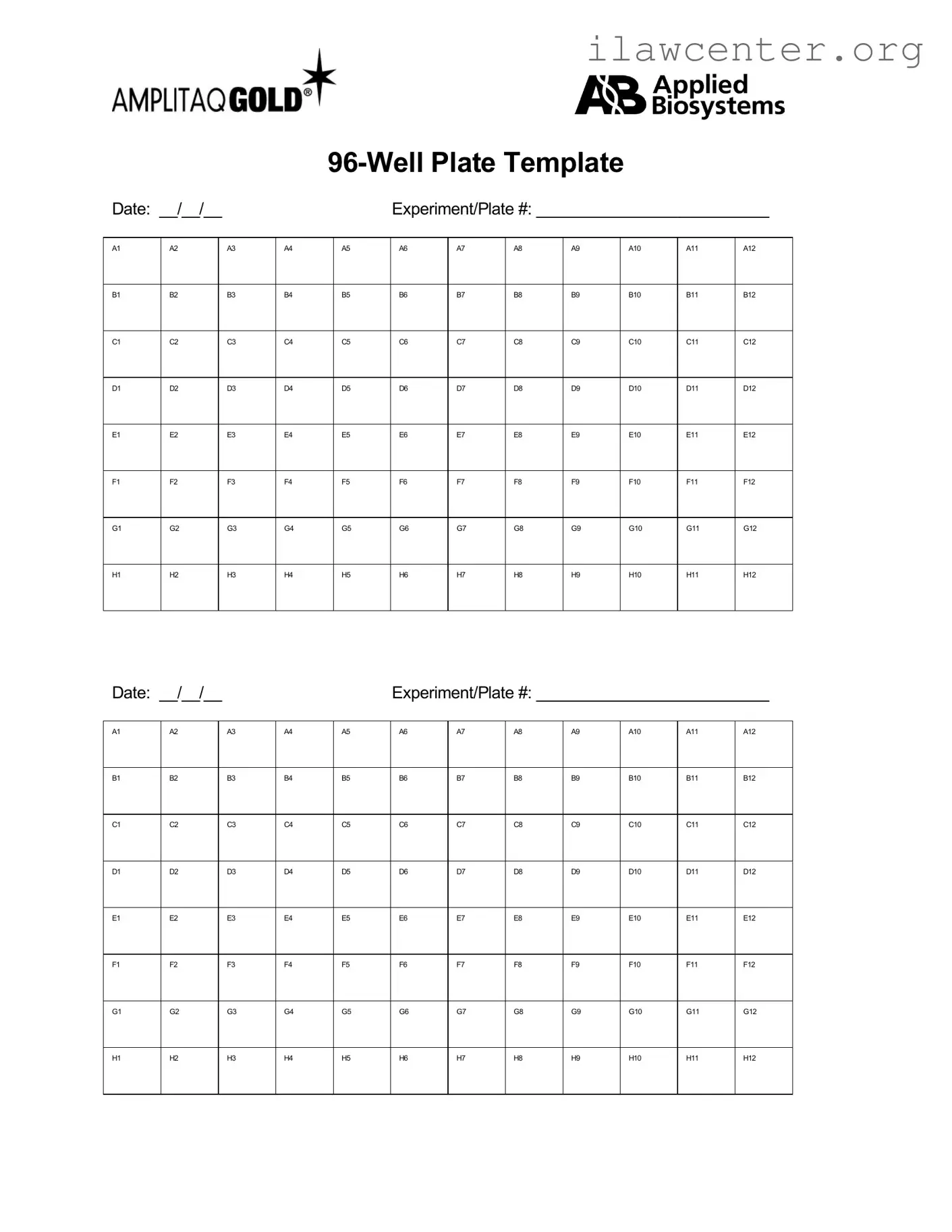
96-Well Plate Template
Date: __/__/__ Experiment/Plate #: __________________________
A1 A2 A3 A4 A5 A6 A7 A8 A9 A10 A11 A12
B1 B2 B3 B4 B5 B6 B7 B8 B9 B10 B11 B12
C1 C2 C3 C4 C5 C6 C7 C8 C9 C10 C11 C12
D1 D2 D3 D4 D5 D6 D7 D8 D9 D10 D11 D12
E1 E2 E3 E4 E5 E6 E7 E8 E9 E10 E11 E12
F1 F2 F3 F4 F5 F6 F7 F8 F9 F10 F11 F12
G1 G2 G3 G4 G5 G6 G7 G8 G9 G10 G11 G12
H1 H2 H3 H4 H5 H6 H7 H8 H9 H10 H11 H12
Date: __/__/__ Experiment/Plate #: __________________________
A1 A2 A3 A4 A5 A6 A7 A8 A9 A10 A11 A12
B1 B2 B3 B4 B5 B6 B7 B8 B9 B10 B11 B12
C1 C2 C3 C4 C5 C6 C7 C8 C9 C10 C11
C12
D1 D2 D3 D4 D5 D6 D7 D8 D9 D10 D11 D12
E1 E2 E3 E4 E5 E6 E7 E8 E9 E10 E11 E12
F1 F2 F3 F4 F5 F6 F7 F8 F9 F10 F11 F12
G1 G2 G3 G4 G5 G6 G7 G8 G9 G10 G11 G12
H1 H2 H3 H4 H5 H6 H7 H8 H9 H10 H11 H12

File Properties

Fact Name Description
Purpose The 96 Well form is used for organizing and storing information in a structured format, typically for data collection in scientific and research contexts.
Format This form is structured as a grid with 96 wells, allowing for multiple samples to be tested simultaneously.
Common Uses Researchers frequently use the 96 Well form in laboratories for experiments involving biological assays, chemical reactions, and sample analysis.
State-Specific Forms Some states may have specific guidelines for the use of the 96 Well form, governed by local regulations on data collection and laboratory practices.
Governing Laws In the United States, relevant laws may include the FDA regulations for laboratory practices and state-specific health and safety codes.
Data Management Proper labeling and organization of the 96 Well form are essential for accurate data management and analysis.

Instructions on Utilizing 96 Well

Filling out the 96 Well form is an important task that ensures accurate data collection and organization. Following these steps will help you complete the form efficiently, allowing for a smooth transition to the next stages of your project.

  1. Begin by gathering all necessary information that you will need to fill out the form.
  2. Locate the section on the form where you need to enter your name and contact information. Fill in your details clearly.
  3. Next, move to the section designated for project or experiment details. Provide a concise description of your project.
  4. In the following section, input any relevant dates associated with your project, such as start and end dates.
  5. Now, review the fields related to sample information. Enter the necessary details for each sample, ensuring accuracy.
  6. Check for any additional notes or comments sections. Use these spaces to clarify any specific instructions or considerations.
  7. Before finalizing, double-check all entries for spelling errors and completeness.
  8. Once satisfied, sign and date the form as required.
  9. Make a copy of the completed form for your records.
  10. Submit the form to the designated recipient or department as instructed.

Important Facts about 96 Well

What is the 96 Well form?

The 96 Well form is a standardized template used primarily in laboratory settings. It allows for the organization and documentation of experiments involving 96-well plates, commonly used in various scientific fields, including biology and chemistry. This form helps researchers track sample information, test conditions, and results efficiently.

Who typically uses the 96 Well form?

This form is primarily utilized by researchers, lab technicians, and scientists conducting experiments that require the use of 96-well plates. It is especially useful in high-throughput screening, where multiple samples are tested simultaneously.

What information is usually included in the 96 Well form?

The 96 Well form typically includes fields for sample identification, well location, reagent details, experimental conditions, and results. Each well can be documented individually, allowing for precise tracking of each sample's data.

How can I obtain a 96 Well form?

Many laboratories provide their own versions of the 96 Well form, tailored to their specific needs. Additionally, templates can often be found online or created using spreadsheet software. Customization may be necessary to fit particular experimental protocols.

Is the 96 Well form required for all experiments?

While not mandatory for every experiment, using the 96 Well form is highly recommended when working with 96-well plates. It enhances organization and ensures that data is accurately recorded, which is crucial for reproducibility and analysis.

Can the 96 Well form be modified?

Yes, the 96 Well form can be modified to suit specific experimental needs. Researchers may add or remove fields based on their protocols or the types of data they wish to collect. Flexibility is a key feature of this form.

What are the benefits of using a 96 Well form?

Using a 96 Well form streamlines the data collection process, reduces the chances of errors, and enhances clarity in experimental documentation. It allows researchers to maintain a clear overview of their experiments, making it easier to analyze results and share findings with colleagues.

How should I store completed 96 Well forms?

Completed 96 Well forms should be stored in a secure location, whether digitally or in physical form. Digital copies can be backed up in cloud storage or on secure servers, while physical copies should be kept in a designated filing system to ensure easy access when needed.

Can I use the 96 Well form for different types of assays?

Absolutely. The 96 Well form is versatile and can be adapted for various types of assays, including enzyme-linked immunosorbent assays (ELISA), polymerase chain reaction (PCR), and more. Its design accommodates a wide range of experimental setups.
Common mistakes

Filling out the 96 Well form can be a straightforward task, but many people make common mistakes that can lead to delays or complications. One frequent error is not providing complete information. Each section of the form is designed to gather specific details. Omitting even a small piece of information can cause processing issues. Always double-check that every required field is filled out accurately.

Another mistake is misinterpreting the instructions. The guidelines accompanying the form are there for a reason. Some individuals may overlook these instructions or fail to read them carefully. This can lead to incorrect entries or misunderstandings about what is required. Taking the time to read the instructions thoroughly can save a lot of time and trouble later on.

In addition, using incorrect or inconsistent formatting is a common pitfall. For instance, dates should be entered in a specific format. If someone writes a date in an unexpected way, it can create confusion. Consistency is key. Always follow the formatting guidelines provided to ensure clarity and avoid unnecessary errors.

People also often forget to review their work before submitting the form. After completing the 96 Well form, it is essential to take a moment to look it over. Mistakes can be easily missed in the rush to submit. A careful review can catch errors that might otherwise go unnoticed, ensuring that the information is accurate and complete.

Lastly, neglecting to keep a copy of the submitted form is a mistake many make. Having a record of what was submitted can be invaluable, especially if there are questions or issues later. Always retain a copy for personal records. This simple step can provide peace of mind and help resolve any future discrepancies.

Documents used along the form

The 96 Well form is a crucial document often utilized in various processes, particularly in research and clinical settings. However, it is commonly accompanied by several other forms and documents that help streamline operations and ensure compliance with necessary protocols. Below is a list of five such documents that are frequently used alongside the 96 Well form.

  • Sample Submission Form: This document collects essential information about the samples being submitted for analysis. It typically includes details such as sample type, quantity, and any specific handling instructions. The form ensures that the laboratory has all the necessary information to process the samples efficiently.
  • Chain of Custody Form: This form is vital for maintaining the integrity of samples throughout their handling and analysis. It documents the transfer of samples from one individual to another, ensuring accountability and traceability. This is particularly important in legal or regulatory contexts.
  • Consent Form: In situations involving human subjects, a consent form is essential. It outlines the purpose of the study, the procedures involved, and any potential risks. Participants must sign this document to indicate their understanding and agreement to participate, protecting their rights and ensuring ethical compliance.
  • Data Entry Form: This form is used to capture the results and observations from the experiments or analyses conducted on the samples. It standardizes the data collection process, making it easier to compile and analyze results later. Accurate data entry is critical for the validity of research findings.
  • Laboratory Safety Data Sheet (SDS): This document provides information about the safe handling and potential hazards associated with the chemicals or biological agents used in conjunction with the samples. It is essential for ensuring the safety of personnel working in the laboratory environment.

In summary, the 96 Well form is part of a broader framework of documentation that supports effective sample management and compliance with ethical standards. Each of these accompanying forms plays a significant role in ensuring that processes run smoothly, data is accurately captured, and safety is prioritized. Together, they contribute to the overall integrity of research and clinical practices.

Similar forms

The 96 Well form is a commonly used document in various fields, particularly in laboratory settings. Here are six documents that share similarities with the 96 Well form:

  • Sample Submission Form: Like the 96 Well form, this document collects essential information about samples being submitted for testing or analysis. It ensures that all necessary details are captured for accurate processing.
  • Chain of Custody Form: This document tracks the handling of samples from collection to analysis. Similar to the 96 Well form, it emphasizes the importance of maintaining sample integrity and documentation throughout the process.
  • Laboratory Request Form: This form initiates testing requests and includes specific details about the tests required. It parallels the 96 Well form by organizing information in a structured manner for efficient processing.
  • Data Entry Sheet: Used for recording results from experiments, this document is similar in that it requires precise data entry, much like the layout of the 96 Well form which organizes results systematically.
  • Inventory Log: This document tracks the stock of materials and reagents used in experiments. It shares a similar purpose of maintaining accurate records, akin to how the 96 Well form keeps track of sample wells and their contents.
  • Quality Control Checklist: This checklist ensures that all necessary quality checks are performed during testing. It resembles the 96 Well form in its methodical approach to documenting essential steps in a process.

Dos and Don'ts

When filling out the 96 Well form, it is important to follow certain guidelines to ensure accuracy and compliance. Here are some key dos and don’ts to consider:

  • Do double-check all entries for accuracy before submission.
  • Do use clear and legible handwriting if filling out the form by hand.
  • Don’t leave any required fields blank; make sure to complete all sections.
  • Don’t use abbreviations unless they are commonly understood within the context.

Misconceptions

Understanding the 96 Well form can be crucial for many individuals and organizations, especially in scientific and research settings. However, several misconceptions often arise regarding its use and purpose. Here’s a list of ten common misconceptions, along with clarifications to help clear the air.

  1. It is only used in laboratories. Many people believe the 96 Well form is exclusive to laboratory environments. In reality, it can be utilized in various fields, including clinical settings, educational institutions, and even in some industrial applications.
  2. All 96 Well forms are the same. There are different types of 96 Well forms designed for specific purposes. Some are optimized for PCR, while others may be intended for ELISA or cell culture, each with unique features.
  3. Using a 96 Well form is complicated. While it may seem daunting at first, the 96 Well form is designed for efficiency and ease of use. With a bit of practice, most users find it straightforward to work with.
  4. Only experienced researchers can use it. This is not true. Anyone can learn to use a 96 Well form effectively, regardless of their experience level. Many resources and training materials are available to assist beginners.
  5. It can only hold liquids. Some may think that the 96 Well form is limited to liquid samples. However, it can also accommodate solid samples, depending on the specific application and the type of wells used.
  6. All wells are the same size. While the standard 96 Well form features uniform wells, variations exist. Some wells are designed to hold different volumes, catering to various experimental needs.
  7. You can’t reuse a 96 Well form. Many believe these forms are single-use only. In fact, some types can be cleaned and reused, provided they are properly sterilized and maintained.
  8. Results are always accurate. While the 96 Well form is designed for precision, results can be affected by numerous factors, including sample quality and handling techniques. Proper protocol is essential for obtaining reliable data.
  9. It is only useful for quantitative analysis. The 96 Well form is versatile and can be employed for both qualitative and quantitative analyses, depending on the experimental design.
  10. It is too expensive for small labs. Many assume that 96 Well forms are only for large institutions due to cost. However, affordable options are available, making them accessible for smaller labs and individual researchers.

By debunking these misconceptions, individuals can better understand the capabilities and applications of the 96 Well form, enhancing their research and experimentation efforts.

Key takeaways

Filling out the 96 Well form accurately is essential for effective data collection and analysis. Here are five key takeaways to keep in mind:

  1. Accuracy is Crucial: Ensure all information is filled out correctly to avoid errors that could compromise the results.
  2. Follow Instructions: Adhere to the specific guidelines provided for each section of the form to ensure consistency and reliability.
  3. Use Clear Labels: Clearly label each well to facilitate easy identification and tracking of samples.
  4. Double-Check Entries: Review the completed form for any mistakes before submission to ensure all data is precise.
  5. Keep a Copy: Retain a copy of the filled-out form for your records, which can be useful for future reference or audits.

By following these guidelines, you can enhance the effectiveness of your data collection process using the 96 Well form.