


Aao Transfer PDF Template

Aao Transfer PDF Template

The Aao Transfer Form is a document used to facilitate the transfer of a patient's orthodontic records from one provider to another. This form ensures that the new orthodontist has all necessary information regarding the patient's treatment history, current status, and any special concerns. To begin the transfer process, fill out the form by clicking the button below.

Article Guide

The Aao Transfer Form is an essential document for patients undergoing orthodontic treatment who find it necessary to change providers. This form serves multiple purposes, ensuring that the transition between orthodontists is smooth and efficient. It captures vital patient information, including personal details, treatment history, and specific concerns that may affect ongoing care. The form outlines the patient's current treatment plan, progress, and any appliances being used, allowing the new orthodontist to understand the patient's unique situation fully. Additionally, it includes sections for financial information, which helps in clarifying any outstanding fees or payment arrangements. The form also emphasizes the importance of transferring accurate records to the new provider, facilitating continuity of care. By completing this form, patients can help ensure that their new orthodontist is well-informed and prepared to continue their treatment effectively.

Aao Transfer Preview

1
© American Association of Orthodontists 2014
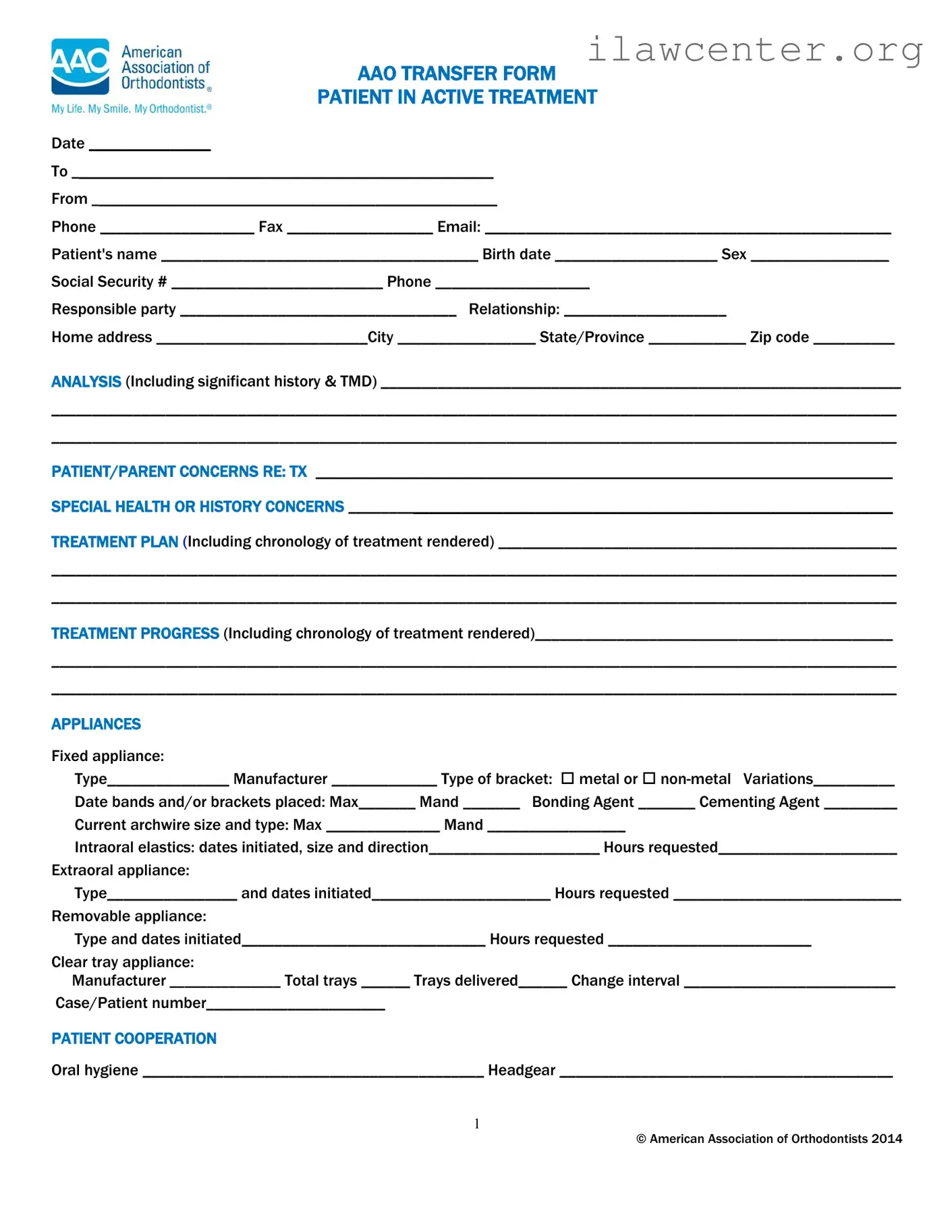
AAO TRANSFER FORM
PATIENT IN ACTIVE TREATMENT
Date _______________
To ____________________________________________________
From __________________________________________________
Phone ___________________ Fax __________________ Email: __________________________________________________
Patient's name _______________________________________ Birth date ____________________ Sex _________________
Social Security # __________________________ Phone ___________________
Responsible party __________________________________ Relationship: ____________________
Home address __________________________City _________________ State/Province ____________ Zip code __________
ANALYSIS (Including significant history & TMD) ________________________________________________________________
________________________________________________________________________________________________________
________________________________________________________________________________________________________
PATIENT/PARENT CONCERNS RE: TX _______________________________________________________________________
SPECIAL HEALTH OR HISTORY CONCERNS ___________________________________________________________________
TREATMENT PLAN (Including chronology of treatment rendered) _________________________________________________
________________________________________________________________________________________________________
________________________________________________________________________________________________________
TREATMENT PROGRESS (Including chronology of treatment rendered)____________________________________________
________________________________________________________________________________________________________
________________________________________________________________________________________________________
APPLIANCES
Fixed appliance:
Type_______________ Manufacturer _____________ Type of bracket: metal or non-metal Variations__________
Date bands and/or brackets placed: Max_______ Mand _______ Bonding Agent _______ Cementing Agent _________
Current archwire size and type: Max ______________ Mand _________________
Intraoral elastics: dates initiated, size and direction_____________________ Hours requested______________________
Extraoral appliance:
Type________________ and dates initiated______________________ Hours requested ____________________________
Removable appliance:
Type and dates initiated______________________________ Hours requested _________________________
Clear tray appliance:
Manufacturer _______________ Total trays ______ Trays delivered______ Change interval __________________________
Case/Patient number______________________
PATIENT COOPERATION
Oral hygiene __________________________________________ Headgear _________________________________________
2
© American Association of Orthodontists 2014
Elastics ______________________________________________ Clear trays _______________________________________
Appointments _________________________________________ Broken appliances ________________________________
Patient's attitude toward treatment ________________________________________________________________________
Suggestions for patient motivation _________________________________________________________________________
ACTIVE TX TIME ESTIMATES Original _________________________ Remaining _____ % of active treatment completed
RECOMMENDATIONS FOR CONTINUED TREATMENT __________________________________________________________
______________________________________________________________________________________________________
RECOMMENDATIONS FOR RETENTION _____________________________________________________________________
ADDITIONAL COMMENTS _______________________________________________________________________________
_____________________________________________________________________________________________________
FINANCIAL
Closed ______________ Open End (Fixed) _______________Other ______________________
Fees: Active _______________ Extras ______________________________________________
Terms ________________________________________________________________________
Third party payment ____________________________________________________________
Total charges before transfer _________________________
Total amount paid before transfer _____________________
Unpaid amount still owed transferring office ____________
Balance of original quoted fee not yet charged ______________ or overpaid at transfer ______________
This patient/parent has been advised that orthodontic treatment fees vary widely throughout the country and the world
and it is reasonable for them to expect that a transfer may increase treatment fees and may involve changes in payment
policies. For most people who transfer during their orthodontic treatment, the total treatment cost is likely to increase.
AVAILABLE RECORDS FOR TRANSFER
Casts Initial Date ________ Progress Date ________ Articulator type________
Ceph Initial Date ________ Progress Date ________
Tracings Initial Date ________ Progress Date ________
Panoramic Initial Date ________ Progress Date ________
CBCT Initial Date ________ Progress Date ________
Intra-oral scan Initial Date ________ Progress Date ________
files
Intraoral x-rays Initial Date ________ Progress Date ________
Facial photos Initial Date ________ Progress Date ________
Intraoral photos Initial Date ________ Progress Date ________
Check appropriate status of records:
Record duplicates sent upon request (may be an additional charge to patient) Yes No
Records enclosed Yes No Records sent under separate cover Yes No
Signature: __________________________________________________Date_______________________
(Orthodontist)
3
© American Association of Orthodontists 2014
REQUEST TO TRANSFER RECORDS TO NEW PROVIDER
When a patient moves, or, for other reasons, there is a necessity to change orthodontists during the course of
ongoing orthodontic treatment, it is highly advantageous for all involved parties that the transfer be as prompt and
convenient as possible. Of paramount importance is the identification of an orthodontist who will accept the
patient and successfully complete the treatment.
The American Association of Orthodontists represents over ninety percent of the orthodontic specialists in the U.S.
and Canada. Your current doctor is a member and will assist you in finding a qualified orthodontist.
It is necessary that your records be transferred to assure that the receiving orthodontist is knowledgeable of your
orthodontic condition(s), orthodontic treatment goals, the current treatment plan, and related financial
arrangements. To facilitate the transfer of these records, it is necessary that you complete the following:
I authorize Dr. ____________________ to release all records of ____________________ (patient’s name) for the
purpose of continuation of treatment by Dr. ___________________(new provider’s name).
Signature: __________________________________________________________Date_______________________
(Patient or Guardian)
Print Name ________________________________________
Relationship to Patient ______________________________

File Properties

Fact Name Details
Purpose The Aao Transfer Form is used to facilitate the transfer of orthodontic records when a patient changes providers.
Patient Information It collects essential details such as the patient's name, date of birth, and contact information.
Health Concerns The form includes sections for documenting any special health or history concerns related to the patient.
Treatment History It outlines the treatment plan and progress, including any appliances used and patient cooperation.
Financial Information Sections address fees, payment status, and potential changes in treatment costs due to the transfer.
Records for Transfer The form specifies which records will be transferred, including x-rays and progress notes.
Signature Requirement Both the current orthodontist and the patient (or guardian) must sign the form to authorize the transfer.
Governing Law This form is governed by state-specific laws regarding patient privacy and record transfer, such as HIPAA.

Instructions on Utilizing Aao Transfer

Filling out the AAO Transfer form is a straightforward process that ensures the smooth transition of your orthodontic care. By providing detailed information about the patient's treatment history and current status, the new provider can better understand the necessary steps for continued care.

  1. Enter the date at the top of the form.
  2. Fill in the to and from sections with the names of the new and current orthodontists.
  3. Provide the phone, fax, and email of the current orthodontist.
  4. Complete the patient's name, birth date, sex, and social security number.
  5. List the responsible party's name and their relationship to the patient.
  6. Fill in the patient's home address, city, state/province, and zip code.
  7. Detail the analysis of the patient's condition, including significant history and TMD.
  8. Note any patient/parent concerns regarding treatment.
  9. Outline any special health or history concerns.
  10. Describe the treatment plan, including a chronology of treatments rendered.
  11. Summarize the treatment progress with dates and details.
  12. Specify the appliances used, including types, manufacturers, and relevant dates.
  13. Document the patient cooperation regarding oral hygiene, appointments, and any issues with appliances.
  14. Estimate active treatment time with original and remaining percentages.
  15. Provide recommendations for continued treatment and retention.
  16. Add any additional comments as necessary.
  17. Indicate the financial status of the treatment, including fees and any unpaid amounts.
  18. Check the appropriate status of records for transfer and indicate if records are enclosed or sent separately.
  19. Sign and date the form as the orthodontist.
  20. Complete the section to request the transfer of records to the new provider.
  21. Have the patient or guardian sign and date the authorization for record transfer.
  22. Print the name of the patient or guardian and their relationship to the patient.

Important Facts about Aao Transfer

What is the purpose of the AAO Transfer Form?

The AAO Transfer Form is designed to facilitate the smooth transition of orthodontic care when a patient needs to change their orthodontist. This form collects essential information about the patient's treatment history, current status, and any specific concerns that may affect ongoing care. By providing detailed information about the patient's treatment plan and progress, the form ensures that the new orthodontist can continue care without missing a beat.

What information do I need to provide on the AAO Transfer Form?

When filling out the AAO Transfer Form, you will need to provide comprehensive details about the patient. This includes personal information such as the patient's name, birth date, and contact information. Additionally, you will need to outline the patient's treatment history, including any appliances used, treatment progress, and patient cooperation. It's also important to include any financial details regarding treatment costs and payments made. This thorough documentation helps the new orthodontist understand the patient's unique situation and treatment needs.

How does the transfer of records work?

The transfer of records is a crucial part of the process. Once the AAO Transfer Form is completed and signed, the current orthodontist will send the patient's records to the new provider. This can include various documents such as treatment plans, progress notes, and diagnostic records. It’s important to note that the patient may need to authorize the release of these records, ensuring that all necessary permissions are in place. The aim is to make this transfer as seamless as possible, allowing for uninterrupted care.

Will transferring to a new orthodontist affect the cost of treatment?

Yes, transferring to a new orthodontist may affect the overall cost of treatment. Fees for orthodontic services can vary significantly between providers. The AAO Transfer Form includes a section that informs patients about the potential for increased treatment fees and changes in payment policies when switching orthodontists. It is advisable for patients to discuss financial arrangements with both their current and new orthodontists to fully understand any implications of the transfer.

Common mistakes

Filling out the AAO Transfer form accurately is crucial for ensuring a smooth transition in orthodontic care. However, many individuals make common mistakes that can lead to delays or complications. Here are eight mistakes to avoid when completing this important document.

One frequent error is failing to provide complete contact information. This includes not only the patient's name and phone number but also the email address of the new provider. Omitting any of these details can hinder communication and result in delays in treatment.

Another mistake involves neglecting to specify the patient's concerns regarding treatment. The section for patient or parent concerns is vital for the new orthodontist to understand any issues or preferences. Leaving this blank can lead to misunderstandings about the patient's needs.

Additionally, individuals often overlook the importance of documenting significant health or history concerns. This information is essential for the new provider to tailor treatment effectively. Failing to include relevant medical history can impact the patient's care.

Some people forget to detail the treatment progress and chronology. This section should outline what has been done so far in the treatment process. Incomplete information can create confusion and may lead to unnecessary duplication of efforts.

Another common error is not indicating the status of financial arrangements. It is important to clarify whether the account is closed or open and to specify any outstanding balances. This helps the new provider understand the financial context of the transfer.

Many individuals also mistakenly leave out information regarding available records for transfer. This includes documenting whether records are enclosed or sent under separate cover. Clear communication about records is crucial for a seamless transition.

Furthermore, failing to sign and date the form is a simple yet significant oversight. Without a signature, the transfer may not be authorized, leading to delays in care. Always ensure that the form is signed by the patient or guardian.

Finally, many make the mistake of not reviewing the form for completeness before submission. Taking a moment to double-check all sections can prevent many of these errors. A thorough review ensures that all necessary information is included and accurate.

Documents used along the form

When transferring orthodontic care, several important forms and documents accompany the AAO Transfer form. Each of these documents plays a crucial role in ensuring a smooth transition for the patient. Here’s a brief overview of these essential forms.

  • Patient Medical History Form: This document provides a comprehensive overview of the patient's medical history, including any allergies, previous surgeries, and current medications. It helps the new orthodontist understand the patient's health background.
  • Treatment Summary Report: This report outlines the treatment progress made up to the point of transfer. It includes details about the procedures performed, any appliances used, and the overall status of the treatment plan.
  • Financial Agreement Form: This form details the financial arrangements made prior to the transfer. It includes information about fees paid, outstanding balances, and any payment plans that may be in place.
  • Authorization for Release of Records: This document allows the current orthodontist to share the patient's records with the new provider. It ensures that the transfer of information is compliant with privacy regulations.
  • Consent for Treatment Form: This form confirms that the patient or guardian agrees to the continuation of treatment under the new orthodontist. It often includes acknowledgment of the new provider’s treatment plan and associated costs.

These documents collectively ensure that the new orthodontist has all the necessary information to continue the patient’s treatment effectively. Proper documentation facilitates better communication and care, ultimately benefiting the patient.

Similar forms

  • Patient Referral Form: This document serves to refer a patient from one healthcare provider to another. Similar to the AAO Transfer Form, it includes patient details and treatment history, ensuring continuity of care.

  • Medical Records Release Form: This form authorizes the transfer of a patient's medical records between healthcare providers. Like the AAO Transfer Form, it requires patient consent and outlines the specific records to be shared.

  • Continuity of Care Document (CCD): A CCD is a standardized document that summarizes a patient’s health information. It is similar to the AAO Transfer Form in that it provides a comprehensive overview of the patient’s treatment history and current status.

  • Treatment Summary Report: This report details the treatment a patient has received and outlines future recommendations. It mirrors the AAO Transfer Form by documenting treatment progress and plans for ongoing care.

  • Insurance Authorization Form: This form is used to authorize the release of information to insurance companies for billing purposes. Like the AAO Transfer Form, it involves patient information and ensures that the necessary details are communicated effectively.

  • Patient Discharge Summary: This document summarizes a patient's treatment and outlines any follow-up care needed. It is similar to the AAO Transfer Form as it provides essential information for the next provider to continue care seamlessly.

Dos and Don'ts

When filling out the AAO Transfer form, follow these guidelines to ensure accuracy and clarity.

  • Do fill in all required fields completely.
  • Do double-check the patient's name and date of birth for accuracy.
  • Do provide current contact information for both the transferring and receiving orthodontists.
  • Do include a detailed treatment history, including any appliances used.
  • Do indicate any special health or history concerns that may affect treatment.
  • Don't leave any sections blank; incomplete forms can delay processing.
  • Don't use abbreviations or shorthand that may confuse the reader.
  • Don't forget to sign and date the form before submission.
  • Don't omit financial information, as it is crucial for the new provider.
  • Don't forget to keep a copy of the completed form for your records.

Misconceptions

  • Misconception 1: The Aao Transfer form is only for patients who are unhappy with their current orthodontist.
  • This form is designed for any patient who needs to change orthodontists, regardless of their satisfaction level. Life circumstances, such as relocation or changes in insurance, may necessitate a transfer.

  • Misconception 2: The transfer process is complicated and lengthy.
  • While it may seem daunting, the Aao Transfer form simplifies the process. It provides a clear structure for transferring important records, which can expedite the transition between orthodontists.

  • Misconception 3: Transferring records will result in a loss of treatment progress.
  • Transferring records ensures that the new orthodontist is fully informed of the patient's treatment history. This continuity helps maintain progress and allows for a seamless continuation of care.

  • Misconception 4: There are no financial implications when transferring to a new orthodontist.
  • It is important to note that treatment costs may vary between providers. The Aao Transfer form includes sections that address financial arrangements, which helps patients understand potential changes in fees.

Key takeaways

When filling out the AAO Transfer form, keep these key points in mind:

  • Accurate Information: Ensure all patient details, including name, birth date, and contact information, are correct. This helps avoid confusion during the transfer process.
  • Clear Treatment History: Provide a thorough analysis of the patient's treatment history. Include significant details about any concerns and the treatment plan.
  • Document Progress: Note the treatment progress accurately. This includes dates and types of appliances used, as well as any patient cooperation issues.
  • Financial Transparency: Clearly outline any financial details, including fees paid and any outstanding balances. This transparency is crucial for the new provider.
  • Authorization for Release: Make sure to sign the authorization section. This grants permission for the current orthodontist to share necessary records with the new provider.

By following these guidelines, you can help ensure a smooth transition for the patient to their new orthodontic provider.