Fillable Actor Release Document

Fillable Actor Release Document

The Actor Release form is a legal document that grants permission for the use of an actor's likeness, voice, or performance in various media productions. This form protects both the actor's rights and the production company's interests by clearly outlining the terms of use. For those involved in film, television, or theater, completing this form is essential; click the button below to fill it out.

Article Guide

In the world of film and television, the Actor Release form plays a crucial role in ensuring that both actors and production companies are protected legally. This document serves as a binding agreement that grants permission for the use of an actor's likeness, voice, and performance in a specific project. By signing this form, actors not only affirm their consent to be filmed but also acknowledge the potential for their work to be edited, distributed, and displayed across various platforms. Additionally, the form often outlines the terms regarding compensation, usage rights, and any limitations on how the actor's image may be utilized in promotional materials. Understanding the intricacies of this form is essential for both actors and producers, as it helps to establish clear expectations and safeguard the interests of all parties involved in the creative process.

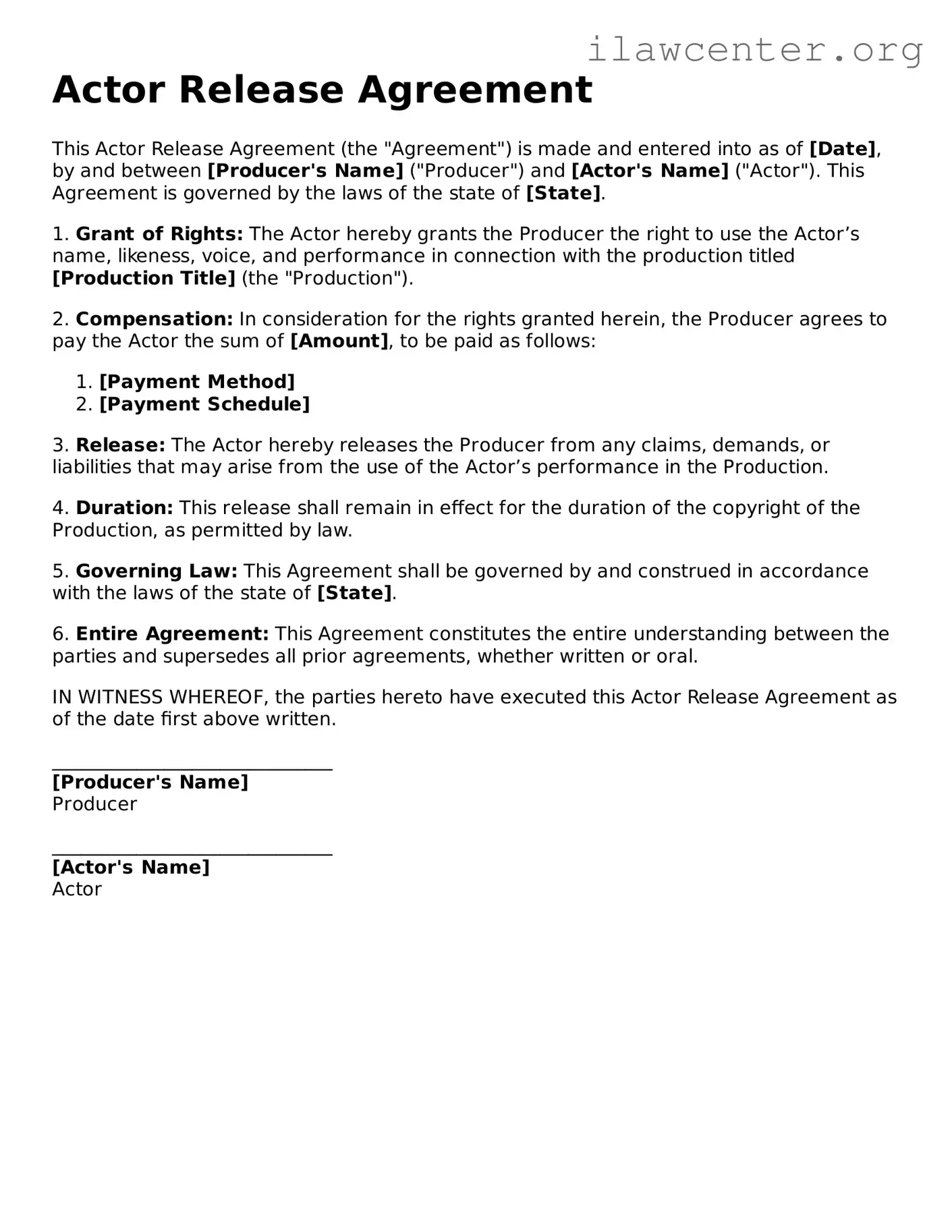
Actor Release Preview

Actor Release Agreement

This Actor Release Agreement (the "Agreement") is made and entered into as of [Date], by and between [Producer's Name] ("Producer") and [Actor's Name] ("Actor"). This Agreement is governed by the laws of the state of [State].

1. Grant of Rights: The Actor hereby grants the Producer the right to use the Actor’s name, likeness, voice, and performance in connection with the production titled [Production Title] (the "Production").

2. Compensation: In consideration for the rights granted herein, the Producer agrees to pay the Actor the sum of [Amount], to be paid as follows:

  1. [Payment Method]
  2. [Payment Schedule]

3. Release: The Actor hereby releases the Producer from any claims, demands, or liabilities that may arise from the use of the Actor’s performance in the Production.

4. Duration: This release shall remain in effect for the duration of the copyright of the Production, as permitted by law.

5. Governing Law: This Agreement shall be governed by and construed in accordance with the laws of the state of [State].

6. Entire Agreement: This Agreement constitutes the entire understanding between the parties and supersedes all prior agreements, whether written or oral.

IN WITNESS WHEREOF, the parties hereto have executed this Actor Release Agreement as of the date first above written.

______________________________
[Producer's Name]
Producer

______________________________
[Actor's Name]
Actor

PDF Form Characteristics

Fact Name Description
Purpose The Actor Release form grants permission for the use of an actor's likeness and performance in various media.
Parties Involved The form typically involves the actor, the production company, and sometimes a third party.
Scope of Use It outlines the specific ways in which the actor's performance can be used, such as in films, commercials, or promotional materials.
Compensation The form may specify whether the actor will receive payment or other compensation for their performance.
Revocation Once signed, the actor typically cannot revoke the release unless otherwise stated in the form.
State-Specific Forms Some states may have specific requirements or forms; for example, California law governs releases under Civil Code Section 3344.
Duration The release often specifies the duration of the rights granted, which can be indefinite or limited to a specific time frame.
Legal Considerations It is advisable for both parties to consult legal counsel to ensure compliance with applicable laws.
Additional Clauses The form may include clauses related to credit, dispute resolution, or indemnification.

Instructions on Utilizing Actor Release

Once you have the Actor Release form in hand, it’s time to complete it accurately. This form is essential for ensuring that all parties are aligned on usage rights and permissions. Follow these steps carefully to fill it out correctly.

  1. Begin by entering the actor's full name at the top of the form.
  2. Provide the actor's contact information, including email and phone number.
  3. Fill in the production title where the actor will be featured.
  4. Specify the role or character the actor will portray.
  5. Indicate the date of the shoot or production schedule.
  6. Review the terms of the release, ensuring the actor understands their rights and obligations.
  7. Have the actor sign and date the form in the designated area.
  8. Collect any additional signatures if required, such as a guardian's if the actor is a minor.
  9. Make a copy of the completed form for your records.

After filling out the form, it will be ready for submission. Ensure that all parties involved have a clear understanding of the agreement before moving forward with the production.

Important Facts about Actor Release

What is an Actor Release form?

An Actor Release form is a legal document that grants permission for filmmakers or producers to use an actor's likeness, voice, and performance in a production. This form ensures that the actor acknowledges their participation and agrees to the terms under which their image and work may be used. By signing this form, actors provide the necessary rights for the production to proceed without any legal complications regarding their portrayal.

Why is an Actor Release form important?

This form is crucial for protecting both the actor and the production team. For the actor, it clarifies how their work will be used and ensures they receive appropriate credit or compensation. For the production team, it provides legal assurance that they can use the actor's performance without fear of future disputes or claims. Ultimately, this document helps foster a clear understanding between all parties involved.

When should an Actor Release form be signed?

Ideally, an Actor Release form should be signed before filming begins. This timing allows for any potential concerns or questions to be addressed upfront, ensuring that the actor is fully aware of their rights and the scope of their participation. However, if circumstances change during production, adjustments to the agreement may be necessary, and a new form can be issued to reflect those changes.

What information is typically included in an Actor Release form?

An Actor Release form generally includes the actor's name, contact information, and details about the production, such as the title and nature of the project. It outlines the rights being granted, including how the actor's likeness and performance may be used. Additionally, the form may specify any compensation arrangements and include clauses regarding the duration of the rights granted. Clear language is essential to ensure that all parties understand their obligations.

Can an actor withdraw their consent after signing the release?

Once an Actor Release form is signed, it typically cannot be revoked without mutual agreement. This is because the form serves as a binding contract. However, if an actor has legitimate concerns about how their likeness or performance is being used, they should communicate these concerns to the production team. Open dialogue may lead to a resolution that respects the actor's wishes while still meeting the production's needs.

What happens if an Actor Release form is not signed?

If an Actor Release form is not signed, the production team may face significant legal challenges. Without this form, the actor retains the right to their likeness and performance, which could lead to disputes over unauthorized use. This situation can result in costly legal battles, delays in production, and potential financial losses. Therefore, obtaining a signed release is a critical step in the filmmaking process.

Are there different types of Actor Release forms?

Yes, there are various types of Actor Release forms, each tailored to specific needs. Some forms may be more general, covering a range of uses, while others might be specific to a particular project or medium, such as film, television, or online content. Additionally, some forms may include provisions for promotional use or merchandise. It is essential for both actors and producers to choose the appropriate form that aligns with their specific circumstances and intentions.
Common mistakes

When filling out an Actor Release form, individuals often make several common mistakes that can lead to complications later on. Understanding these pitfalls can help ensure that the form is completed accurately and effectively. Here are six mistakes to watch out for.

One frequent error is failing to provide complete contact information. Actors sometimes overlook the importance of including their current address, phone number, and email. This information is crucial for any future communications related to the project. Without it, the production team may struggle to reach out for follow-ups or clarifications.

Another common mistake involves not reading the entire form carefully. Many actors rush through the process, skimming the document instead of taking the time to understand each section. This can lead to signing a release that contains terms they are uncomfortable with or unaware of. It is essential to read every clause to ensure that all conditions are acceptable.

Additionally, actors may neglect to date their signatures. A missing date can create confusion about when the agreement was made. This oversight can complicate matters if there are disputes or if the production team needs to reference the timeline of agreements later on.

Some individuals also forget to ask questions about unclear terms. If there are sections of the form that are confusing, it is vital to seek clarification before signing. Failing to do so may result in misunderstandings about rights and responsibilities, which could have lasting implications for the actor’s career.

Moreover, actors sometimes assume that a verbal agreement suffices. They might think that because they discussed certain terms with the production team, they do not need to include those specifics in the written form. However, a signed release is a binding document, and verbal agreements can easily be forgotten or misinterpreted.

Finally, individuals may not keep a copy of the signed form for their records. After signing, it is important to retain a copy for personal reference. This ensures that actors have access to the terms they agreed to and can refer back to them if needed in the future. Without this, they may find themselves in a difficult position if questions arise later.

Documents used along the form

When working on film or media projects, several forms and documents are commonly used alongside the Actor Release form. Each of these documents serves a specific purpose to protect the rights of both the talent and the production team. Below is a list of important documents that may accompany the Actor Release form.

  • Talent Agreement: This document outlines the terms of employment for the actor, including compensation, duration of the project, and any specific obligations the actor must fulfill.
  • Location Release: This form grants permission to film in a specific location. It ensures that the production has the right to use the space and protects against potential legal issues related to property rights.
  • Model Release: Used when featuring individuals in promotional materials or advertisements, this form secures permission to use their likeness. It is crucial for avoiding claims related to privacy and image rights.
  • Copyright Assignment: This document transfers ownership of creative work from the creator to the production company. It clarifies who holds the rights to the content produced during the project.

Using these forms helps to establish clear agreements and protect the interests of all parties involved. Proper documentation is essential for a smooth production process and minimizes potential legal disputes.

Similar forms

  • Model Release Form: Similar to the Actor Release form, a Model Release form grants permission for the use of a person's likeness in photographs or videos. Both documents protect the rights of the creator while ensuring that the individual is aware of how their image will be used.

  • Talent Release Form: This form is specifically designed for individuals providing their talent, such as musicians or performers. Like the Actor Release form, it secures the rights for the creator to use the individual's performance in various media.

  • Location Release Form: While not directly related to individuals, a Location Release form grants permission to use a specific location for filming or photography. It shares the same purpose of obtaining consent and protecting rights, similar to the Actor Release form.

  • Video Release Form: This document allows filmmakers to use footage of individuals in their projects. It is akin to the Actor Release form in that it ensures the subjects are aware of and consent to their participation in a video production.

  • Photo Release Form: A Photo Release form is used when taking photographs of individuals. It serves the same function as the Actor Release form by securing permission for the use of those photographs in various contexts, protecting both the photographer and the subject.

Dos and Don'ts

When filling out the Actor Release form, it's important to follow certain guidelines to ensure everything is completed correctly. Here are four things to keep in mind:

  • Do read the entire form carefully before filling it out.
  • Do provide accurate and complete information about yourself.
  • Don't rush through the form; take your time to avoid mistakes.
  • Don't leave any required fields blank; this can delay the process.

Misconceptions

Misconceptions about the Actor Release form can lead to misunderstandings in the film and television industry. Here are ten common misconceptions, along with clarifications:

  1. All actors must sign an Actor Release form.

    This is not always true. While it is common practice, some projects may not require a release form for non-union actors or for certain types of performances.

  2. Signing a release means the actor gives up all rights to their image.

    In reality, the release typically grants permission for specific uses of the actor's image, not an outright transfer of all rights.

  3. Release forms are only needed for professional actors.

    Amateurs and extras also need to sign release forms to protect the production legally, regardless of their experience level.

  4. Once signed, the release cannot be revoked.

    While it is difficult to revoke a release, actors may have some legal avenues to contest it under certain circumstances, such as misrepresentation.

  5. Actor Release forms are the same across all productions.

    Each production may have its own version of a release form, tailored to its specific needs and legal requirements.

  6. Release forms are only about the visual image.

    In addition to images, release forms often cover audio recordings and any other aspects of performance that may be captured.

  7. Signing a release means the actor will be paid.

    Payment terms are separate from the release. An actor may sign a release without any guarantee of compensation.

  8. All release forms are legally binding.

    A release form may not hold up in court if it is poorly drafted or if the actor was coerced into signing it.

  9. Actors cannot negotiate the terms of a release.

    Actors can and should negotiate terms if they feel uncomfortable with certain aspects of the release.

  10. Release forms are unnecessary for student films.

    Even student films should use release forms to ensure that all participants are protected and that the production has clear rights to the material.

Key takeaways

When dealing with the Actor Release form, understanding its importance and proper usage is crucial for both talent and producers. Here are some key takeaways to keep in mind:

  • Purpose of the Form: The Actor Release form grants permission for the use of an actor's likeness, voice, and performance in a project. This legal document protects both the actor and the production team.
  • Clarity is Key: Ensure that the terms of the release are clearly stated. Ambiguities can lead to misunderstandings and potential legal issues down the line.
  • Compensation Details: If applicable, include details about compensation. This may cover payment for the performance or any royalties associated with the project.
  • Duration of Use: Specify how long the rights granted by the form will last. This can vary depending on the project and should be mutually agreed upon.
  • Scope of Use: Outline where and how the footage or performance may be used. This could include film, television, online platforms, and promotional materials.
  • Revocation Rights: Understand the conditions under which an actor can revoke their consent. Knowing these rights is essential for both parties.
  • Legal Advice: It is wise for both actors and producers to seek legal advice before signing. This ensures that all parties fully understand their rights and obligations.

By keeping these points in mind, you can navigate the complexities of the Actor Release form with confidence and clarity.