Ada Dental Claim PDF Template

Ada Dental Claim PDF Template

The Ada Dental Claim Form is a standardized document used to submit dental insurance claims. It collects essential information about the patient, the policyholder, and the services provided, ensuring that claims are processed efficiently by insurance companies. Completing this form accurately is crucial for receiving timely reimbursement for dental services rendered; click the button below to start filling out the form.

Article Guide

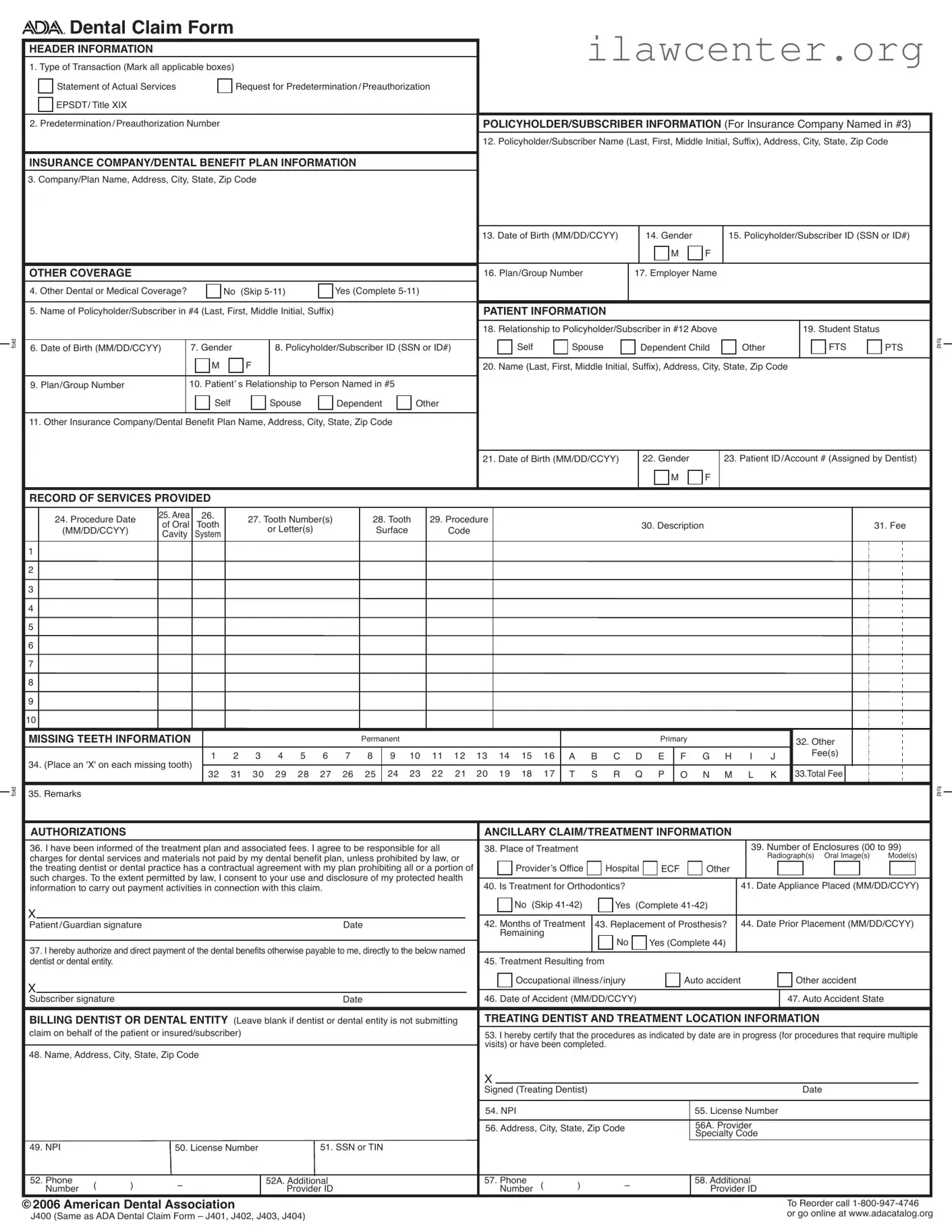
The ADA Dental Claim Form is an essential tool for both dental professionals and patients navigating the insurance landscape. This form captures crucial information, ensuring that claims are processed efficiently and accurately. At the top, it requires the type of transaction, whether it’s a statement of actual services or a request for preauthorization. Policyholder and subscriber details follow, including names, addresses, and insurance company information. Patient information is vital too, with sections dedicated to relationships, student status, and other insurance coverage. The record of services provided is where dental procedures are documented, detailing dates, tooth numbers, and associated fees. Additionally, there’s a section for missing teeth information and authorizations, confirming that patients understand their treatment plans and agree to the associated costs. The form also includes specific identifiers for dental providers and treatment locations, ensuring that all necessary parties are accounted for. Completing the ADA Dental Claim Form accurately can significantly influence the speed and success of claims processing, making it a critical component of dental care management.

Ada Dental Claim Preview

Dental Claim Form
1. Type of Transaction (Mark all applicable boxes)
EPSDT/ Title XIX
HEADER INFORMATION
OTHER COVERAGE
Statement of Actual Services Request for Predetermination / Preauthorization
© 2006 American Dental Association
MISSING TEETH INFORMATION
34. (Place an 'X' on each missing tooth)
35. Remarks
J400 (Same as ADA Dental Claim Form – J401, J402, J403, J404)
To Reorder call 1-800-947-4746
or go online at www.adacatalog.org
1 2 3 4 5 6 7 8
32 31 30 29 28 27 26 25
24 23 22 2 1 20 19 18 17
9 10 11 12 13 14 15 16
A B C D E F G H I J
T S R Q P
O N M L K
Permanent
Primary
32. Other
Fee(s)
33.Total Fee
24. Procedure Date
(MM/DD/CCYY)
25. Area
of Oral
Cavity
26.
Tooth
System
27. Tooth Number(s)
or Letter(s)
28. Tooth
Surface
29. Procedure
Code
30. Description 31. Fee
fold
RECORD OF SERVICES PROVIDED
TREATING DENTIST AND TREATMENT LOCATION INFORMATION
BILLING DENTIST OR DENTAL ENTITY
(Leave blank if dentist or dental entity is not submitting
claim on behalf of the patient or insured/subscriber)
PATIENT INFORMATION
18. Relationship to Policyholder/Subscriber in #12 Above 19. Student Status
Self Spouse
Dependent Child Other
20. Name (Last, First, Middle Initial, Suffix), Address, City, State, Zip Code
21. Date of Birth (MM/DD/CCYY)
23. Patient ID/Account # (Assigned by Dentist)
22. Gender
M
F
INSURANCE COMPANY/DENTAL BENEFIT PLAN INFORMATION
3. Company/Plan Name, Address, City, State, Zip Code
5. Name of Policyholder/Subscriber in #4 (Last, First, Middle Initial, Suffix)
11. Other Insurance Company/Dental Benefit Plan Name, Address, City, State, Zip Code
4. Other Dental or Medical Coverage?
48. Name, Address, City, State, Zip Code
56. Address, City, State, Zip Code
54. NPI 55. License Number
49. NPI
( ) –
( ) –
50. License Number
51. SSN or TIN
Yes (Complete 5-11)
No (Skip 5-11)
53. I hereby certify that the procedures as indicated by date are in progress (for procedures that require multiple
visits) or have been completed.
Signed (Treating Dentist)
Date
X
fold
fold
fold
2. Predetermination / Preauthorization Number
ANCILLARY CLAIM/ TREATMENT INFORMATION
41. Date Appliance Placed (MM/DD/CCYY)
44. Date Prior Placement (MM/DD/CCYY)
42. Months of Treatment
Remaining
No
Yes (Complete 44)
38. Place of Treatment
43. Replacement of Prosthesis?
39. Number of Enclosures (00 to 99)
Radiograph(s)
Oral Image(s) Model(s)
Yes (Complete 41-42)
No (Skip 41-42)
40. Is Treatment for Orthodontics?
Provider’s Office
Hospital
ECF Other
45. Treatment Resulting from
47. Auto Accident State
46. Date of Accident (MM/DD/CCYY)
Occupational illness/ injury
Auto accident
Other accident
AUTHORIZATIONS
36. I have been informed of the treatment plan and associated fees. I agree to be responsible for all
charges for dental services and materials not paid by my dental benefit plan, unless prohibited by law, or
the treating dentist or dental practice has a contractual agreement with my plan prohibiting all or a portion of
such charges. To the extent permitted by law, I consent to your use and disclosure of my protected health
information to carry out payment activities in connection with this claim.
Date
Patient /Guardian signature
X
37.
I hereby authorize and direct payment of the dental benefits otherwise payable to me, directly to the below named
dentist or dental entity.
Date
Subscriber signature
X
58. Additional
Provider ID
FTS
PTS
1
2
3
4
5
6
7
8
9
10
6. Date of Birth (MM/DD/CCYY)
8. Policyholder/Subscriber ID (SSN or ID#)
7. Gender
M
F
9. Plan/Group Number
10. Patient’ s Relationship to Person Named in #5
Self Spouse
Dependent Other
POLICYHOLDER/SUBSCRIBER INFORMATION (For Insurance Company Named in #3)
12. Policyholder/Subscriber Name (Last, First, Middle Initial, Suffix), Address, City, State, Zip Code
13. Date of Birth (MM/DD/CCYY)
15. Policyholder/Subscriber ID (SSN or ID#)
14. Gender
M
F
16. Plan/Group Number 17. Employer Name
52A. Additional
Provider ID
56A. Provider
Specialty Code
52. Phone
Number
57. Phone
Number
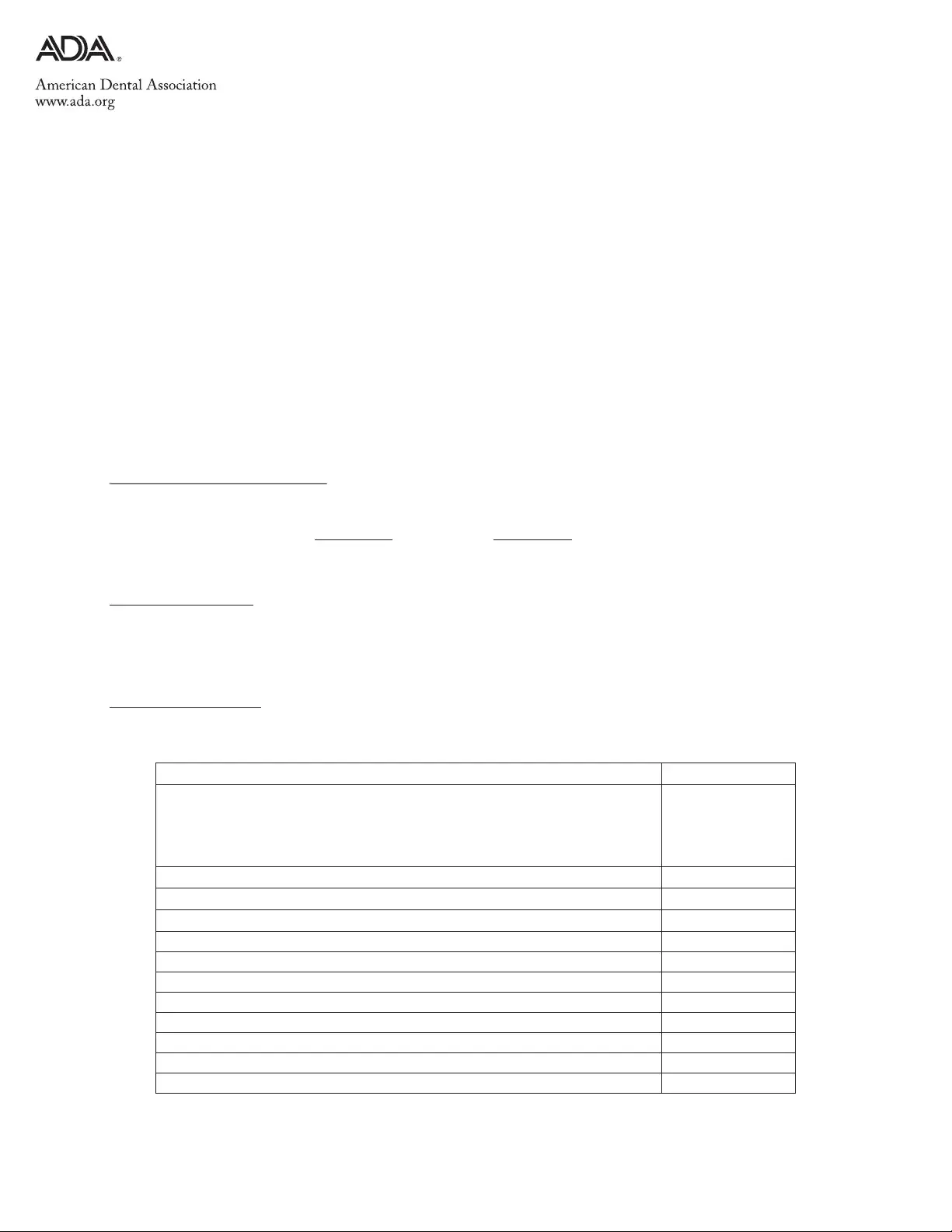
Comprehensive completion instructions for the ADA Dental Claim Form are found in Section 4 of the ADA Publication titled CDT-2007/2008.
Five relevant extracts from that section follow:
GENERAL INSTRUCTIONS
A. The form is designed so that the name and address (Item 3) of the third-party payer receiving the claim (insurance company/dental 
benefit plan) is visible in a standard #10 window envelope. Please fold the form using the ‘tick-marks’ printed in the margin.
B.  In the upper-right of the form, a blank space is provided for the convenience of the payer or insurance company, to allow the 
assignment of a claim or control number.
C. 
All Items in the form must be completed unless it is noted on the form or in the following instructions that completion is not required.
D. 
When a name and address field is required, the full name of an individual or a full business name, address and zip code must be entered.
E.  All dates must include the four-digit year.
F.  If the number of procedures reported exceeds the number of lines available on one claim form, the remaining procedures must be 
listed on a separate, fully completed claim form.
COORDINATION OF BENEFITS (COB)
When a claim is being submitted to the secondary payer, complete the form in its entirety and attach the primary payers Explanation of Benefits
(EOB) showing the amount paid by the primary payer. You may indicate the amount the primary carrier paid in the “Remarks” field (Item # 35).
NATIONAL PROVIDER IDENTIFIER (NPI)
49 and 54 NPI (National Provider Indentifier): This is an identifier assigned by the Federal government to all providers considered to be
HIPAA covered entities. Dentists who are not covered entities may elect to obtain an NPI at their discretion, or may be
enumerated if required by a participating provider agreement with a third-party payer or applicable state law/regulation. An NPI
is unique to an individual dentist (Type 1 NPI) or dental entity (Type 2 NPI), and has no intrinsic meaning. Additional information
on NPI and enumeration can be obtained from the ADAs Internet Web Site: www.ada.org/goto/npi
ADDITIONAL PROVIDER IDENTIFIER
52A and 58
Additional Provider ID: This is an identifier assigned to the billing dentist or dental entity other than a Social Security
Number (SSN) or Tax Identification Number (TIN). It is not the providers NPI. The additional identifier is sometimes referred
to as a Legacy Identifier (LID). LIDs may not be unique as they are assigned by different entities (e.g., third-party payer; Federal
government). Some Legacy IDs have an intrinsic meaning.
PROVIDER SPECIALTY CODES
56A Provider Specialty Code: Enter the code that indicates the type of dental professional who delivered the treatment. Available
codes describing treating dentists are listed below. The general code listed as ‘Dentist’ may be used instead of any other dental
practitioner code.
Category / Description Code Code
A dentist is a person qualified by a doctorate in dental surgery (D.D.S)
or dental medicine (D.M.D.) licensed by the state to practice dentistry,
and practicing within the scope of that license.
Dentist
122300000X
General Practice
1223G0001X
Dental Specialty (see following list)
Dental Public Health
Endodontics
Orthodontics
Pediatric Dentistry
Periodontics
Prosthodontics
Oral & Maxillofacial Pathology
Oral & Maxillofacial Radiology
Oral & Maxillofacial Surgery
Various
1223D0001X
1223E0200X
1223X0400X
1223P0221X
1223P0300X
1223P0700X
1223P0106X
1223D0008X
1223S0112X
Should there be any updates to ADA Dental Claim Form completion instructions, the updates will be posted on the ADAs web site at:
www.ada.org/goto/dentalcode
Dental provider taxonomy codes listed above are a subset of the full code set that is posted at:
www.wpc-edi.com/codes/taxonomy

File Properties

Fact Name Details
Form Purpose The ADA Dental Claim Form is used to submit claims for dental services to insurance companies or dental benefit plans.
Types of Transactions Claimants can mark multiple transaction types including Statement of Actual Services, Request for Predetermination/Preauthorization, and EPSDT/Title XIX.
Policyholder Information Section for entering the policyholder's name, address, and identification details, including their date of birth and gender.
Other Coverage If there is other dental or medical coverage, additional information must be provided about the other policyholder.
Patient Information This section captures details about the patient, including their relationship to the policyholder and their date of birth.
Record of Services Providers must document services rendered, including procedure dates, tooth numbers, and associated fees.
Authorization Requirement Signatures from the patient or guardian are required to authorize treatment and payment of benefits directly to the dentist.
National Provider Identifier (NPI) Providers must include their NPI, a unique identifier assigned to healthcare providers by the federal government.
State-Specific Laws Each state may have specific laws governing the submission of dental claims, which should be reviewed before submission.

Instructions on Utilizing Ada Dental Claim

Filling out the ADA Dental Claim Form can seem daunting, but with a little guidance, you can navigate it with ease. This form is essential for submitting your dental claims to insurance companies or dental benefit plans. Each section requires specific information, and it's crucial to provide accurate details to ensure timely processing. Follow these steps to complete the form successfully.

  1. Header Information: Mark all applicable boxes for the type of transaction at the top of the form. This includes options like "Statement of Actual Services" or "Request for Predetermination/Preauthorization."
  2. Policyholder/Subscriber Information: Fill in the policyholder's name (last, first, middle initial, suffix), address, city, state, and zip code.
  3. Insurance Company Information: Enter the name of the insurance company or dental benefit plan, along with its address, city, state, and zip code.
  4. Date of Birth and Gender: Provide the policyholder's date of birth (MM/DD/CCYY) and gender (M/F).
  5. Policyholder ID: Input the policyholder's ID number or Social Security Number (SSN).
  6. Other Coverage: If there is other dental or medical coverage, answer "Yes" and complete the required sections (5-11). If not, skip to the patient information section.
  7. Patient Information: Fill in the patient's relationship to the policyholder, their date of birth, gender, and ID/account number assigned by the dentist.
  8. Record of Services Provided: For each procedure, list the date, area, tooth number(s), procedure code, description, and fee.
  9. Missing Teeth Information: Indicate any missing teeth by placing an 'X' on the appropriate teeth.
  10. Authorization: Sign and date the authorization section, confirming you understand the treatment plan and associated fees.
  11. Treating Dentist Information: Complete the details for the treating dentist, including their name, address, and NPI.
  12. Billing Dentist Information: If applicable, fill in the billing dentist's information, including their NPI and phone number.

Once you have completed the form, double-check all the information for accuracy. It's essential to ensure that each section is filled out correctly to avoid delays in processing your claim. After confirming everything is correct, you can submit the form to your insurance company or dental benefit plan for review.

Important Facts about Ada Dental Claim

What is the purpose of the ADA Dental Claim Form?

The ADA Dental Claim Form is used to submit claims for dental services provided to patients. It facilitates communication between dental providers and insurance companies, ensuring that claims are processed efficiently and accurately. The form collects necessary information about the patient, the services rendered, and the insurance coverage involved.

Who should fill out the ADA Dental Claim Form?

The form should be completed by the dental provider or the billing entity on behalf of the patient. Information about the patient, the policyholder, and the insurance company must be accurately provided to ensure proper processing of the claim.

What information is required on the form?

Key information required includes the type of transaction, policyholder details, patient information, procedure details, and the billing dentist's information. It is essential to fill out all applicable fields to avoid delays in processing the claim.

How do I submit the ADA Dental Claim Form?

The completed form should be submitted to the appropriate dental benefit plan or insurance company. It is recommended to fold the form according to the tick marks provided, ensuring that the payer's address is visible in a standard #10 envelope. Submission can be done via mail or electronically, depending on the payer's requirements.

What should I do if the form has missing information?

If any required information is missing, the claim may be delayed or denied. It is crucial to review the form thoroughly before submission. If additional information is needed, it may be necessary to contact the patient or the insurance company for clarification.

Can I submit multiple procedures on one claim form?

Yes, multiple procedures can be submitted on one claim form as long as they fit within the available lines. If the number of procedures exceeds the lines provided, a separate claim form must be completed for the additional procedures.

What is the significance of the National Provider Identifier (NPI)?

The NPI is a unique identifier assigned to healthcare providers, including dentists, by the federal government. It is essential for billing purposes and helps to streamline the claims process. Providers must include their NPI on the claim form to ensure proper identification and processing.

What is Coordination of Benefits (COB) and how does it work?

Coordination of Benefits is the process used when a patient has multiple insurance plans. In such cases, the claim must be submitted to the primary insurer first. The secondary insurer will require the primary payer’s Explanation of Benefits (EOB) to process the claim. The ADA Dental Claim Form must be fully completed, and the EOB should be attached when submitting to the secondary payer.

What should I do if my claim is denied?

If a claim is denied, the first step is to review the denial notice for reasons provided. Common reasons may include missing information or services not covered under the policy. Contacting the insurance company for clarification and possibly appealing the decision may be necessary.

Where can I find additional resources for completing the ADA Dental Claim Form?

Additional resources and comprehensive instructions for completing the ADA Dental Claim Form can be found in the ADA publication titled CDT-2007/2008. Updates and further guidance are also available on the ADA's website.

Common mistakes

Filling out the ADA Dental Claim form can be straightforward, but many people make common mistakes that can delay processing or lead to denials. One frequent error is failing to complete all required fields. Each section of the form is essential, and leaving any item blank can cause issues. Always ensure that all relevant information, such as the policyholder's name, patient details, and treatment information, is filled out completely.

Another common mistake involves incorrect or incomplete dates. Dates must be entered in the specified format, including the four-digit year. For instance, writing “03/15/23” instead of “03/15/2023” can result in confusion or rejection of the claim. It is crucial to double-check that all dates are accurate and formatted correctly to avoid unnecessary complications.

People also often overlook the requirement to provide the correct insurance company information. This includes the name, address, and policyholder ID. If this information is incorrect or incomplete, the claim may not reach the intended payer. Be sure to verify the details with the insurance provider before submitting the form.

Lastly, many individuals forget to sign and date the form. A missing signature can halt the processing of the claim. It is essential to ensure that both the patient and the provider’s signatures are included where required. Taking a moment to review the form for completeness and accuracy can save time and prevent delays in receiving benefits.

Documents used along the form

The ADA Dental Claim Form is a crucial document for submitting dental claims to insurance companies. However, it is often accompanied by several other forms and documents that provide additional information necessary for processing the claim. Below is a list of commonly used forms that may accompany the ADA Dental Claim Form.

  • Explanation of Benefits (EOB): This document outlines the services covered by the insurance plan, the amounts paid, and any patient responsibility. It is essential for claims involving coordination of benefits.
  • Patient Registration Form: This form collects essential information about the patient, including contact details, insurance information, and medical history. It helps the dental office maintain accurate records.
  • Authorization for Release of Information: This document allows the dental provider to share the patient’s health information with the insurance company. It is necessary for compliance with privacy laws.
  • Preauthorization Request Form: Used when a dentist seeks approval from the insurance company before providing certain treatments. This ensures that the proposed services will be covered.
  • Referral Form: If a patient is referred to a specialist, this form details the reason for the referral and the services needed. It aids in ensuring continuity of care.
  • Treatment Plan: This document outlines the proposed dental procedures and associated costs. It is often required by insurance companies for approval of complex treatments.
  • Patient Consent Form: This form ensures that the patient understands the treatment plan and consents to the procedures. It protects both the patient and the provider legally.
  • Claim Attachment Form: If additional documentation is needed to support the claim, this form is used to list those attachments. It helps streamline the claims process.
  • Orthodontic Treatment Record: For orthodontic claims, this document provides detailed information about the treatment process and progress, which is necessary for reimbursement.

These documents are integral to the claims process and help ensure that patients receive the benefits they are entitled to under their dental plans. Properly completing and submitting these forms can significantly reduce delays in claim processing and reimbursement.

Similar forms

The ADA Dental Claim form shares similarities with several other documents commonly used in healthcare and insurance. Here are four documents that are comparable, along with a brief explanation of how they relate to the ADA Dental Claim form:

  • Health Insurance Claim Form (CMS-1500): This form is used for submitting medical claims to insurance providers. Like the ADA Dental Claim form, it collects patient information, policyholder details, and the services rendered. Both forms require similar information to process claims efficiently.
  • Dental Preauthorization Request Form: This document is used to obtain approval from an insurance company before dental procedures are performed. Similar to the ADA Dental Claim form, it includes patient and provider information and outlines the proposed treatment, ensuring that coverage is verified prior to service.
  • Explanation of Benefits (EOB): An EOB is provided by insurance companies after a claim is processed. It details what services were covered, the amount billed, and any patient responsibility. Both the EOB and the ADA Dental Claim form are essential in the claims process, with the latter being the initial submission and the former providing the outcome of that submission.
  • Patient Registration Form: This form gathers essential information from patients at the start of treatment. It includes personal details, insurance information, and medical history. The ADA Dental Claim form also collects similar information, ensuring that the dental office has all necessary data to submit a claim accurately.

Dos and Don'ts

Things to Do:

  • Complete all required fields on the form.
  • Use the full name and address for the policyholder and patient.
  • Include the four-digit year when entering dates.
  • Fold the form correctly to ensure visibility of the payer's information.
  • Attach any necessary documents, like the primary payer’s Explanation of Benefits (EOB), if applicable.

Things Not to Do:

  • Do not leave any required fields blank.
  • Avoid using abbreviations for names or addresses.
  • Do not forget to include the National Provider Identifier (NPI) if required.
  • Do not submit multiple claims on one form if the number of procedures exceeds the lines available.
  • Do not ignore the instructions for coordination of benefits if there is secondary coverage.

Misconceptions

Understanding the ADA Dental Claim Form is crucial for both dental professionals and patients. However, several misconceptions can lead to confusion and errors during the submission process. Here are six common misconceptions:

  • All fields on the form are optional. Many people believe that they can skip fields they think are unnecessary. In reality, all items must be completed unless specified otherwise. Missing information can delay processing.
  • The form can be submitted without supporting documents. Some assume that the claim form alone is sufficient. However, if the claim is being sent to a secondary payer, it’s essential to attach the primary payer’s Explanation of Benefits (EOB) to ensure proper processing.
  • Only the dentist needs to sign the form. There is a common belief that only the treating dentist's signature is required. In fact, the patient or guardian must also sign the form, indicating their agreement to the treatment and associated fees.
  • Dates can be written in any format. Some individuals think that any date format is acceptable. However, it’s important to use the MM/DD/CCYY format for clarity and consistency, as this is a requirement of the form.
  • Missing teeth do not need to be reported. There’s a misconception that if teeth are missing, they can simply be ignored on the form. In reality, it’s necessary to indicate missing teeth by marking the appropriate boxes to avoid confusion during claims processing.
  • The National Provider Identifier (NPI) is optional for all dentists. Many believe that obtaining an NPI is not mandatory. However, for those considered HIPAA covered entities, having an NPI is essential for claim submissions, as it uniquely identifies the provider.

By clarifying these misconceptions, dental professionals and patients can navigate the claims process more effectively, ensuring timely and accurate reimbursements.

Key takeaways

Key Takeaways for Filling Out the ADA Dental Claim Form:

  • Ensure all required fields are completed, including the policyholder's name, address, and insurance information.
  • Use the 'tick-marks' on the form to fold it properly for mailing, ensuring the payer's address is visible.
  • If submitting to a secondary payer, attach the primary payer's Explanation of Benefits (EOB) and indicate the amount paid in the remarks section.
  • Include the National Provider Identifier (NPI) for the dentist, as well as any additional provider identifiers if applicable.