
Additional Insured PDF Template

Additional Insured PDF Template

The Additional Insured form is an important endorsement that modifies a general liability insurance policy to include specific individuals or organizations as additional insureds. This coverage is particularly relevant for owners, lessees, or contractors involved in completed operations, ensuring they are protected against certain liabilities stemming from the insured's work. To ensure you have the necessary coverage, consider filling out the form by clicking the button below.

Article Guide

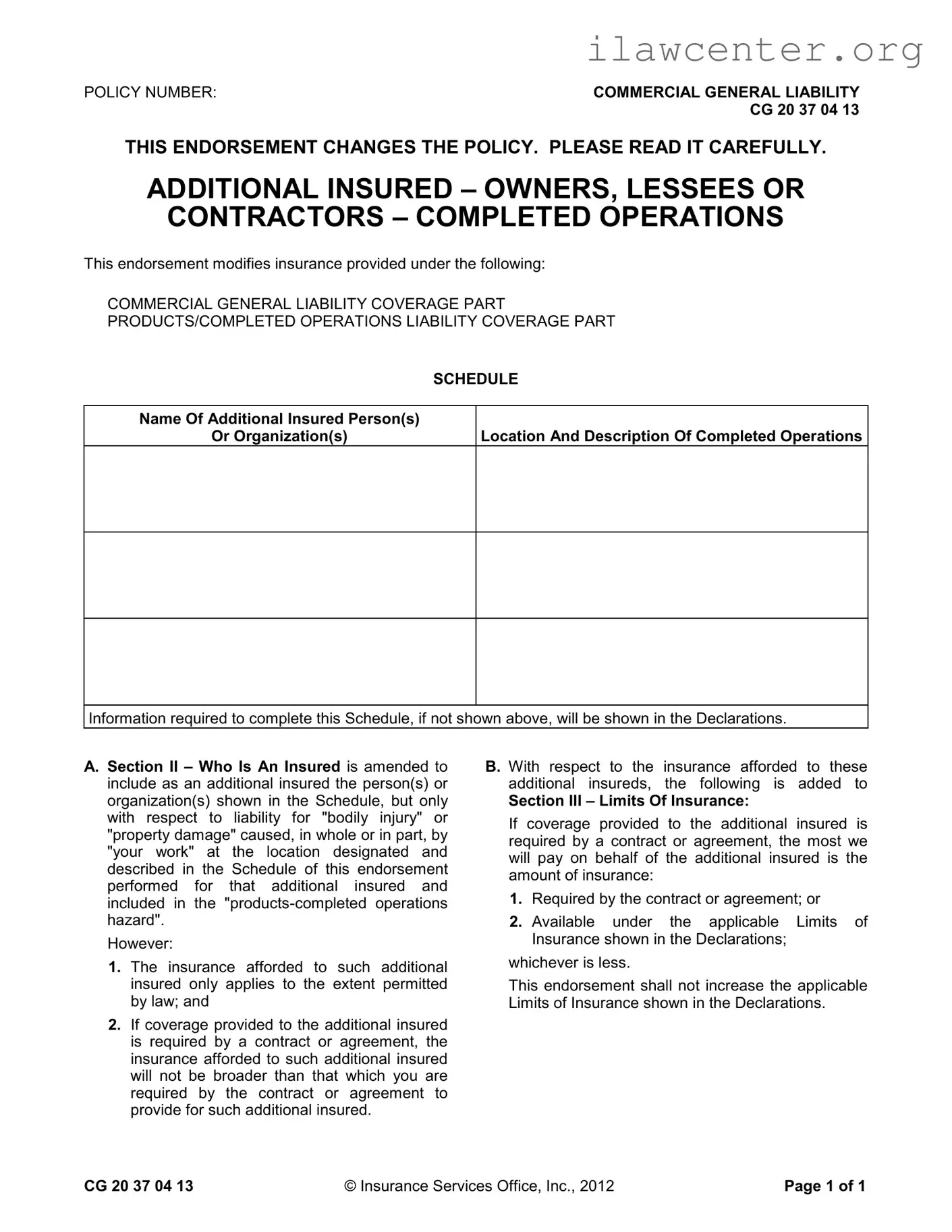
Understanding the Additional Insured form is crucial for anyone involved in contracts or insurance policies, especially in the construction and service industries. This form, specifically known as CG 20 37 04 13, serves as an endorsement to a Commercial General Liability policy, modifying the coverage to include additional parties as insureds. Typically, these additional insureds are owners, lessees, or contractors who may be exposed to liability due to the actions of the primary insured. The form outlines specific conditions under which the additional insureds are covered, particularly concerning bodily injury or property damage resulting from the work performed for them. Importantly, the coverage is limited to what is required by the contract or agreement, ensuring that it does not exceed the terms agreed upon. Furthermore, it emphasizes that the coverage provided will not increase the overall limits of the insurance policy. With this understanding, parties can better navigate their responsibilities and protections under the insurance framework.

Additional Insured Preview

POLICY NUMBER:
COMMERCIAL GENERAL LIABILITY
CG 20 37 04 13
THIS ENDORSEMENT CHANGES THE POLICY. PLEASE READ IT CAREFULLY.
CG 20 37 04 13
© Insurance Services Office, Inc., 2012
Page 1 of 1
ADDITIONAL INSURED OWNERS, LESSEES OR
CONTRACTORS COMPLETED OPERATIONS
This endorsement modifies insurance provided under the following:
COMMERCIAL GENERAL LIABILITY COVERAGE PART
PRODUCTS/COMPLETED OPERATIONS LIABILITY COVERAGE PART
SCHEDULE
Name Of Additional Insured Person(s)
Or Organization(s)
Location And Description Of Completed Operations
Information required to complete this Schedule, if not shown above, will be shown in the Declarations.
A. Section II Who Is An Insured is amended to
include as an additional insured the person(s) or
organization(s) shown in the Schedule, but only
with respect to liability for "bodily injury" or
"property damage" caused, in whole or in part, by
"your work" at the location designated and
described in the Schedule of this endorsement
performed for that additional insured and
included in the "products-completed operations
hazard".
However:
1. The insurance afforded to such additional
insured only applies to the extent permitted
by law; and
2. If coverage provided to the additional insured
is required by a contract or agreement, the
insurance afforded to such additional insured
will not be broader than that which you are
required by the contract or agreement to
provide for such additional insured.
B. With respect to the insurance afforded to these
additional insureds, the following is added to
Section III Limits Of Insurance:
If coverage provided to the additional insured is
required by a contract or agreement, the most we
will pay on behalf of the additional insured is the
amount of insurance:
1. Required by the contract or agreement; or
2. Available under the applicable Limits of
Insurance shown in the Declarations;
whichever is less.
This endorsement shall not increase the applicable
Limits of Insurance shown in the Declarations.

File Properties

Fact Name Description Governing Law
Purpose of the Endorsement This form adds protection for additional insured parties, such as owners or contractors, for completed operations. Varies by state
Scope of Coverage Covers liability for bodily injury or property damage caused by the named insured's work. Varies by state
Contractual Requirement If a contract requires additional insured coverage, the endorsement will not exceed what the contract specifies. Varies by state
Limits of Insurance The maximum payout for an additional insured is the lesser of the contract amount or the policy limits. Varies by state
Completed Operations Hazard The endorsement specifically applies to operations that have been completed, as defined in the policy. Varies by state
Amendment to Insured Definition Section II of the policy is modified to include additional insureds as defined in the endorsement. Varies by state
Legal Compliance The coverage provided is only valid to the extent permitted by law in the relevant jurisdiction. Varies by state

Instructions on Utilizing Additional Insured

Filling out the Additional Insured form is a straightforward process. This document ensures that specific individuals or organizations are covered under your insurance policy for certain liabilities. Follow the steps below to complete the form accurately.

  1. Locate the POLICY NUMBER section at the top of the form. Write down your policy number clearly.
  2. In the Name Of Additional Insured Person(s) Or Organization(s) section, provide the full name of the individual or organization you are adding as an additional insured.
  3. Next, fill in the Location And Description Of Completed Operations section. Be specific about the location and give a brief description of the operations completed for the additional insured.
  4. Review the information you entered to ensure accuracy. Double-check the spelling of names and details of the operations.
  5. Sign and date the form at the bottom. This indicates your agreement to the terms outlined in the endorsement.
  6. Submit the completed form to your insurance provider or the relevant party as instructed.

Important Facts about Additional Insured

What is an Additional Insured form?

The Additional Insured form is a document that extends liability coverage to other parties, such as owners, lessees, or contractors, for claims arising from your work. This endorsement is part of a Commercial General Liability policy and is designed to protect those additional insureds from liability related to "bodily injury" or "property damage" that may occur during completed operations.

Who can be named as an Additional Insured?

Any person or organization can be named as an additional insured as long as it is specified in the endorsement's schedule. Typically, this includes clients, contractors, or property owners who require coverage as part of a contract or agreement.

What does the Additional Insured coverage include?

The coverage includes liability for bodily injury or property damage caused by your work at a specific location described in the endorsement. It is limited to the operations completed for the additional insured and does not extend beyond what is required by law or specified in a contract.

Are there limitations to the coverage provided to Additional Insureds?

Yes, there are limitations. The coverage will only apply to the extent permitted by law. Additionally, if a contract requires coverage for the additional insured, the insurance provided cannot be broader than what the contract stipulates. This means that the coverage is tailored to match contractual obligations.

What happens if the contract requires different limits of insurance?

If the contract requires specific limits of insurance for the additional insured, the coverage provided will be limited to the lesser of those required limits or the available limits outlined in the policy's Declarations. This ensures that you do not exceed the coverage limits specified in your policy.

Does the Additional Insured endorsement increase my policy limits?

No, the Additional Insured endorsement does not increase the overall limits of insurance stated in your policy's Declarations. The limits remain the same, and the endorsement simply extends coverage to additional parties under those existing limits.

How should I complete the Additional Insured form?

To complete the form, list the names of the additional insured persons or organizations in the designated section. Also, provide the location and a description of the completed operations. If any required information is missing, it will be included in the policy's Declarations. Make sure to review the endorsement carefully to ensure all details are accurate.

Common mistakes

Filling out the Additional Insured form can be straightforward, but there are common mistakes that can lead to complications. One major error is failing to accurately list the name of the additional insured. If the name is misspelled or incomplete, it can create issues when it comes time to file a claim. Always double-check the spelling and ensure that the correct legal entity is listed.

Another frequent mistake is neglecting to provide a specific location and description of completed operations. This section is crucial because it clarifies the scope of coverage. Without this information, the additional insured may not be protected for the intended activities. Take the time to clearly define the operations and locations associated with the additional insured.

Some individuals also overlook the contractual obligations tied to the additional insured status. If the coverage is required by a contract, the insurance provided cannot exceed what is stipulated in that agreement. Failing to align the coverage with the contract can lead to gaps in protection. Review the contract carefully to ensure compliance.

Lastly, many people forget to check the limits of insurance specified in the Declarations. If the coverage for the additional insured is limited by the contract or the policy itself, it’s essential to understand these limits. Not knowing the maximum amount that can be claimed may result in insufficient coverage when it is most needed. Always verify that the limits match the requirements set forth in the contract.

Documents used along the form

When managing insurance policies, especially in construction or service contracts, several documents accompany the Additional Insured form. Understanding these documents is crucial for ensuring compliance and protecting all parties involved. Here’s a brief overview of six commonly used forms and documents that often work alongside the Additional Insured form.

  • Certificate of Insurance (COI): This document provides proof of insurance coverage. It outlines the types of coverage, policy limits, and the insured parties. A COI is often requested by clients to confirm that contractors or service providers have the necessary insurance in place.
  • Contractor Agreement: This is a formal document outlining the terms of engagement between the contractor and the client. It typically includes details about the scope of work, payment terms, and insurance requirements, including the necessity for additional insured status.
  • Indemnity Agreement: This document is designed to protect one party from legal liability for the actions of another. It may require one party to indemnify the other for any losses or damages, often tying in with the requirements for additional insured coverage.
  • Waiver of Subrogation: This form prevents an insurance company from pursuing a claim against a third party after paying a loss. It is often included in contracts to ensure that the parties involved do not hold each other liable for damages covered by insurance.
  • Endorsement Forms: These are modifications to an insurance policy that add or change coverage. The Additional Insured form itself is a type of endorsement, but other endorsements may be necessary to adjust coverage based on specific project needs.
  • Insurance Requirements Checklist: This checklist outlines the specific insurance coverages required for a project or contract. It serves as a guide to ensure that all parties meet the necessary insurance obligations, including the addition of any additional insured parties.

Each of these documents plays a vital role in the insurance landscape, particularly in construction and service industries. Ensuring that all forms are completed accurately and in accordance with contractual obligations can prevent disputes and protect all parties involved. Stay informed and proactive in managing these important documents to safeguard your interests.

Similar forms

The Additional Insured form is an important document in the realm of insurance, particularly in the context of commercial general liability. Several other documents share similarities with it, often serving related purposes in risk management and liability coverage. Below is a list of seven documents that are comparable to the Additional Insured form, each highlighting how they are similar.

  • Named Insured Endorsement: Like the Additional Insured form, this endorsement specifies who is covered under a policy. It identifies individuals or entities that are directly named as insured parties, ensuring they receive the same protections as those explicitly listed in the policy.
  • Certificate of Insurance: This document provides proof of insurance coverage. It indicates the types of coverage, limits, and additional insured status, similar to how the Additional Insured form outlines specific protections for other parties involved in a contract.
  • Waiver of Subrogation: This agreement prevents an insurer from pursuing recovery from a third party after a loss. It often accompanies the Additional Insured form to protect the interests of all parties involved, ensuring that liability is appropriately managed without future claims against one another.
  • Contractual Liability Endorsement: This endorsement modifies a policy to cover liabilities assumed under a contract. It functions similarly to the Additional Insured form by extending coverage to liabilities that arise from contractual obligations, often including those of additional insureds.
  • Primary and Non-Contributory Endorsement: This endorsement establishes that the insurance policy will respond first in the event of a claim, before any other insurance. It relates closely to the Additional Insured form by ensuring that the additional insured's coverage is prioritized.
  • Products Liability Endorsement: This endorsement extends coverage for damages related to products sold or manufactured. It parallels the Additional Insured form by addressing liability issues that can arise from completed operations, ensuring that additional insureds are covered in such scenarios.
  • Excess Liability Policy: This type of policy provides additional coverage beyond the limits of a primary policy. It can be similar to the Additional Insured form in that it offers extended protection for additional insureds, ensuring they are not left vulnerable if primary coverage limits are exhausted.

Each of these documents plays a crucial role in defining and clarifying liability coverage. Understanding their similarities helps individuals and organizations navigate the complexities of insurance and ensure adequate protection in various circumstances.

Dos and Don'ts

When filling out the Additional Insured form, it's important to follow certain guidelines to ensure accuracy and compliance. Here are six things to do and avoid:

  • Do verify the policy number to ensure it matches the correct insurance coverage.
  • Do clearly identify the name of the additional insured person or organization.
  • Do provide a detailed location and description of the completed operations.
  • Don't leave any sections blank; incomplete forms may lead to coverage issues.
  • Don't assume that coverage extends beyond what is specified in the contract or agreement.
  • Don't overlook the limits of insurance; ensure they align with the contract requirements.

Misconceptions

Understanding the Additional Insured form can be challenging. Here are ten common misconceptions that often lead to confusion:

  1. All parties are automatically covered. Many believe that simply naming someone as an additional insured guarantees coverage. In reality, coverage is limited to specific situations outlined in the policy.
  2. Coverage is unlimited. Some think that the insurance coverage for additional insureds has no cap. However, the limits of insurance apply, and the coverage cannot exceed what is stated in the policy.
  3. It covers all types of liability. There is a misconception that being an additional insured provides blanket coverage for any liability. Coverage is only for liabilities arising from the named insured's work.
  4. It applies to all operations. Many assume that additional insured status applies to all operations of the named insured. The coverage is specific to completed operations as outlined in the endorsement.
  5. All contracts require the same level of coverage. Some believe that all contracts mandate the same insurance requirements. Each contract can specify different coverage limits and conditions.
  6. It protects against negligence of the additional insured. There is a belief that additional insured status protects the additional insured from their own negligence. This is not true; coverage is limited to the named insured's actions.
  7. Once added, the coverage is permanent. Many think that once an entity is added as an additional insured, they remain covered indefinitely. Coverage can be temporary and is often tied to specific projects or contracts.
  8. Only general liability policies can have additional insured endorsements. Some assume that only general liability policies offer additional insured endorsements. In fact, other types of insurance can also include similar provisions.
  9. The additional insured has no responsibilities. There is a misconception that additional insureds have no obligations under the policy. They may still need to comply with certain conditions to maintain coverage.
  10. Coverage is the same across all states. Many believe that the terms of additional insured coverage are uniform nationwide. However, laws and interpretations can vary significantly by state.

Being informed about these misconceptions can help you navigate the complexities of insurance coverage more effectively.

Key takeaways

Filling out and using the Additional Insured form correctly is crucial for ensuring adequate coverage. Here are some key takeaways to consider:

  • Understand the Purpose: The Additional Insured form allows you to extend your liability coverage to other parties, such as owners or contractors, for specific operations. This is essential for protecting all involved parties.
  • Complete the Schedule Accurately: It is vital to provide the correct name of the additional insured and detailed descriptions of the completed operations. Any missing information could lead to gaps in coverage.
  • Know Your Limits: The coverage for additional insureds is limited to what is required by contract or the available limits in your policy. Ensure you are aware of these limits to avoid unexpected liabilities.
  • Review Contractual Obligations: If the coverage is mandated by a contract, the insurance provided cannot exceed what is stipulated in that agreement. Always align your policy with contractual requirements.