Advance Beneficiary Notice of Non-coverage PDF Template

Advance Beneficiary Notice of Non-coverage PDF Template

The Advance Beneficiary Notice of Non-coverage (ABN) is a crucial document that informs Medicare beneficiaries when a service or item may not be covered by Medicare. This form allows patients to understand their financial responsibilities before receiving care, ensuring they can make informed decisions. To learn more about how to fill out the ABN and protect your healthcare rights, click the button below.

Article Guide

The Advance Beneficiary Notice of Non-coverage (ABN) form plays a crucial role in the Medicare system, helping beneficiaries understand their rights and responsibilities when it comes to coverage decisions. This form is issued by healthcare providers when they believe that a service or item may not be covered by Medicare. By providing this notice, providers ensure that patients are informed ahead of time, allowing them to make educated decisions about their care. The ABN outlines the specific services that may not be covered, along with the reasons for this potential non-coverage. Beneficiaries are given the opportunity to either accept or refuse the service after being made aware of the possible costs. This transparency is designed to protect patients from unexpected medical bills and to promote a clear understanding of their options. Ultimately, the ABN serves as an important tool for communication between healthcare providers and patients, fostering a collaborative approach to healthcare decisions.

Advance Beneficiary Notice of Non-coverage Preview

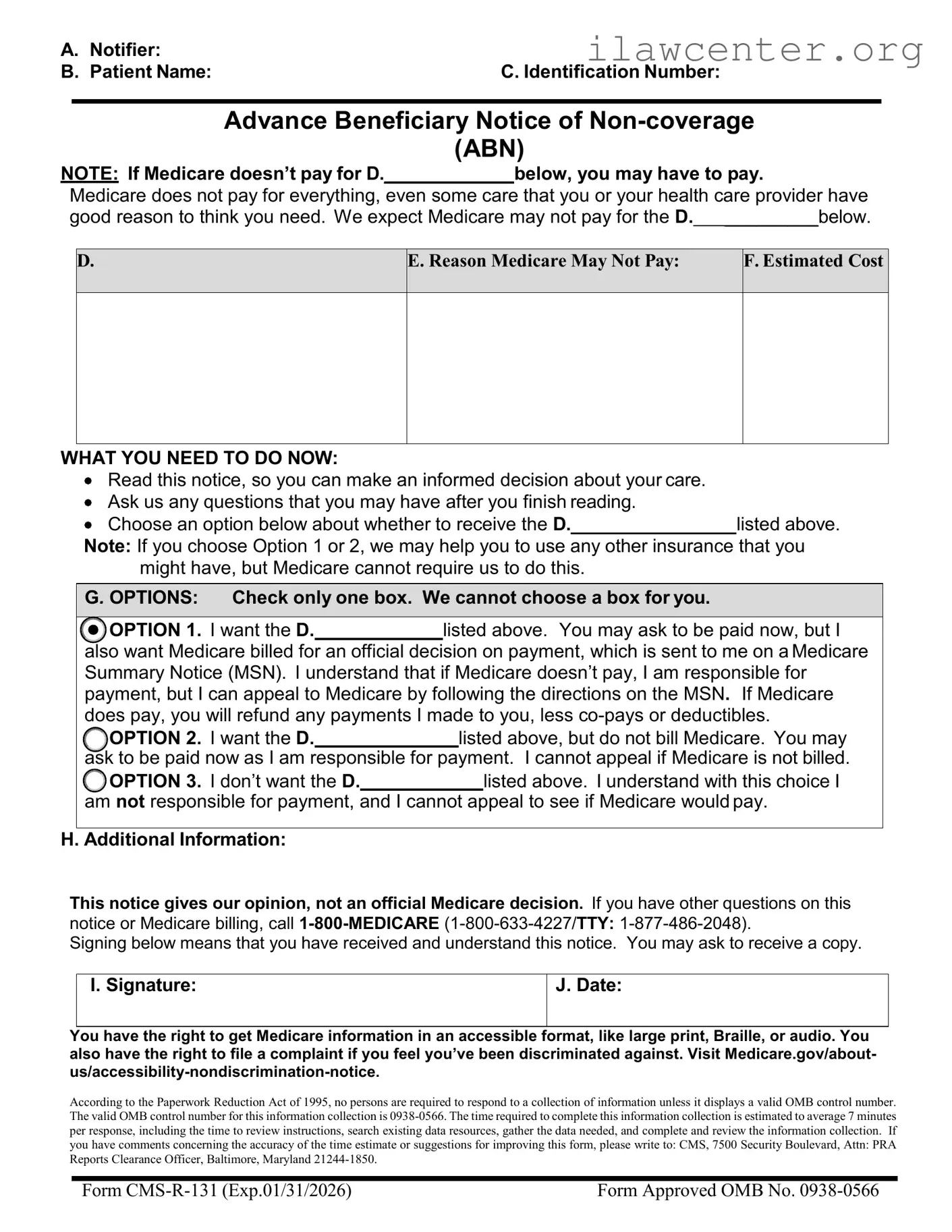
A. Notifier:
B. Patient Name: C. Identification Number:
Advance Beneficiary Notice of Non-coverage
(ABN)
NOTE: If Medicare doesn’t pay for D.____________ below, you may have to pay.
Medicare does not pay for everything, even some care that you or your health care provider have
good reason to think you need. We expect Medicare may not pay for the D. _________below.
D.
E. Reason Medicare May Not Pay:
F. Estimated Cost
WHAT YOU NEED TO DO NOW:
Read this notice, so you can make an informed decision about your care.
Ask us any questions that you may have after you finish reading.
Choose an option below about whether to receive the D. listed above.
Note: If you choose Option 1 or 2, we may help you to use any other insurance that you
might have, but Medicare cannot require us to do this.
G. OPTIONS: Check only one box. We cannot choose a box for you.
OPTION 1. I want the D. listed above. You may ask to be paid now, but I
also want Medicare billed for an official decision on payment, which is sent to me on a Medicare
Summary Notice (MSN). I understand that if Medicare doesn’t pay, I am responsible for
payment, but I can appeal to Medicare by following the directions on the MSN. If Medicare
does pay, you will refund any payments I made to you, less co-pays or deductibles.
OPTION 2. I want the D. listed above, but do not bill Medicare. You may
ask to be paid now as I am responsible for payment. I cannot appeal if Medicare is not billed.
OPTION 3. I don’t want the D. listed above. I understand with this choice I
am not responsible for payment, and I cannot appeal to see if Medicare would pay.
H. Additional Information:
Thi
s notice gives our opinion, not an official Medicare decision. If you have other questions on this
notice or Medicare billing, call 1-800-MEDICARE (1-800-633-4227/TTY: 1-877-486-2048).
Signing below means that you have received and understand this notice. You may ask to receive a copy.
I. Signature:
J. Date:
You have the right to get Medicare information in an accessible format, like large print, Braille, or audio. You
also have the right to file a complaint if you feel you’ve been discriminated against. Visit Medicare.gov/about-
us/accessibility-nondiscrimination-notice.
According to the Paperwork Reduction Act of 1995, no persons are required to respond to a collection of information unless it displays a valid OMB control number.
The valid OMB control number for this information collection is 0938-0566. The time required to complete this information collection is estimated to average 7 minutes
per response, including the time to review instructions, search existing data resources, gather the data needed, and complete and review the information collection. If
you have comments concerning the accuracy of the time estimate or suggestions for improving this form, please write to: CMS, 7500 Security Boulevard, Attn: PRA
Reports Clearance Officer, Baltimore, Maryland 21244-1850.
Form CMS-R-131 (Exp.01/31/2026) Form Approved OMB No. 0938-0566
File Properties

Fact Name Description
Purpose The Advance Beneficiary Notice of Non-coverage (ABN) informs Medicare beneficiaries that a service may not be covered by Medicare.
When to Use Providers must issue an ABN when they believe that Medicare will not pay for a specific service or item.
Beneficiary Rights Patients have the right to choose whether to receive the service after being informed of the potential costs.
Signature Requirement The patient must sign the ABN to acknowledge understanding of the potential non-coverage.
State-Specific Forms Some states may have their own versions of the ABN, governed by local laws and regulations.
Governing Laws In states with specific ABN requirements, applicable laws may include state Medicare regulations and health care statutes.
Delivery Method The ABN can be delivered in person or via mail, but it must be provided before the service is rendered.
Validity Period An ABN is valid for the specific service or item indicated and does not apply to future services.

Instructions on Utilizing Advance Beneficiary Notice of Non-coverage

After receiving the Advance Beneficiary Notice of Non-coverage form, you will need to fill it out accurately to ensure that your Medicare coverage is clearly understood. This form allows you to acknowledge services that may not be covered by Medicare. Follow the steps below to complete the form correctly.

  1. Begin by entering your personal information at the top of the form. This includes your name, Medicare number, and date of birth.
  2. Identify the service or item for which you are receiving the notice. Clearly describe what the service is.
  3. Next, indicate the date when the service was provided or is expected to be provided.
  4. In the designated section, check the box that applies to your understanding of the coverage. This may include options like “I understand that Medicare may not pay for this service.”
  5. Sign and date the form at the bottom. This confirms that you have read and understood the notice.
  6. Keep a copy of the completed form for your records. This is important for any future reference or disputes regarding coverage.

Important Facts about Advance Beneficiary Notice of Non-coverage

What is the Advance Beneficiary Notice of Non-coverage (ABN)?

The Advance Beneficiary Notice of Non-coverage, commonly known as the ABN, is a form used by healthcare providers to inform Medicare beneficiaries that a service or item may not be covered by Medicare. This notice is essential because it helps beneficiaries understand their financial responsibilities before receiving services that may not be reimbursed by Medicare.

When should I receive an ABN?

You should receive an ABN before a service or item is provided if your healthcare provider believes that Medicare may deny coverage. This is typically done when the provider thinks that the service is not medically necessary or does not meet Medicare's coverage criteria. Receiving this notice allows you to make informed decisions about your care and any potential costs involved.

What should I do if I receive an ABN?

If you receive an ABN, read it carefully. It will outline the specific service or item in question, the reason for the non-coverage, and your options. You can choose to accept the service and agree to pay out-of-pocket, or you can decline the service. Make sure to ask your provider any questions you may have about the notice or the service in question.

Is it mandatory for providers to give me an ABN?

While it is not mandatory for all services, healthcare providers are required to issue an ABN when they believe that Medicare may not cover a specific service. This requirement helps ensure that you are aware of your potential financial responsibility before receiving care. However, some services may not require an ABN, so it is always good to ask your provider if you are unsure.

What happens if I don’t sign the ABN?

If you choose not to sign the ABN, your provider may decide not to provide the service, or they may proceed with the service but inform you that you will be responsible for the payment if Medicare denies coverage. It is crucial to communicate with your provider about your decision, as this can affect your access to necessary care.

Can I appeal a Medicare denial after signing an ABN?

Yes, you can appeal a Medicare denial even after signing an ABN. Signing the notice does not waive your right to appeal Medicare’s decision regarding coverage. If Medicare denies payment, you can file an appeal to contest the denial. Make sure to keep a copy of the ABN and any related documents to support your case during the appeal process.

Common mistakes

When filling out the Advance Beneficiary Notice of Non-coverage (ABN) form, individuals often make several common mistakes that can lead to confusion or complications later on. Understanding these pitfalls is crucial for ensuring that the process runs smoothly and that beneficiaries are well-informed about their coverage options.

One frequent error is not providing accurate patient information. The form requires specific details such as the patient’s name, Medicare number, and date of service. Omitting or incorrectly entering this information can result in delays or denials of coverage. It is essential to double-check that all personal information is correct before submitting the form.

Another mistake involves failing to understand the services being billed. The ABN should clearly outline the service in question and why it may not be covered by Medicare. If a patient does not fully comprehend the nature of the service or the reason for the notice, they may unknowingly agree to pay for something that could have been covered. It’s important to ask questions if anything is unclear.

Some individuals neglect to sign and date the form. The ABN is not valid unless it is signed by the patient or their representative. This signature indicates that the patient acknowledges the potential costs associated with the service. Without this crucial step, the form may not be considered legally binding, which can lead to unexpected bills.

Additionally, people sometimes misunderstand the options presented on the form. The ABN typically offers choices regarding whether to receive the service and accept financial responsibility if it is not covered. Misinterpreting these options can lead to unintended financial obligations. Patients should carefully read through each choice and consider their implications before making a decision.

Lastly, individuals may overlook the importance of keeping a copy of the ABN for their records. This document serves as proof that the patient was informed about potential non-coverage. Without a copy, it can be challenging to contest any unexpected charges that arise later. Maintaining a personal record of all important documents, including the ABN, is a wise practice.

Documents used along the form

The Advance Beneficiary Notice of Non-coverage (ABN) is an important document used in healthcare settings. It informs patients when a service may not be covered by Medicare, allowing them to make informed decisions about their care. There are several other forms and documents that often accompany the ABN. Here is a brief overview of these documents.

  • Medicare Summary Notice (MSN): This document provides details about services billed to Medicare. It shows what was covered, what was not, and the patient’s financial responsibility.
  • Notice of Exclusion from Medicare Benefits (NEMB): This notice is given to inform patients that a service is excluded from Medicare coverage. It helps patients understand their options and potential costs.
  • Claim Form (CMS-1500): This is the standard form used by healthcare providers to bill Medicare for services provided. It includes patient information and details about the services rendered.
  • Authorization for Release of Information: This document allows healthcare providers to share a patient’s medical information with other parties, such as insurance companies, to facilitate billing and claims processing.
  • Patient Consent Form: This form ensures that patients understand and agree to the services being provided. It typically covers the risks and benefits associated with the treatment.

Each of these documents plays a vital role in the healthcare process. Understanding them can help patients navigate their medical care and insurance coverage more effectively. Always feel free to ask questions about these forms to ensure clarity and confidence in your healthcare decisions.

Similar forms

The Advance Beneficiary Notice of Non-coverage (ABN) form is a key document in the healthcare system, particularly for Medicare beneficiaries. It informs patients that a service may not be covered by Medicare. Several other documents serve similar purposes in different contexts. Here are nine documents that share similarities with the ABN:

  • Medicare Summary Notice (MSN): This document provides details about the services you received, what Medicare paid, and what you may owe. Like the ABN, it helps beneficiaries understand coverage decisions.
  • Notice of Exclusions from Medicare Benefits (NEMB): This notice informs beneficiaries about services that Medicare does not cover. It is similar to the ABN in that it clarifies coverage limitations.
  • Patient Responsibility Notice: This document outlines the financial responsibilities of the patient for services rendered. It parallels the ABN by highlighting potential out-of-pocket costs.
  • Prior Authorization Request: This form is used to obtain approval from Medicare before certain services are provided. It shares the goal of ensuring beneficiaries understand coverage before receiving services.
  • Medicare Enrollment Form: This form is used to enroll in Medicare and outlines the benefits available. While different in purpose, it sets the stage for understanding coverage similar to the ABN.
  • Claim Denial Letter: When a claim is denied, this letter explains why. Like the ABN, it communicates important information about coverage decisions.
  • Appeal Request Form: If a beneficiary disagrees with a coverage decision, they can use this form to appeal. It relates to the ABN by allowing patients to challenge non-coverage decisions.
  • Out-of-Pocket Cost Estimate: This document provides an estimate of expected costs for services. It complements the ABN by helping beneficiaries prepare financially for non-covered services.
  • Service Authorization Notice: This notice is provided when a service requires prior approval. It is similar to the ABN as it informs patients about coverage prerequisites.

Dos and Don'ts

When filling out the Advance Beneficiary Notice of Non-coverage (ABN) form, it is essential to follow certain guidelines to ensure clarity and compliance. Below is a list of things to do and avoid during this process.

Things You Should Do:

  • Carefully read the instructions provided with the ABN form.
  • Provide accurate and complete information about the services you received.
  • Sign and date the form to acknowledge your understanding of the notice.

Things You Shouldn't Do:

  • Do not leave any sections of the form blank; incomplete forms can lead to confusion.
  • Do not ignore the potential financial implications outlined in the notice.
  • Do not rush through the process; take your time to ensure everything is filled out correctly.

By adhering to these guidelines, you can help ensure that your rights are protected and that you fully understand your options regarding coverage.

Misconceptions

The Advance Beneficiary Notice of Non-coverage (ABN) form can be confusing. Here are four common misconceptions about it:

  1. ABN means Medicare will not pay for the service.

    Many people think that receiving an ABN automatically means that Medicare will deny coverage. In reality, the ABN is a notification that Medicare may not cover a specific service, but it does not guarantee denial. It simply informs you of the possibility.

  2. You must sign the ABN.

    Some believe that signing the ABN is mandatory. However, you have the option to refuse to sign it. If you do not sign, the provider may still choose to provide the service, but you may be held responsible for payment if Medicare denies coverage.

  3. ABN is only for outpatient services.

    Another misconception is that ABNs are only applicable to outpatient services. In fact, they can also be used for certain inpatient services. Providers may issue an ABN whenever they believe Medicare may not cover a service, regardless of the setting.

  4. Receiving an ABN means you are being denied care.

    Lastly, some people think that an ABN signifies a denial of care. This is not the case. An ABN is a proactive measure to inform you about potential coverage issues, allowing you to make an informed decision about your care.

Key takeaways

The Advance Beneficiary Notice of Non-coverage (ABN) form is an important document for Medicare beneficiaries. Here are some key takeaways regarding its use and completion:

  • The ABN is used to inform patients that Medicare may not cover a specific service or item.
  • Patients should receive the ABN before services are provided, allowing them to make informed decisions.
  • It is essential to fill out the ABN accurately, including the specific service or item and the reason for non-coverage.
  • Beneficiaries must sign and date the form to acknowledge their understanding of the potential costs involved.
  • Providers are required to keep a copy of the signed ABN in the patient's medical record.
  • Patients can choose to receive the service despite the notice, but they may be responsible for payment if Medicare denies coverage.
  • Understanding the ABN can help beneficiaries avoid unexpected medical bills and ensure they are aware of their rights.