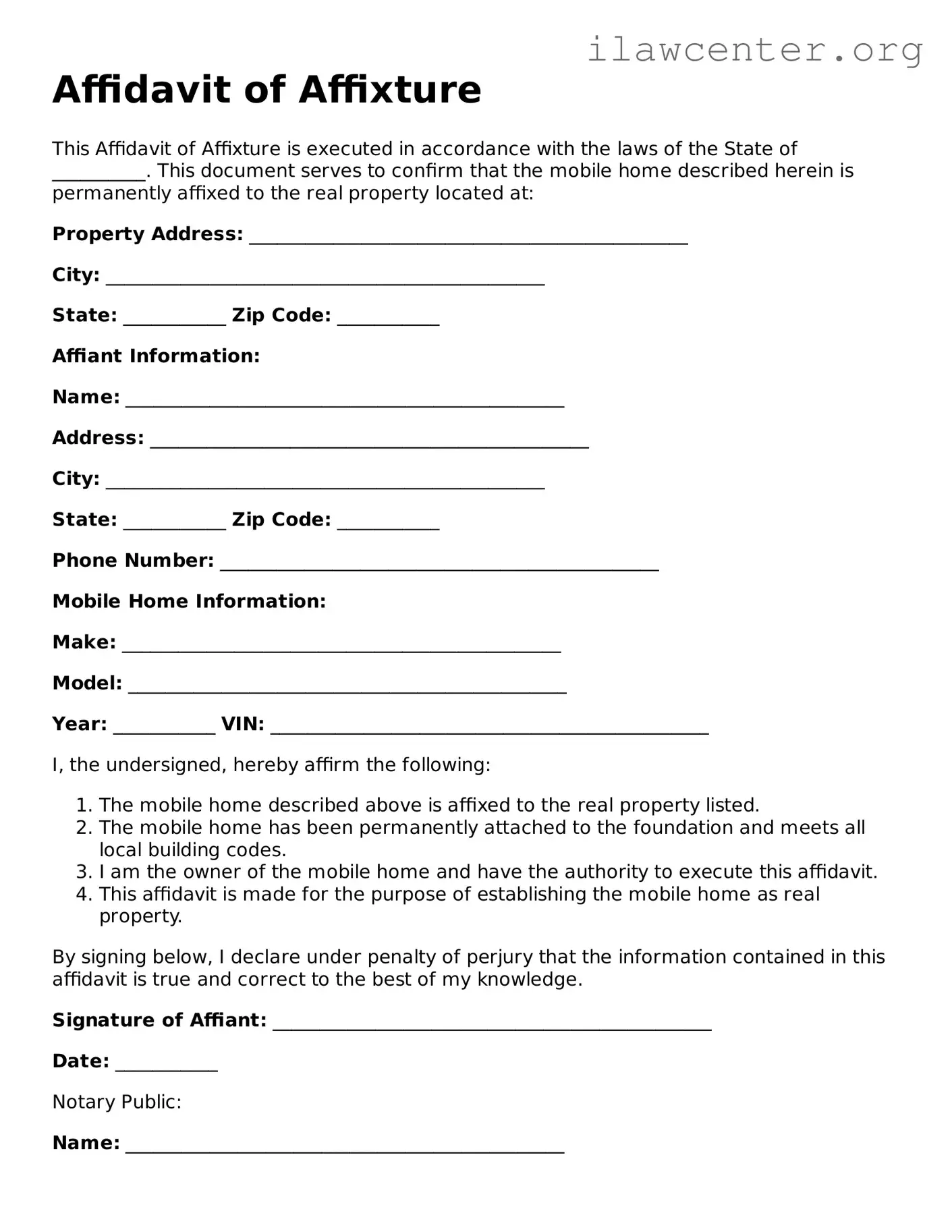
Fillable Affidavit of Affixture Document

Fillable Affidavit of Affixture Document

The Affidavit of Affixture is a legal document used to attach a mobile home or manufactured structure to real property, effectively converting it into real estate. This form is essential for homeowners who want to establish ownership and ensure their property is recognized by local authorities. Ready to secure your property? Fill out the form by clicking the button below.

Article Guide

The Affidavit of Affixture form plays a crucial role in the relationship between manufactured homes and real estate. This document is essential for homeowners who wish to establish their manufactured home as a permanent fixture on a piece of land. By completing this form, individuals can clarify the legal status of their home, ensuring that it is treated as part of the real property rather than as a movable asset. The form typically requires information such as the location of the home, details about the homeowner, and any relevant identification numbers. Additionally, it often necessitates signatures from the homeowner and sometimes a notary public, which adds an extra layer of authenticity. Understanding the importance of this form can help homeowners protect their investments and avoid potential legal complications down the road. As the housing landscape continues to evolve, knowing how to properly utilize the Affidavit of Affixture can make a significant difference in the ownership experience of a manufactured home.

Affidavit of Affixture Preview

Affidavit of Affixture

This Affidavit of Affixture is executed in accordance with the laws of the State of __________. This document serves to confirm that the mobile home described herein is permanently affixed to the real property located at:

Property Address: _______________________________________________

City: _______________________________________________

State: ___________ Zip Code: ___________

Affiant Information:

Name: _______________________________________________

Address: _______________________________________________

City: _______________________________________________

State: ___________ Zip Code: ___________

Phone Number: _______________________________________________

Mobile Home Information:

Make: _______________________________________________

Model: _______________________________________________

Year: ___________ VIN: _______________________________________________

I, the undersigned, hereby affirm the following:

  1. The mobile home described above is affixed to the real property listed.
  2. The mobile home has been permanently attached to the foundation and meets all local building codes.
  3. I am the owner of the mobile home and have the authority to execute this affidavit.
  4. This affidavit is made for the purpose of establishing the mobile home as real property.

By signing below, I declare under penalty of perjury that the information contained in this affidavit is true and correct to the best of my knowledge.

Signature of Affiant: _______________________________________________

Date: ___________

Notary Public:

Name: _______________________________________________

Commission Number: _______________________________________________

My Commission Expires: ___________

PDF Form Characteristics

Fact Name Description
Definition An Affidavit of Affixture is a legal document that establishes a manufactured home as a permanent fixture to a piece of land.
Purpose This form is used to convert a manufactured home from personal property to real property, making it subject to real estate laws.
Governing Laws In many states, the governing laws include state-specific statutes on property and real estate. For example, in California, it falls under the California Civil Code Section 8000.
Requirements Typically, you must provide proof of ownership, a description of the home, and details about the land it is affixed to.
Filing Process The affidavit must be filed with the local county recorder's office or equivalent authority to be legally recognized.
Impact on Taxes Once filed, the property may be subject to property taxes rather than vehicle taxes, which can change the financial obligations of the homeowner.
State Variations Each state has its own version of the form and specific requirements, so it's crucial to check local regulations for compliance.

Instructions on Utilizing Affidavit of Affixture

After gathering all necessary information, you are ready to fill out the Affidavit of Affixture form. Completing this form accurately is essential for ensuring that your manufactured or mobile home is legally recognized as part of the real estate. Follow these steps carefully to ensure a smooth process.

  1. Begin by entering the date at the top of the form. This should be the date you are completing the affidavit.
  2. Provide the name of the owner of the property where the home is affixed. This should match the name on the property title.
  3. Next, fill in the address of the property. Include the street address, city, state, and zip code.
  4. In the designated section, enter the legal description of the property. This can usually be found on the property deed.
  5. Identify the manufacturer of the home. Include the name and any relevant details, such as the model and year.
  6. Provide the serial number of the home. This is typically found on a plate inside the home or in the manufacturer’s paperwork.
  7. Indicate the date when the home was affixed to the property. This is important for record-keeping.
  8. Sign the affidavit in the designated area. Ensure that you date your signature.
  9. Have the affidavit witnessed or notarized as required by your state. This adds an extra layer of validation to your document.

Once you have completed the form, ensure that you keep a copy for your records. You may need to submit the original affidavit to your local government office or county clerk's office for it to be officially recorded. This step is crucial for establishing the legal status of your home as part of the real estate.

Important Facts about Affidavit of Affixture

What is an Affidavit of Affixture?

An Affidavit of Affixture is a legal document that establishes a mobile home as a permanent fixture on a piece of real property. This form is often used to indicate that the mobile home has been affixed to the land and is no longer considered personal property. By completing this affidavit, the owner can ensure that the mobile home is treated as part of the real estate for tax and legal purposes.

Why do I need an Affidavit of Affixture?

You may need an Affidavit of Affixture to clarify the status of your mobile home. If you want to sell the property or secure financing, lenders and buyers often require proof that the mobile home is permanently attached to the land. This document helps eliminate any confusion about ownership and property classification, making transactions smoother.

How do I complete an Affidavit of Affixture?

To complete an Affidavit of Affixture, you will need to provide specific information about the mobile home and the property. This includes details such as the legal description of the property, the mobile home’s serial number, and the owner’s information. After filling out the form, it must be signed in front of a notary public. Finally, file the affidavit with the local county recorder's office to make it a matter of public record.

Are there any fees associated with filing an Affidavit of Affixture?

What happens after I file the Affidavit of Affixture?

Once you file the Affidavit of Affixture, it becomes part of the public record. This means that anyone can access it if needed. The mobile home will now be considered a permanent fixture on the property. This change may affect property taxes and ownership records. It is important to keep a copy of the filed affidavit for your records, as it serves as proof of the mobile home’s status.

Common mistakes

Filling out the Affidavit of Affixture form can be a daunting task for many individuals. Mistakes in this process can lead to delays or even legal complications. One common error is failing to provide accurate information about the property. When details such as the legal description or address are incorrect, it can create confusion regarding ownership and the property’s status.

Another frequent mistake involves neglecting to sign the form. A signature is crucial; without it, the affidavit holds no legal weight. Additionally, individuals often forget to date the form. An undated affidavit may raise questions about its validity and the timing of the claims made within it.

People sometimes overlook the requirement for notarization. An affidavit must be notarized to be considered valid. Skipping this step can result in the form being rejected or deemed insufficient. Furthermore, individuals may not provide all necessary supporting documents. This could include proof of ownership or other relevant information that backs up the claims made in the affidavit.

Another common error is using outdated or incorrect forms. Laws and requirements can change, so it is essential to ensure that the most current version of the form is being utilized. Additionally, some individuals might not fully understand the implications of what they are signing. This lack of comprehension can lead to unintended consequences.

Inconsistent information is also a significant issue. If the information on the Affidavit of Affixture does not match other documents related to the property, it can raise red flags. This inconsistency can cause delays in processing or even legal disputes. Lastly, failing to keep copies of submitted documents is a mistake that can lead to difficulties in the future. Without records, proving claims or resolving issues becomes much more challenging.

Documents used along the form

The Affidavit of Affixture is a key document used in the process of converting a mobile home into real property. Alongside this affidavit, several other forms and documents are commonly required to ensure a smooth transition and compliance with local regulations. Below are four important documents often used in conjunction with the Affidavit of Affixture.

  • Title Certificate: This document proves ownership of the mobile home. It is essential for verifying that the individual filing the affidavit has the legal right to convert the home into real property.
  • Property Deed: The property deed outlines the ownership of the land where the mobile home is situated. It is necessary to establish that the mobile home will be affixed to the land and will become part of the real estate.
  • Tax Clearance Certificate: This certificate confirms that all property taxes have been paid on the mobile home. Local authorities often require this document to ensure there are no outstanding tax liabilities before processing the affidavit.
  • Site Plan: A site plan provides a detailed layout of the property, including the location of the mobile home. This document helps local officials assess compliance with zoning regulations and land use requirements.

Understanding these accompanying documents is crucial for anyone looking to successfully file an Affidavit of Affixture. Each plays a vital role in the process, ensuring that all legal and regulatory requirements are met.

Similar forms

The Affidavit of Affixture form has similarities with several other legal documents. Here are eight documents that share characteristics with it:

  • Title Deed: Like the Affidavit of Affixture, a title deed establishes ownership of property. Both documents provide essential information about the property and its owner.
  • Bill of Sale: A bill of sale transfers ownership of personal property. Similar to the Affidavit of Affixture, it documents the transaction and the details of the item being transferred.
  • Lease Agreement: This document outlines the terms under which one party rents property from another. Both the lease agreement and the Affidavit of Affixture clarify rights and responsibilities regarding property use.
  • Mortgage Agreement: A mortgage agreement details the terms of a loan secured by real estate. It shares the purpose of establishing legal rights and obligations concerning property ownership.
  • Property Survey: A property survey defines the boundaries and features of a piece of land. Like the Affidavit of Affixture, it provides crucial information about the property in question.
  • Homeowners Association (HOA) Agreement: This document outlines the rules and regulations for a community. Similar to the Affidavit of Affixture, it governs the use and maintenance of property within a specific area.
  • Quitclaim Deed: A quitclaim deed transfers any ownership interest in property without guaranteeing that the title is clear. Both documents facilitate the transfer of property rights but do so in different contexts.
  • Construction Contract: This agreement outlines the terms of construction work on a property. Like the Affidavit of Affixture, it establishes legal obligations related to property development and improvements.

Dos and Don'ts

When filling out the Affidavit of Affixture form, it is crucial to approach the process with care. Here are some important do's and don'ts to keep in mind:

  • Do ensure that all information is accurate and complete. Double-check names, addresses, and other relevant details.
  • Do sign the affidavit in the presence of a notary public. This step adds credibility to your document.
  • Don't leave any sections blank. If a particular section does not apply, indicate that clearly.
  • Don't rush through the process. Take your time to understand each requirement and fill it out thoughtfully.

Misconceptions

The Affidavit of Affixture is an important document in the realm of property law, particularly for those who own manufactured homes. However, several misconceptions surround this form. Below are five common misunderstandings:

  1. It is only for mobile homes.

    Many people believe that the Affidavit of Affixture applies exclusively to mobile homes. In reality, this form can also be used for any manufactured home that has been permanently affixed to land. This means that if a manufactured home is placed on a foundation and connected to utilities, it may require this affidavit.

  2. Filing the affidavit guarantees ownership.

    Some individuals think that simply filing the Affidavit of Affixture automatically secures ownership of the property. However, while the affidavit is an important step in establishing ownership, it does not replace the need for proper title transfer and registration. Ownership must be established through the appropriate legal processes.

  3. It can be filed at any time.

    Another misconception is that the Affidavit of Affixture can be filed whenever the homeowner chooses. In fact, there are specific timelines and requirements that must be met. For example, it should be filed after the manufactured home is permanently affixed to the land but before any transfer of ownership occurs.

  4. Only the homeowner can file it.

    Some people believe that only the homeowner has the authority to file the affidavit. This is not entirely true. In some cases, a legal representative or agent may also file the affidavit on behalf of the homeowner, provided they have the necessary authority to do so.

  5. It is not necessary in all states.

    Lastly, there is a belief that the Affidavit of Affixture is not required in all states. While it is true that requirements vary by state, many states do require this document for manufactured homes to be considered real property. It is essential to check local laws to determine the specific requirements in your area.

Key takeaways

Filling out and using the Affidavit of Affixture form is an important process for homeowners and property owners. Here are some key takeaways to keep in mind:

  • Understand the Purpose: The Affidavit of Affixture serves to legally attach a manufactured home to the land it occupies. This process is crucial for establishing ownership and ensuring proper property tax assessments.
  • Gather Necessary Information: Before filling out the form, collect all relevant information about the property, including the legal description, tax identification number, and details about the manufactured home.
  • Complete the Form Accurately: Accuracy is key. Fill out all sections of the form completely and double-check for any errors. Mistakes can lead to delays in processing or complications down the line.
  • Notarization Requirement: The Affidavit must be notarized to be legally binding. Ensure you sign the document in front of a notary public to validate it.
  • File with the Appropriate Authority: After notarization, submit the completed Affidavit to your local property records office or the relevant authority in your jurisdiction. This step is essential for the document to take effect.
  • Keep Copies: Always retain copies of the completed Affidavit for your records. Having documentation can be helpful in case of future disputes or questions regarding ownership.

By following these steps, you can navigate the process of using the Affidavit of Affixture with confidence and clarity.