Fillable Affidavit of Birth Document

Fillable Affidavit of Birth Document

The Affidavit of Birth is a legal document used to verify the birth of an individual when traditional birth records are unavailable. This form serves as a sworn statement, providing essential details about the birth event, including the date, place, and parentage. If you need to complete this form, click the button below to get started.

Article Guide

The Affidavit of Birth form plays a crucial role in establishing a person's identity and legal status, especially when official birth records are unavailable or incomplete. This document serves as a sworn statement, typically filled out by a parent or guardian, asserting the details of a child's birth. Key components of the form include the child's name, date of birth, place of birth, and the names of the parents. In some cases, additional information, such as the circumstances surrounding the birth, may also be required. The form must be signed in the presence of a notary public, ensuring its authenticity. Understanding how to correctly complete and submit this form is essential for parents seeking to secure their child's rights to citizenship, education, and healthcare. By navigating the requirements and implications of the Affidavit of Birth, families can ensure their child's identity is officially recognized and protected.

Affidavit of Birth Preview

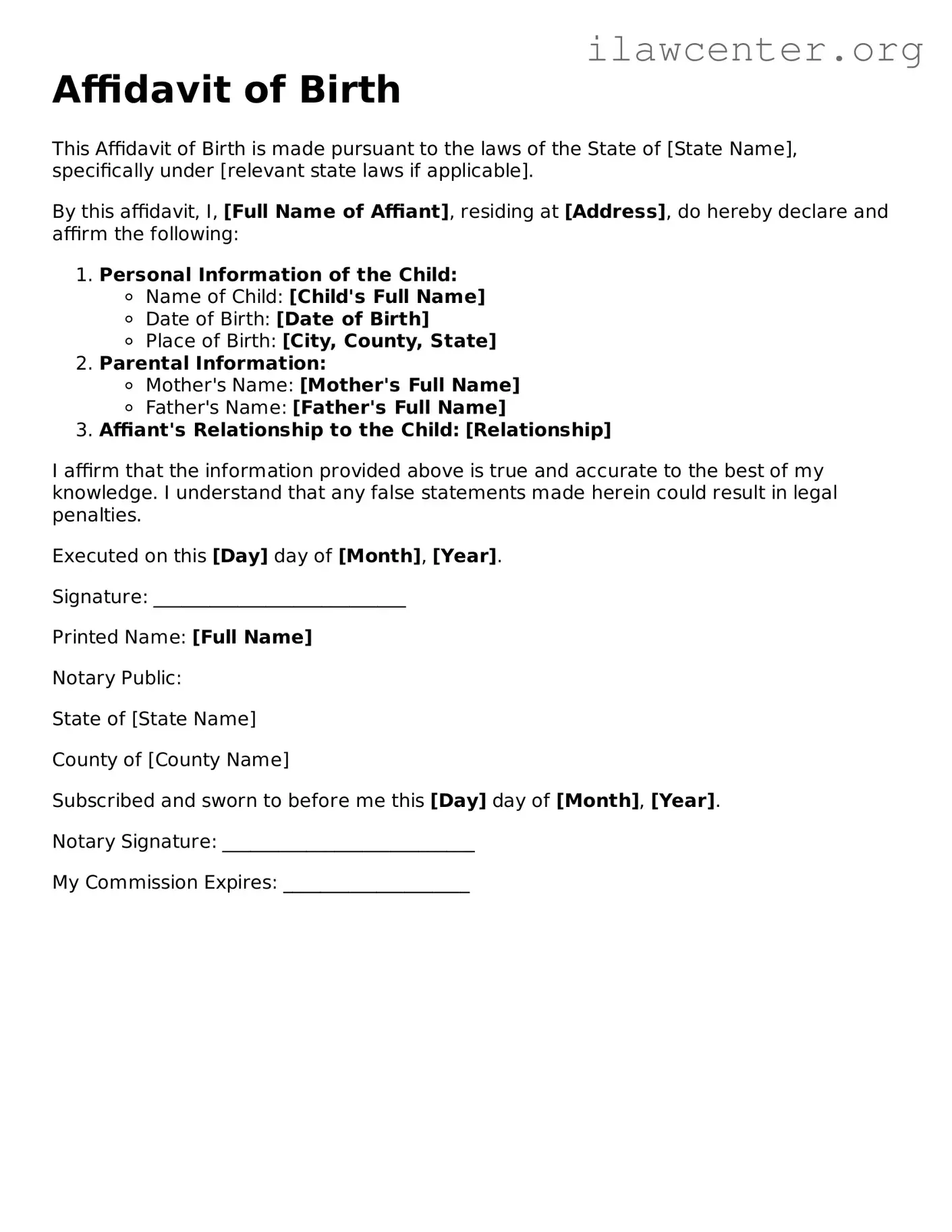
Affidavit of Birth

This Affidavit of Birth is made pursuant to the laws of the State of [State Name], specifically under [relevant state laws if applicable].

By this affidavit, I, [Full Name of Affiant], residing at [Address], do hereby declare and affirm the following:

  1. Personal Information of the Child:
    • Name of Child: [Child's Full Name]
    • Date of Birth: [Date of Birth]
    • Place of Birth: [City, County, State]
  2. Parental Information:
    • Mother's Name: [Mother's Full Name]
    • Father's Name: [Father's Full Name]
  3. Affiant's Relationship to the Child: [Relationship]

I affirm that the information provided above is true and accurate to the best of my knowledge. I understand that any false statements made herein could result in legal penalties.

Executed on this [Day] day of [Month], [Year].

Signature: ___________________________

Printed Name: [Full Name]

Notary Public:

State of [State Name]

County of [County Name]

Subscribed and sworn to before me this [Day] day of [Month], [Year].

Notary Signature: ___________________________

My Commission Expires: ____________________

PDF Form Characteristics

Fact Name Description
Purpose The Affidavit of Birth form is used to establish the identity and birth details of an individual, often for legal or administrative purposes.
Who Can File Typically, a parent or legal guardian of the child can file the affidavit. In some cases, a relative or other designated individual may also be allowed to submit it.
Required Information The form generally requires the child's full name, date of birth, place of birth, and the names of the parents or guardians.
Notarization Most states require the affidavit to be notarized, ensuring that the information provided is verified and legally binding.
State-Specific Forms Each state may have its own version of the Affidavit of Birth form. It is crucial to use the correct form for your state to ensure compliance with local laws.
Governing Laws In many states, the governing laws for the Affidavit of Birth can be found in the vital records statutes. For example, in California, it is governed by the California Health and Safety Code.
Filing Process After completing the affidavit, it must be submitted to the appropriate vital records office, along with any required fees and supporting documents.
Importance of Accuracy Providing accurate information on the affidavit is crucial. Errors can lead to complications in obtaining official documents, such as a birth certificate.

Instructions on Utilizing Affidavit of Birth

Completing the Affidavit of Birth form is an important step in documenting a person's birth. After filling out the form, you will need to submit it to the appropriate authority, which may vary depending on your location. Make sure to gather any additional documents that may be required alongside the affidavit.

  1. Begin by downloading the Affidavit of Birth form from the official website or obtain a physical copy from your local vital records office.
  2. Fill in the full name of the individual whose birth is being documented in the designated section.
  3. Provide the date of birth. Ensure the format is consistent with local requirements.
  4. Enter the place of birth, including the city and state.
  5. Complete the section for the parents’ information, including their full names and any other requested details.
  6. Sign and date the affidavit at the bottom of the form. Ensure that the signature matches the name provided in the document.
  7. If required, have the affidavit notarized. This step may involve visiting a notary public to verify your identity and signature.
  8. Make copies of the completed affidavit for your records before submission.
  9. Submit the affidavit to the appropriate office, such as the local vital records office or the state department of health.

Important Facts about Affidavit of Birth

What is an Affidavit of Birth?

An Affidavit of Birth is a legal document that serves as a sworn statement confirming the birth of an individual. This form is often used when a birth certificate is unavailable or when there are discrepancies in the existing birth records. It provides essential details about the individual’s birth, such as the date, place, and parentage, allowing for the establishment of identity and citizenship.

Who can complete an Affidavit of Birth?

The Affidavit of Birth can typically be completed by a parent or legal guardian of the individual whose birth is being affirmed. In some cases, other relatives or witnesses who were present at the birth may also be eligible to complete the affidavit, provided they can accurately attest to the details of the birth.

What information is required on the Affidavit of Birth?

To fill out the Affidavit of Birth, specific information is needed. This includes the full name of the person being affirmed, their date and place of birth, the names of the parents, and any relevant details about the birth circumstances. Some forms may also require the signatures of witnesses who can corroborate the information provided.

Is the Affidavit of Birth legally binding?

Yes, an Affidavit of Birth is a legally binding document. When signed, it affirms that the information contained within is true to the best knowledge of the signer. Providing false information can lead to legal consequences, including penalties for perjury.

How is the Affidavit of Birth used?

The Affidavit of Birth is often used to obtain a birth certificate when the original is lost or not issued. It can also be helpful for various legal purposes, such as applying for identification documents, enrolling in school, or establishing eligibility for government benefits. Each state may have specific requirements regarding its acceptance, so it’s essential to check local regulations.

Where can I obtain an Affidavit of Birth form?

An Affidavit of Birth form can usually be obtained from local government offices, such as the vital records office or the department of health. Additionally, some organizations provide downloadable versions online. It’s advisable to ensure that the form meets your state’s specific requirements before submission.

Do I need to have the Affidavit of Birth notarized?

In many cases, yes, the Affidavit of Birth must be notarized to be considered valid. Notarization serves as a means to verify the identity of the signer and the authenticity of the document. However, requirements can vary by state, so it is important to verify local laws regarding notarization.

Can the Affidavit of Birth be challenged?

Yes, an Affidavit of Birth can be challenged, particularly if there are discrepancies in the information provided or if someone contests the validity of the claims made within the document. In such cases, additional evidence may be required to support the affidavit, and legal proceedings may ensue to resolve the matter.

How long does it take to process an Affidavit of Birth?

The processing time for an Affidavit of Birth can vary significantly depending on the jurisdiction and the specific circumstances involved. Generally, if all required information is accurate and complete, processing may take anywhere from a few days to several weeks. It’s wise to check with the relevant local office for estimated timelines.

What should I do if my Affidavit of Birth is denied?

If your Affidavit of Birth is denied, you should first review the reasons for the denial, which are typically provided in writing. Common reasons include incomplete information or failure to meet state requirements. You may need to gather additional documentation or correct any errors before resubmitting the affidavit. Consulting with legal assistance can also be beneficial in navigating the appeals process.
Common mistakes

Filling out the Affidavit of Birth form can be a straightforward process, but many individuals make common mistakes that can lead to delays or complications. Understanding these pitfalls can help ensure that the form is completed correctly and efficiently.

One frequent mistake is providing inaccurate personal information. This includes misspellings of names, incorrect dates of birth, or wrong places of birth. Such errors can cause significant issues, as the information on the affidavit must match official records. Always double-check the details before submission.

Another common error is failing to sign the affidavit. Some individuals may forget this crucial step, thinking that the form is complete without their signature. Without a signature, the affidavit is not legally binding and will not be accepted. It's essential to review the form thoroughly and ensure all required signatures are present.

Many people also overlook the need for witnesses. The Affidavit of Birth typically requires one or two witnesses to sign the document, affirming the truth of the information provided. Neglecting to include witnesses can render the affidavit invalid. Make sure to arrange for appropriate witnesses who are willing to sign.

Inadequate documentation is another mistake that can hinder the process. Individuals often forget to attach necessary supporting documents, such as identification or proof of birth. These documents are crucial for verifying the information on the affidavit. Always check the requirements and include all necessary paperwork.

Some individuals may not be aware of the specific requirements for their state. Each state may have different rules regarding the Affidavit of Birth, including what information must be included or how it must be notarized. Researching state-specific guidelines can prevent errors and ensure compliance.

Another issue arises when people use outdated forms. Laws and requirements can change, so using an old version of the Affidavit of Birth may lead to complications. Always obtain the most current version of the form from a reliable source.

Finally, a lack of clarity in the information provided can be a significant mistake. If the details are vague or ambiguous, it may lead to confusion or rejection of the affidavit. Clear, concise, and complete information is essential for the affidavit to be processed smoothly.

By being aware of these common mistakes, individuals can approach the Affidavit of Birth form with confidence. Careful attention to detail and adherence to guidelines will help ensure that the form is completed accurately and efficiently.

Documents used along the form

The Affidavit of Birth form is a crucial document used to establish the identity and birth details of an individual. It is often accompanied by several other forms and documents that serve to support and validate the information provided. Below is a list of commonly used documents that may be required alongside the Affidavit of Birth.

  • Birth Certificate: This official document issued by a government authority confirms the birth of an individual, including details such as the date, time, and place of birth.
  • Identification Documents: These may include a driver's license, passport, or state ID, which serve to verify the identity of the individual submitting the affidavit.
  • Social Security Card: This card provides a unique identification number assigned to an individual for social security purposes and can help in confirming identity.
  • Proof of Residency: Documents such as utility bills or lease agreements that show the individual's current address may be required to establish residency.
  • Parentage Documents: These may include marriage certificates or other legal documents that establish the relationship between the individual and their parents.
  • Medical Records: In some cases, medical records may be used to provide evidence of birth, especially in situations where a birth certificate is unavailable.
  • Affidavit of Support: This document may be necessary to show that the individual has support from family or guardians, especially in cases of minors.
  • Legal Name Change Documents: If the individual has changed their name, documentation such as a court order may be needed to verify the name change.

Each of these documents plays a significant role in the process of verifying an individual's identity and birth details. Having them prepared can facilitate a smoother experience when submitting the Affidavit of Birth form.

Similar forms

The Affidavit of Birth form serves as a crucial document for establishing a person's identity and confirming their birth details. There are several other documents that share similarities with the Affidavit of Birth in terms of purpose and function. Below are four such documents:

  • Birth Certificate: This official document is issued by a government authority and provides proof of an individual's birth. Like the Affidavit of Birth, it contains essential details such as the date, place of birth, and the names of the parents.
  • Certificate of Live Birth: Often used interchangeably with a birth certificate, this document is typically generated shortly after birth. It serves a similar purpose, confirming the birth of a child and providing vital statistics, much like the Affidavit of Birth.
  • Social Security Card: This card is issued by the Social Security Administration and serves as proof of a person's identity and eligibility for benefits. While it does not provide birth details, it is often linked to the information contained in an Affidavit of Birth, as it requires proof of identity and age.
  • Passport: A passport is an official government document that certifies a person's identity and nationality. It requires proof of birth and identity, similar to the Affidavit of Birth, as both documents validate a person's existence and legal status.

Each of these documents plays a vital role in establishing identity and legal recognition, just as the Affidavit of Birth does.

Dos and Don'ts

When filling out the Affidavit of Birth form, it's essential to be careful and precise. Here are ten important dos and don'ts to keep in mind:

  • Do ensure all information is accurate and complete.
  • Do use clear and legible handwriting or type the information.
  • Do provide all required supporting documents.
  • Do double-check for any spelling errors.
  • Do sign and date the affidavit where indicated.
  • Don't leave any sections blank unless instructed.
  • Don't use white-out or correction fluid on the form.
  • Don't provide false information under any circumstances.
  • Don't forget to keep a copy of the completed form for your records.
  • Don't submit the form without reviewing all requirements first.

Misconceptions

Many people have misunderstandings about the Affidavit of Birth form. This can lead to confusion when trying to navigate the process of establishing a child's identity. Here are six common misconceptions:

  • It is only needed for children born out of wedlock. Some believe that the Affidavit of Birth is solely for children whose parents are not married. In reality, it can be used by any parent who needs to provide proof of a child's birth, regardless of marital status.
  • It is the same as a birth certificate. While both documents serve to establish a child's identity, they are not interchangeable. A birth certificate is an official document issued by the state, while an Affidavit of Birth is a sworn statement that may be used to supplement or replace a birth certificate in certain situations.
  • It can be completed by anyone. Some people think that any adult can fill out the Affidavit of Birth. However, it must be completed by a parent or legal guardian of the child, as they have the authority to provide this information.
  • It is not legally binding. A common belief is that an Affidavit of Birth holds no legal weight. In fact, when properly completed and notarized, it is a legally binding document that can be used in various legal situations, such as applying for a passport or enrolling in school.
  • It can be submitted without notarization. Many assume that the Affidavit of Birth can be submitted without being notarized. However, for it to be valid, it typically requires a notary's signature, confirming that the information is accurate and that the signer is who they claim to be.
  • It is a complicated process. Some people feel overwhelmed by the idea of completing an Affidavit of Birth. In truth, the process is relatively straightforward. With the right information and guidance, most parents can complete it without much difficulty.

Understanding these misconceptions can help clarify the purpose and importance of the Affidavit of Birth. By knowing the facts, parents can ensure they are taking the right steps to establish their child's identity.

Key takeaways

Filling out the Affidavit of Birth form is an important process for establishing a person's identity and legal status. Here are key takeaways to consider:

  • Ensure all required information is accurate and complete to avoid delays.
  • The form typically requires details such as the child's name, date of birth, and place of birth.
  • It may also require information about the parents, including their names and addresses.
  • Sign the affidavit in the presence of a notary public to validate the document.
  • Check if additional documentation is needed, such as proof of identity or residency.
  • Submit the completed form to the appropriate government agency, often the vital records office.
  • Keep a copy of the affidavit for personal records after submission.
  • Understand that the affidavit may be used for various purposes, such as obtaining a birth certificate.
  • Be aware of the deadlines for submission, as they can vary by state.
  • If there are any errors after submission, contact the agency promptly to correct them.

Following these guidelines can help ensure a smooth process when filling out and using the Affidavit of Birth form.