Fillable Affidavit of Correction Document

Fillable Affidavit of Correction Document

An Affidavit of Correction is a legal document used to amend or correct errors in a previously filed document, such as a deed or a birth certificate. This form serves to clarify information and ensure that records accurately reflect the intended details. For those needing to correct a mistake, filling out this form is a crucial step—click the button below to get started.

Article Guide

The Affidavit of Correction form serves as a crucial tool for individuals and entities seeking to amend or rectify errors in official documents. Whether it’s a mistake in a property deed, a birth certificate, or any other legal record, this form provides a straightforward method to address inaccuracies. By completing this form, the affiant—who is the person making the correction—asserts that the information being amended is indeed incorrect and outlines the necessary changes. This sworn statement must be signed in front of a notary public, ensuring its authenticity and legal standing. Once filed with the appropriate government office, the corrected document can help prevent future disputes and confusion. Understanding the process and requirements for the Affidavit of Correction is essential for anyone looking to maintain accurate records and uphold the integrity of their legal documents.

Affidavit of Correction Preview

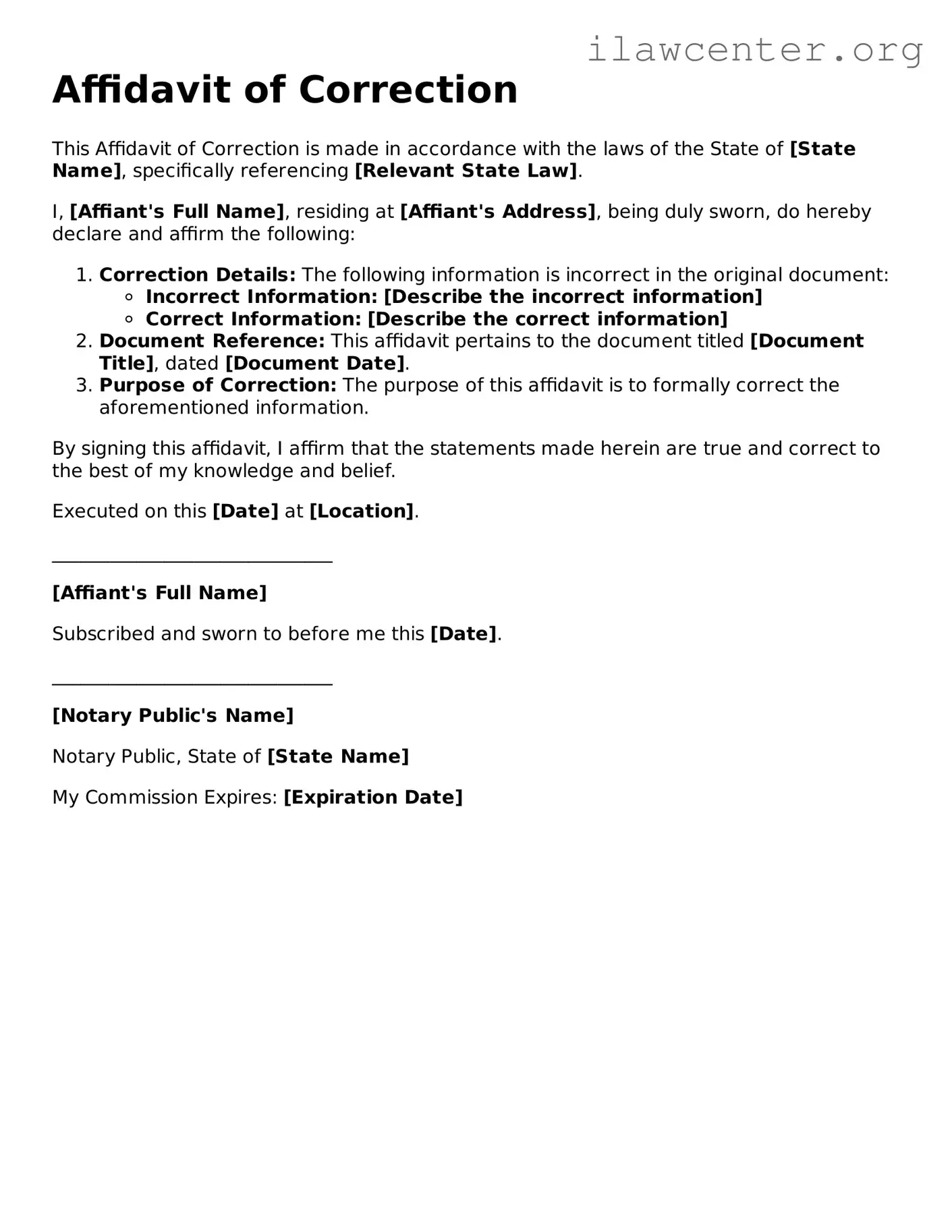
Affidavit of Correction

This Affidavit of Correction is made in accordance with the laws of the State of [State Name], specifically referencing [Relevant State Law].

I, [Affiant's Full Name], residing at [Affiant's Address], being duly sworn, do hereby declare and affirm the following:

  1. Correction Details: The following information is incorrect in the original document:
    • Incorrect Information: [Describe the incorrect information]
    • Correct Information: [Describe the correct information]
  2. Document Reference: This affidavit pertains to the document titled [Document Title], dated [Document Date].
  3. Purpose of Correction: The purpose of this affidavit is to formally correct the aforementioned information.

By signing this affidavit, I affirm that the statements made herein are true and correct to the best of my knowledge and belief.

Executed on this [Date] at [Location].

______________________________

[Affiant's Full Name]

Subscribed and sworn to before me this [Date].

______________________________

[Notary Public's Name]

Notary Public, State of [State Name]

My Commission Expires: [Expiration Date]

PDF Form Characteristics

Fact Name Description
Purpose The Affidavit of Correction form is used to correct clerical errors in public records, ensuring that the information is accurate and up-to-date.
Common Uses This form is often utilized for correcting errors in property deeds, marriage licenses, and other legal documents.
State-Specific Forms Each state may have its own version of the Affidavit of Correction. For example, in California, the form is governed by California Civil Code Section 1187.
Filing Process After completing the form, it must be filed with the appropriate government office, such as the county recorder's office, to be officially recognized.
Legal Effect Once filed, the corrections made through the affidavit are legally binding, ensuring that future references to the document reflect the accurate information.

Instructions on Utilizing Affidavit of Correction

After gathering the necessary information, you are ready to complete the Affidavit of Correction form. This form is essential for correcting errors in legal documents. Follow these steps carefully to ensure accuracy.

  1. Obtain the Affidavit of Correction form from the appropriate government website or office.
  2. Read the instructions provided with the form to understand the requirements.
  3. Fill in your name and contact information in the designated fields at the top of the form.
  4. Identify the document that contains the error by providing its title and date.
  5. Clearly describe the error that needs correction. Be specific and concise.
  6. State the correct information that should replace the erroneous details.
  7. Sign the form in the designated area. Ensure your signature matches your name as written above.
  8. Have the form notarized if required. A notary will verify your identity and witness your signature.
  9. Submit the completed form to the appropriate office, along with any required fees or additional documents.

Once submitted, the office will process your request. You may receive confirmation or further instructions regarding your correction. Be sure to keep a copy of the completed form for your records.

Important Facts about Affidavit of Correction

What is an Affidavit of Correction?

An Affidavit of Correction is a legal document used to correct errors in public records. These errors can include mistakes in names, dates, or other important details on documents such as deeds, contracts, or court records. By filing this affidavit, individuals can ensure that the public record accurately reflects the true information, thereby preventing future complications or misunderstandings.

When should I use an Affidavit of Correction?

You should consider using an Affidavit of Correction when you discover an error in a document that has been filed with a government agency or a court. Common scenarios include misspelled names, incorrect addresses, or wrong dates. It’s essential to address these mistakes promptly to maintain the integrity of the public record and avoid potential legal issues down the line.

How do I complete an Affidavit of Correction?

Completing an Affidavit of Correction typically involves filling out a specific form that outlines the error and the correct information. You will need to provide details about the document being corrected, such as the title, date, and the nature of the error. After filling out the form, it must be signed in the presence of a notary public to verify your identity and the authenticity of your claim. Once notarized, the affidavit should be filed with the appropriate government agency.

Is there a fee associated with filing an Affidavit of Correction?

What happens after I file the Affidavit of Correction?

After you file the Affidavit of Correction, the agency will review your submission. If everything is in order, they will update the public record to reflect the corrected information. You may receive confirmation of the change, but this can vary by agency. It’s a good practice to keep a copy of the filed affidavit for your records, in case you need to reference it in the future.

Common mistakes

Filling out the Affidavit of Correction form can be a straightforward process, but many individuals make common mistakes that can lead to complications. One frequent error is not providing complete information. When sections are left blank or filled out incorrectly, it can delay the correction process. It is essential to ensure that every required field is filled accurately to avoid unnecessary setbacks.

Another mistake often made is failing to sign the document. A signature is crucial, as it verifies that the information provided is true and accurate. Without a signature, the form may be deemed invalid, and the corrections will not be processed. Always double-check that you have signed the affidavit before submission.

People sometimes overlook the importance of including supporting documentation. When correcting a record, it is vital to attach any necessary evidence that supports the requested changes. This could include copies of identification, prior documents, or any other relevant materials. Failing to include these documents can lead to rejection of the application.

Additionally, individuals may not follow the specific instructions outlined for the form. Each jurisdiction may have its own requirements for how the Affidavit of Correction should be completed and submitted. Ignoring these instructions can result in confusion and delays. It is advisable to read all guidelines carefully before starting the process.

Finally, some people underestimate the importance of reviewing the completed form before submission. Mistakes in spelling, dates, or other details can easily occur. Taking the time to review the affidavit can prevent these errors and ensure that the information is accurate. A thorough review can save time and effort in the long run.

Documents used along the form

The Affidavit of Correction form is often used to amend or clarify information in official documents. When submitting this form, it is helpful to have additional documents to support your request. Below is a list of other forms and documents that may be used alongside the Affidavit of Correction.

  • Certificate of Correction: This document is filed to officially correct errors in corporate filings, such as articles of incorporation or amendments. It provides a legal acknowledgment of the changes made.
  • Notarized Statement: A notarized statement may be required to verify the identity of the person making the correction. This adds an extra layer of authenticity to the information provided.
  • Supporting Documentation: Any additional paperwork that supports the need for correction can be included. This might consist of prior documents, correspondence, or other records that clarify the issue.
  • Application for Change: If the correction involves a change of name or address, an application form specific to that change may be needed. This ensures that all records are updated accordingly.
  • Affidavit of Identity: In some cases, an affidavit confirming the identity of the individual making the correction is necessary. This helps to prevent fraud and ensures that changes are legitimate.
  • Request for Reissue: If the original document needs to be reissued after the correction, a request for reissue form may be required. This allows for the updated document to be formally issued.

Having these documents ready can help streamline the correction process. It is essential to ensure that all necessary forms are completed accurately to avoid delays.

Similar forms

The Affidavit of Correction form serves a specific purpose in legal documentation, primarily aimed at correcting errors in previously filed documents. Several other documents share similarities in their function or intent. Here are five such documents:

  • Affidavit of Identity: This document is used to affirm a person's identity, often in situations where there may be confusion or discrepancies in identification. Like the Affidavit of Correction, it is sworn under oath and serves to clarify important information.
  • Correction Deed: A Correction Deed is utilized to amend errors in a previously executed deed. Similar to the Affidavit of Correction, it addresses inaccuracies to ensure that the legal record reflects the true intent of the parties involved.
  • Amendment Agreement: This document modifies an existing agreement to correct or update terms. Both the Amendment Agreement and the Affidavit of Correction aim to rectify mistakes, ensuring that all parties are in agreement with the current terms.
  • Notice of Error: A Notice of Error is filed to formally alert parties about inaccuracies in documents or records. This document, like the Affidavit of Correction, seeks to bring attention to issues that need resolution.
  • Statement of Facts: This document outlines specific facts or clarifications regarding a situation or transaction. It serves a similar purpose to the Affidavit of Correction by providing clear information to rectify misunderstandings or misrepresentations.

Dos and Don'ts

When completing the Affidavit of Correction form, it is essential to follow certain guidelines to ensure accuracy and compliance. Below is a list of ten things you should and shouldn't do.

  • Do read the instructions carefully before starting.
  • Do provide all required information clearly and accurately.
  • Do use black or blue ink for legibility.
  • Do sign and date the form where indicated.
  • Do keep a copy of the completed form for your records.
  • Don't leave any fields blank unless specified.
  • Don't use white-out or correction fluid on the form.
  • Don't submit the form without reviewing it for errors.
  • Don't forget to check the submission deadline.
  • Don't assume that the form will be accepted without proper documentation.

By adhering to these guidelines, individuals can help ensure that their Affidavit of Correction is processed smoothly and efficiently.

Misconceptions

The Affidavit of Correction form is often misunderstood. Here are eight common misconceptions about this legal document:

  1. Only lawyers can file an Affidavit of Correction. Many people believe that only legal professionals can submit this form. In reality, individuals can file it themselves as long as they meet the necessary requirements.
  2. It can be used for any type of correction. Some think that the Affidavit of Correction is a catch-all for any errors. However, it is specifically designed for correcting clerical or typographical errors in official documents.
  3. It requires a court appearance. Many assume that filing an Affidavit of Correction necessitates going to court. This is not the case; the form can typically be submitted directly to the appropriate office without a court hearing.
  4. It can change the content of a document. Some believe that this form allows for substantial changes to the content of a document. In fact, it is limited to correcting minor errors and does not allow for alterations to the original intent or meaning.
  5. It is only for property-related documents. While many people associate the Affidavit of Correction with real estate, it can also be used for various types of legal documents, including marriage licenses and birth certificates.
  6. Once filed, it is permanent and cannot be undone. Some think that an Affidavit of Correction is irreversible. However, if further errors are discovered, additional affidavits can be filed to address those issues.
  7. There is a universal form for all states. Many believe that there is a single Affidavit of Correction form applicable nationwide. In reality, each state may have its own specific requirements and forms.
  8. It does not require notarization. Some individuals think that notarization is unnecessary. However, most jurisdictions require the Affidavit of Correction to be notarized to ensure its validity.

Understanding these misconceptions can help individuals navigate the process of filing an Affidavit of Correction more effectively.

Key takeaways

Filling out and using the Affidavit of Correction form is a process that requires attention to detail. Here are some key takeaways to keep in mind:

  • Understand the Purpose: The Affidavit of Correction serves to rectify errors in official documents. It is essential for ensuring that records accurately reflect the intended information.
  • Gather Required Information: Before completing the form, collect all necessary details, such as the original document, the specific errors, and the correct information.
  • Follow Instructions Carefully: Each jurisdiction may have its own specific requirements for the form. Adhering to these guidelines is crucial for the affidavit to be accepted.
  • Provide Clear Explanations: When detailing the corrections, clarity is key. Clearly state what the error was and what the correct information should be.
  • Sign and Notarize: Most affidavits require a signature and notarization. Ensure that you sign the document in front of a notary public to validate it.
  • Submit to the Appropriate Authority: Once completed, the affidavit must be submitted to the relevant office or agency that maintains the original document. This step is vital for making the corrections official.

By keeping these points in mind, individuals can effectively navigate the process of using the Affidavit of Correction form.