Fillable Affidavit of Gift Document

Fillable Affidavit of Gift Document

The Affidavit of Gift form is a legal document used to declare the transfer of property or assets as a gift, typically for tax purposes. This form provides essential details about the donor and recipient, ensuring that the gift is recognized officially and can help avoid potential tax liabilities. To ensure compliance and clarity in the gifting process, consider filling out the Affidavit of Gift form by clicking the button below.

Article Guide

The Affidavit of Gift form plays a crucial role in the process of transferring ownership of personal property without any exchange of money. This form is often used in situations such as gifting real estate, vehicles, or valuable items, providing a clear record of the transaction. It serves to affirm that the donor willingly gives the property to the recipient, ensuring that both parties understand the nature of the gift. By completing this form, the donor can avoid potential disputes in the future regarding ownership or intent. Additionally, the affidavit may require the signature of a witness or notary, adding an extra layer of authenticity. It is essential for both the giver and the receiver to keep a copy of this document for their records, as it can be important for tax purposes and legal verification down the line. Understanding the significance of this form can help individuals navigate the complexities of property transfer smoothly.

Affidavit of Gift Preview

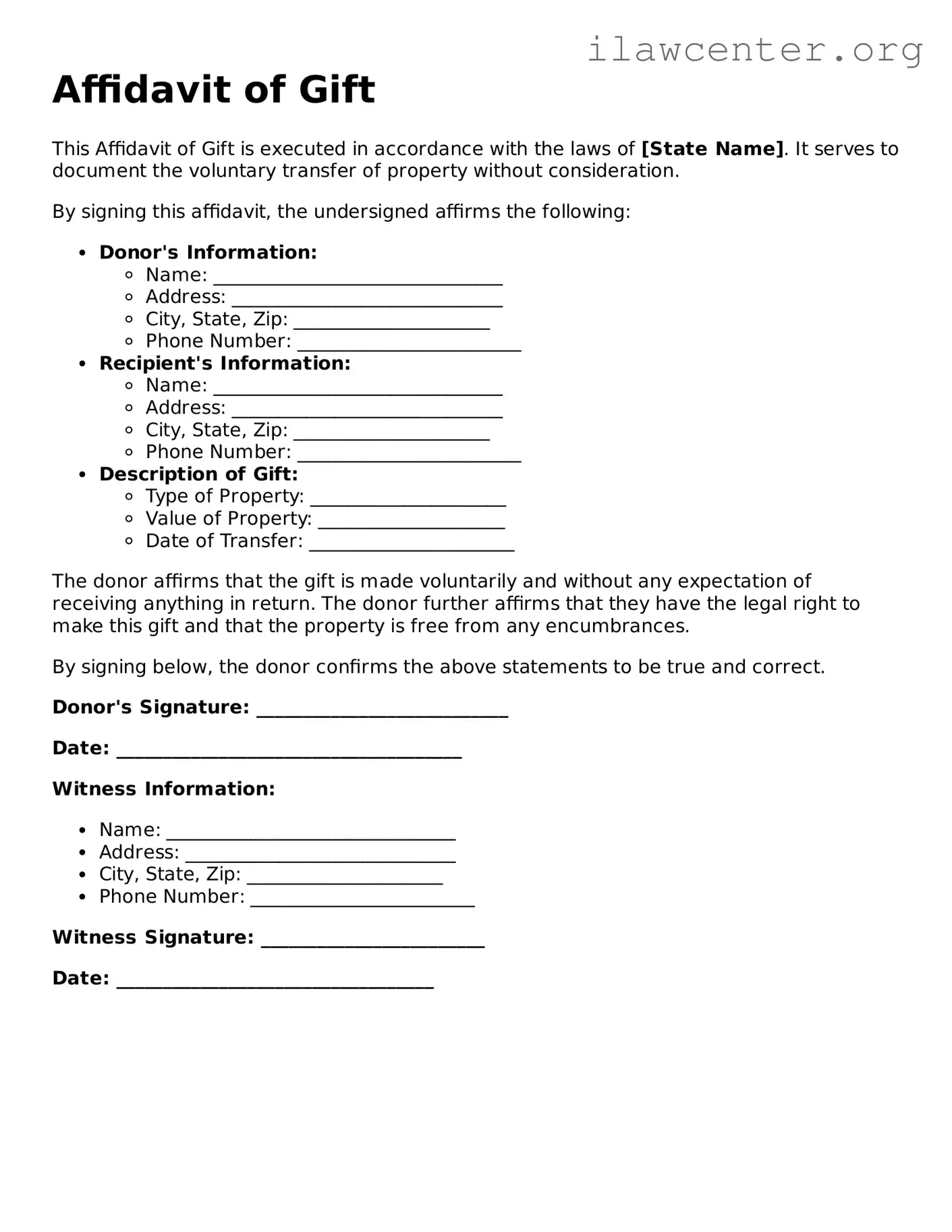
Affidavit of Gift

This Affidavit of Gift is executed in accordance with the laws of [State Name]. It serves to document the voluntary transfer of property without consideration.

By signing this affidavit, the undersigned affirms the following:

  • Donor's Information:
    • Name: _______________________________
    • Address: _____________________________
    • City, State, Zip: _____________________
    • Phone Number: ________________________
  • Recipient's Information:
    • Name: _______________________________
    • Address: _____________________________
    • City, State, Zip: _____________________
    • Phone Number: ________________________
  • Description of Gift:
    • Type of Property: _____________________
    • Value of Property: ____________________
    • Date of Transfer: ______________________

The donor affirms that the gift is made voluntarily and without any expectation of receiving anything in return. The donor further affirms that they have the legal right to make this gift and that the property is free from any encumbrances.

By signing below, the donor confirms the above statements to be true and correct.

Donor's Signature: ___________________________

Date: _____________________________________

Witness Information:

  • Name: _______________________________
  • Address: _____________________________
  • City, State, Zip: _____________________
  • Phone Number: ________________________

Witness Signature: ________________________

Date: __________________________________

PDF Form Characteristics

Fact Name Description
Definition An Affidavit of Gift form is a legal document used to declare a gift of property or assets from one person to another.
Purpose This form serves to provide evidence of the donor's intent and to clarify the transfer of ownership without expectation of compensation.
State-Specific Forms Different states may have their own versions of the Affidavit of Gift form, governed by local laws regarding property transfer.
Governing Law In many states, the Uniform Transfers to Minors Act (UTMA) or local property laws govern the use and validity of an Affidavit of Gift.

Instructions on Utilizing Affidavit of Gift

After you have obtained the Affidavit of Gift form, you are ready to fill it out. This document requires specific information that will help clarify the nature of the gift. Follow these steps carefully to ensure accuracy.

  1. Start with your personal information. Fill in your full name, address, and contact details at the top of the form.
  2. Next, provide the recipient's details. Include their full name, address, and any relevant identification information.
  3. Describe the gift. Clearly state what is being given, including any identifying details such as serial numbers or descriptions.
  4. Indicate the date of the gift. Specify the exact date when the transfer of ownership occurred.
  5. Sign the form. Your signature confirms that the information provided is accurate and that the gift is being made voluntarily.
  6. Have the form notarized. A notary public will verify your identity and witness your signature, adding an extra layer of authenticity.

Once you have completed the form, keep a copy for your records. Submit the original form to the appropriate authority or the recipient as required.

Important Facts about Affidavit of Gift

What is an Affidavit of Gift form?

An Affidavit of Gift form is a legal document used to declare that a gift has been made. This form is typically used when transferring ownership of property, such as real estate or vehicles, to another person without any expectation of payment or compensation. It serves as proof that the transfer was intended as a gift, which can be important for tax purposes and to clarify ownership rights.

Who needs to use an Affidavit of Gift form?

This form is generally used by individuals who are giving a gift of significant value to another person. Whether you are transferring property to a family member, friend, or charitable organization, an Affidavit of Gift can help document the transaction. It is especially important when the gift involves property that may require title transfer, such as cars or real estate.

What information is required on the Affidavit of Gift form?

The form typically requires the names and addresses of both the donor (the person giving the gift) and the recipient (the person receiving the gift). Additionally, a description of the property being gifted, including its value, should be included. The donor must also provide a statement affirming that the transfer is a gift and not a loan or sale. Signature and date lines for both parties are usually included to finalize the document.

Do I need a witness or notary for the Affidavit of Gift?

Are there tax implications associated with gifting property?

Yes, there can be tax implications when gifting property. The IRS has specific rules regarding gift taxes, which may apply if the value of the gift exceeds a certain threshold. As of 2023, gifts valued over $17,000 per recipient may require the donor to file a gift tax return. It is advisable to consult with a tax professional to understand the potential tax consequences of your gift.

How should I store the Affidavit of Gift once completed?

After completing the Affidavit of Gift, it is important to keep it in a safe place. Both the donor and recipient should retain copies of the signed document for their records. This will be useful for any future reference, especially if questions arise about the ownership of the gifted property or for tax purposes. Storing it with other important documents, such as wills or property deeds, is recommended.
Common mistakes

When completing the Affidavit of Gift form, individuals often overlook important details that can lead to complications. One common mistake is failing to provide accurate information about the donor and recipient. It is essential to ensure that names, addresses, and identification numbers are correct. Any discrepancies can cause delays or even invalidate the affidavit.

Another frequent error is neglecting to include a proper description of the gift. The form requires clear and specific details about what is being gifted. Vague descriptions can create confusion and may lead to disputes later on. Providing precise information helps to clarify the intent and nature of the gift.

Many people also forget to sign the affidavit in the appropriate places. Signatures are critical for the document's validity. Both the donor and the recipient should sign, and if applicable, witnesses must also provide their signatures. Omitting any required signatures can render the affidavit ineffective.

Additionally, individuals sometimes overlook the need for notarization. Depending on state laws, notarizing the affidavit may be necessary to ensure its legal standing. Failing to have the document notarized can result in challenges to its authenticity.

Finally, some individuals fail to keep copies of the completed affidavit. It is important to retain a copy for personal records. Without documentation, proving the gift's legitimacy can become difficult if questions arise in the future. Keeping a well-organized record helps to prevent misunderstandings.

Documents used along the form

The Affidavit of Gift form is an important document used to declare the transfer of property or assets as a gift. Along with this form, several other documents may be required to ensure the process is smooth and legally compliant. Below is a list of commonly used forms that often accompany the Affidavit of Gift.

  • Gift Tax Return (Form 709): This form is used to report gifts that exceed the annual exclusion amount. It helps the IRS track the total value of gifts made during the tax year and ensures compliance with tax regulations.
  • Deed of Gift: This document formally transfers ownership of real property or personal items from the donor to the recipient. It serves as a legal record of the gift and includes details about the property being transferred.
  • Bill of Sale: If the gift involves tangible personal property, a Bill of Sale may be necessary. This document outlines the transaction details and serves as proof of the transfer of ownership.
  • Letter of Intent: Although not always required, a Letter of Intent can clarify the donor's wishes regarding the gift. It provides context and can help prevent misunderstandings between the parties involved.

Understanding these accompanying documents can help streamline the gifting process. Each serves a specific purpose and together, they create a comprehensive record of the transaction. Always ensure that all necessary paperwork is completed accurately to avoid potential issues in the future.

Similar forms

  • Gift Letter: Similar to an Affidavit of Gift, a gift letter is a written statement from the donor confirming the intention to give a gift. It often includes details about the gift and the relationship between the donor and recipient.
  • Bill of Sale: A bill of sale serves as proof of transfer of ownership for personal property. Like the Affidavit of Gift, it documents the transaction and includes details about the item being transferred.
  • Deed of Gift: This document is used to formally transfer ownership of property without any exchange of money. It is akin to the Affidavit of Gift in that it emphasizes the donor's intention to give.
  • Donation Receipt: A donation receipt provides evidence of a charitable contribution. It shares similarities with the Affidavit of Gift by affirming that a gift has been made, often for tax purposes.
  • Trust Agreement: A trust agreement outlines how assets are managed for beneficiaries. It resembles the Affidavit of Gift in its focus on transferring assets, but it typically involves more complex arrangements.
  • Power of Attorney: A power of attorney allows someone to act on another's behalf. While it serves a different purpose, both documents involve the transfer of rights or property from one person to another.
  • Will: A will specifies how a person's assets will be distributed after death. Like the Affidavit of Gift, it addresses the transfer of property, though it takes effect upon the individual's passing.
  • Transfer on Death Deed: This deed allows property to pass directly to a beneficiary upon the owner’s death. It is similar to the Affidavit of Gift in that it facilitates the transfer of assets without going through probate.
  • Release of Claim: A release of claim document indicates that one party waives their right to make a claim against another. It can be related to gifts, as it may confirm that no further claims will be made regarding the gifted item.
  • Promissory Note: A promissory note is a written promise to pay a specific amount. While it typically involves a loan, it can be similar to an Affidavit of Gift if it documents a gift of money with repayment terms.

Dos and Don'ts

When filling out the Affidavit of Gift form, it's important to follow certain guidelines to ensure the process goes smoothly. Here are ten things you should and shouldn't do:

  • Do read the entire form carefully before starting.
  • Don't leave any required fields blank.
  • Do provide accurate and truthful information.
  • Don't use incorrect names or misspellings.
  • Do sign and date the form where indicated.
  • Don't forget to have a witness sign if required.
  • Do keep a copy of the completed form for your records.
  • Don't submit the form without reviewing it for errors.
  • Do ask for help if you're unsure about any part of the form.
  • Don't rush through the process; take your time to ensure accuracy.

Misconceptions

Understanding the Affidavit of Gift form can be crucial for many individuals, especially when it comes to gifting assets. However, there are several misconceptions that can lead to confusion. Below are some common misunderstandings about this important document.

  • Misconception 1: An Affidavit of Gift is only necessary for large gifts.
  • This is not true. An Affidavit of Gift can be used for any size gift, regardless of its value. It serves as a formal declaration of the gift, ensuring clarity and reducing potential disputes.

  • Misconception 2: The form is only required for gifts of real estate.
  • While many associate the form with real estate transactions, it is applicable to various types of gifts, including cash, personal property, and stocks. It is essential for documenting the transfer of ownership.

  • Misconception 3: You can fill out the form after the gift has been given.
  • It is advisable to complete the Affidavit of Gift before or at the time of the gift. This ensures that both parties are clear about the terms and helps prevent any misunderstandings later on.

  • Misconception 4: The Affidavit of Gift is a legally binding contract.
  • While the form does provide a declaration of the gift, it is not a contract in the traditional sense. It serves more as a proof of intent and can be used to support the legitimacy of the gift if questioned.

  • Misconception 5: Only the giver needs to sign the form.
  • Both the giver and the recipient should sign the Affidavit of Gift. This mutual acknowledgment helps confirm the transfer and can be important for tax purposes.

  • Misconception 6: The form is not necessary if the gift is made to a family member.
  • Even when gifting to family, using the Affidavit of Gift is a good practice. It formalizes the transaction and can help avoid potential disputes or misunderstandings in the future.

  • Misconception 7: You don’t need to keep a copy of the Affidavit of Gift.
  • It is crucial to retain a copy of the signed form for your records. This documentation can be beneficial for tax reporting and in the event of any future questions regarding the gift.

By addressing these misconceptions, individuals can approach the process of gifting with greater confidence and clarity. Understanding the purpose and importance of the Affidavit of Gift can lead to smoother transactions and fewer complications down the road.

Key takeaways

When it comes to the Affidavit of Gift form, understanding its purpose and proper usage is essential. Here are some key takeaways to keep in mind:

  • Purpose of the Form: The Affidavit of Gift is a legal document that certifies a gift was made without any expectation of repayment. It serves as proof of the transfer of ownership.
  • Who Should Use It: This form is typically used by individuals who are gifting property, money, or other assets to another person. It is important for both the giver and receiver to complete it accurately.
  • Information Required: Be prepared to provide details such as the names and addresses of both the giver and recipient, a description of the gift, and the date of the transfer.
  • Signature Requirements: The form must be signed by the giver, and in some cases, a witness may also be required to validate the gift.
  • Tax Implications: While the Affidavit of Gift itself does not incur taxes, large gifts may have tax implications for the giver. It’s wise to consult a tax professional for guidance.
  • Record Keeping: Once completed, keep a copy of the Affidavit of Gift for your records. This can be important for future reference or in case of disputes.

Filling out the Affidavit of Gift form correctly can help ensure a smooth transfer of ownership and protect both parties involved. Always double-check the information provided to avoid any potential issues down the line.