Fillable Affidavit of Identity Document

Fillable Affidavit of Identity Document

The Affidavit of Identity form is a legal document used to verify an individual's identity, often required in various legal and administrative processes. This form serves as a sworn statement, providing assurance to institutions or authorities that the person presenting it is indeed who they claim to be. To ensure a smooth process, consider filling out the form by clicking the button below.

Article Guide

The Affidavit of Identity form serves as a crucial document in various legal and administrative processes, providing a means for individuals to affirm their identity when it may be in question. This form is often utilized in situations such as applying for government-issued identification, verifying identity in court proceedings, or addressing discrepancies in personal records. By signing this affidavit, an individual asserts that the information provided is accurate and true to the best of their knowledge. The form typically requires personal details, including the individual’s full name, date of birth, and address, along with any supporting documentation that may be necessary to substantiate the claim of identity. It is important to note that the affidavit must be signed in the presence of a notary public, adding a layer of authenticity and legal weight to the declaration. Understanding the significance of this form can empower individuals to navigate identity-related challenges with confidence and clarity.

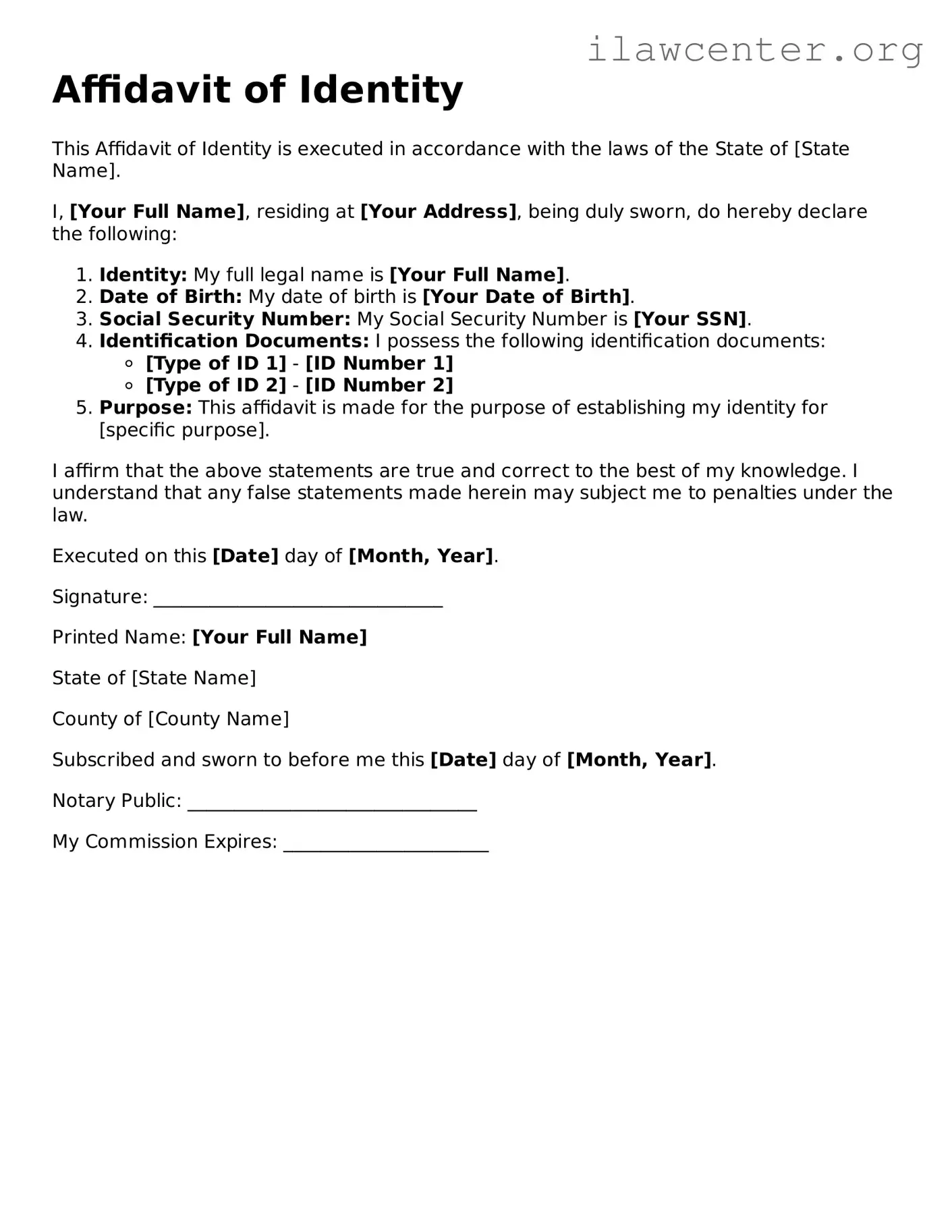
Affidavit of Identity Preview

Affidavit of Identity

This Affidavit of Identity is executed in accordance with the laws of the State of [State Name].

I, [Your Full Name], residing at [Your Address], being duly sworn, do hereby declare the following:

  1. Identity: My full legal name is [Your Full Name].
  2. Date of Birth: My date of birth is [Your Date of Birth].
  3. Social Security Number: My Social Security Number is [Your SSN].
  4. Identification Documents: I possess the following identification documents:
    • [Type of ID 1] - [ID Number 1]
    • [Type of ID 2] - [ID Number 2]
  5. Purpose: This affidavit is made for the purpose of establishing my identity for [specific purpose].

I affirm that the above statements are true and correct to the best of my knowledge. I understand that any false statements made herein may subject me to penalties under the law.

Executed on this [Date] day of [Month, Year].

Signature: _______________________________

Printed Name: [Your Full Name]

State of [State Name]

County of [County Name]

Subscribed and sworn to before me this [Date] day of [Month, Year].

Notary Public: _______________________________

My Commission Expires: ______________________

PDF Form Characteristics

Fact Name Description
Purpose The Affidavit of Identity form is used to verify a person's identity, often in situations where legal documentation is required.
State-Specific Forms Different states may have their own versions of the Affidavit of Identity, tailored to meet local requirements.
Governing Laws In many states, the use of an Affidavit of Identity is governed by local statutes that outline the necessary elements for validity.
Notarization Requirement Most states require that the Affidavit of Identity be notarized to ensure its authenticity and prevent fraud.

Instructions on Utilizing Affidavit of Identity

Once you have gathered the necessary information, you can begin filling out the Affidavit of Identity form. This document is essential for verifying your identity in various legal situations. It’s important to complete the form accurately to ensure that it serves its intended purpose without any complications.

  1. Begin by writing your full legal name in the designated space at the top of the form.
  2. Next, provide your current address, including the city, state, and ZIP code.
  3. Enter your date of birth in the specified format, typically MM/DD/YYYY.
  4. Fill in your Social Security number, if required, but be cautious about sharing sensitive information.
  5. Indicate any other names you have used, such as maiden names or aliases, if applicable.
  6. Provide a brief statement explaining the purpose of the affidavit.
  7. Sign the form in the designated area, ensuring that your signature matches the name you provided.
  8. Date the form on the line provided, usually next to your signature.
  9. Finally, if required, have the affidavit notarized by a certified notary public.

After completing the form, review it for any errors or omissions. Once everything is in order, you can submit it according to the instructions provided for your specific situation. Ensure that you keep a copy for your records.

Important Facts about Affidavit of Identity

What is an Affidavit of Identity?

An Affidavit of Identity is a legal document that verifies a person's identity. It is often used in situations where someone needs to prove who they are, such as when applying for a job, opening a bank account, or dealing with legal matters. This document typically includes the individual's name, address, date of birth, and sometimes a signature, along with a statement affirming that the information provided is true.

Who needs to complete an Affidavit of Identity?

Anyone who needs to confirm their identity for legal or official purposes may need to complete an Affidavit of Identity. This can include individuals applying for government documents, such as a passport or driver's license, or those involved in court proceedings. Additionally, businesses may require this affidavit from employees or clients to ensure compliance with identity verification processes.

How do I fill out an Affidavit of Identity?

To fill out an Affidavit of Identity, start by providing your personal information, including your full name, current address, and date of birth. It is important to ensure that all details are accurate and up-to-date. After completing the form, you will typically need to sign it in the presence of a notary public, who will witness your signature and add their seal to the document. This step helps to verify the authenticity of your identity declaration.

Is an Affidavit of Identity legally binding?

Yes, an Affidavit of Identity is considered a legally binding document. By signing it, you are affirming that the information you provided is true to the best of your knowledge. If someone were to provide false information, they could face legal consequences, such as charges of perjury. Therefore, it is crucial to be honest and accurate when completing this form.

Where can I obtain an Affidavit of Identity form?

You can often obtain an Affidavit of Identity form from various sources. Many state or local government websites provide downloadable versions of the form. Additionally, some legal offices or notary services may have the forms available. If you're unsure where to find one, consider consulting with a legal professional for guidance.

Common mistakes

Filling out the Affidavit of Identity form can be a straightforward process, but many people make common mistakes that can lead to delays or complications. Understanding these pitfalls can help ensure that your application is processed smoothly.

One frequent error occurs when individuals fail to provide complete information. Each section of the form is designed to capture specific details about your identity. Leaving any part blank can raise questions and cause your affidavit to be rejected. Always double-check that every required field is filled in before submitting.

Another mistake is using incorrect or outdated personal information. This includes names, addresses, or identification numbers. It’s crucial to ensure that the information matches your official documents. If there are discrepancies, it could lead to confusion or even legal issues down the line.

Many people also overlook the importance of signatures. The affidavit must be signed by the individual making the statement, and it may also require a witness or notary. Failing to include a signature or having an incorrect signature can invalidate the form. Take the time to ensure that all necessary signatures are present.

In addition, some individuals do not provide sufficient identification documentation. The affidavit typically requires you to submit copies of specific forms of ID. Not including these documents or providing ones that are not accepted can delay the process. Always check the requirements beforehand to avoid this mistake.

Another common issue arises when individuals rush through the form. Taking your time to read the instructions carefully can save you from making errors. Hasty mistakes can lead to omissions or misunderstandings that could have been easily avoided with a little more attention.

Lastly, many forget to keep a copy of the completed form. This can be a significant oversight. Having a copy allows you to reference what you submitted if there are any questions or follow-ups. It’s a simple step that can provide peace of mind.

By being aware of these seven mistakes, you can fill out the Affidavit of Identity form more effectively. Attention to detail and careful review can lead to a smoother process, helping you achieve your goals without unnecessary delays.

Documents used along the form

The Affidavit of Identity form serves as a critical document for individuals needing to verify their identity in various legal contexts. It is often accompanied by other forms and documents that complement its purpose and ensure a comprehensive approach to identity verification. Below are some commonly used documents that may accompany the Affidavit of Identity.

  • Government-Issued Identification: This includes documents such as a driver's license or passport. These forms of ID provide official proof of identity and are often required to validate the information provided in the affidavit.
  • Social Security Card: This card contains an individual's unique Social Security number. It is frequently requested to confirm identity and can be essential for various legal and financial transactions.
  • Proof of Residence: Documents such as utility bills or lease agreements can serve as proof of where an individual resides. This information can be critical in establishing identity and residency status in legal matters.
  • Birth Certificate: A birth certificate is an official document that records the birth of an individual. It is often used to verify identity and age, particularly in situations involving legal rights and responsibilities.

Understanding the significance of these documents in conjunction with the Affidavit of Identity can facilitate smoother processes in legal proceedings. Having these forms readily available can help ensure that identity verification is both accurate and efficient.

Similar forms

The Affidavit of Identity form is an important document used to verify a person's identity. There are several other documents that serve similar purposes. Here are ten documents that are comparable to the Affidavit of Identity:

  • Declaration of Identity: This document is a sworn statement that confirms a person's identity, often used in legal proceedings.
  • Identity Verification Letter: This letter is issued by a recognized authority to confirm a person's identity for various purposes.
  • Notarized Statement: A notarized statement serves as proof of identity, as it is signed in the presence of a notary public.
  • Certificate of Identity: This certificate is issued by government agencies to verify a person's identity, usually for travel or legal matters.
  • Identity Affidavit: Similar to the Affidavit of Identity, this document is a sworn statement affirming a person's identity.
  • Personal Identification Statement: This statement provides personal details to confirm identity, often used in financial transactions.
  • Proof of Identity Document: These documents, such as a driver's license or passport, serve as official proof of a person's identity.
  • Identity Confirmation Form: This form is used to collect information that verifies a person's identity for various applications.
  • Witness Statement: A witness statement can confirm a person's identity through the testimony of someone who knows them.
  • Application for Identification: This application is submitted to request an official identification document, verifying the applicant's identity.

Dos and Don'ts

When filling out the Affidavit of Identity form, it's essential to follow certain guidelines to ensure the process goes smoothly. Here are four things you should do and should not do:

  • Do: Provide accurate and truthful information.
  • Do: Review the form for any errors before submitting.
  • Do: Sign the affidavit in the presence of a notary public.
  • Do: Keep a copy of the completed form for your records.
  • Don't: Leave any sections of the form blank unless instructed.
  • Don't: Use white-out or erasers on the form.
  • Don't: Submit the form without a notary signature if required.
  • Don't: Provide false information, as this could lead to legal consequences.

Misconceptions

The Affidavit of Identity form is often misunderstood. Here are some common misconceptions about this important document:

  • It is only for legal issues. Many believe this form is only necessary in legal disputes. However, it can also be used for various purposes, such as verifying identity for financial transactions or government applications.
  • Anyone can fill it out. While the form may seem straightforward, it typically requires the signer to be of legal age and possess valid identification to ensure authenticity.
  • It does not need to be notarized. Some think notarization is optional. In most cases, a notary public must witness the signing to validate the document.
  • It is the same as a passport or ID. An Affidavit of Identity is not a substitute for official identification. It serves as a sworn statement confirming one's identity rather than a government-issued ID.
  • It can be used for any identity verification. This form is specific to certain situations. Not all institutions accept it for every type of identity verification.
  • It is a permanent record. Some people think once filed, it remains on record indefinitely. In reality, its validity may depend on the context in which it was used.
  • It is only needed once. Individuals may need to submit an Affidavit of Identity multiple times for different applications or situations, depending on requirements.
  • Filling it out incorrectly has no consequences. Errors in the form can lead to delays or rejections in the application process. Accuracy is crucial.

Key takeaways

When filling out and using the Affidavit of Identity form, consider the following key takeaways:

  1. Ensure that all personal information is accurate and up-to-date.
  2. Provide a clear and concise explanation of why the affidavit is needed.
  3. Include any relevant identification numbers, such as Social Security or driver's license numbers.
  4. Sign the affidavit in the presence of a notary public to validate the document.
  5. Keep copies of the completed affidavit for your records.
  6. Be aware of the specific requirements in your state regarding the use of affidavits.
  7. Submit the affidavit to the appropriate agency or organization as required.
  8. Use clear language to avoid confusion about your identity.
  9. Consider seeking legal advice if you are unsure about any part of the process.
  10. Act promptly to ensure that your affidavit is processed in a timely manner.

By following these guidelines, you can effectively complete and utilize the Affidavit of Identity form.