Fillable Affidavit of Residency Document

Fillable Affidavit of Residency Document

The Affidavit of Residency is a legal document that verifies an individual’s residence at a specific address. This form is often required for various purposes, such as enrolling in schools or applying for government benefits. If you need to complete this important document, click the button below to get started.

Article Guide

The Affidavit of Residency form plays an important role in various legal and administrative processes. This document serves as a written statement where an individual confirms their current address, often under oath. It is commonly used in situations such as enrolling children in school, applying for certain government benefits, or verifying residency for legal matters. The form typically requires personal details, including the individual's name, address, and the length of time they have lived at that address. Additionally, it may ask for the signatures of witnesses or notaries to validate the information provided. Understanding the purpose and requirements of the Affidavit of Residency form can help individuals navigate situations where proof of residency is necessary.

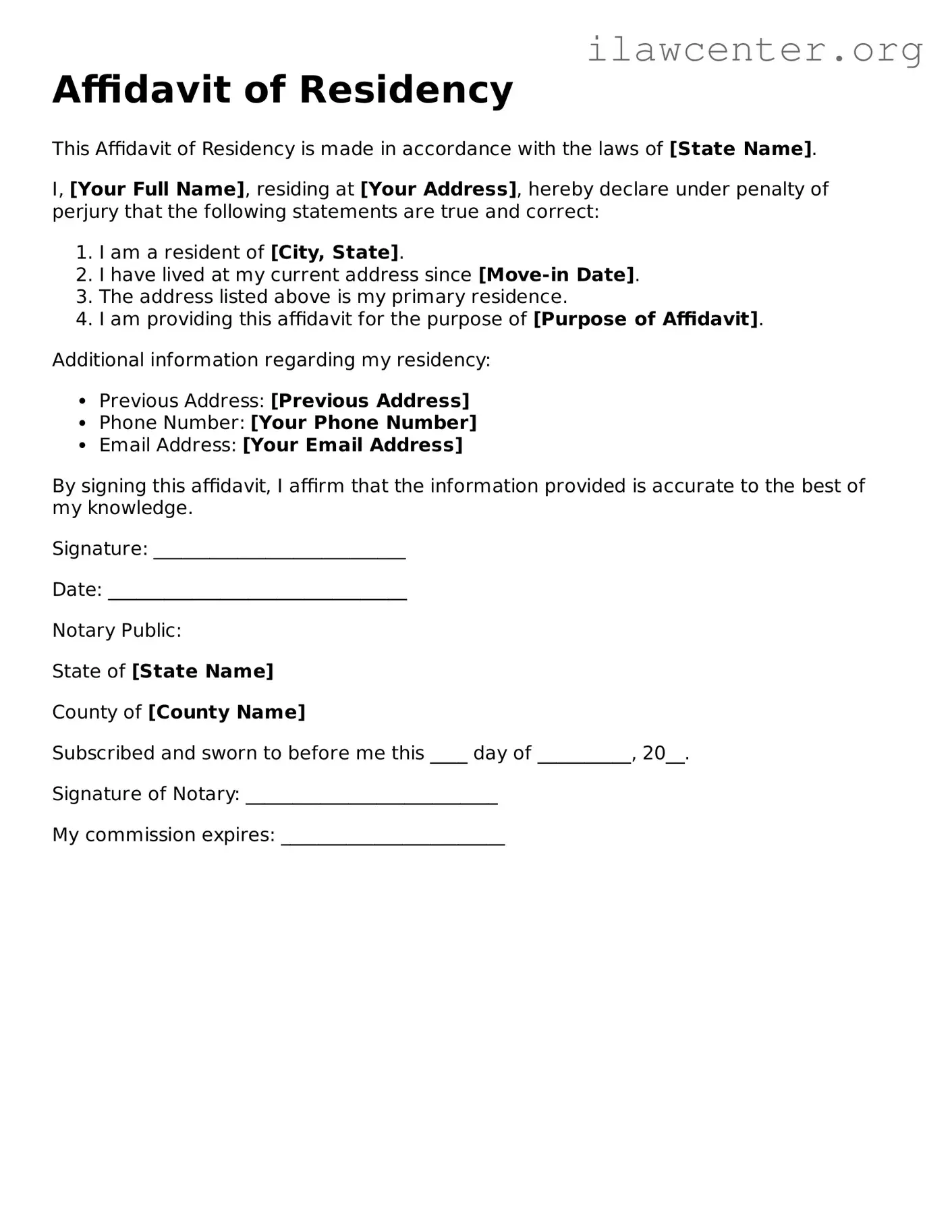
Affidavit of Residency Preview

Affidavit of Residency

This Affidavit of Residency is made in accordance with the laws of [State Name].

I, [Your Full Name], residing at [Your Address], hereby declare under penalty of perjury that the following statements are true and correct:

  1. I am a resident of [City, State].
  2. I have lived at my current address since [Move-in Date].
  3. The address listed above is my primary residence.
  4. I am providing this affidavit for the purpose of [Purpose of Affidavit].

Additional information regarding my residency:

  • Previous Address: [Previous Address]
  • Phone Number: [Your Phone Number]
  • Email Address: [Your Email Address]

By signing this affidavit, I affirm that the information provided is accurate to the best of my knowledge.

Signature: ___________________________

Date: ________________________________

Notary Public:

State of [State Name]

County of [County Name]

Subscribed and sworn to before me this ____ day of __________, 20__.

Signature of Notary: ___________________________

My commission expires: ________________________

PDF Form Characteristics

Fact Name Description
Purpose The Affidavit of Residency form is used to verify a person's residence for various legal or administrative purposes.
State-Specific Forms Different states may have their own versions of the Affidavit of Residency, each tailored to local requirements.
Governing Laws The use of the Affidavit of Residency is governed by state laws, which can vary significantly. For example, in California, it falls under Family Code Section 7600.
Notarization Most states require the affidavit to be notarized to ensure its authenticity and validity.

Instructions on Utilizing Affidavit of Residency

Completing the Affidavit of Residency form is an important step in establishing your residency status. After filling out the form, you will need to submit it to the appropriate authority or organization as required. Ensure that all information is accurate and complete before submission.

  1. Begin by downloading the Affidavit of Residency form from the official website or obtaining a physical copy from the relevant office.
  2. Read the instructions carefully to understand what information is required.
  3. Fill in your full name in the designated section at the top of the form.
  4. Provide your current address, including street number, street name, city, state, and ZIP code.
  5. Indicate the length of time you have lived at this address.
  6. Include any previous addresses if required by the form.
  7. Sign and date the form at the bottom to certify that the information provided is true and accurate.
  8. Have the form notarized if required, by presenting it to a notary public.
  9. Make a copy of the completed form for your records before submitting it.
  10. Submit the original Affidavit of Residency form to the designated authority or organization.

Important Facts about Affidavit of Residency

What is an Affidavit of Residency?

An Affidavit of Residency is a legal document that confirms a person's residence at a specific address. It is often used for various purposes, such as enrolling children in school, applying for government assistance, or verifying residency for legal matters. This document is typically signed under oath, meaning the person swearing to the information must affirm that it is true to the best of their knowledge.

Who needs to fill out an Affidavit of Residency?

Individuals who need to prove their residency may be required to fill out this form. Common situations include parents enrolling their children in a school district, individuals applying for state benefits, or those involved in legal proceedings where residency is a factor. If you are asked to provide proof of where you live, this form may be necessary.

What information is typically included in the Affidavit of Residency?

The Affidavit of Residency usually includes the individual's name, the address where they reside, and a statement affirming that the information is accurate. Additional details, such as how long the individual has lived at that address, may also be required. In some cases, the form may need to be notarized to confirm its authenticity.

How do I complete the Affidavit of Residency?

To complete the form, start by providing your personal information, including your full name and current address. Next, write a statement affirming that you reside at the address mentioned. After filling out the form, sign it in the presence of a notary public if required. Notarization adds an extra layer of verification to your claim of residency.

Is there a fee associated with obtaining an Affidavit of Residency?

Generally, there is no fee to complete the Affidavit of Residency itself, as it is often a standard form provided by schools or government agencies. However, if you need to have the document notarized, there may be a small fee for that service. Notary fees can vary, so it’s a good idea to check with local notaries for their rates.

Can I use the Affidavit of Residency for multiple purposes?

Yes, the Affidavit of Residency can often be used for various purposes, but it’s important to check the specific requirements of the institution or agency requesting it. Some schools or organizations may have their own forms or additional requirements, so always verify that your affidavit meets their standards before submission.

What should I do if my residency changes after submitting the Affidavit?

If your residency changes after you have submitted the Affidavit of Residency, you should inform any relevant parties immediately. This could include schools, government agencies, or legal representatives. Depending on the situation, you may need to fill out a new affidavit to reflect your current address and residency status.
Common mistakes

Filling out the Affidavit of Residency form can seem straightforward, but many individuals make common mistakes that can lead to delays or rejections. One significant error is providing inaccurate personal information. For instance, if a person lists an incorrect address or misspells their name, it can create confusion and complicate the verification process. Always double-check that the information matches official documents.

Another frequent mistake involves omitting required signatures. The form typically requires signatures from both the affiant and a witness. Forgetting to sign or having an unqualified witness can invalidate the affidavit. It is crucial to read the instructions carefully and ensure all necessary parties have signed before submission.

Many people also fail to provide sufficient proof of residency. Supporting documents such as utility bills, lease agreements, or bank statements are often required. Submitting the affidavit without these documents can lead to denial. Always attach the necessary evidence that clearly shows residency at the listed address.

Lastly, individuals sometimes submit the form without understanding the legal implications. An affidavit is a sworn statement, and providing false information can lead to serious consequences. It is essential to be honest and thorough when completing the form. Understanding the responsibilities involved can prevent future legal issues.

Documents used along the form

When completing the Affidavit of Residency form, there are several other documents that may be required or helpful to support your claim of residency. Each of these documents serves a unique purpose and can provide additional evidence of your living situation. Below is a list of common forms and documents often used alongside the Affidavit of Residency.

  • Utility Bill: A recent utility bill, such as electricity, water, or gas, can show your name and address, confirming your residency.
  • Lease Agreement: A copy of your lease agreement outlines the terms of your rental and provides proof of your residence at a specific address.
  • Government-Issued ID: An identification card, such as a driver's license or state ID, typically includes your current address and confirms your identity.
  • Bank Statement: A bank statement with your name and address can serve as additional verification of your residency.
  • Tax Documents: Recent tax returns or documents can establish your residency status and may be required for certain applications.
  • Voter Registration: Proof of voter registration can demonstrate your residency and intent to reside in a particular location.
  • Affidavit from a Neighbor: A signed statement from a neighbor confirming your residency can be helpful, especially if other documents are lacking.

Having these documents ready can help streamline the process and provide a clearer picture of your residency situation. It is important to ensure that all documents are current and accurately reflect your living circumstances.

Similar forms

  • Lease Agreement: This document outlines the terms between a landlord and tenant, establishing residency at a specific address.
  • Utility Bill: A recent utility bill can serve as proof of residency, showing the individual's name and address, similar to an affidavit.
  • Bank Statement: A bank statement with the individual's name and address can confirm residency, much like an affidavit of residency.
  • Government-Issued ID: An ID that includes the individual's current address can verify residency status, paralleling the purpose of an affidavit.
  • Voter Registration: This document indicates where a person is registered to vote and can serve as proof of residency, similar to an affidavit.
  • Tax Return: A tax return showing the individual's address can be used to establish residency, akin to the affidavit's intent.
  • Employment Records: Documents from an employer that include the individual's address can also confirm residency, functioning similarly to an affidavit.

Dos and Don'ts

When completing the Affidavit of Residency form, it is important to follow specific guidelines to ensure accuracy and compliance. Here are five things you should and shouldn't do:

  • Do provide accurate and truthful information.
  • Do sign and date the form where required.
  • Do double-check your contact information for errors.
  • Don't leave any required fields blank.
  • Don't submit the form without reviewing it for clarity.

Misconceptions

The Affidavit of Residency form is often misunderstood. Here are nine common misconceptions about this important document:

  1. Only homeowners can use it. Many believe that only individuals who own their homes can complete an Affidavit of Residency. In reality, renters and those living with family or friends can also use this form to verify their residency.
  2. It is only needed for school enrollment. While this form is frequently required for enrolling children in school, it can also serve other purposes, such as applying for government benefits or securing a driver's license.
  3. The form must be notarized. Some think that notarization is mandatory for the Affidavit of Residency. However, notarization is not always required, though it may add credibility in certain situations.
  4. Anyone can complete it on behalf of another. It is a common belief that any adult can fill out the form for someone else. However, the person claiming residency should personally complete and sign the affidavit to ensure accuracy.
  5. It is a permanent document. Many assume that once the affidavit is submitted, it remains valid indefinitely. In truth, the affidavit may need to be updated if there are changes in residency status.
  6. It guarantees acceptance. Some individuals think that submitting the affidavit guarantees acceptance for services or programs. Acceptance is ultimately at the discretion of the organization reviewing the document.
  7. Only specific formats are accepted. There is a misconception that only a specific version of the Affidavit of Residency form is valid. Most organizations will accept a properly completed affidavit as long as it meets their requirements.
  8. It can be submitted without proof of residency. Many believe that the affidavit alone suffices. However, supporting documents, such as utility bills or lease agreements, are often required to verify residency.
  9. It is not legally binding. Some think that the affidavit holds no legal weight. In fact, it is a sworn statement, and providing false information can lead to legal consequences.

Understanding these misconceptions can help individuals navigate the requirements and ensure they complete the Affidavit of Residency correctly.

Key takeaways

When filling out and using the Affidavit of Residency form, it's essential to keep a few key points in mind. Understanding these can help ensure that the process goes smoothly and that the document serves its intended purpose.

  • Accuracy is Crucial: Ensure that all information provided is correct and up to date. Errors can lead to delays or complications.
  • Signatures Matter: The affidavit must be signed by the person affirming their residency. If applicable, a witness or notary may also need to sign.
  • Document Requirements: Check if any additional documents are required to support your claim of residency, such as utility bills or lease agreements.
  • Submission Process: Understand where and how to submit the completed affidavit. Different institutions may have specific requirements for submission.