Fillable Affidavit of Service Document

Fillable Affidavit of Service Document

The Affidavit of Service is a legal document that confirms a party has properly delivered court documents to another party. This form serves as proof that the necessary paperwork has reached the intended recipient, ensuring that all parties are informed and can participate in legal proceedings. To get started on filling out the form, click the button below.

Article Guide

The Affidavit of Service form is a crucial document in the legal process, serving as proof that a particular legal document has been delivered to the appropriate party. This form is typically used in various legal contexts, such as court cases, eviction notices, and other formal proceedings where notification is required. It outlines essential details including the date and time of service, the method of delivery—whether it was personal, by mail, or through a process server—and the identity of the individual who received the documents. In many cases, the person serving the documents must also include a statement affirming that the information provided is accurate and truthful. This affidavit not only helps ensure that all parties are informed but also protects the rights of those involved by providing a verifiable record of service. Understanding the components and significance of the Affidavit of Service can help individuals navigate the often complex landscape of legal requirements with confidence.

Affidavit of Service Preview

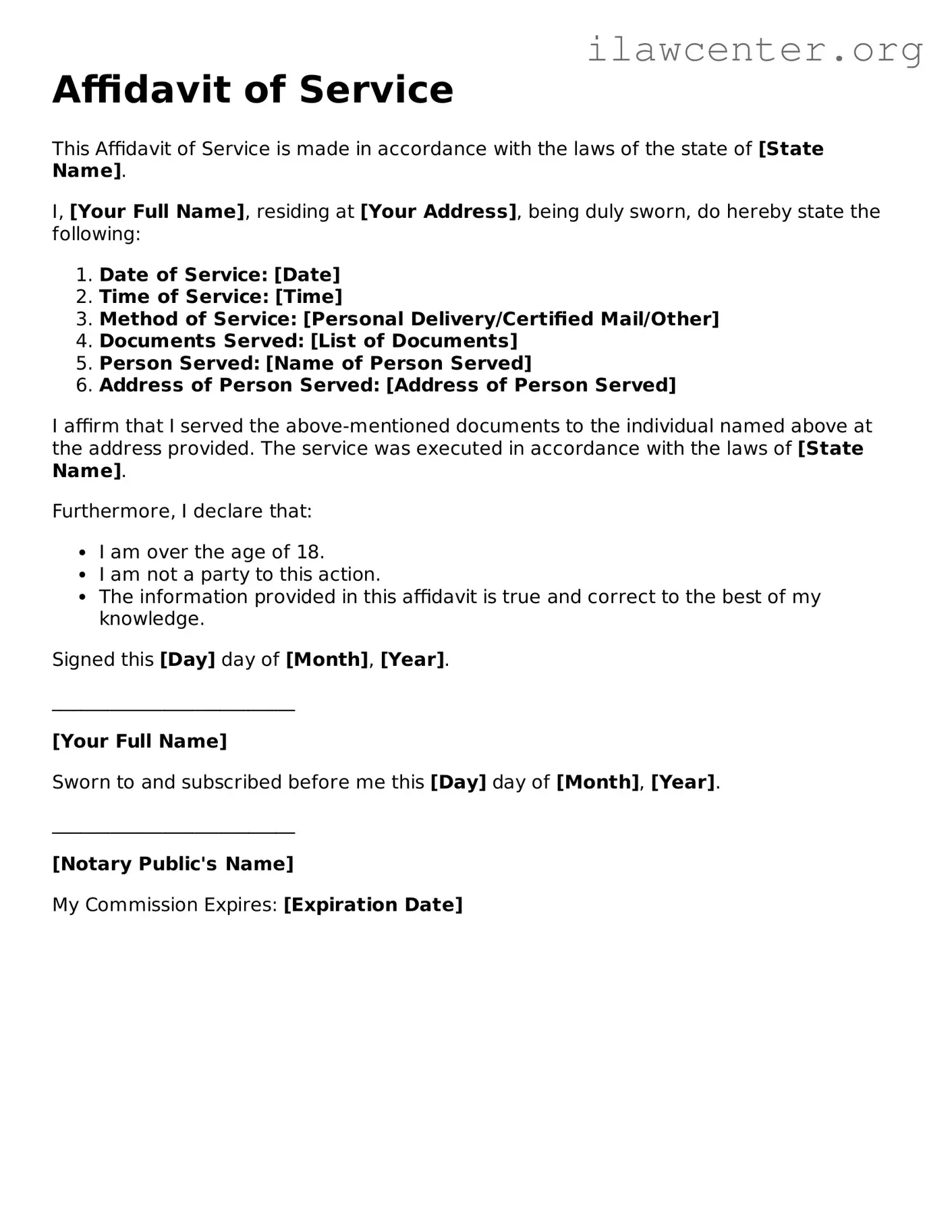
Affidavit of Service

This Affidavit of Service is made in accordance with the laws of the state of [State Name].

I, [Your Full Name], residing at [Your Address], being duly sworn, do hereby state the following:

  1. Date of Service: [Date]
  2. Time of Service: [Time]
  3. Method of Service: [Personal Delivery/Certified Mail/Other]
  4. Documents Served: [List of Documents]
  5. Person Served: [Name of Person Served]
  6. Address of Person Served: [Address of Person Served]

I affirm that I served the above-mentioned documents to the individual named above at the address provided. The service was executed in accordance with the laws of [State Name].

Furthermore, I declare that:

  • I am over the age of 18.
  • I am not a party to this action.
  • The information provided in this affidavit is true and correct to the best of my knowledge.

Signed this [Day] day of [Month], [Year].

__________________________

[Your Full Name]

Sworn to and subscribed before me this [Day] day of [Month], [Year].

__________________________

[Notary Public's Name]

My Commission Expires: [Expiration Date]

PDF Form Characteristics

Fact Name Description
Definition An Affidavit of Service is a legal document that confirms that a specific document has been delivered to a party involved in a legal proceeding.
Purpose The primary purpose is to provide proof that a party has received legal documents, ensuring that due process is followed.
Common Uses This form is commonly used in court cases, including divorce, eviction, and civil lawsuits.
Governing Laws Each state has its own rules regarding service of process. For example, in California, it is governed by the California Code of Civil Procedure, Section 415.
Who Can Serve Typically, a non-party individual over the age of 18 can serve the documents and complete the Affidavit of Service.
Filing Requirements After completing the affidavit, it must be filed with the court to confirm that service has been properly executed.

Instructions on Utilizing Affidavit of Service

Once you have the Affidavit of Service form ready, you'll need to fill it out accurately to ensure it meets all necessary requirements. This form is essential for confirming that legal documents have been delivered properly. Follow these steps to complete the form correctly.

  1. Begin by entering the name of the person who served the documents in the designated space.
  2. Next, provide the date when the service took place. Be specific and accurate.
  3. Indicate the method of service used, such as personal delivery or mail.
  4. Fill in the name and address of the individual or entity that received the documents.
  5. In the appropriate section, include a brief description of the documents that were served.
  6. Sign the affidavit to confirm that the information provided is true and accurate.
  7. Date your signature to complete the affidavit.

After completing the form, make sure to keep a copy for your records. You may need to file the affidavit with the court or provide it to the other party involved in the case. Ensure that all details are clear and legible to avoid any issues.

Important Facts about Affidavit of Service

What is an Affidavit of Service?

An Affidavit of Service is a legal document that confirms that a specific legal document has been delivered to a party involved in a legal proceeding. This affidavit serves as proof that the service of process was completed in accordance with the law.

Why is an Affidavit of Service important?

The Affidavit of Service is crucial because it provides evidence that a party has been properly notified of legal actions against them. This ensures that the legal process is fair and that all parties have an opportunity to respond.

Who can complete an Affidavit of Service?

Typically, the person who delivers the legal documents must complete the Affidavit of Service. This individual can be a process server, a sheriff, or any adult who is not involved in the case. It's important that the server is impartial and can provide accurate information about the service.

What information is included in an Affidavit of Service?

An Affidavit of Service generally includes details such as the name of the person served, the date and time of service, the method of service, and the location where the documents were delivered. Additionally, the affidavit should contain the signature of the person who performed the service, along with a notary's acknowledgment if required.

How do I file an Affidavit of Service?

To file an Affidavit of Service, you should submit the completed document to the court where the legal action is pending. Some jurisdictions may allow electronic filing, while others may require a physical submission. Be sure to check the specific requirements for your local court.

Can an Affidavit of Service be contested?

Yes, an Affidavit of Service can be contested. If the party who was served believes that the service was not completed properly or that they were not given proper notice, they can challenge the affidavit in court. This may involve providing evidence to support their claims.

What happens if an Affidavit of Service is not filed?

If an Affidavit of Service is not filed, it may result in delays in the legal process. The court may dismiss the case or rule in favor of the party who was not properly served. It is essential to file the affidavit to ensure that the legal proceedings can move forward without complications.

Is there a deadline for filing an Affidavit of Service?

Yes, there is typically a deadline for filing an Affidavit of Service, which varies by jurisdiction. It is important to check local rules to ensure that the affidavit is filed within the required timeframe, as failing to do so may impact the case.

Can I use a template for an Affidavit of Service?

Using a template for an Affidavit of Service can be helpful, but it is important to ensure that the template complies with the specific legal requirements of your jurisdiction. Customizing the template to fit the details of your case is also necessary to maintain accuracy.

What should I do if I lose the Affidavit of Service?

If the Affidavit of Service is lost, it is advisable to contact the person who served the documents. They may be able to provide a copy or complete a new affidavit. If necessary, consult with legal counsel to determine the best course of action to address the loss.
Common mistakes

Filling out the Affidavit of Service form correctly is crucial. Many people make mistakes that can delay their case or even lead to its dismissal. One common error is failing to include all necessary details about the person being served. This includes their full name, address, and any other identifying information. Omitting these details can create confusion and undermine the validity of the affidavit.

Another frequent mistake is not providing accurate information about the method of service. Whether the documents were delivered in person, sent via certified mail, or served by a process server, it is essential to specify this clearly. Inaccurate descriptions can raise questions about the legitimacy of the service.

People often forget to date the affidavit. This may seem minor, but a missing date can lead to complications. The date serves as a record of when the service occurred, which is critical for establishing timelines in legal proceedings.

Signature errors are also common. The affidavit must be signed by the person who completed the service. If someone else signs it, or if the signature is missing, the affidavit could be deemed invalid. Always ensure that the correct individual signs the document.

Another mistake is failing to have the affidavit notarized when required. Some jurisdictions mandate that affidavits be notarized to be considered valid. Skipping this step can render the document ineffective in court.

Lastly, individuals sometimes submit the affidavit without making copies. It’s important to keep a copy for personal records and to provide one to the court. Not having a record of what was submitted can complicate matters later on.

Documents used along the form

The Affidavit of Service form is a crucial document in legal proceedings, as it verifies that legal papers have been delivered to the appropriate parties. However, there are several other forms and documents that often accompany it, each serving a specific purpose in the legal process. Below is a list of these documents, along with a brief description of each.

  • Summons: A legal document that notifies a defendant of a lawsuit and compels them to respond to the claims made against them.
  • Complaint: This document outlines the plaintiff's case, detailing the facts and legal reasons for the lawsuit.
  • Proof of Service: A document that provides evidence that the Affidavit of Service has been properly executed, often including details about the service process.
  • Notice of Appearance: A form filed by an attorney to indicate their representation of a party in a legal proceeding.
  • Motion: A formal request made to the court for a specific ruling or order related to the case.
  • Response: A document filed by the defendant addressing the claims made in the complaint, often including defenses or counterclaims.
  • Exhibits: Supporting documents or evidence attached to pleadings or motions to strengthen a party's position.
  • Order: A directive issued by a judge that outlines specific actions that must be taken by the parties involved in the case.
  • Settlement Agreement: A document that outlines the terms agreed upon by the parties to resolve the dispute without going to trial.

These documents work together to ensure that the legal process runs smoothly and that all parties are properly informed and represented. Understanding each form's role can help individuals navigate the complexities of legal proceedings more effectively.

Similar forms

  • Proof of Service: This document serves as evidence that legal documents were delivered to a party. Like the Affidavit of Service, it confirms the date and method of delivery.
  • Certificate of Service: Similar to the Affidavit of Service, this certificate indicates that a party has served documents to another party. It often includes the details of the service.
  • Return of Service: This document is completed by the process server and details how and when the service was executed. It is akin to the Affidavit of Service in providing verification of service.
  • Service of Process Document: This document outlines the procedure followed for serving legal documents. It shares similarities with the Affidavit of Service in its purpose to document the service process.
  • Notice of Service: This notice informs parties that legal documents have been served. It parallels the Affidavit of Service by confirming that service has taken place.
  • Statement of Service: This statement provides details about the service of legal documents. It functions similarly to the Affidavit of Service in affirming that service was completed.
  • Service Acknowledgment: This document is signed by the recipient to acknowledge receipt of documents. It is similar to the Affidavit of Service in that it confirms delivery to the intended party.

Dos and Don'ts

When filling out the Affidavit of Service form, attention to detail is crucial. Here are some important dos and don'ts to keep in mind:

  • Do ensure that all information is accurate and complete.
  • Do sign the affidavit in the presence of a notary public.
  • Do keep a copy of the completed affidavit for your records.
  • Don't leave any sections blank; fill in all required fields.
  • Don't use white-out or any correction fluid on the form.
  • Don't forget to file the affidavit with the appropriate court or agency.

Misconceptions

The Affidavit of Service form is an important document in legal proceedings. However, several misconceptions exist regarding its purpose and usage. Below is a list of common misconceptions along with clarifications.

  • It is not necessary to file an Affidavit of Service. Many believe that this document is optional. In reality, it is often required to prove that legal documents were properly served to the involved parties.
  • Anyone can serve documents and complete the Affidavit of Service. While it may seem that anyone can deliver documents, many jurisdictions require that the server be a disinterested party, meaning they cannot have a stake in the case.
  • The Affidavit of Service guarantees that the recipient received the documents. This form serves as proof of service but does not guarantee that the recipient read or understood the documents. It only confirms that the documents were delivered.
  • Filing the Affidavit of Service is the last step in the service process. Some may think that once the affidavit is filed, the service process is complete. However, the court may require additional steps or documentation depending on the case.
  • There is a standard format for the Affidavit of Service. While many jurisdictions have guidelines, the format can vary. It is essential to check local rules to ensure compliance with specific requirements.
  • Once signed, the Affidavit of Service cannot be changed. Although the affidavit is a sworn statement, if an error is discovered, it can often be amended or corrected through proper legal channels.

Understanding these misconceptions can help individuals navigate the legal process more effectively.

Key takeaways

Filling out and using the Affidavit of Service form is an important step in the legal process. Here are some key takeaways to keep in mind:

  • The Affidavit of Service serves as proof that legal documents have been delivered to the intended recipient.
  • Ensure all information is accurate, including names, addresses, and dates of service.
  • The form must be signed by the person who completed the service, affirming that the information provided is true.
  • It is essential to file the affidavit with the court to demonstrate compliance with service requirements.
  • Keep a copy of the affidavit for your records, as it may be needed for future reference.
  • Filing deadlines may vary by jurisdiction, so be aware of the specific requirements in your area.