Attorney-Verified  Employee Handbook Document for Alabama

Attorney-Verified Employee Handbook Document for Alabama

The Alabama Employee Handbook form serves as a vital document that outlines workplace policies, procedures, and employee rights within an organization. This handbook not only informs employees about company expectations but also ensures compliance with state and federal regulations. To get started on creating your handbook, click the button below to fill out the form.

Article Guide

Creating a comprehensive employee handbook is essential for any business in Alabama, as it serves as a vital resource for both employers and employees. This handbook outlines key policies, procedures, and expectations that guide workplace behavior and promote a positive work environment. It typically includes sections on workplace conduct, attendance policies, and anti-discrimination measures, ensuring that all employees understand their rights and responsibilities. Additionally, the handbook often addresses topics such as compensation, benefits, and leave policies, providing clarity on what employees can expect from their employer. By offering clear guidelines, the Alabama Employee Handbook form helps to foster transparency and accountability within the workplace, ultimately contributing to a more harmonious and productive atmosphere. With the right information in place, both new hires and seasoned employees can navigate their roles with confidence and understanding.

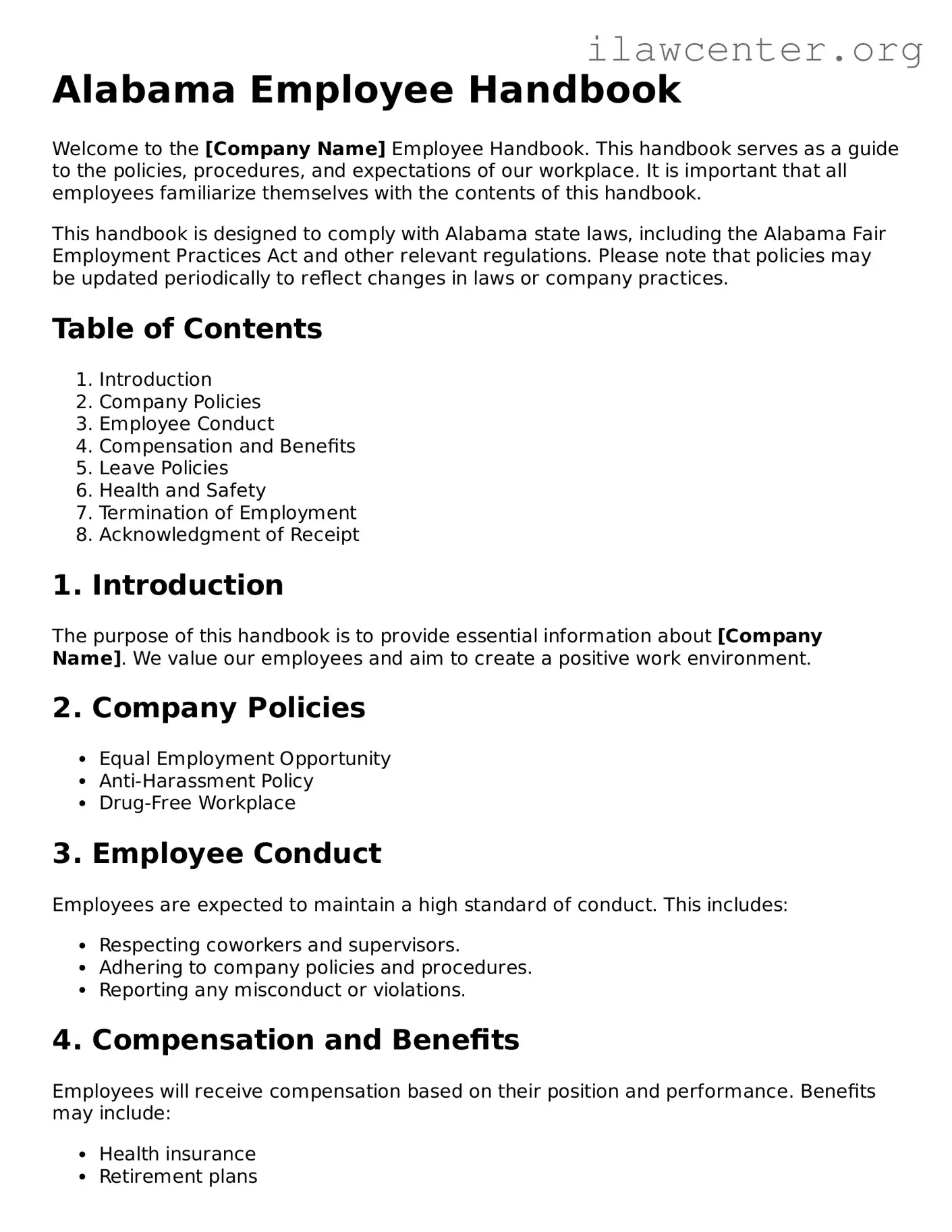
Alabama Employee Handbook Preview

Alabama Employee Handbook

Welcome to the [Company Name] Employee Handbook. This handbook serves as a guide to the policies, procedures, and expectations of our workplace. It is important that all employees familiarize themselves with the contents of this handbook.

This handbook is designed to comply with Alabama state laws, including the Alabama Fair Employment Practices Act and other relevant regulations. Please note that policies may be updated periodically to reflect changes in laws or company practices.

Table of Contents

  1. Introduction
  2. Company Policies
  3. Employee Conduct
  4. Compensation and Benefits
  5. Leave Policies
  6. Health and Safety
  7. Termination of Employment
  8. Acknowledgment of Receipt

1. Introduction

The purpose of this handbook is to provide essential information about [Company Name]. We value our employees and aim to create a positive work environment.

2. Company Policies

  • Equal Employment Opportunity
  • Anti-Harassment Policy
  • Drug-Free Workplace

3. Employee Conduct

Employees are expected to maintain a high standard of conduct. This includes:

  • Respecting coworkers and supervisors.
  • Adhering to company policies and procedures.
  • Reporting any misconduct or violations.

4. Compensation and Benefits

Employees will receive compensation based on their position and performance. Benefits may include:

  • Health insurance
  • Retirement plans
  • Paid time off

5. Leave Policies

Employees are entitled to various types of leave, including:

  • Sick leave
  • Vacation leave
  • Family and Medical Leave

6. Health and Safety

Maintaining a safe workplace is a priority. Employees should:

  • Report unsafe conditions immediately.
  • Follow safety protocols at all times.

7. Termination of Employment

Termination may occur due to various reasons, including:

  • Voluntary resignation
  • Involuntary termination for cause
  • Layoffs due to business needs

8. Acknowledgment of Receipt

All employees must sign an acknowledgment form indicating that they have received and understood the Employee Handbook. This form will be kept in your personnel file.

By working at [Company Name], you agree to comply with the policies outlined in this handbook. If you have any questions, please contact your supervisor or the HR department.
PDF Form Characteristics

Fact Name Description
Purpose The Alabama Employee Handbook serves as a guide for employees, outlining company policies, procedures, and expectations.
Governing Laws It is governed by Alabama state employment laws, including the Alabama Wage and Hour Law and the Alabama Workers' Compensation Act.
Mandatory Inclusions Employers are encouraged to include policies on anti-discrimination, harassment, and workplace safety.
Employee Acknowledgment Employees should sign an acknowledgment form to confirm they have received and understood the handbook.
Updates The handbook should be reviewed regularly and updated as necessary to reflect changes in laws or company policies.
Legal Protection A well-crafted employee handbook can provide legal protection for employers by clearly outlining policies and procedures.

Instructions on Utilizing Alabama Employee Handbook

To complete the Alabama Employee Handbook form, follow the steps outlined below. Each step will guide you through the necessary fields to ensure accurate submission. Make sure to have all required information on hand before you begin.

  1. Begin by entering your full name in the designated field.
  2. Provide your employee identification number, if applicable.
  3. Fill in your job title and department.
  4. Indicate your start date with the company.
  5. Review the company policies outlined in the handbook.
  6. Sign and date the form to confirm your understanding and acceptance of the policies.
  7. Submit the completed form to your HR department or designated supervisor.

Important Facts about Alabama Employee Handbook

What is the Alabama Employee Handbook form?

The Alabama Employee Handbook form is a vital document that outlines the policies, procedures, and expectations of an employer regarding their employees. This handbook serves as a guide for employees, detailing everything from workplace conduct to benefits and disciplinary actions. It helps ensure that everyone is on the same page and understands their rights and responsibilities within the organization.

Why is it important to have an Employee Handbook?

An Employee Handbook is crucial for several reasons. It not only sets clear expectations for employee behavior and performance but also protects the employer from potential legal issues. By providing a written record of policies, the handbook helps to establish consistency in how rules are applied. Additionally, it can enhance communication within the workplace, making it easier for employees to understand their roles and the company’s culture.

Who should create the Employee Handbook?

How often should the Employee Handbook be updated?

What should be included in the Alabama Employee Handbook?

Common mistakes

Completing the Alabama Employee Handbook form can be straightforward, but many individuals make common mistakes that can lead to confusion or delays. One frequent error is not reading the entire form before filling it out. Skimming through the instructions can result in missing critical information, leading to incomplete submissions.

Another mistake is neglecting to provide accurate personal information. Employees sometimes forget to double-check their names, addresses, or contact details. This oversight can create issues when the employer attempts to reach out for further information or clarification.

Some individuals fail to sign and date the form. A signature is often required to confirm that the employee has read and understood the handbook. Without it, the form may be considered invalid, which could lead to misunderstandings about workplace policies.

In addition, individuals may overlook the importance of reviewing the handbook itself. Employees should familiarize themselves with the contents, as this knowledge is essential for understanding their rights and responsibilities. Ignoring this step can lead to unintentional violations of company policies.

Another common error is not asking questions when something is unclear. Employees might hesitate to seek clarification, assuming they should know everything. This can lead to mistakes that could have been easily avoided through communication.

Some people also make the mistake of submitting the form late. Timeliness is crucial, as delays can affect payroll or benefits. It is advisable to complete and submit the form as soon as possible to ensure compliance with company deadlines.

Finally, failing to keep a copy of the submitted form can be problematic. Employees should always retain a personal copy for their records. This practice can help in resolving any discrepancies that may arise in the future.

Documents used along the form

When preparing an Alabama Employee Handbook, there are several other forms and documents that may be beneficial for both employers and employees. These documents help clarify workplace policies, rights, and responsibilities, creating a more structured and informed work environment. Below is a list of commonly used forms that complement the Employee Handbook.

  • Employment Application: This document collects essential information from job applicants, such as their work history, education, and references. It helps employers assess candidates' qualifications and fit for the position.
  • Job Description: A job description outlines the specific duties, responsibilities, and expectations associated with a particular role. It serves as a guide for both employees and managers regarding performance standards.
  • Employee Agreement: This document formalizes the relationship between the employer and employee, detailing terms of employment, including salary, benefits, and confidentiality obligations. It helps protect both parties' interests.
  • Performance Evaluation Form: This form is used to assess an employee's job performance periodically. It provides a structured way for managers to give feedback and for employees to understand areas for improvement.
  • Attendance Policy: This document outlines the expectations regarding employee attendance, including guidelines for reporting absences and the consequences of excessive absenteeism. Clarity in this area helps maintain workplace productivity.
  • Disciplinary Action Form: In the event of employee misconduct or policy violations, this form records the details of the incident and the actions taken by management. It ensures that there is a documented process for addressing issues.
  • Employee Exit Interview Form: This form is used when an employee leaves the organization. It gathers feedback about the employee's experience and reasons for departure, which can provide valuable insights for improving workplace culture.

Utilizing these documents in conjunction with the Alabama Employee Handbook can enhance communication, set clear expectations, and foster a positive work environment. Each form serves a unique purpose, contributing to a well-rounded approach to employee management and organizational policies.

Similar forms

The Employee Handbook is an important document for any workplace, but it shares similarities with several other documents. Here’s a list of nine documents that are comparable to the Employee Handbook and how they relate:

  • Company Policy Manual: Like the Employee Handbook, this document outlines the rules and guidelines that employees are expected to follow. It provides detailed procedures and policies specific to the organization.
  • Onboarding Guide: This guide helps new employees acclimate to the company culture and expectations, similar to how the Employee Handbook introduces policies and procedures.
  • Code of Conduct: Both documents set standards for behavior within the workplace. The Code of Conduct often focuses on ethics and integrity, while the Employee Handbook covers broader policies.
  • Employee Agreement: This document outlines the terms of employment, much like the Employee Handbook, which clarifies rights and responsibilities of employees.
  • Safety Manual: Just as the Employee Handbook includes safety protocols, the Safety Manual provides specific guidelines on maintaining a safe work environment.
  • Benefits Guide: Similar to the Employee Handbook, this guide details employee benefits, including health insurance and retirement plans, ensuring employees understand what is available to them.
  • Performance Review Guidelines: Both documents provide insights into expectations and evaluation criteria for employee performance, helping employees understand how they will be assessed.
  • Leave of Absence Policy: This document outlines the procedures for taking leave, much like the Employee Handbook, which covers various types of leave and the process for requesting it.
  • Disciplinary Policy: Both documents address the consequences of violating company policies. The Disciplinary Policy provides specifics on disciplinary actions, while the Employee Handbook gives an overview of the process.

Dos and Don'ts

When filling out the Alabama Employee Handbook form, it's essential to follow certain guidelines to ensure accuracy and compliance. Here are six key points to consider:

  • Do read the entire form carefully before starting.
  • Do provide accurate and up-to-date information.
  • Do ask questions if you do not understand any section.
  • Don't rush through the form; take your time to avoid mistakes.
  • Don't leave any required fields blank.
  • Don't ignore instructions regarding signatures and dates.

Misconceptions

Understanding the Alabama Employee Handbook is essential for both employers and employees. However, several misconceptions can lead to confusion. Below is a list of common misconceptions about the Alabama Employee Handbook form, along with clarifications for each.

  1. It is a legal requirement to have an employee handbook. Many believe that all employers must have an employee handbook. While it is not legally required, having one can help clarify policies and expectations.
  2. All employee handbooks must be the same. Each handbook should be tailored to the specific needs of the organization. Policies may vary based on industry, company culture, and state laws.
  3. Handbooks are only for large companies. Small businesses can also benefit from an employee handbook. It helps establish clear guidelines and can prevent misunderstandings.
  4. Once created, the handbook does not need to be updated. This is incorrect. Handbooks should be reviewed and updated regularly to reflect changes in laws or company policies.
  5. Employees must sign the handbook to acknowledge receipt. While it is a good practice to have employees sign an acknowledgment, it is not a legal requirement. However, documenting receipt can be beneficial.
  6. Handbooks cover only workplace policies. In addition to workplace policies, handbooks can include information on company culture, benefits, and employee rights.
  7. All policies in the handbook are enforceable. Some policies may be subject to legal limitations or may not be enforceable if they contradict state or federal laws.
  8. Employees can be terminated for any reason stated in the handbook. Employment laws protect employees from wrongful termination, and not all reasons in the handbook may be valid grounds for dismissal.
  9. Handbooks are only for new employees. Current employees should also have access to the handbook, as it serves as a reference for policies and procedures.
  10. Creating a handbook is a one-time task. Developing an employee handbook is an ongoing process. Regular reviews and updates are essential to keep it relevant and compliant.

By addressing these misconceptions, employers and employees can better understand the purpose and importance of the Alabama Employee Handbook.

Key takeaways

The Alabama Employee Handbook form is an essential document for both employers and employees. Understanding how to fill it out and use it effectively can enhance workplace communication and compliance.

  • Ensure that all sections of the form are completed accurately to reflect company policies and procedures.
  • Review the handbook regularly to keep it updated with any changes in state or federal employment laws.
  • Provide employees with a copy of the handbook upon hire and ensure they acknowledge receipt.
  • Encourage employees to read the handbook thoroughly to understand their rights and responsibilities.
  • Utilize the handbook as a reference tool for addressing workplace issues and conflicts.
  • Consider seeking legal advice to ensure that the handbook complies with all relevant laws and regulations.