Attorney-Verified  Notary Acknowledgement Document for Alabama

Attorney-Verified Notary Acknowledgement Document for Alabama

The Alabama Notary Acknowledgement form is a legal document used to verify the identity of a signer and confirm that they willingly signed a document. This form plays a crucial role in ensuring the authenticity of various legal transactions. To get started with your own Notary Acknowledgement, fill out the form by clicking the button below.

Article Guide

The Alabama Notary Acknowledgement form plays a crucial role in the notarization process, ensuring that signatures on documents are authentic and voluntary. This form is often required for various legal documents, such as deeds, contracts, and powers of attorney. By using this form, individuals can confirm their identity and the intention behind their signatures. The form typically includes essential details like the name of the person signing, the date of the acknowledgment, and the notary's information. It also features a statement affirming that the signer appeared before the notary and acknowledged their signature. Understanding the importance of this form can help individuals navigate the legal landscape more effectively and ensure their documents hold up in court if needed.

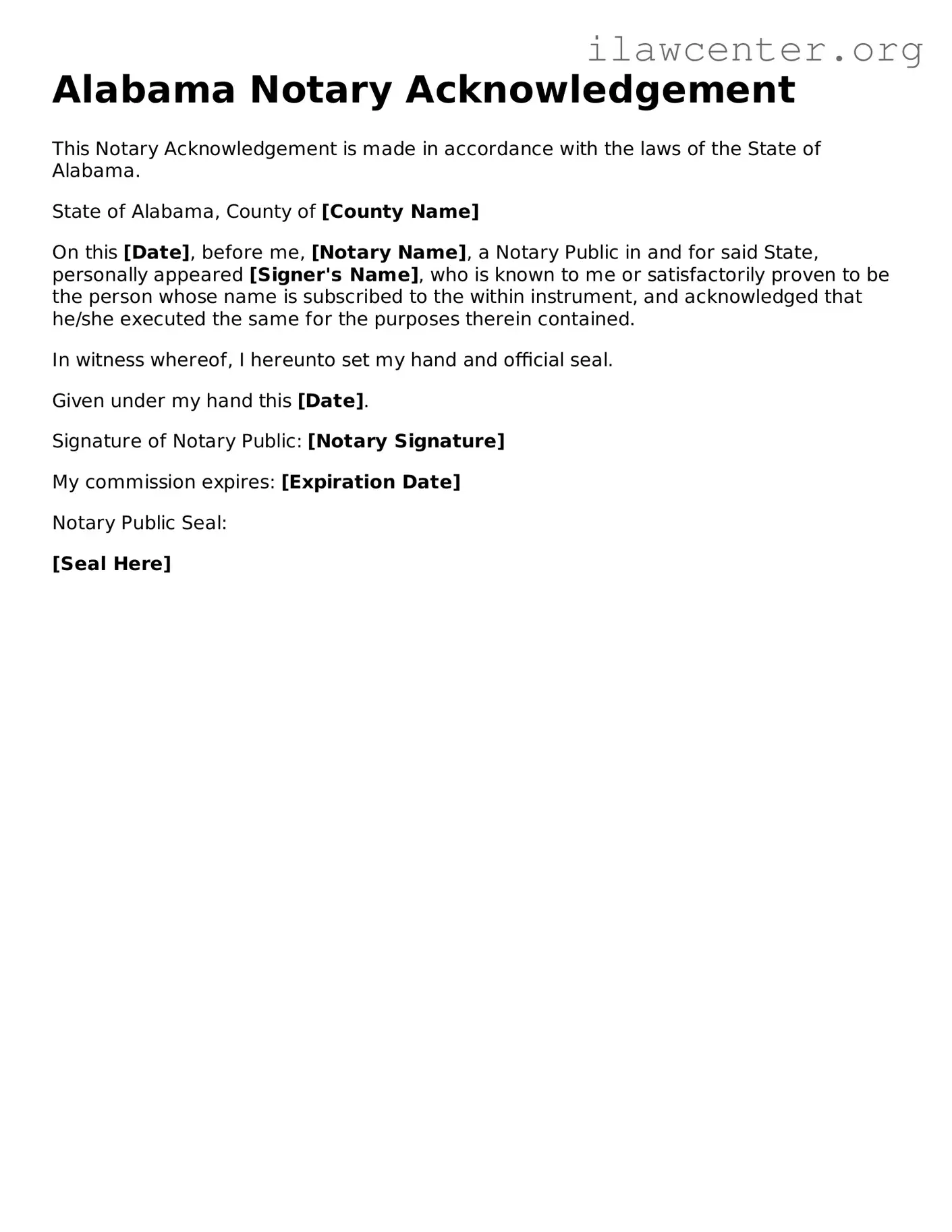
Alabama Notary Acknowledgement Preview

Alabama Notary Acknowledgement

This Notary Acknowledgement is made in accordance with the laws of the State of Alabama.

State of Alabama, County of [County Name]

On this [Date], before me, [Notary Name], a Notary Public in and for said State, personally appeared [Signer's Name], who is known to me or satisfactorily proven to be the person whose name is subscribed to the within instrument, and acknowledged that he/she executed the same for the purposes therein contained.

In witness whereof, I hereunto set my hand and official seal.

Given under my hand this [Date].

Signature of Notary Public: [Notary Signature]

My commission expires: [Expiration Date]

Notary Public Seal:

[Seal Here]

PDF Form Characteristics

Fact Name Description
Purpose The Alabama Notary Acknowledgment form is used to verify that a signer has willingly signed a document in the presence of a notary public.
Governing Law This form is governed by the Alabama Code, specifically Section 36-20-1 et seq.
Signature Requirement The signer must personally appear before the notary and sign the document in their presence.
Notary’s Role The notary public must complete the acknowledgment section, which includes their signature, seal, and the date of notarization.
Use Cases This form is commonly used for legal documents such as deeds, contracts, and powers of attorney.

Instructions on Utilizing Alabama Notary Acknowledgement

After completing the Alabama Notary Acknowledgement form, you will need to submit it as part of your documentation process. Ensure that all information is accurate to avoid any delays. Follow these steps carefully to fill out the form correctly.

  1. Start by locating the section for the notary's name. Write your full name as it appears on your notary commission.
  2. Next, find the area designated for the notary's signature. Sign your name in the appropriate space.
  3. Proceed to the date section. Fill in the date on which you are completing the acknowledgment.
  4. Identify the venue section. Write the county and state where the acknowledgment is taking place.
  5. In the section for the signer's name, write the full name of the individual whose signature you are witnessing.
  6. Lastly, ensure that all information is legible and that you have filled in every required field before submitting the form.

Important Facts about Alabama Notary Acknowledgement

What is an Alabama Notary Acknowledgement form?

The Alabama Notary Acknowledgement form is a legal document used to verify that a person has signed a document in the presence of a notary public. This form serves as proof that the individual has willingly signed the document and that the notary has witnessed this act. It is commonly used in various transactions, including real estate deals, legal agreements, and other formal documents requiring notarization.

Who can act as a notary public in Alabama?

In Alabama, a notary public must be at least 18 years old, a resident of the state, and possess the necessary qualifications. Notaries are appointed by the Secretary of State and must complete an application process. They are authorized to perform notarial acts, such as witnessing signatures and administering oaths, ensuring that documents are legally binding.

What information is typically included in the Notary Acknowledgement form?

The form generally includes the name of the signer, the date of the acknowledgment, the notary's name, and the notary's signature and seal. Additionally, it may contain a statement affirming that the signer personally appeared before the notary and that the notary verified the signer's identity. This information helps create a clear record of the notarization process.

Is the Notary Acknowledgement form required for all documents?

No, not all documents require a Notary Acknowledgement form. However, many legal documents, especially those related to property transactions or court filings, do require notarization to be considered valid. It is essential to check the specific requirements for each document to determine whether notarization is necessary.

Can I use an Alabama Notary Acknowledgement form for documents signed outside of Alabama?

While the Alabama Notary Acknowledgement form is designed for use within Alabama, it can be used for documents signed outside the state if the signer is an Alabama resident. However, it’s crucial to ensure that the notary public is authorized to perform notarial acts in the state where the signing occurs. Always verify local laws and requirements when dealing with out-of-state documents.

What happens if a Notary Acknowledgement form is not properly completed?

If a Notary Acknowledgement form is not properly completed, it may lead to issues regarding the validity of the document. A missing signature, seal, or incorrect information can result in the document being challenged or deemed unenforceable. It’s vital to double-check that all required fields are filled out accurately to avoid complications down the line.

How can I find a notary public in Alabama?

Finding a notary public in Alabama is relatively easy. You can search online for notary services in your area or check with local banks, law offices, or post offices, as many offer notary services. Additionally, the Alabama Secretary of State's website provides a directory of notaries, making it simple to locate a certified notary near you.
Common mistakes

Filling out the Alabama Notary Acknowledgement form can seem straightforward, yet many individuals make common mistakes that can lead to delays or even invalidations of documents. One prevalent error occurs when the signer fails to provide their name clearly. If the name is misspelled or illegible, it can create confusion about the identity of the individual signing the document. This mistake can undermine the integrity of the notarial act.

Another frequent issue arises with the date of the acknowledgment. Some people neglect to include the date entirely or mistakenly write the wrong date. The date is crucial as it signifies when the acknowledgment took place. Without an accurate date, the document may be questioned in terms of its validity, especially if it is presented at a later time.

Additionally, individuals often overlook the requirement for the notary to sign the form. A notary's signature is essential to authenticate the acknowledgment. Without it, the document lacks the official recognition needed to be considered valid. This oversight can lead to complications, especially in legal or business transactions.

Furthermore, many fail to check the notary's commission details. The Alabama Notary Acknowledgement form requires that the notary's commission number and expiration date be included. If this information is missing or incorrect, it can raise doubts about the notary's authority to perform the acknowledgment, potentially rendering the document unenforceable.

Another common mistake involves the notary's seal. Some individuals forget to apply the notary seal altogether, while others may place it in an incorrect location on the form. The seal serves as a mark of authenticity and must be affixed appropriately to ensure that the acknowledgment is recognized as valid by other parties.

People also sometimes fail to complete the venue section of the form. The venue, which indicates where the acknowledgment took place, is essential for legal purposes. Omitting this information can create uncertainty about the jurisdiction in which the notarial act was performed, complicating matters if the document is challenged later.

Finally, a lack of understanding regarding the purpose of the acknowledgment itself can lead to mistakes. Some individuals may confuse the acknowledgment with other notarial acts, such as jurats or oaths. Understanding the specific requirements and implications of an acknowledgment is vital to ensuring that the form is completed correctly and serves its intended purpose.

Documents used along the form

When engaging in legal transactions in Alabama, several forms and documents may accompany the Notary Acknowledgement form. Each of these documents serves a specific purpose and helps ensure that the transaction is legally binding and properly executed.

  • Power of Attorney: This document allows one person to act on behalf of another in legal matters. It is often used when someone is unable to be present for a transaction.
  • Affidavit: A written statement confirmed by oath or affirmation, used as evidence in court. It often requires notarization to verify the identity of the person making the statement.
  • Deed: A legal document that conveys ownership of property from one party to another. Notarization is typically required to validate the transfer.
  • Mortgage Agreement: This document outlines the terms of a loan secured by real property. Notarization helps confirm the identities of the parties involved.
  • Contract: A legally binding agreement between two or more parties. Notarization can add an extra layer of verification to the agreement.
  • Living Will: A document that outlines an individual's wishes regarding medical treatment in the event they become unable to communicate. Notarization may be required for it to be legally recognized.
  • Last Will and Testament: A legal document that expresses a person's wishes regarding the distribution of their assets after death. Notarization can help ensure its validity.
  • Release of Liability: This document protects one party from being held liable for certain actions or events. Notarization can reinforce its enforceability.
  • Consent Forms: These documents grant permission for specific actions, such as medical treatment or participation in activities. Notarization may be needed to confirm the consent was given voluntarily.

Understanding the various documents that may accompany the Alabama Notary Acknowledgement form is essential for ensuring legal compliance and protecting your rights. Each document plays a vital role in facilitating smooth transactions and safeguarding interests.

Similar forms

The Notary Acknowledgment form serves a specific purpose in the realm of legal documentation, primarily to verify the identity of the signer and confirm their willingness to sign a document. Several other documents share similarities with the Notary Acknowledgment form in terms of their function and the processes involved. Below is a list of ten such documents:

  • Affidavit: An affidavit is a written statement confirmed by oath or affirmation, used as evidence in court. Like the Notary Acknowledgment, it requires a notary to verify the identity of the affiant.
  • Power of Attorney: This document grants one person the authority to act on behalf of another. A notary acknowledgment may be required to validate the identity of the principal and the agent.
  • Deed: A deed is a legal document that conveys ownership of property. Notarization is often necessary to confirm the identities of the parties involved in the transaction.
  • Loan Agreement: A loan agreement outlines the terms of a loan. Notarization may be required to authenticate the signatures of the borrower and lender.
  • Living Will: This document expresses an individual's wishes regarding medical treatment. A notary acknowledgment can help confirm the identity of the person making the declaration.
  • Release of Liability: This document releases one party from liability for certain actions. Notarization ensures that the signer understands the implications of the release.
  • Marriage License Application: This application requires notarization to verify the identities of the applicants before a marriage can be legally recognized.
  • Child Custody Agreement: This agreement outlines custody arrangements for children. A notary may be involved to confirm the identities of the parents or guardians.
  • Trust Document: A trust document establishes a trust for managing assets. Notarization helps verify the identities of the trustor and trustee.
  • Certificate of Acknowledgment: This is a formal declaration that a signer appeared before a notary. It serves a similar purpose as the Notary Acknowledgment form in affirming the authenticity of a signature.

Dos and Don'ts

When filling out the Alabama Notary Acknowledgment form, it’s important to follow specific guidelines to ensure accuracy and compliance. Here’s a list of things to do and avoid:

  • Do read the entire form carefully before filling it out.
  • Do provide accurate information for all required fields.
  • Do sign the form in the presence of the notary.
  • Do ensure that the notary’s commission is current.
  • Do use black or blue ink to complete the form.
  • Don't leave any required fields blank.
  • Don't sign the form before meeting with the notary.
  • Don't use white-out or any correction fluid on the form.
  • Don't forget to check for any additional state-specific requirements.
  • Don't alter the form in any way that could affect its validity.

Misconceptions

  • Notaries can draft legal documents. Many people believe that notaries have the authority to create or modify legal documents. In reality, notaries are only responsible for witnessing signatures and verifying identities.
  • All notarizations require the presence of the signer. Some think that a notary can notarize a document without the signer being present. However, the signer must be physically present for the notarization to be valid.
  • Notaries can refuse to notarize any document. While notaries have the right to refuse notarization, they cannot do so arbitrarily. They must have a valid reason, such as suspecting fraud or lacking proper identification.
  • Notaries are responsible for the content of the document. It is a common misconception that notaries verify the accuracy of the document's content. Notaries only confirm the identity of the signer and witness the signing process.
  • All states have the same notary laws. Many assume that notary laws are uniform across the United States. In fact, each state has its own regulations and requirements for notaries, including the Alabama Notary Acknowledgement form.
  • Notaries can notarize documents in any language. Some believe that notaries can notarize documents written in any language. However, notaries must be able to understand the document to ensure that the signer comprehends what they are signing.
  • Notarization guarantees the legality of a document. A common misunderstanding is that notarization makes a document legally binding. While notarization adds a layer of authenticity, it does not ensure the legality or enforceability of the document itself.

Key takeaways

  • The Alabama Notary Acknowledgement form is a legal document used to verify the identity of a signer.

  • It is essential to ensure that the signer is present at the time of notarization.

  • The form requires the notary to confirm that the signer understands the document they are signing.

  • Signers must provide valid identification, such as a driver's license or passport.

  • The notary should complete the form accurately, including their signature and seal.

  • It is important to fill out the date of notarization on the form.

  • The form must be kept secure and confidential after completion.

  • Notaries should familiarize themselves with Alabama state laws regarding notarial acts.

  • Inaccurate or incomplete forms may lead to legal complications.

  • Always check for any updates or changes in notary regulations in Alabama.