Attorney-Verified  Power of Attorney for a Child Document for Alabama

Attorney-Verified Power of Attorney for a Child Document for Alabama

The Alabama Power of Attorney for a Child form is a legal document that allows a parent or guardian to grant another individual the authority to make decisions on behalf of their child. This form is essential for situations where a parent may be temporarily unavailable or needs someone to take care of their child's needs. To ensure your child's well-being, consider filling out this important form by clicking the button below.

Article Guide

When it comes to ensuring the well-being of a child, having the right legal documents in place is crucial. The Alabama Power of Attorney for a Child form is designed to grant a trusted adult the authority to make decisions on behalf of a minor. This can be particularly important in situations where parents are unable to be present, such as during travel or medical emergencies. The form allows the designated agent to handle various responsibilities, including making medical decisions, enrolling the child in school, and managing day-to-day needs. It’s important to understand that this document is temporary and can be revoked at any time by the parent or guardian. By using this form, parents can have peace of mind knowing that their child will be cared for by someone they trust, even when they cannot be there themselves. Understanding the major aspects of this form can help parents make informed decisions about their child's care and ensure that their wishes are honored.

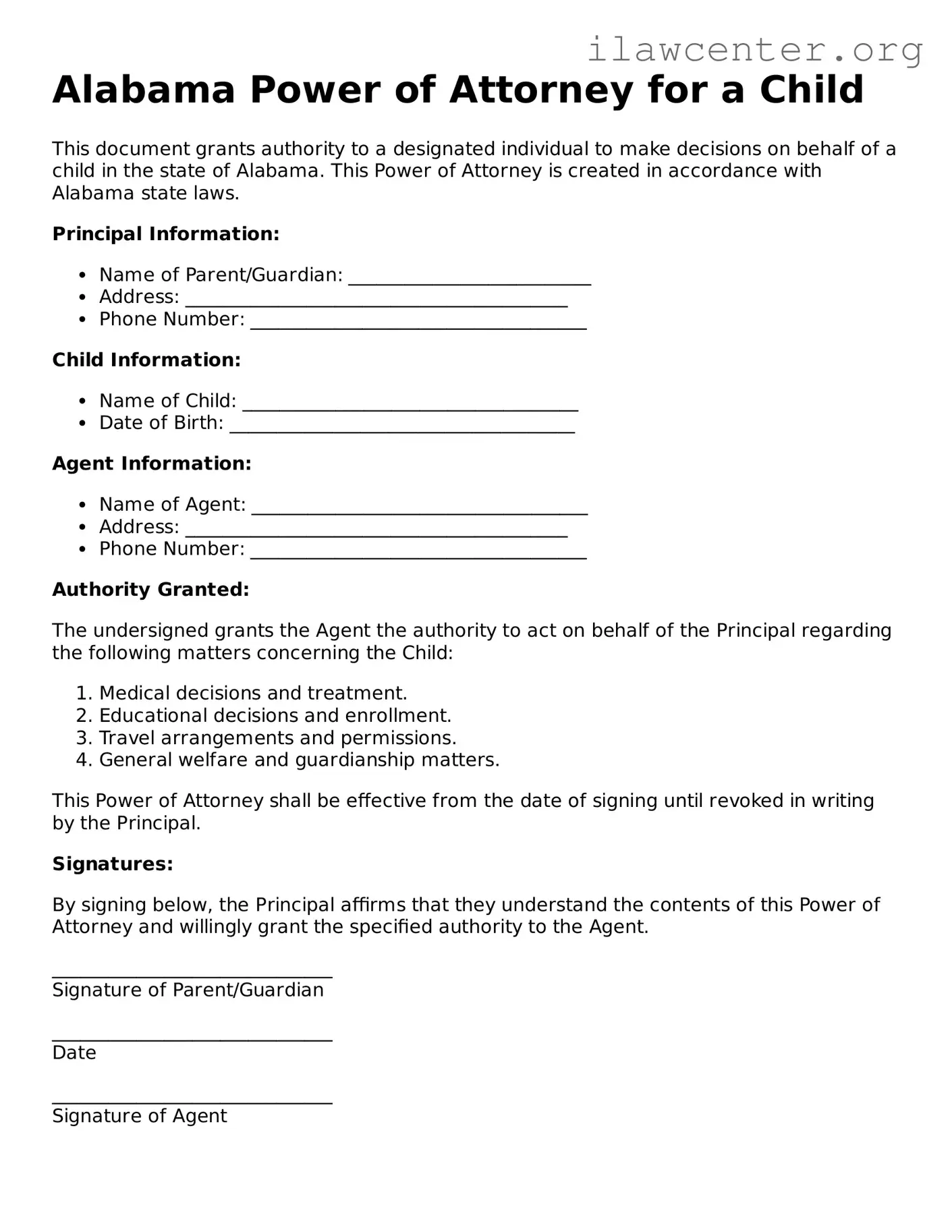
Alabama Power of Attorney for a Child Preview

Alabama Power of Attorney for a Child

This document grants authority to a designated individual to make decisions on behalf of a child in the state of Alabama. This Power of Attorney is created in accordance with Alabama state laws.

Principal Information:

  • Name of Parent/Guardian: __________________________
  • Address: _________________________________________
  • Phone Number: ____________________________________

Child Information:

  • Name of Child: ____________________________________
  • Date of Birth: _____________________________________

Agent Information:

  • Name of Agent: ____________________________________
  • Address: _________________________________________
  • Phone Number: ____________________________________

Authority Granted:

The undersigned grants the Agent the authority to act on behalf of the Principal regarding the following matters concerning the Child:

  1. Medical decisions and treatment.
  2. Educational decisions and enrollment.
  3. Travel arrangements and permissions.
  4. General welfare and guardianship matters.

This Power of Attorney shall be effective from the date of signing until revoked in writing by the Principal.

Signatures:

By signing below, the Principal affirms that they understand the contents of this Power of Attorney and willingly grant the specified authority to the Agent.

______________________________
Signature of Parent/Guardian

______________________________
Date

______________________________
Signature of Agent

______________________________
Date

PDF Form Characteristics

Fact Name Details
Definition The Alabama Power of Attorney for a Child form allows a parent or legal guardian to grant temporary authority to another adult to make decisions for their child.
Governing Law This form is governed by Alabama Code § 26-1-1, which outlines the provisions for powers of attorney concerning minors.
Duration The authority granted can be limited to a specific period, typically up to one year, unless otherwise specified.
Eligibility Any adult can be appointed as an agent, provided they are willing and able to act in the child's best interest.
Signature Requirement The form must be signed by the parent or guardian in the presence of a notary public.
Revocation The power of attorney can be revoked at any time by the parent or guardian, as long as they provide written notice.
Limitations The agent cannot make decisions regarding the child's medical treatment without additional consent.
Uses This form is often used for travel, emergencies, or temporary guardianship situations.
Availability The Alabama Power of Attorney for a Child form can typically be obtained online or from legal offices.

Instructions on Utilizing Alabama Power of Attorney for a Child

After obtaining the Alabama Power of Attorney for a Child form, you will need to fill it out carefully. Ensure all information is accurate and complete before submitting it. Follow these steps to fill out the form correctly.

  1. Begin with the child's full name. Write it clearly at the top of the form.
  2. Provide the child's date of birth. Use the format MM/DD/YYYY.
  3. Enter the name of the person who will act as the attorney-in-fact. This is the individual you are granting authority to.
  4. Include the attorney-in-fact’s address. Make sure to include the street, city, state, and zip code.
  5. Specify the duration of the power of attorney. Indicate if it is for a specific period or until revoked.
  6. Sign the form in the designated area. This signature must be yours as the parent or legal guardian.
  7. Have the signature notarized. Find a notary public to witness your signature and stamp the document.

Once completed, review the form for any errors. Ensure all required sections are filled out before submitting it to the appropriate parties.

Important Facts about Alabama Power of Attorney for a Child

What is a Power of Attorney for a Child in Alabama?

A Power of Attorney for a Child in Alabama is a legal document that allows a parent or legal guardian to grant another person the authority to make decisions on behalf of their child. This could include decisions about medical care, education, and general welfare. It is particularly useful in situations where the parent is unable to be present, such as during travel or emergencies.

Who can be appointed as an agent in the Power of Attorney for a Child?

In Alabama, the agent can be any responsible adult, such as a relative, friend, or neighbor. However, it is crucial to choose someone trustworthy and capable of making decisions in the best interest of the child. The agent should also be aware of their responsibilities and willing to accept them.

How long does the Power of Attorney for a Child remain in effect?

The Power of Attorney for a Child can remain in effect for a specified period or until revoked by the parent or guardian. It is important to clearly state the duration in the document. If no time frame is mentioned, it generally lasts until the child reaches the age of majority, which is 19 in Alabama.

Do I need to have the Power of Attorney for a Child notarized?

Yes, in Alabama, the Power of Attorney for a Child must be signed in the presence of a notary public. This adds a layer of authenticity and ensures that the document is legally binding. Notarization helps prevent any potential disputes regarding the validity of the document.

Can I revoke the Power of Attorney for a Child once it is created?

Absolutely. A parent or legal guardian can revoke the Power of Attorney at any time, as long as they are of sound mind. It is advisable to do this in writing and notify the agent and any relevant parties to avoid confusion. Keeping a copy of the revocation is also a good practice.

What if the child needs medical attention while the Power of Attorney is in effect?

When the Power of Attorney for a Child is in effect, the appointed agent has the authority to make medical decisions for the child. This includes consenting to medical treatments or procedures. It is essential for the agent to have a clear understanding of the child’s medical history and any preferences the parent may have regarding treatment.

Is there a specific form I need to use for the Power of Attorney for a Child?

While there is no official state form mandated by Alabama law, it is advisable to use a well-drafted template that complies with state requirements. Many legal resources and websites offer templates that can be customized to fit your needs. Ensuring that the form includes all necessary elements is crucial for its validity.

Can the Power of Attorney for a Child be used for educational decisions?

Yes, the Power of Attorney for a Child can grant the agent the authority to make educational decisions on behalf of the child. This may include enrolling the child in school, attending parent-teacher conferences, or making decisions regarding special education services. It is important to specify these powers in the document if they are intended to be included.

What should I do if I have more questions about the Power of Attorney for a Child?

If you have further questions or need assistance, consider consulting a legal professional who specializes in family law. They can provide personalized guidance and ensure that your Power of Attorney is properly executed and tailored to your specific situation. Additionally, local legal aid organizations may offer resources and support.
Common mistakes

When completing the Alabama Power of Attorney for a Child form, individuals often make several common mistakes that can lead to complications. One frequent error is failing to provide complete information about the child. It is essential to include the child’s full name, date of birth, and any other identifying details. Incomplete information can delay processing and create confusion regarding the child’s identity.

Another mistake is neglecting to specify the powers granted to the agent. The form allows for a range of powers, and not clearly defining these can lead to misunderstandings. It is important to articulate what the agent can and cannot do on behalf of the child. Vague language may result in limitations that do not align with the parent’s intentions.

Additionally, individuals sometimes forget to sign and date the form. A signature is crucial for the document to be legally binding. Without a signature, the form is considered invalid, and the intended authority cannot be exercised. Always double-check for a signature before submitting the form.

Another common oversight involves not having the form notarized. In Alabama, notarization is a requirement for the Power of Attorney for a Child to be recognized. Failing to have the document notarized can render it ineffective, which may complicate matters when the agent needs to act on behalf of the child.

Some people also make the mistake of not providing contact information for the agent. It is vital to include a reliable phone number and address for the agent. This ensures that anyone who needs to reach the agent can do so without difficulty, facilitating smoother communication.

In addition, individuals may overlook the need to inform the child about the Power of Attorney. Depending on the child’s age, it is important to explain the situation to them. This can help alleviate any confusion or anxiety the child might feel regarding the arrangement.

Another error is not updating the form when circumstances change. Life events such as relocation, changes in guardianship, or the agent’s availability can impact the effectiveness of the Power of Attorney. Regularly reviewing and updating the document ensures that it reflects current realities.

Lastly, people often fail to keep copies of the completed form. It is advisable to retain copies for personal records and to provide a copy to the agent. This allows for easy reference and helps prevent disputes about the authority granted.

Documents used along the form

When creating a Power of Attorney for a Child in Alabama, several other forms and documents may be useful to ensure proper legal authority and care for the child. Here are a few commonly used documents that complement the Power of Attorney.

  • Medical Authorization Form: This document allows the designated caregiver to make medical decisions for the child. It grants permission for healthcare providers to treat the child in case of an emergency or when the parent is unavailable.
  • Child Custody Agreement: If the parent is sharing custody or has specific arrangements with another party, this agreement outlines the terms of custody and visitation. It helps clarify the rights and responsibilities of each party involved.
  • School Enrollment Authorization: This form allows the designated caregiver to enroll the child in school and make educational decisions. It ensures that the caregiver has the authority to act on behalf of the child in educational matters.
  • Travel Consent Form: If the child will be traveling, this document gives permission for the child to travel with the caregiver. It is especially important for trips that cross state lines or involve air travel.

Using these documents in conjunction with the Power of Attorney for a Child can help ensure that the caregiver has all necessary legal authority to act in the child's best interest. Always consider consulting with a legal professional for personalized advice tailored to your situation.

Similar forms

  • Guardianship Agreement: This document establishes a legal relationship where a guardian is appointed to care for a child, similar to how a Power of Attorney allows a designated person to make decisions on behalf of the child.
  • Parental Consent Form: This form grants permission for another adult to take specific actions on behalf of a child, such as medical treatment or travel, akin to the authority given in a Power of Attorney.
  • Child Custody Agreement: This document outlines the arrangements for a child's care and upbringing between parents or guardians. It shares similarities with the Power of Attorney in terms of decision-making authority.
  • Medical Authorization Form: This form allows a designated individual to make medical decisions for a child. Like a Power of Attorney, it ensures that someone can act on the child's behalf in health-related matters.
  • Travel Consent Form: This document provides permission for a child to travel with someone other than their parents. It parallels the Power of Attorney by granting authority for specific actions regarding the child.

Dos and Don'ts

When filling out the Alabama Power of Attorney for a Child form, it is crucial to approach the task with care. Here are ten important dos and don'ts to keep in mind:

  • Do read the entire form thoroughly before starting to fill it out.
  • Do ensure that you have all necessary information about the child and the appointed agent.
  • Do use clear and legible handwriting or type the information if possible.
  • Do sign and date the form in the appropriate sections.
  • Do keep a copy of the completed form for your records.
  • Don't leave any required fields blank; this may cause delays.
  • Don't use white-out or erasers on the form, as this can raise questions about validity.
  • Don't fill out the form under pressure; take your time to ensure accuracy.
  • Don't forget to check if notarization is required for your specific situation.
  • Don't overlook any state-specific guidelines that may apply to the form.

Completing this form accurately is essential for ensuring that your child's needs are met. Attention to detail can prevent complications in the future.

Misconceptions

Understanding the Alabama Power of Attorney for a Child form is essential for parents and guardians. Several misconceptions exist regarding its use and implications. Here are nine common misconceptions:

  1. It can only be used for medical decisions.

    This is incorrect. The Power of Attorney for a Child can grant authority for various decisions, including educational and financial matters, not just medical ones.

  2. It must be notarized to be valid.

    While notarization is recommended for added validity, it is not a strict requirement for the Power of Attorney for a Child in Alabama.

  3. It is permanent and cannot be revoked.

    This is a misconception. The parent or guardian can revoke the Power of Attorney at any time, as long as they follow the proper procedures.

  4. Only parents can create a Power of Attorney for a Child.

    In reality, legal guardians and other authorized individuals can also establish this document, provided they have the proper authority.

  5. It automatically expires when the child turns 18.

    This is not true. The Power of Attorney for a Child specifically pertains to minors, but it does not have an automatic expiration upon the child's 18th birthday unless stated otherwise.

  6. It can be used to transfer custody of the child.

    The Power of Attorney for a Child does not transfer custody. It only grants specific decision-making authority while the parent retains custody rights.

  7. It is only necessary for long-term situations.

    This is misleading. The Power of Attorney can be useful for both short-term and long-term situations, depending on the needs of the child and the circumstances.

  8. All states have the same rules regarding Power of Attorney for a Child.

    This is incorrect. Each state, including Alabama, has its own laws and requirements regarding the Power of Attorney for a Child.

  9. It can be used without informing the child.

    While there is no legal requirement to inform the child, it is generally advisable to discuss the arrangement with them, especially if they are old enough to understand.

Key takeaways

When considering the Alabama Power of Attorney for a Child form, several important points should be kept in mind. This document allows a parent or legal guardian to designate another individual to make decisions on behalf of their child. Here are key takeaways to help navigate this process:

  • The form is specifically designed for temporary delegation of parental authority.
  • It is crucial to select a trustworthy individual to act as the agent for your child.
  • The Power of Attorney can cover a wide range of responsibilities, including medical care and educational decisions.
  • It is advisable to clearly outline the duration of the authority granted in the form.
  • Both the parent and the agent must sign the document for it to be valid.
  • Notarization is recommended, although it may not be strictly required.
  • Keep a copy of the completed form for your records and provide one to the designated agent.
  • Review the document periodically to ensure it still meets your needs and reflects any changes in circumstances.
  • Consulting with a legal professional can provide additional guidance tailored to your specific situation.