Attorney-Verified  Self-Proving Affidavit Document for Alabama

Attorney-Verified Self-Proving Affidavit Document for Alabama

The Alabama Self-Proving Affidavit is a legal document that allows a testator's will to be validated without the need for witnesses to testify in court. This form simplifies the probate process by confirming the authenticity of the will at the time of signing. Ensure your estate planning is secure by filling out the form—click the button below.

Article Guide

In the realm of estate planning, ensuring that a will is recognized as valid can significantly ease the process for loved ones left behind. One useful tool in Alabama is the Self-Proving Affidavit, a legal document that enhances the credibility of a will by allowing witnesses to affirm its authenticity. This affidavit is typically executed at the same time as the will, providing a streamlined method for verifying the testator's intentions. By signing this form, witnesses attest that they observed the testator sign the will and that the testator was of sound mind at the time. This process not only simplifies probate proceedings but also helps to prevent potential disputes over the will's validity. In Alabama, the Self-Proving Affidavit must meet specific requirements to be legally binding, including the need for notarization. The form serves as a safeguard, ensuring that the wishes of the deceased are honored without unnecessary complications. Understanding the nuances of this affidavit can empower individuals to make informed decisions about their estate planning and provide peace of mind for their families.

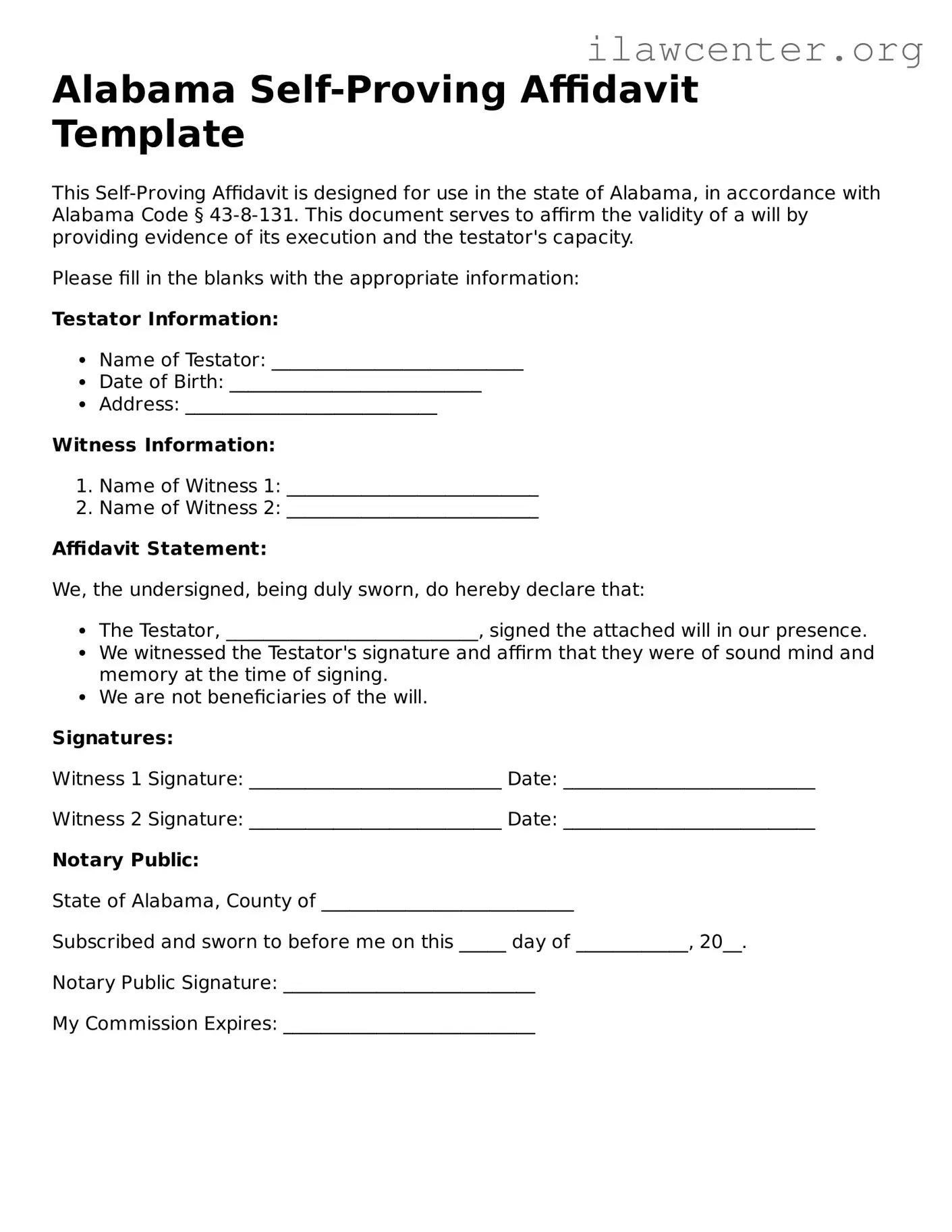
Alabama Self-Proving Affidavit Preview

Alabama Self-Proving Affidavit Template

This Self-Proving Affidavit is designed for use in the state of Alabama, in accordance with Alabama Code § 43-8-131. This document serves to affirm the validity of a will by providing evidence of its execution and the testator's capacity.

Please fill in the blanks with the appropriate information:

Testator Information:

  • Name of Testator: ___________________________
  • Date of Birth: ___________________________
  • Address: ___________________________

Witness Information:

  1. Name of Witness 1: ___________________________
  2. Name of Witness 2: ___________________________

Affidavit Statement:

We, the undersigned, being duly sworn, do hereby declare that:

  • The Testator, ___________________________, signed the attached will in our presence.
  • We witnessed the Testator's signature and affirm that they were of sound mind and memory at the time of signing.
  • We are not beneficiaries of the will.

Signatures:

Witness 1 Signature: ___________________________ Date: ___________________________

Witness 2 Signature: ___________________________ Date: ___________________________

Notary Public:

State of Alabama, County of ___________________________

Subscribed and sworn to before me on this _____ day of ____________, 20__.

Notary Public Signature: ___________________________

My Commission Expires: ___________________________

PDF Form Characteristics

Fact Name Details
Definition The Alabama Self-Proving Affidavit is a legal document that allows a will to be validated without the need for witnesses to testify in court.
Governing Law This form is governed by the Alabama Code, specifically Section 43-8-131.
Purpose Its main purpose is to simplify the probate process and reduce the time and costs associated with validating a will.
Requirements The affidavit must be signed by the testator and two witnesses in the presence of a notary public.
Notarization A notary public must acknowledge the signatures on the affidavit for it to be valid.
When to Use This form is typically used at the time of executing the will, but can also be added later.
Benefits It eliminates the need for witnesses to appear in court, making the probate process smoother.
Legal Standing A self-proving affidavit has the same legal weight as having witnesses testify in court.
Limitations Not all states recognize self-proving affidavits, so it's important to ensure compliance with Alabama law.

Instructions on Utilizing Alabama Self-Proving Affidavit

Once you have the Alabama Self-Proving Affidavit form ready, the next step involves carefully filling it out to ensure it meets the necessary legal requirements. This process is straightforward but requires attention to detail. Follow these steps to complete the form correctly.

  1. Begin by writing the date at the top of the form. Use the format month, day, and year.
  2. Next, fill in the name of the testator, which is the person who made the will.
  3. Provide the address of the testator. This should include the street address, city, state, and zip code.
  4. Identify the witnesses. You will need to list the names and addresses of each witness who will sign the affidavit.
  5. In the designated area, have the testator sign their name. This signature should be done in the presence of the witnesses.
  6. Each witness should then sign the form. They should also print their names and provide their addresses below their signatures.
  7. Finally, ensure that the notary public signs and stamps the affidavit. This step is crucial for the document to be legally recognized.

Once the form is completed and signed, it is ready for submission or storage with the will. Keeping it in a safe place ensures that it can be easily accessed when needed.

Important Facts about Alabama Self-Proving Affidavit

What is a Self-Proving Affidavit in Alabama?

A Self-Proving Affidavit is a legal document that allows a will to be validated without the need for witnesses to testify in court. In Alabama, this affidavit is typically signed by the testator (the person making the will) and witnesses in front of a notary public. This process simplifies the probate process, making it more efficient and less time-consuming.

Why should I use a Self-Proving Affidavit?

Using a Self-Proving Affidavit can save time and reduce complications during the probate process. If a will includes this affidavit, it can be accepted by the probate court without requiring the witnesses to appear. This is especially helpful if witnesses are unavailable or have passed away. It provides an added layer of assurance that the will is valid and reflects the testator's intentions.

What information is included in a Self-Proving Affidavit?

The Self-Proving Affidavit typically includes the names of the testator and witnesses, the date of the will's execution, and a statement confirming that the testator was of sound mind and under no duress when signing the will. It also includes a notary's acknowledgment, which verifies the identities of the signers and the authenticity of their signatures.

How do I create a Self-Proving Affidavit?

To create a Self-Proving Affidavit, start by drafting your will and ensuring it meets all legal requirements. After the will is signed by you and your witnesses, you can complete the affidavit section. It is advisable to have a notary public present to witness the signing of the affidavit. Once completed, keep the affidavit with your will in a safe place.

Is a Self-Proving Affidavit required in Alabama?

No, a Self-Proving Affidavit is not required in Alabama, but it is highly recommended. While a will can still be valid without it, having this affidavit can significantly streamline the probate process and avoid potential disputes. It provides clear evidence of the will's validity, which can be beneficial for your heirs.

Common mistakes

Filling out the Alabama Self-Proving Affidavit form can be a straightforward process, but several common mistakes can lead to complications. One of the first errors people often make is not including all required signatures. The affidavit must be signed by the testator, as well as two witnesses. If any of these signatures are missing, the document may not hold up in court.

Another frequent mistake is failing to date the affidavit correctly. Dates are crucial in legal documents, as they establish when the affidavit was executed. If the date is left blank or incorrectly filled out, it can create confusion about the validity of the will. Always double-check that the date is accurate and clearly written.

Some individuals overlook the importance of clarity in the language used in the affidavit. Vague or ambiguous wording can lead to misinterpretation. It’s essential to be clear and concise, ensuring that the intent of the testator is unmistakable. This clarity helps avoid potential disputes among heirs or beneficiaries.

In addition, people sometimes forget to include a notary public’s signature and seal. While the affidavit can be signed by the testator and witnesses, it must also be notarized to be considered self-proving. Without this step, the affidavit may not be accepted by the probate court.

Another mistake is neglecting to review the completed affidavit for errors. Simple typos or incorrect information can jeopardize the document’s validity. Taking the time to proofread ensures that all details are correct, which can save time and stress later on.

People also often fail to understand the purpose of the self-proving affidavit. This form is designed to simplify the probate process by confirming that the will was properly executed. If individuals do not grasp its significance, they may not fill it out with the necessary care, leading to potential issues during probate.

Lastly, some individuals do not keep the affidavit in a safe place. After completing the form, it should be stored alongside the will in a secure location. If the affidavit is lost or damaged, it can complicate the probate process and delay the distribution of assets.

Documents used along the form

When dealing with estate planning and the probate process in Alabama, several forms and documents may accompany the Alabama Self-Proving Affidavit. Understanding these documents can simplify the process and ensure that your wishes are honored. Below is a list of commonly used forms that you may encounter.

  • Last Will and Testament: This document outlines how you want your assets distributed after your passing. It names beneficiaries and may appoint guardians for minor children.
  • Living Will: A living will specifies your healthcare preferences in case you become unable to communicate your wishes. It addresses end-of-life decisions and medical treatment options.
  • Durable Power of Attorney: This form designates someone to make financial decisions on your behalf if you become incapacitated. It grants authority to manage your affairs as specified in the document.
  • Healthcare Power of Attorney: Similar to the durable power of attorney, this document allows you to appoint someone to make medical decisions for you if you cannot do so yourself.
  • Affidavit of Heirship: This document is used to establish the heirs of a deceased person when there is no will. It helps clarify the distribution of assets among family members.
  • Petition for Probate: This legal document is filed with the court to initiate the probate process. It requests the court to validate the will and appoint a personal representative.
  • Notice to Creditors: This form informs creditors of the deceased’s passing and provides them with a deadline to submit any claims against the estate.
  • Inventory of Assets: This document lists all the assets owned by the deceased at the time of death. It is often required by the probate court to assess the estate's value.
  • Final Accounting: After the estate has been settled, this document summarizes all financial transactions made during the probate process, including income, expenses, and distributions to heirs.
  • Release of Claims: This form is signed by beneficiaries to acknowledge receipt of their inheritance and to waive any further claims against the estate.

Each of these documents plays a crucial role in the estate planning and probate process. By familiarizing yourself with them, you can navigate this often complex area with greater confidence and clarity. Always consider consulting with a legal professional to ensure that your documents are in order and reflect your intentions accurately.

Similar forms

The Self-Proving Affidavit form shares similarities with several other legal documents. Here are four such documents, each with a brief explanation of how they relate to the Self-Proving Affidavit:

  • Will: A will outlines how a person's assets will be distributed after their death. Like the Self-Proving Affidavit, it requires signatures and may need witnesses to validate its authenticity.
  • Power of Attorney: This document grants someone the authority to act on another person's behalf. Both the Power of Attorney and the Self-Proving Affidavit require the principal's signature and may need to be notarized to be legally binding.
  • Living Trust: A living trust manages a person's assets during their lifetime and after death. Similar to a Self-Proving Affidavit, it often involves witnesses and can help streamline the transfer of assets, reducing the need for probate.
  • Durable Power of Attorney for Health Care: This document allows someone to make medical decisions on behalf of another person. Like the Self-Proving Affidavit, it must be signed and may require witnesses to ensure that the person's wishes are honored.

Dos and Don'ts

When filling out the Alabama Self-Proving Affidavit form, it’s crucial to follow specific guidelines to ensure the document is valid and effective. Here are ten essential do's and don'ts:

  • Do ensure that the will is properly signed by the testator and witnesses before completing the affidavit.
  • Do have the affidavit signed in the presence of a notary public.
  • Do clearly state the date when the will was executed.
  • Do include all necessary information about the testator and witnesses.
  • Do keep a copy of the signed affidavit with the original will.
  • Don't forget to have all witnesses present when signing the affidavit.
  • Don't leave any sections of the form blank; complete all required fields.
  • Don't use a different form or template that does not comply with Alabama law.
  • Don't attempt to alter the affidavit after it has been signed and notarized.
  • Don't neglect to review the completed form for accuracy before submission.

Following these guidelines will help ensure that the Alabama Self-Proving Affidavit is executed correctly and serves its intended purpose.

Misconceptions

The Alabama Self-Proving Affidavit is an important legal document that can simplify the probate process. However, several misconceptions surround its use and purpose. Here are six common misunderstandings:

  • It is only for wealthy individuals. Many believe that only those with substantial assets need a self-proving affidavit. In reality, anyone who wants to ensure their will is validated efficiently can benefit from this form.
  • It replaces the need for a will. Some think that completing a self-proving affidavit eliminates the necessity of having a will. This is incorrect; the affidavit serves to affirm the validity of the will but does not replace it.
  • It must be signed in front of a notary. While a notary is often involved, the affidavit must also be signed by witnesses. This dual requirement is crucial for the document's validity.
  • It can be completed at any time. Many people assume they can fill out the self-proving affidavit whenever they choose. However, it must be signed at the same time as the will to be effective.
  • It is only necessary in Alabama. Some believe that the self-proving affidavit is unique to Alabama. In fact, many states have similar provisions, though the specific requirements may vary.
  • It guarantees the will's acceptance. While a self-proving affidavit can streamline the probate process, it does not guarantee that the will will be accepted by the court. Other legal issues may still arise.

Understanding these misconceptions can help individuals navigate the complexities of estate planning more effectively. Proper use of the self-proving affidavit can lead to a smoother probate process, ensuring that a person's wishes are honored after their passing.

Key takeaways

Here are some key takeaways about filling out and using the Alabama Self-Proving Affidavit form:

  • The affidavit serves as proof that a will was properly executed.
  • It must be signed by the testator and two witnesses.
  • The form should be notarized to ensure its validity.
  • It is typically attached to the will when submitted for probate.
  • Using this affidavit can simplify the probate process.
  • Make sure all signatures are dated correctly.
  • Keep copies of the signed affidavit with the original will.
  • Consult an attorney if you have questions about the process.