Attorney-Verified  Small Estate Affidavit Document for Alabama

Attorney-Verified Small Estate Affidavit Document for Alabama

The Alabama Small Estate Affidavit is a legal document that allows individuals to settle the estate of a deceased person without going through the lengthy probate process, provided the estate meets certain criteria. This form simplifies the transfer of assets, making it easier for heirs to claim what is rightfully theirs. If you need to navigate this process efficiently, consider filling out the form by clicking the button below.

Article Guide

In Alabama, the Small Estate Affidavit serves as a valuable tool for individuals navigating the complexities of settling a deceased loved one’s estate. This legal document simplifies the process for heirs and beneficiaries when the total value of the estate falls below a certain threshold, currently set at $25,000 for personal property. By utilizing this form, individuals can bypass the lengthy and often costly probate process, allowing for a more efficient transfer of assets. The affidavit must be completed and signed by a qualified heir, attesting to the decedent's death, their relationship to the deceased, and the value of the estate. Furthermore, it is crucial to ensure that all debts and taxes owed by the estate are settled before assets are distributed. This process not only provides a clear path for asset distribution but also aims to honor the wishes of the deceased while minimizing the emotional and financial burdens on their loved ones.

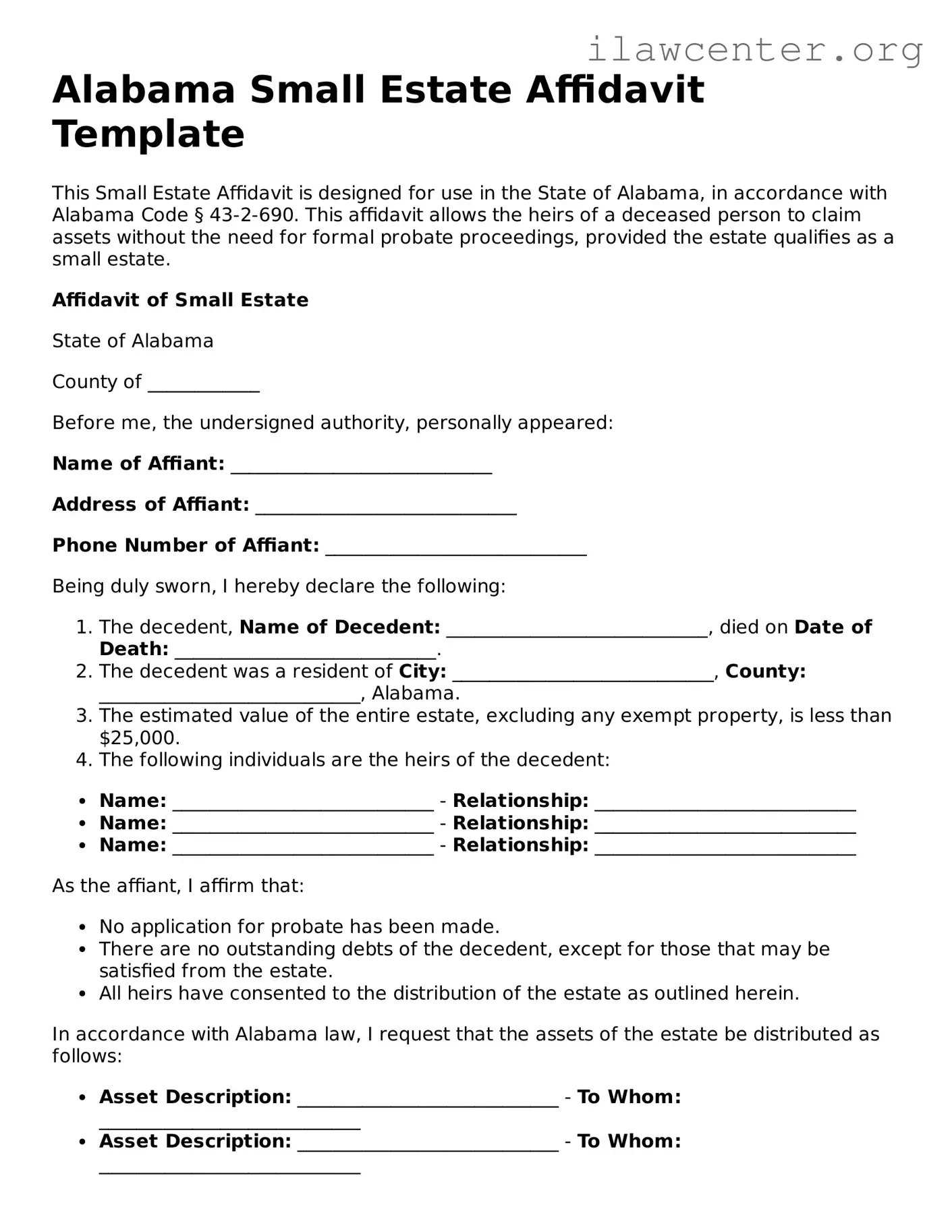
Alabama Small Estate Affidavit Preview

Alabama Small Estate Affidavit Template

This Small Estate Affidavit is designed for use in the State of Alabama, in accordance with Alabama Code § 43-2-690. This affidavit allows the heirs of a deceased person to claim assets without the need for formal probate proceedings, provided the estate qualifies as a small estate.

Affidavit of Small Estate

State of Alabama

County of ____________

Before me, the undersigned authority, personally appeared:

Name of Affiant: ____________________________

Address of Affiant: ____________________________

Phone Number of Affiant: ____________________________

Being duly sworn, I hereby declare the following:

  1. The decedent, Name of Decedent: ____________________________, died on Date of Death: ____________________________.
  2. The decedent was a resident of City: ____________________________, County: ____________________________, Alabama.
  3. The estimated value of the entire estate, excluding any exempt property, is less than $25,000.
  4. The following individuals are the heirs of the decedent:
  • Name: ____________________________ - Relationship: ____________________________
  • Name: ____________________________ - Relationship: ____________________________
  • Name: ____________________________ - Relationship: ____________________________

As the affiant, I affirm that:

  • No application for probate has been made.
  • There are no outstanding debts of the decedent, except for those that may be satisfied from the estate.
  • All heirs have consented to the distribution of the estate as outlined herein.

In accordance with Alabama law, I request that the assets of the estate be distributed as follows:

  • Asset Description: ____________________________ - To Whom: ____________________________
  • Asset Description: ____________________________ - To Whom: ____________________________
  • Asset Description: ____________________________ - To Whom: ____________________________

By signing below, I affirm that the information provided is true and correct to the best of my knowledge.

Signature of Affiant: ____________________________

Date: ____________________________

Sworn to and subscribed before me this ____ day of ____________, 20__.

Notary Public: ____________________________

My Commission Expires: ____________________________

PDF Form Characteristics

Fact Name Description
Purpose The Alabama Small Estate Affidavit allows heirs to claim assets of a deceased person without going through formal probate.
Eligibility To use this form, the total value of the estate must be under $25,000, excluding certain exempt assets.
Governing Law This affidavit is governed by Alabama Code Title 43, Chapter 2, Section 43-2-690.
Filing Requirements Heirs must sign the affidavit in front of a notary public to validate the document.
Asset Types The affidavit can be used for various assets, including bank accounts and personal property.

Instructions on Utilizing Alabama Small Estate Affidavit

Once you have the Alabama Small Estate Affidavit form, you can begin filling it out. This process involves providing specific information about the deceased and their estate. Follow these steps carefully to ensure that the form is completed correctly.

  1. Obtain the Alabama Small Estate Affidavit form from the appropriate source, such as a court or legal website.
  2. Enter the full name of the deceased in the designated section.
  3. Provide the date of death. This information is crucial for establishing the timeline of the estate.
  4. List the address of the deceased at the time of death. Ensure that this is accurate.
  5. Identify the total value of the estate. Include all assets that fall under the small estate threshold.
  6. Complete the section detailing the names and addresses of all heirs. This includes anyone entitled to inherit under Alabama law.
  7. Sign the affidavit. This signature must be made in the presence of a notary public.
  8. Have the affidavit notarized. The notary will verify your identity and witness your signature.
  9. Make copies of the completed affidavit for your records and for submission to the court.

After completing the form, you will need to submit it to the appropriate probate court. This step is essential for the legal recognition of the affidavit and the distribution of the estate. Be prepared to provide any additional documentation that may be required by the court.

Important Facts about Alabama Small Estate Affidavit

What is the Alabama Small Estate Affidavit?

The Alabama Small Estate Affidavit is a legal document that allows heirs to claim property of a deceased person without going through the formal probate process. This form is typically used when the total value of the estate is below a certain threshold, making it a simpler and quicker option for settling small estates.

Who can use the Small Estate Affidavit in Alabama?

Any person who is an heir or beneficiary of the deceased can use the Small Estate Affidavit. This includes spouses, children, parents, and siblings. The estate must meet the value requirement set by Alabama law, which is currently $25,000 for personal property and $50,000 for real property.

What information is required to complete the affidavit?

To complete the affidavit, you will need the deceased person's full name, date of death, a list of assets, and their estimated values. You must also include information about the heirs and their relationship to the deceased. It is important to provide accurate and complete information to avoid delays.

How do I file the Small Estate Affidavit?

After completing the Small Estate Affidavit, you must sign it in front of a notary public. Once notarized, you can file the affidavit with the appropriate probate court in the county where the deceased lived. There may be a filing fee, so check with the court for specific requirements.

What happens after I file the Small Estate Affidavit?

Once filed, the court will review the affidavit. If everything is in order, the court will issue an order allowing the heirs to access the deceased's assets. This process usually takes a few weeks, but it may vary depending on the court's workload.

Can the Small Estate Affidavit be contested?

Common mistakes

When completing the Alabama Small Estate Affidavit form, one common mistake is failing to accurately identify all heirs. It is essential to list every individual who is entitled to a share of the estate. Omitting an heir can lead to complications and may delay the process of settling the estate. Ensure that you include all relevant family members, even those who may have passed away, as their descendants might have rights to the estate.

Another frequent error is not providing the correct information about the decedent's assets. The form requires a detailed account of the deceased's property, including real estate, bank accounts, and personal belongings. If you underestimate the value of these assets or leave some out, it could result in legal challenges later on. Take the time to gather accurate information and provide a comprehensive list.

People also often neglect to sign the affidavit in the appropriate places. This document requires signatures from all heirs, and if one person fails to sign, the affidavit may be considered invalid. Review the form carefully to ensure that everyone who needs to sign has done so. It’s a simple step that can save time and trouble down the road.

Finally, individuals sometimes overlook the requirement for notarization. The Alabama Small Estate Affidavit must be notarized to be legally binding. Failing to have the document notarized can render it ineffective. Make sure to visit a notary public after completing the form to ensure that it meets all legal requirements.

Documents used along the form

The Alabama Small Estate Affidavit is a useful tool for settling the estate of a deceased person when the total value of the estate is below a certain threshold. In addition to this affidavit, there are several other forms and documents that may be necessary to complete the estate settlement process. Here are some commonly used documents that can accompany the Small Estate Affidavit.

  • Death Certificate: This official document verifies the death of the individual. It is essential for proving the decedent's passing and is often required when filing the Small Estate Affidavit.
  • Will: If the deceased left a will, it must be presented during the estate settlement process. The will outlines the decedent's wishes regarding asset distribution and may influence how the Small Estate Affidavit is completed.
  • Inventory of Assets: This document lists all assets owned by the deceased at the time of death. An inventory helps clarify the estate's value and ensures that all assets are accounted for in the Small Estate Affidavit.
  • Affidavit of Heirs: This form identifies the legal heirs of the deceased. It is used to establish who is entitled to inherit the estate and may be necessary to accompany the Small Estate Affidavit.

Gathering these documents will help streamline the estate settlement process and ensure compliance with Alabama law. Each document plays a vital role in confirming the necessary details for the Small Estate Affidavit and ultimately aids in the efficient distribution of the deceased's assets.

Similar forms

  • Affidavit of Heirship: This document establishes the identity of heirs when someone dies without a will. It serves to clarify who is entitled to inherit property, similar to how a Small Estate Affidavit identifies heirs for small estates.
  • Will: A will outlines how a person's assets should be distributed after death. Both documents are used to determine the distribution of assets, although a will is more formal and typically goes through probate.
  • Letters Testamentary: Issued by a court, these letters authorize an executor to manage the deceased's estate. Like a Small Estate Affidavit, they confirm authority but are used in the context of larger estates that require probate.
  • Probate Petition: This document initiates the probate process. It is similar to a Small Estate Affidavit in that both seek to settle an estate, but the probate petition is for estates that exceed the small estate threshold.
  • Trust Agreement: A trust outlines how assets are to be managed and distributed. Both documents facilitate the transfer of assets, but a trust is often used to avoid probate altogether.
  • Asset Transfer Document: This document transfers ownership of specific assets. Similar to a Small Estate Affidavit, it helps in the direct transfer of property without going through lengthy legal processes.
  • Affidavit of Collection: This document allows a person to collect a deceased person's assets without probate. It functions similarly to a Small Estate Affidavit by simplifying the process of accessing assets.
  • Death Certificate: This official document confirms a person's death. While it does not directly distribute assets, it is often required alongside a Small Estate Affidavit to validate claims to the estate.
  • Inventory of Estate Assets: This document lists all assets of the deceased. Both it and the Small Estate Affidavit help clarify what is part of the estate, aiding in the distribution process.
  • Release of Claims: This document releases a party from any claims against the estate. It is similar to a Small Estate Affidavit in that it helps resolve issues surrounding the estate's assets.

Dos and Don'ts

When filling out the Alabama Small Estate Affidavit form, it is important to follow certain guidelines to ensure accuracy and compliance. Here are four things you should and shouldn't do:

  • Do double-check all personal information for accuracy before submission.
  • Don't leave any required fields blank; this can delay the processing of your affidavit.
  • Do ensure that all signatures are properly executed and dated.
  • Don't provide false information; this can lead to legal complications.

Misconceptions

Misconceptions about the Alabama Small Estate Affidavit form can lead to confusion for individuals navigating the probate process. Below are ten common misunderstandings, along with clarifications.

  1. The Small Estate Affidavit can only be used for estates under $10,000. Many believe this is the threshold, but the limit is actually $25,000 for individuals and $50,000 for married couples.
  2. Only heirs can use the Small Estate Affidavit. This is incorrect. Any qualified individual, such as a personal representative, can file the affidavit if they meet the necessary requirements.
  3. The form can be used for any type of asset. Not all assets qualify. For example, jointly owned property and certain retirement accounts may not be included.
  4. Filing the affidavit avoids all probate processes. While it simplifies the process, it does not eliminate all legal requirements. Some steps may still be necessary.
  5. The affidavit must be filed in court. This is a common belief, but the affidavit is typically presented to financial institutions or other entities holding the deceased's assets.
  6. All debts must be settled before using the Small Estate Affidavit. This is misleading. While debts should be addressed, the affidavit allows for distribution of remaining assets without full debt settlement.
  7. The Small Estate Affidavit is a permanent solution. This is not true. The affidavit is a one-time document for a specific estate and does not serve for future estates.
  8. It is unnecessary to gather supporting documents. In fact, supporting documents such as death certificates may be required to validate the affidavit.
  9. Anyone can create the Small Estate Affidavit. While it is not overly complex, it must be completed accurately and in accordance with state laws, which may require legal guidance.
  10. The Small Estate Affidavit guarantees asset transfer. Although it facilitates the process, there is no absolute guarantee that all institutions will accept it without additional verification.

Understanding these misconceptions can help individuals better navigate the process of settling a small estate in Alabama.

Key takeaways

Filling out and using the Alabama Small Estate Affidavit form can be a straightforward process if you keep a few key points in mind. Here are some important takeaways:

  • Eligibility Requirements: Ensure that the estate meets the criteria for a small estate in Alabama. Typically, this means the total value of the estate must be below a specific threshold.
  • Complete Information: Fill out the affidavit completely and accurately. Include all necessary details about the deceased, the heirs, and the assets involved.
  • Notarization: The affidavit must be signed in front of a notary public. This step is crucial to validate the document.
  • Submission: After completing the form, submit it to the probate court in the county where the deceased lived. This will initiate the process of transferring the estate assets.

By following these steps, you can navigate the process more easily and ensure that the small estate is handled properly.