Alberta Bill Sale PDF Template

Alberta Bill Sale PDF Template

The Alberta Bill of Sale is a vital document used when buying or selling a vehicle in Alberta. It serves as proof of the transaction and includes essential information about the buyer, seller, and the vehicle itself. To ensure a smooth registration process, it’s important to fill out this form correctly, so don’t hesitate to get started by clicking the button below.

Article Guide

The Alberta Bill of Sale form is a crucial document for anyone looking to buy or sell a used vehicle in Alberta. This form ensures that both the buyer and seller have a clear record of the transaction, which is essential for vehicle registration. Before completing the form, buyers are strongly encouraged to check the vehicle identification number (VIN) on the Canadian Police Information Centre (CPIC) website to ensure the vehicle has not been reported stolen. The form consists of several sections that capture vital information, including the seller’s and buyer’s details, vehicle specifics, and the sale price. Sections 1 and 2 must be filled out completely for the Bill of Sale to be valid for registration, while Section 3, which outlines any special conditions of sale, is optional. It is important to note that two copies of the form should be completed: one for the buyer and one for the seller. Any changes made to the form must be initialed by both parties to maintain its integrity. Additionally, buyers should be aware of the legal requirements regarding vehicle insurance and registration, as well as the potential need for an out-of-province safety inspection if the vehicle is coming from outside Alberta. Understanding these elements will help ensure a smooth transaction and compliance with provincial regulations.

Alberta Bill Sale Preview

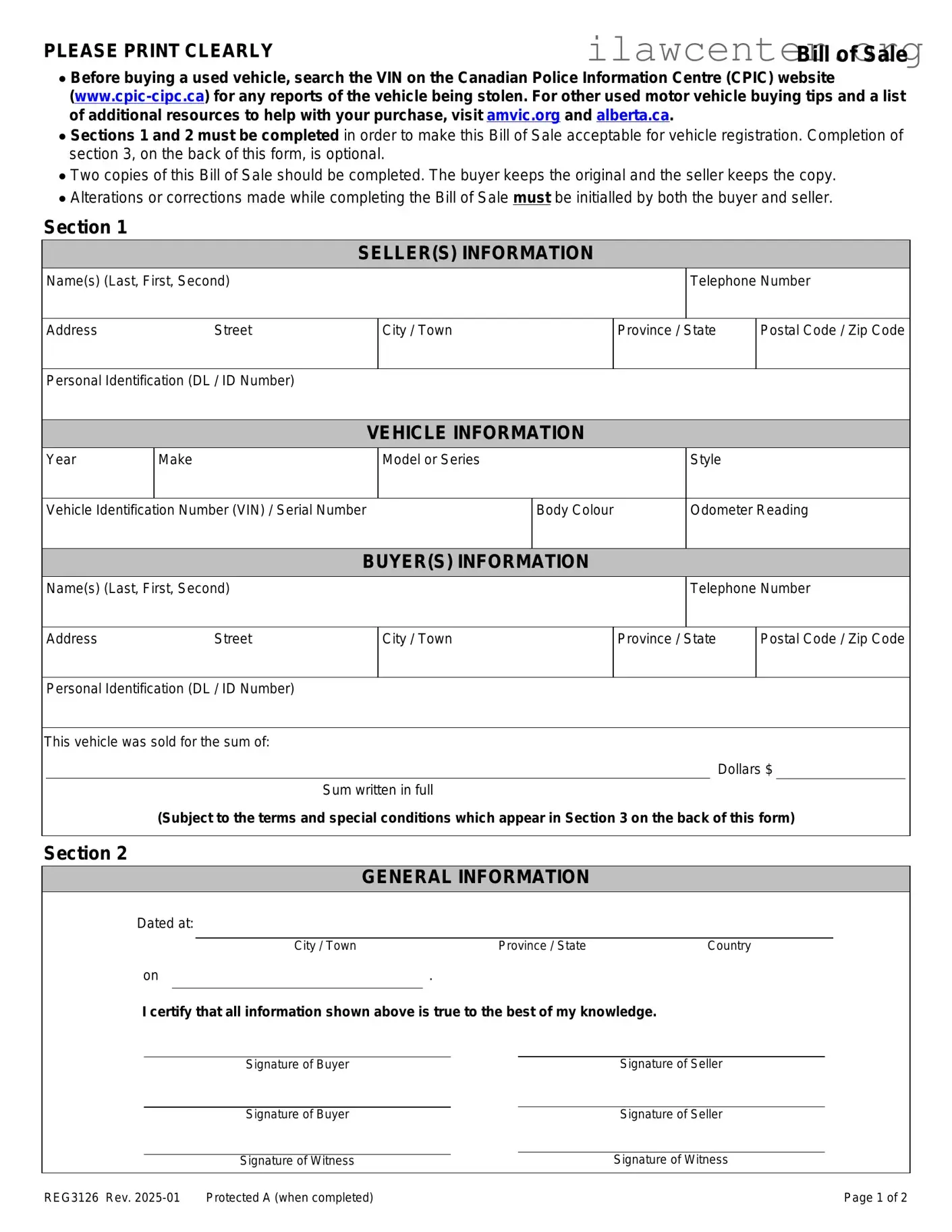
REG3126 Rev. 2025-01 Page 1 of 2
Protected A (when completed)
PLEASE PRINT CLEARLY
Before buying a used vehicle, search the VIN on the Canadian Police Information Centre (CPIC) website
(www.cpic-cipc.ca) for any reports of the vehicle being stolen. For other used motor vehicle buying tips and a list
of additional resources to help with your purchase, visit amvic.org and alberta.ca.
Sections 1 and 2 must be completed in order to make this Bill of Sale acceptable for vehicle registration. Completion of
section 3, on the back of this form, is optional.
Two copies of this Bill of Sale should be completed. The buyer keeps the original and the seller keeps the copy.
Alterations or corrections made while completing the Bill of Sale must be initialled by both the buyer and seller.
Bill of Sale
Section 1
SELLER(S) INFORMATION
Name(s) (Last, First, Second) Telephone Number
Address Street City / Town Province / State Postal Code / Zip Code
Personal Identification (DL / ID Number)
VEHICLE INFORMATION
Year Make Model or Series Style
Vehicle Identification Number (VIN) / Serial Number Body Colour Odometer Reading
BUYER(S) INFORMATION
Name(s) (Last, First, Second)
Telephone Number
Address Street City / Town Province / State Postal Code / Zip Code
Personal Identification (DL / ID Number)
This vehicle was sold for the sum of:
Sum written in full
Dollars $
(Subject to the terms and special conditions which appear in Section 3 on the back of this form)
Section 2
GENERAL INFORMATION
Dated at:
City / Town Province / State Country
on .
I certify that all information shown above is true to the best of my knowledge.
Signature of Buyer
Signature of Seller
Signature of Buyer
Signature of Seller
Signature of Witness
REG3126 Rev. 2025-01 Page 2 of 2
Protected A (when completed)
Section 3
SPECIAL CONDITIONS OF SALE
1. The vehicle described on the front of this form is:
Check the appropriate box(es)
a) Free of all liens and encumbrances:
Yes No
If No, please give names of lien holders:
b) Being paid for in full:
Yes No
Being paid by:
Cash Cheque Money Order Other (please specify):
2. Payment Terms:
3. Vehicle was last registered in:
Province / State Country
4. Special conditions of sale (if any):
General Information:
The Buyer should make sure that they visually inspect the vehicle identification number (VIN) for the vehicle identified in Section 1.
The law in the Province of Alberta requires a vehicle to be insured prior to registration. Documentary proof of vehicle insurance is
required. Legislation allows a person to whom a valid licence plate is issued to transfer the licence plate
to a newly purchased vehicle to be registered within 14 days of the date on their Bill of Sale.
The above does not apply to commercial vehicles used for the transportation of goods or passengers for compensation.
A vehicle entering Alberta from another jurisdiction may require an out-of-province safety inspection. Information can be obtained from
a registry agent. A listing of local registry agents can be found in the telephone directory under Licence and Registry Services; or visit
alberta.ca for comprehensive registries and consumer information and services.
In addition to the Bill of Sale, other identification is required to obtain Alberta registration. Where possible, obtain Section 2 of the
previous Alberta vehicle registration certificate.
The prospective purchaser can determine whether a vehicle is free of liens and encumbrances in Alberta by contacting a registry
agent.
In order to perform a search, a registry agent will require the VIN of the vehicle. A request for a search can be made in person or in
writing. There is a fee for this service.
Vehicle Information Reports are available from a registry agent. There is a fee for each service.
The buyer must produce the original properly completed Bill of Sale, that includes the same information as shown on this standardized
form, in order to register a vehicle in Alberta.
This form is provided as a courtesy by Service Alberta to ensure that sufficient information is contained within the Bill of Sale to permit
registration of the described vehicle by the new owner.
No liability attaches to the Crown through the use of this document in respect of the sale of this vehicle. Any dispute arising from the sale
becomes a civil matter among the parties named in this document.

File Properties

Fact Name Description
Purpose The Alberta Bill of Sale form is used to document the sale of a used vehicle in Alberta, Canada.
VIN Check Before purchasing a vehicle, buyers should verify the Vehicle Identification Number (VIN) on the Canadian Police Information Centre (CPIC) website for any theft reports.
Sections Requirement Sections 1 and 2 must be filled out completely for the Bill of Sale to be accepted for vehicle registration.
Copies of the Form Two copies of the Bill of Sale should be created: the buyer keeps the original, and the seller retains a copy.
Alterations Any changes made to the form must be initialed by both the buyer and seller to ensure agreement on the alterations.
Insurance Requirement Alberta law mandates that a vehicle must be insured before it can be registered, and proof of insurance is necessary.
Out-of-Province Inspection Vehicles entering Alberta from other jurisdictions may require a safety inspection, which can be arranged through a registry agent.
Liens and Encumbrances Buyers can check if a vehicle is free from liens by contacting a registry agent, who will need the VIN to perform the search.
Legal Disclaimer The use of this form does not create any liability for the Crown; disputes related to the sale are civil matters between the involved parties.

Instructions on Utilizing Alberta Bill Sale

Filling out the Alberta Bill of Sale form is an important step in the process of purchasing a used vehicle. Once you have completed the form, you can move forward with registering your vehicle and ensuring all necessary documentation is in order.

  1. Start by printing the form clearly to avoid any confusion.
  2. In Section 1, fill in the seller's information, including their name, telephone number, and address.
  3. Provide the seller's personal identification number, such as a driver's license or ID number.
  4. Next, enter the vehicle information: year, make, model, style, VIN (Vehicle Identification Number), body color, and odometer reading.
  5. Then, complete the buyer's information in the same way as the seller's section, including their name, telephone number, address, and personal identification number.
  6. Indicate the sale price of the vehicle in both numeric and written form.
  7. In Section 2, enter the city, province, and date of the sale.
  8. Both the buyer and seller must sign the form. If there are multiple buyers or sellers, ensure all signatures are included.
  9. If applicable, fill out Section 3 regarding special conditions of sale, such as liens and payment terms.
  10. Once completed, make two copies of the Bill of Sale. The buyer keeps the original, and the seller retains the copy.
  11. Any alterations or corrections made on the form must be initialed by both parties.

Important Facts about Alberta Bill Sale

What is the Alberta Bill of Sale form used for?

The Alberta Bill of Sale form is a document used when buying or selling a used vehicle in Alberta. It provides important information about the transaction, including details about the buyer, seller, and the vehicle itself. This form is essential for registering the vehicle in the new owner's name.

What information do I need to complete the Bill of Sale?

You will need to provide details about both the buyer and seller, including names, addresses, and contact numbers. Additionally, you must fill in the vehicle's information, such as the year, make, model, and Vehicle Identification Number (VIN). The sale price must also be noted.

Do I need to complete all sections of the form?

Sections 1 and 2 of the Bill of Sale must be completed for the document to be acceptable for vehicle registration. Section 3 is optional and can be used for any special conditions related to the sale.

How many copies of the Bill of Sale should I make?

Two copies of the Bill of Sale should be completed. The buyer keeps the original, while the seller retains a copy for their records.

What should I do if I make a mistake on the form?

If you need to make alterations or corrections while filling out the Bill of Sale, both the buyer and seller must initial these changes. This helps ensure that both parties agree to the modifications.

Is it necessary to check the vehicle's VIN before purchasing?

Yes, it is highly recommended to search the VIN on the Canadian Police Information Centre (CPIC) website for any reports of the vehicle being stolen. This step helps protect buyers from purchasing stolen vehicles.

What do I need to register the vehicle after the sale?

To register the vehicle in Alberta, the buyer must present the original Bill of Sale, proof of vehicle insurance, and any other required identification. It's also helpful to have Section 2 of the previous Alberta vehicle registration certificate if available.

Are there any fees associated with checking for liens on a vehicle?

Yes, there is a fee for requesting a search to determine if the vehicle is free of liens and encumbrances. This search can be done through a registry agent, and you will need the VIN to proceed.

What happens if a dispute arises from the sale?

If a dispute occurs, it becomes a civil matter between the buyer and seller. The Alberta Bill of Sale form does not provide legal protection or liability for the Crown regarding the sale.

Common mistakes

Filling out the Alberta Bill of Sale form can be straightforward, but many people make common mistakes that can lead to complications. One frequent error is not providing complete information in Sections 1 and 2. Both the seller and buyer must ensure that all fields are filled out accurately. Missing details can delay vehicle registration and create unnecessary headaches.

Another mistake involves the Vehicle Identification Number (VIN). Buyers often fail to double-check the VIN on the vehicle against what is written on the form. This step is crucial as discrepancies can lead to issues with ownership verification. Always visually inspect the VIN before finalizing the sale.

People sometimes overlook the requirement to initial any alterations made to the Bill of Sale. If changes are made, both the buyer and seller must initial these corrections. Failing to do so can render the document invalid, complicating the registration process.

Additionally, some buyers neglect to write the sale price in both numerical and written form. This is a vital step, as both formats help prevent misunderstandings about the sale amount. Ensure that the written amount matches the numerical figure to avoid confusion.

Another common oversight is not including the seller's and buyer's signatures. All parties involved in the sale must sign the document. Without these signatures, the Bill of Sale lacks legal validity, which can create problems down the line.

People often forget to check the box indicating whether the vehicle is free of liens and encumbrances. This information is essential for the buyer to ensure that they are not inheriting any debts related to the vehicle. Always confirm this before completing the form.

Some individuals fail to provide adequate personal identification numbers. The form requires the driver's license or ID number for both the buyer and seller. Missing this information can lead to delays in registration and may require additional steps to rectify.

Another mistake is not keeping copies of the Bill of Sale. It is recommended that two copies be made: one for the buyer and one for the seller. Having a copy ensures that both parties have a record of the transaction, which can be useful for future reference.

Finally, many people overlook the special conditions of sale in Section 3. This section allows for additional terms to be included, which can clarify payment methods or other agreements. Ignoring this section can lead to misunderstandings later on.

By being aware of these common mistakes, individuals can navigate the process of completing the Alberta Bill of Sale form more effectively. Taking the time to fill out the form correctly can save time and prevent issues during vehicle registration.

Documents used along the form

The Alberta Bill of Sale form is an essential document for anyone looking to purchase a used vehicle in Alberta. However, there are several other forms and documents that are often needed to ensure a smooth transaction and proper registration. Below is a list of these important documents, each described briefly to help you understand their purpose.

  • Vehicle Registration Certificate: This document shows the vehicle's registration history and is required for registering the vehicle in the buyer's name. It provides proof of ownership and must be presented during the registration process.
  • Insurance Documentation: Before registering a vehicle, buyers must provide proof of insurance. This document confirms that the vehicle is insured, which is a legal requirement in Alberta.
  • Out-of-Province Inspection Certificate: If the vehicle is coming from another province, it may need to undergo a safety inspection. This certificate ensures that the vehicle meets Alberta's safety standards.
  • Vehicle Information Report (VIR): This report provides details about the vehicle's history, including any liens or encumbrances. It is helpful for buyers to verify that the vehicle is free from any financial claims.
  • Odometer Disclosure Statement: This document is necessary to confirm the accuracy of the vehicle's odometer reading. It protects buyers from potential fraud regarding mileage.
  • Transfer of Ownership Form: This form is used to officially transfer the ownership of the vehicle from the seller to the buyer. It is often required by the registry office during the registration process.
  • Payment Receipt: A receipt for the payment made for the vehicle serves as proof of the transaction. It can be helpful in case of disputes or for record-keeping purposes.

Having these documents prepared and organized can make the process of buying and registering a vehicle much easier. It is always best to ensure that all necessary paperwork is completed correctly to avoid any complications in the future.

Similar forms

The Alberta Bill of Sale form is an important document for vehicle transactions, but it shares similarities with several other forms. Here are four documents that are comparable to the Alberta Bill of Sale:

  • Vehicle Title Transfer Form: This document is used to officially transfer ownership of a vehicle from one person to another. Like the Bill of Sale, it requires information about the buyer and seller, as well as details about the vehicle, including the VIN. Both documents are essential for registering the vehicle in the new owner's name.
  • Purchase Agreement: A purchase agreement outlines the terms of the sale between the buyer and seller. Similar to the Bill of Sale, it includes details about the vehicle, the sale price, and any special conditions. Both documents serve to protect the interests of both parties during the transaction.
  • Receipt for Vehicle Purchase: This document serves as proof of payment for the vehicle. While it may not contain as much detail as the Bill of Sale, it confirms that the buyer has paid for the vehicle. Both documents are important for record-keeping and may be needed for registration purposes.
  • Odometer Disclosure Statement: This form is used to disclose the vehicle's odometer reading at the time of sale. Like the Bill of Sale, it is designed to prevent fraud by ensuring that the buyer is aware of the vehicle's mileage. Both documents are often required during the registration process.

Dos and Don'ts

When filling out the Alberta Bill of Sale form, it is essential to follow specific guidelines to ensure accuracy and compliance. Here are four important do's and don'ts:

  • Do print all information clearly to avoid any misunderstandings.
  • Do complete Sections 1 and 2 fully; these sections are necessary for vehicle registration.
  • Don't make alterations or corrections without initialing them by both the buyer and seller.
  • Don't forget to obtain proof of vehicle insurance before registration, as it is legally required.

Misconceptions

Misconceptions about the Alberta Bill of Sale form can lead to confusion for both buyers and sellers. Here are seven common misunderstandings:

  • It is unnecessary to check the VIN before purchase. Many believe that checking the Vehicle Identification Number (VIN) is optional. In reality, it is crucial to search the VIN on the Canadian Police Information Centre (CPIC) website to ensure the vehicle is not stolen.
  • Only one copy of the Bill of Sale is needed. Some assume that a single copy suffices. However, two copies must be completed—one for the buyer and one for the seller—to ensure both parties have a record of the transaction.
  • Section 3 is mandatory. A common myth is that filling out Section 3 is required for the Bill of Sale to be valid. In fact, this section is optional and only includes special conditions of sale.
  • Alterations to the form are acceptable without signatures. Many think they can simply correct mistakes without any formal process. Any alterations must be initialed by both the buyer and seller to maintain the document's integrity.
  • The Bill of Sale is sufficient for vehicle registration. Some individuals believe that having the Bill of Sale alone is enough to register the vehicle. However, additional identification and proof of insurance are also required.
  • All vehicles are exempt from safety inspections. It is a misconception that vehicles entering Alberta from other jurisdictions do not need inspections. Depending on the vehicle's origin, an out-of-province safety inspection may be necessary.
  • The Bill of Sale protects against all disputes. Some think that the Bill of Sale guarantees protection in case of disputes. While it serves as a record of the transaction, any disputes arising from the sale are civil matters between the parties involved.

Understanding these misconceptions can help ensure a smoother transaction when buying or selling a vehicle in Alberta.

Key takeaways

When filling out and using the Alberta Bill of Sale form, keep these key takeaways in mind:

  • Verify the Vehicle's Status: Before purchasing, always check the VIN on the Canadian Police Information Centre website to ensure the vehicle isn't stolen.
  • Complete Required Sections: Sections 1 and 2 must be filled out for the Bill of Sale to be valid for vehicle registration. Section 3 is optional.
  • Keep Copies: Fill out two copies of the Bill of Sale. The buyer retains the original, while the seller keeps a copy for their records.
  • Initial Changes: Any alterations or corrections made on the form must be initialed by both the buyer and seller to maintain validity.
  • Insurance Requirement: Alberta law mandates that a vehicle must be insured before it can be registered. Proof of insurance is necessary.
  • Out-of-Province Inspections: If the vehicle is coming from outside Alberta, it may need a safety inspection. Check with a local registry agent for details.
  • Liens and Encumbrances: Buyers should confirm that the vehicle is free of any liens. This can be done by contacting a registry agent.
  • Documentation for Registration: To register the vehicle, the buyer must present the original Bill of Sale along with other identification as required.