Attorney-Verified  Affidavit of Death Document for Arizona

Attorney-Verified Affidavit of Death Document for Arizona

The Arizona Affidavit of Death form is a legal document used to officially declare the death of an individual. This form helps to simplify the process of transferring assets and settling affairs after a person's passing. For assistance in completing the form, please click the button below.

Article Guide

The Arizona Affidavit of Death form serves as an important legal document that facilitates the transfer of property and assets following an individual's death. This form is typically used when a person passes away and their estate needs to be settled without going through the probate process. By providing a formal declaration of death, the affidavit allows surviving family members or heirs to assert their rights to the deceased's property. It includes essential details such as the deceased's full name, date of birth, date of death, and a statement affirming that the individual has not been subject to any pending probate proceedings. Furthermore, the affidavit must be signed by the affiant, who is often a family member or someone with a vested interest in the estate. Once completed and notarized, the form can be presented to financial institutions, title companies, or other entities holding the deceased's assets, thereby streamlining the process of asset transfer and ensuring that the deceased's wishes are honored. Understanding the nuances of this document is crucial for those navigating the complexities of estate management in Arizona.

Arizona Affidavit of Death Preview

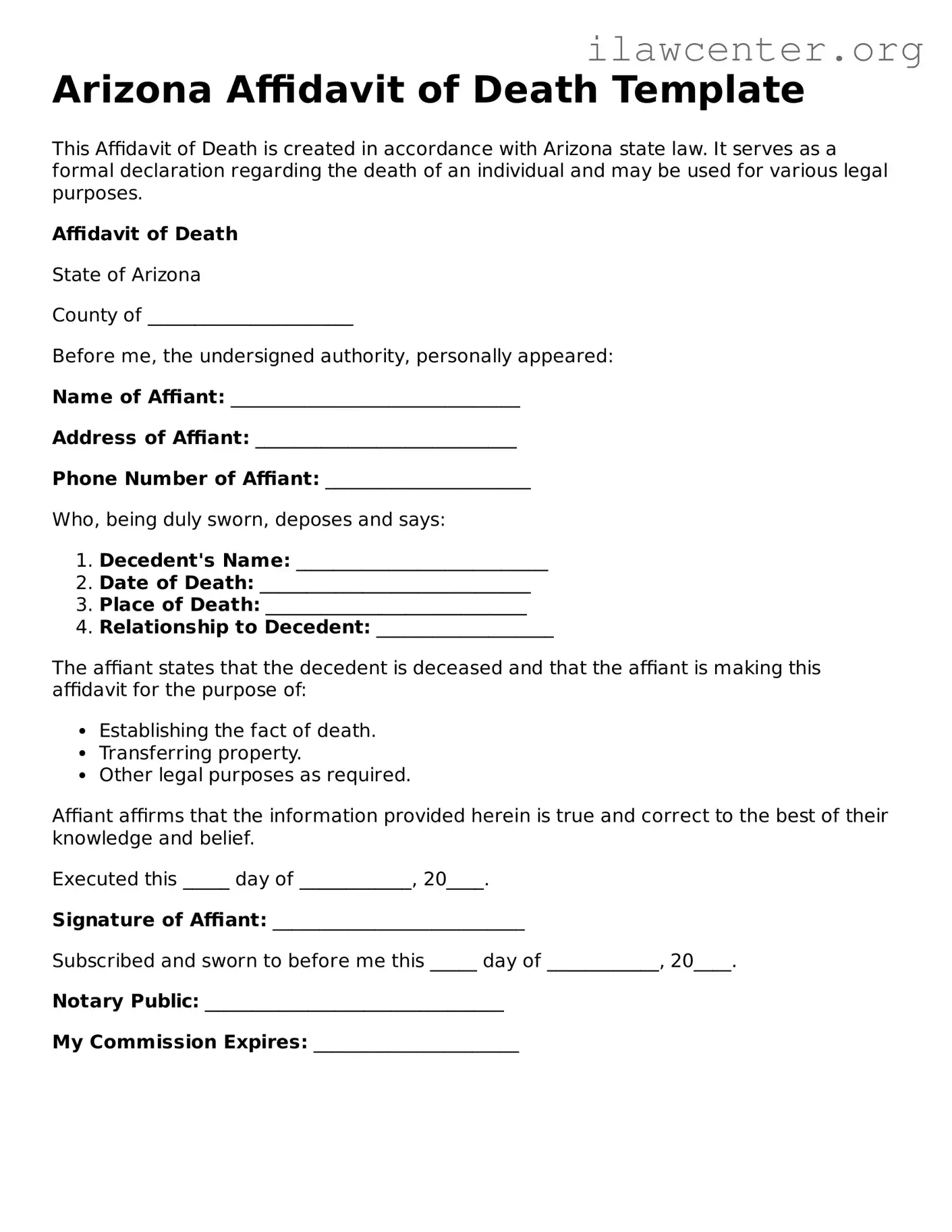
Arizona Affidavit of Death Template

This Affidavit of Death is created in accordance with Arizona state law. It serves as a formal declaration regarding the death of an individual and may be used for various legal purposes.

Affidavit of Death

State of Arizona

County of ______________________

Before me, the undersigned authority, personally appeared:

Name of Affiant: _______________________________

Address of Affiant: ____________________________

Phone Number of Affiant: ______________________

Who, being duly sworn, deposes and says:

  1. Decedent's Name: ___________________________
  2. Date of Death: _____________________________
  3. Place of Death: ____________________________
  4. Relationship to Decedent: ___________________

The affiant states that the decedent is deceased and that the affiant is making this affidavit for the purpose of:

  • Establishing the fact of death.
  • Transferring property.
  • Other legal purposes as required.

Affiant affirms that the information provided herein is true and correct to the best of their knowledge and belief.

Executed this _____ day of ____________, 20____.

Signature of Affiant: ___________________________

Subscribed and sworn to before me this _____ day of ____________, 20____.

Notary Public: ________________________________

My Commission Expires: ______________________

PDF Form Characteristics

Fact Name Description
Purpose The Arizona Affidavit of Death form is used to officially declare the death of an individual, primarily for the purpose of transferring property or settling estates.
Governing Law This form is governed by Arizona Revised Statutes (A.R.S.) § 14-3971, which outlines the requirements for affidavits of death.
Who Can File Typically, a family member, personal representative, or an interested party may file the affidavit.
Required Information The form requires details such as the deceased's full name, date of death, and place of death.
Signature Requirement The affidavit must be signed by the affiant, who is the person declaring the death, and may need to be notarized.
Use in Property Transfer This affidavit is often necessary for transferring real property or other assets to heirs or beneficiaries.
Filing Location The completed affidavit should be filed with the county recorder’s office where the deceased owned property.
Impact on Estate Settlement Filing this affidavit can expedite the process of settling the deceased's estate by clarifying the status of property ownership.
Additional Documentation Sometimes, a certified copy of the death certificate may need to accompany the affidavit when filed.
Availability The Arizona Affidavit of Death form can typically be obtained from county recorder offices or legal resource websites.

Instructions on Utilizing Arizona Affidavit of Death

After completing the Arizona Affidavit of Death form, it is important to ensure that all information is accurate and complete. This form is a crucial document that will be used in various legal matters, including settling the deceased's estate. Once filled out, the form will need to be submitted to the appropriate authorities.

  1. Begin by obtaining the Arizona Affidavit of Death form. This can typically be found online or at a local courthouse.
  2. At the top of the form, enter the name of the deceased individual as it appears on their legal documents.
  3. Provide the date of death. This should be the official date recorded on the death certificate.
  4. Fill in the last known address of the deceased. Ensure that this is the address where they resided at the time of death.
  5. Include the name and contact information of the person completing the affidavit. This individual may be a relative or an executor of the estate.
  6. Affix your signature at the bottom of the form. Ensure that you are signing in the presence of a notary public.
  7. Have the affidavit notarized. The notary will verify your identity and witness your signature.
  8. Make copies of the completed and notarized form for your records and for any relevant parties.
  9. Submit the original affidavit to the appropriate county recorder's office or other designated authority.

Important Facts about Arizona Affidavit of Death

What is the Arizona Affidavit of Death form?

The Arizona Affidavit of Death form is a legal document used to officially declare the death of an individual. It serves as proof of death and is often required for settling estates, transferring property, or handling other legal matters related to the deceased's affairs.

Who needs to file the Affidavit of Death?

Typically, the Affidavit of Death is filed by a personal representative, executor, or any interested party who has a legal interest in the deceased's estate. This could include family members, heirs, or beneficiaries who need to manage the deceased's assets.

What information is required on the form?

The form requires specific details such as the deceased's full name, date of death, place of death, and the relationship of the affiant (the person filing the affidavit) to the deceased. Additional information may include details about the deceased's estate and any relevant legal proceedings.

Where do I file the Affidavit of Death?

You should file the Affidavit of Death with the county recorder's office in the county where the deceased lived or owned property. This ensures that the document is officially recorded and can be accessed by interested parties in the future.

Is there a fee to file the Affidavit of Death?

Yes, there is typically a filing fee associated with submitting the Affidavit of Death. Fees can vary by county, so it's advisable to check with the local county recorder's office for the exact amount and payment methods accepted.

Do I need witnesses or notarization for the form?

While notarization is generally required for the Affidavit of Death to ensure its validity, the specific requirements can vary by county. It’s best to confirm with your local office if witnesses are needed or if a notary public must be present when signing the document.

Can I use the Affidavit of Death for all types of property transfers?

The Affidavit of Death is primarily used for transferring property held in the deceased's name. However, it may not be sufficient for all types of property or assets, especially those that require a different legal process, such as real estate transactions or assets held in a trust. Consult with a legal expert if you're unsure.

Common mistakes

Filling out the Arizona Affidavit of Death form can be a straightforward process, but many individuals make common mistakes that can lead to complications. One significant error occurs when people fail to provide accurate personal information about the deceased. This includes the full legal name, date of birth, and date of death. Omitting or misrepresenting this information can delay the probate process and create unnecessary confusion.

Another frequent mistake is neglecting to include the signature of the individual completing the form. The Affidavit of Death must be signed by the person who is affirming the death. Without a signature, the form is considered incomplete and may not be accepted by the relevant authorities. It is essential to ensure that the signature is clear and matches the name printed on the form.

Additionally, many people overlook the requirement for notarization. The Arizona Affidavit of Death must be notarized to be legally valid. Failing to have the document notarized can result in rejection by the court or other entities that require the affidavit. It is advisable to check for this requirement before submitting the form.

Finally, individuals often forget to attach necessary supporting documents, such as a certified copy of the death certificate. This document serves as proof of death and is crucial for the affidavit's acceptance. Without it, the affidavit may not hold up during legal proceedings, leading to further delays and complications in settling the deceased's estate.

Documents used along the form

The Arizona Affidavit of Death form serves as an important legal document, facilitating the process of transferring property or settling the estate of a deceased individual. However, it is often accompanied by several other forms and documents that help ensure a smooth transition and proper legal compliance. Below are four key documents that are frequently used alongside the Affidavit of Death in Arizona.

  • Death Certificate: This official document, issued by a government authority, provides proof of an individual's death. It is typically required to validate the Affidavit of Death and is often necessary for various legal and financial matters, such as settling an estate or accessing bank accounts.
  • Will: If the deceased left a will, this document outlines their wishes regarding the distribution of their assets. It is essential for determining how property should be divided and may impact the execution of the Affidavit of Death.
  • Trust Documents: In cases where the deceased established a trust, these documents detail the terms of the trust and the management of assets. They may be needed to clarify the intentions of the deceased and guide the distribution of property.
  • Letters Testamentary or Letters of Administration: These documents are issued by a probate court, granting an executor or administrator the authority to manage the deceased's estate. They are crucial for ensuring that the person handling the estate has the legal power to act on behalf of the deceased.

Understanding these accompanying documents can greatly aid individuals navigating the complexities of estate management in Arizona. Each plays a vital role in ensuring that the deceased's wishes are honored and that legal obligations are met.

Similar forms

  • Death Certificate: This official document serves as proof of an individual's death. It is often required for settling estates and handling financial matters.
  • Will: A legal document that outlines how a person's assets should be distributed after their death. It may include provisions for guardianship and funeral arrangements.
  • Trust Document: Similar to a will, this document establishes a trust to manage assets during and after a person's life. It can help avoid probate and streamline asset distribution.
  • Power of Attorney (POA): A legal document that allows one person to act on behalf of another in financial or legal matters. It is often effective until death, at which point the POA becomes void.
  • Living Will: This document specifies a person's wishes regarding medical treatment in the event they become unable to communicate. It guides healthcare decisions when a person is incapacitated.
  • Beneficiary Designation Forms: These forms are used to designate individuals who will receive assets from accounts such as life insurance policies or retirement accounts upon the account holder's death.
  • Estate Inventory: This document lists all assets and liabilities of a deceased person. It is essential for managing the estate and ensuring all debts are settled before distribution to heirs.
  • Letters Testamentary: Issued by a court, this document grants an executor the authority to manage a deceased person's estate. It is crucial for initiating the probate process.

Dos and Don'ts

Filling out the Arizona Affidavit of Death form requires careful attention to detail. Here are five important dos and don’ts to keep in mind:

  • Do ensure that you have the correct form. Verify that you are using the most recent version of the Arizona Affidavit of Death form.
  • Do provide accurate information about the deceased. This includes full name, date of birth, and date of death.
  • Do sign the affidavit in the presence of a notary public. This step is crucial for the document’s validity.
  • Don’t leave any sections blank. If a section does not apply, indicate that it is not applicable instead of skipping it.
  • Don’t forget to include supporting documents. Attach any necessary proof of death, such as a death certificate, to your affidavit.

By following these guidelines, you can help ensure that your affidavit is completed correctly and efficiently.

Misconceptions

There are several misconceptions about the Arizona Affidavit of Death form that can lead to confusion. Understanding the truth behind these misconceptions is important for those navigating this process.

  • It is only needed for estates with a will. The affidavit can be used regardless of whether a will exists. It serves to confirm the death of an individual and may be necessary for various legal and financial matters.
  • Only a lawyer can file the affidavit. While legal assistance can be helpful, individuals can file the affidavit themselves if they feel comfortable doing so.
  • The form is the same for all states. Each state has its own requirements and forms. The Arizona Affidavit of Death form is specific to Arizona and may differ from those in other states.
  • The affidavit must be notarized. While notarization is often required, it is essential to check the specific requirements for Arizona to ensure compliance.
  • It can be filed anytime after the death. There may be deadlines for filing the affidavit, especially if it pertains to estate matters. Timeliness is crucial.
  • Only family members can file the affidavit. Any individual with knowledge of the death can file the affidavit, not just relatives.
  • The affidavit is a substitute for a death certificate. The affidavit does not replace the need for a death certificate, which is typically required for many legal processes.
  • Filing the affidavit automatically settles the estate. The affidavit is a step in the process but does not conclude estate matters. Additional legal steps may be necessary.

Clarifying these misconceptions can help individuals better understand the role of the Arizona Affidavit of Death form in legal and financial situations following a death.

Key takeaways

When dealing with the Arizona Affidavit of Death form, it's important to understand the process and requirements. Here are some key takeaways:

  • The form is used to officially declare that a person has passed away.
  • It must be signed in front of a notary public to be considered valid.
  • Provide accurate information about the deceased, including their full name and date of death.
  • The affidavit may need to be filed with the county recorder's office, depending on the situation.
  • Include the names and addresses of the heirs or beneficiaries when applicable.
  • Ensure that all required fields are completed to avoid delays in processing.
  • Keep a copy of the completed affidavit for your records after it has been filed.

Understanding these points can help streamline the process of handling the affairs of a deceased individual in Arizona.