Attorney-Verified  Divorce Settlement Agreement Document for Arizona

Attorney-Verified Divorce Settlement Agreement Document for Arizona

The Arizona Divorce Settlement Agreement form is a legal document that outlines the terms of a divorce, including the division of assets, debts, and child custody arrangements. This form is essential for ensuring that both parties agree on the settlement terms before finalizing the divorce. To proceed with your divorce, fill out the form by clicking the button below.

Article Guide

When navigating the complexities of divorce in Arizona, a Divorce Settlement Agreement form plays a crucial role in outlining the terms of the separation. This document serves as a comprehensive agreement between both parties, addressing key aspects such as the division of assets and debts, child custody arrangements, and spousal support. It ensures that both individuals have a clear understanding of their rights and responsibilities following the divorce. By detailing the specifics of property distribution, financial obligations, and parenting plans, the form helps minimize conflicts and provides a structured framework for moving forward. Properly completing and filing this form can significantly ease the emotional and logistical challenges that often accompany divorce proceedings.

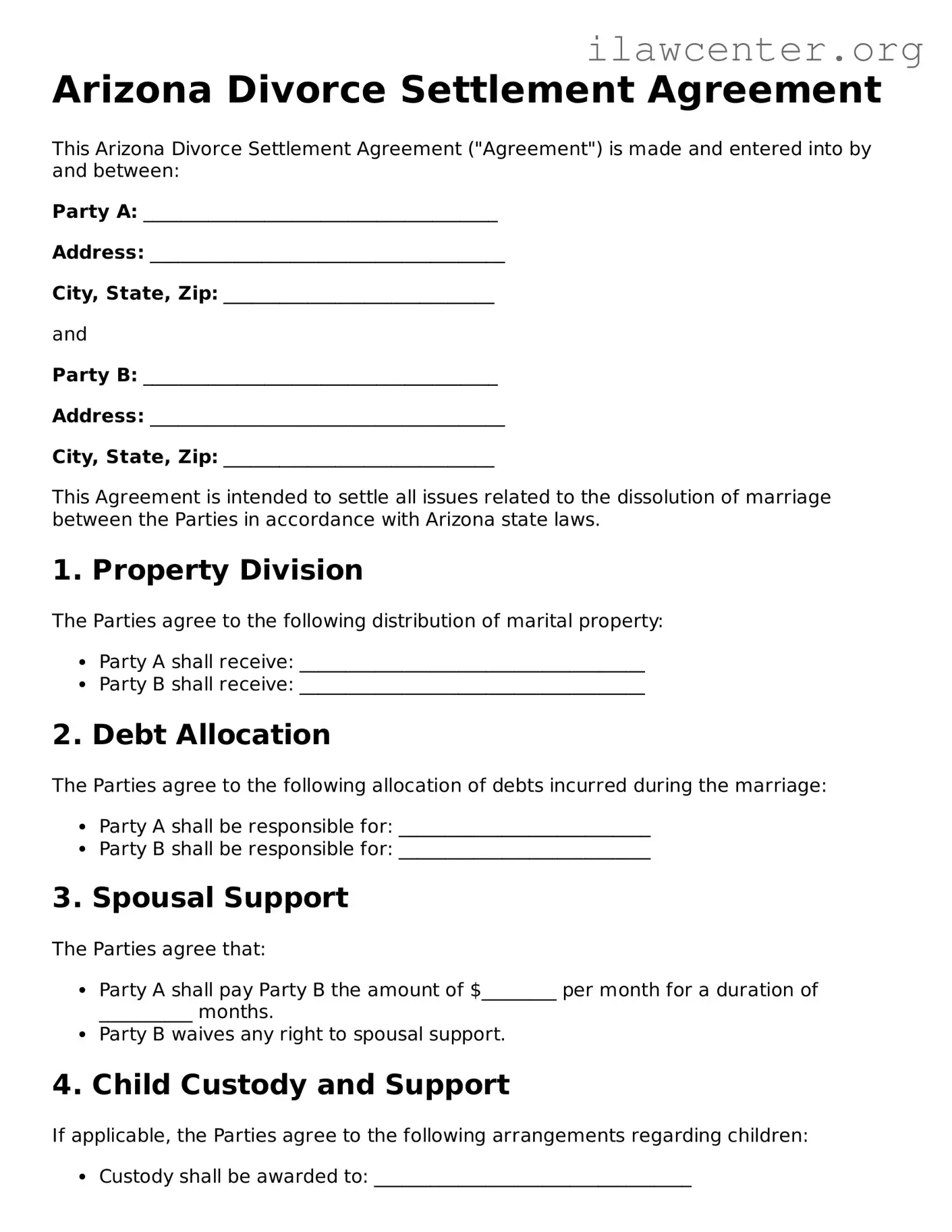
Arizona Divorce Settlement Agreement Preview

Arizona Divorce Settlement Agreement

This Arizona Divorce Settlement Agreement ("Agreement") is made and entered into by and between:

Party A: ______________________________________

Address: ______________________________________

City, State, Zip: _____________________________

and

Party B: ______________________________________

Address: ______________________________________

City, State, Zip: _____________________________

This Agreement is intended to settle all issues related to the dissolution of marriage between the Parties in accordance with Arizona state laws.

1. Property Division

The Parties agree to the following distribution of marital property:

  • Party A shall receive: _____________________________________
  • Party B shall receive: _____________________________________

2. Debt Allocation

The Parties agree to the following allocation of debts incurred during the marriage:

  • Party A shall be responsible for: ___________________________
  • Party B shall be responsible for: ___________________________

3. Spousal Support

The Parties agree that:

  • Party A shall pay Party B the amount of $________ per month for a duration of __________ months.
  • Party B waives any right to spousal support.

4. Child Custody and Support

If applicable, the Parties agree to the following arrangements regarding children:

  • Custody shall be awarded to: __________________________________
  • Child support shall be set at $________ per month.

5. Miscellaneous Provisions

The Parties further agree:

  • This Agreement represents the entire understanding between the Parties.
  • Any modifications must be made in writing and signed by both Parties.

6. Governing Law

This Agreement shall be governed by the laws of the State of Arizona.

IN WITNESS WHEREOF, the Parties have executed this Agreement as of the _____ day of __________, 20__.

Party A Signature: _______________________________

Date: ___________________________________________

Party B Signature: _______________________________

Date: ___________________________________________

PDF Form Characteristics

Fact Name Description
Purpose The Arizona Divorce Settlement Agreement form outlines the terms agreed upon by both parties regarding property division, child custody, and support obligations.
Governing Law This form is governed by Arizona Revised Statutes, Title 25, which covers marriage and divorce laws in the state.
Filing Requirements Both parties must sign the agreement, and it must be submitted to the court during the divorce proceedings for approval.
Enforceability Once approved by the court, the agreement becomes a legally binding document, enforceable by law.

Instructions on Utilizing Arizona Divorce Settlement Agreement

After obtaining the Arizona Divorce Settlement Agreement form, you will need to complete it accurately to ensure that all necessary information is included. Following these steps will help you fill out the form correctly.

  1. Begin by entering the names of both parties involved in the divorce at the top of the form.
  2. Provide the case number, if available. This number can usually be found on any previous court documents related to your divorce.
  3. Fill in the date of the marriage and the date of separation. These dates are important for establishing the timeline of the marriage.
  4. Detail any children from the marriage. Include their names and birthdates. Make sure to indicate whether any child support arrangements are needed.
  5. List all assets and debts acquired during the marriage. Be thorough and honest about the value of each item.
  6. Specify how you and your spouse plan to divide the assets and debts. Clearly outline who will receive what.
  7. Include any agreements regarding spousal support, if applicable. State the amount and duration of support, if agreed upon.
  8. Both parties should review the form for accuracy. Make sure all information is correct before signing.
  9. Sign and date the form. Both parties must sign to indicate agreement to the terms outlined.
  10. Submit the completed form to the appropriate court, along with any required filing fees.

Important Facts about Arizona Divorce Settlement Agreement

What is an Arizona Divorce Settlement Agreement?

An Arizona Divorce Settlement Agreement is a legal document that outlines the terms agreed upon by both spouses during a divorce. This agreement typically covers important issues such as property division, child custody, visitation rights, child support, and spousal support. It serves to ensure that both parties are on the same page regarding their responsibilities and rights after the divorce is finalized.

Do I need a lawyer to create a Divorce Settlement Agreement?

How do I file the Divorce Settlement Agreement with the court?

After both parties have signed the Divorce Settlement Agreement, it must be filed with the appropriate court. This typically involves submitting the agreement along with other required documents, such as a Petition for Dissolution of Marriage. Be sure to check with your local court for specific filing procedures and fees. Once filed, the court will review the agreement to ensure it is fair and in the best interest of any children involved.

Can the terms of the Divorce Settlement Agreement be modified later?

Yes, the terms of a Divorce Settlement Agreement can be modified, but this usually requires a court's approval. If circumstances change significantly—such as a change in income, relocation, or changes in the needs of children—either party may request a modification. It is essential to document any changes and follow the proper legal procedures to ensure that the new terms are enforceable.

What happens if one party does not comply with the Divorce Settlement Agreement?

If one party fails to comply with the terms of the Divorce Settlement Agreement, the other party can take legal action to enforce the agreement. This may involve filing a motion with the court to compel compliance or seeking a modification of the agreement. Courts take these matters seriously, especially when they involve child custody or support, so it is crucial to address any non-compliance promptly.

Is the Divorce Settlement Agreement legally binding?

Yes, once it is signed by both parties and approved by the court, the Divorce Settlement Agreement becomes legally binding. This means that both parties are required to adhere to its terms. If either party fails to do so, they may face legal consequences. It is vital to fully understand the agreement before signing, as it will govern your rights and obligations post-divorce.

Common mistakes

Filling out the Arizona Divorce Settlement Agreement form can be a daunting task, and mistakes are common. One frequent error is not providing complete information. Each section of the form requires specific details, and leaving out even small pieces can lead to delays or complications in the divorce process. It’s essential to read each section carefully and ensure all required information is included.

Another common mistake is failing to understand the legal terms used in the agreement. Many people may not be familiar with terms like "community property" or "separate property." Misunderstanding these concepts can lead to improper asset division. It’s important to take the time to research these terms or consult with a professional to avoid any confusion.

Many individuals also overlook the importance of including all assets and debts in the agreement. It’s easy to forget about certain items, especially if they seem minor. However, every asset and debt should be accounted for to ensure a fair settlement. This includes bank accounts, retirement accounts, and even personal property like vehicles and jewelry.

Additionally, some people may not consider the tax implications of their settlement. For instance, certain assets may have tax consequences that could affect the overall value of the settlement. It’s wise to think about how taxes will impact both parties and include this consideration in the agreement.

Another mistake is not being specific enough in the terms of the agreement. Vague language can lead to misunderstandings down the line. It’s crucial to clearly outline responsibilities, such as who will pay which bills or how assets will be divided. Specificity helps prevent conflicts in the future.

People often forget to include a plan for child custody and support if children are involved. This aspect is vital for ensuring the well-being of the children and should be addressed thoroughly. Both parents need to agree on custody arrangements and financial support to avoid future disputes.

Some individuals may also rush through the process, thinking that a quick completion will save time. However, taking the time to review and double-check the form can prevent costly mistakes. A rushed agreement can lead to oversights that might affect the settlement's fairness.

Another mistake is failing to sign and date the form properly. This may seem trivial, but missing signatures or incorrect dates can render the agreement invalid. Each party must ensure that all necessary signatures are included and that they are dated correctly.

Finally, not seeking legal advice can be a significant oversight. While it is possible to fill out the form independently, having a lawyer review the agreement can provide peace of mind. Legal professionals can spot potential issues and help ensure that the agreement is fair and compliant with Arizona law.

Documents used along the form

When navigating a divorce in Arizona, several forms and documents may accompany the Divorce Settlement Agreement. Each of these documents serves a specific purpose and can help streamline the process. Here’s a brief overview of six commonly used forms.

  • Petition for Dissolution of Marriage: This document initiates the divorce process. It outlines the reasons for the divorce and requests the court to dissolve the marriage.
  • Response to Petition: If you receive a Petition for Dissolution, this form allows you to respond formally. It lets the court know your position regarding the divorce and any requests you may have.
  • Financial Affidavit: This form details each party’s financial situation, including income, expenses, assets, and debts. It is crucial for determining support obligations and property division.
  • Child Support Worksheet: If children are involved, this worksheet calculates the appropriate amount of child support based on income and custody arrangements.
  • Parenting Plan: This document outlines the custody and visitation arrangements for any children. It addresses how decisions will be made and how parenting time will be shared.
  • Final Judgment: Once the divorce is finalized, this document reflects the court's decisions regarding the divorce terms, including asset division, support, and custody arrangements.

Understanding these documents can make the divorce process more manageable. Each form plays a vital role in ensuring that all aspects of the divorce are addressed fairly and thoroughly.

Similar forms

The Divorce Settlement Agreement is an important document that outlines the terms of a divorce, including the division of assets, child custody arrangements, and spousal support. Several other documents serve similar purposes in different contexts. Here are six documents that share similarities with the Divorce Settlement Agreement:

  • Child Custody Agreement: This document specifically addresses the arrangements for the care and custody of children following a divorce. Like the Divorce Settlement Agreement, it outlines responsibilities and rights, ensuring that the best interests of the children are prioritized.
  • Separation Agreement: Before a divorce is finalized, couples may create a separation agreement. This document lays out the terms of living apart, including financial responsibilities and property division, much like the Divorce Settlement Agreement does after the divorce is filed.
  • Marital Settlement Agreement: Similar to the Divorce Settlement Agreement, this document details the terms agreed upon by both parties regarding the division of assets and debts. It is often used interchangeably with the Divorce Settlement Agreement, especially in no-fault divorces.
  • Property Settlement Agreement: This document focuses specifically on how marital property will be divided between spouses. It can be a part of the Divorce Settlement Agreement, but it can also stand alone, emphasizing the division of tangible and intangible assets.
  • Parenting Plan: This document outlines how parents will raise their children post-divorce. It includes schedules for visitation, decision-making responsibilities, and communication strategies, paralleling the child custody elements found in the Divorce Settlement Agreement.
  • Spousal Support Agreement: When one spouse is entitled to receive financial support from the other, a spousal support agreement is drafted. This document details the amount and duration of support, similar to the spousal support provisions often included in a Divorce Settlement Agreement.

Each of these documents serves to clarify the rights and responsibilities of individuals involved in a separation or divorce, ensuring that both parties have a mutual understanding of the terms agreed upon.

Dos and Don'ts

When filling out the Arizona Divorce Settlement Agreement form, it’s important to be careful and thorough. Here’s a list of things to do and avoid:

  • Do read the instructions carefully before starting.
  • Do provide accurate and complete information.
  • Do discuss the terms with your spouse, if possible.
  • Do keep copies of all documents for your records.
  • Do seek legal advice if you have questions or concerns.
  • Don’t rush through the form; take your time.
  • Don’t omit any assets or debts; be transparent.
  • Don’t use vague language; be specific about terms.
  • Don’t forget to sign and date the agreement.
  • Don’t ignore deadlines; submit the form on time.

Following these guidelines can help ensure that your divorce settlement process goes smoothly.

Misconceptions

  • Misconception 1: The Divorce Settlement Agreement is only necessary if children are involved.

    This is not true. A Divorce Settlement Agreement is essential for all divorces, regardless of whether children are part of the equation. It outlines the terms of the divorce, including property division and spousal support.

  • Misconception 2: The form is too complicated for the average person to fill out.

    While legal documents can seem daunting, the Arizona Divorce Settlement Agreement form is designed to be straightforward. With careful reading and attention to detail, most individuals can complete it without legal assistance.

  • Misconception 3: Once signed, the agreement cannot be changed.

    This is incorrect. Parties can modify the agreement if both spouses agree to the changes. It is advisable to document any amendments formally.

  • Misconception 4: The agreement only covers financial matters.

    In reality, the Divorce Settlement Agreement can address various issues, including child custody, visitation rights, and property division. It serves as a comprehensive guide to the terms of the divorce.

  • Misconception 5: You do not need to file the agreement with the court.

    This is a common misunderstanding. The agreement must be filed with the court to be legally binding. Failing to do so can lead to complications in the divorce process.

  • Misconception 6: Only one spouse needs to sign the agreement.

    Both parties must sign the Divorce Settlement Agreement for it to be valid. This ensures that both spouses agree to the terms outlined in the document.

  • Misconception 7: Legal representation is not necessary to complete the agreement.

    While it is possible to complete the form without a lawyer, having legal representation can provide valuable guidance. An attorney can help ensure that the agreement is fair and complies with state laws.

Key takeaways

When filling out and using the Arizona Divorce Settlement Agreement form, it is important to keep several key points in mind. These will help ensure that the process goes smoothly and that all necessary details are addressed.

  • Understand the Purpose: The Divorce Settlement Agreement outlines the terms of the divorce, including property division, child custody, and support obligations.
  • Complete All Sections: Ensure that every section of the form is filled out completely. Missing information can delay the process.
  • Be Clear and Specific: Use clear language to describe agreements. Ambiguities can lead to misunderstandings later on.
  • Consider Legal Advice: It may be beneficial to consult with a lawyer, especially if there are complex issues involved.
  • Include Financial Information: Provide accurate financial details, including income, expenses, and assets. This information is crucial for fair negotiations.
  • Review Before Submitting: Carefully review the completed form for any errors or omissions before submission to the court.
  • File with the Court: Once completed, the agreement must be filed with the appropriate court to become legally binding.
  • Keep Copies: Always keep copies of the signed agreement for your records. This will be important for future reference.

By following these key takeaways, individuals can navigate the Divorce Settlement Agreement process with greater confidence and clarity.