Attorney-Verified  Motor Vehicle Power of Attorney Document for Arizona

Attorney-Verified Motor Vehicle Power of Attorney Document for Arizona

The Arizona Motor Vehicle Power of Attorney form allows an individual to authorize another person to handle specific motor vehicle transactions on their behalf. This form is useful for managing tasks such as vehicle registration, title transfer, and other related activities. To get started, fill out the form by clicking the button below.

Article Guide

The Arizona Motor Vehicle Power of Attorney form serves as a crucial tool for individuals seeking to delegate authority regarding their vehicle-related matters. This document empowers a designated agent to act on behalf of the vehicle owner in various transactions, such as registering a vehicle, transferring ownership, or handling title issues. By utilizing this form, individuals can ensure that their interests are represented even when they cannot be present to manage these affairs personally. It is essential for vehicle owners to understand the scope of authority granted to the agent, which can include signing documents and making decisions related to the vehicle. Additionally, this form must be completed accurately and signed in accordance with state requirements to be legally valid. Understanding the implications and responsibilities that come with this power is vital for both the principal and the agent, ensuring a smooth process in managing vehicle-related transactions.

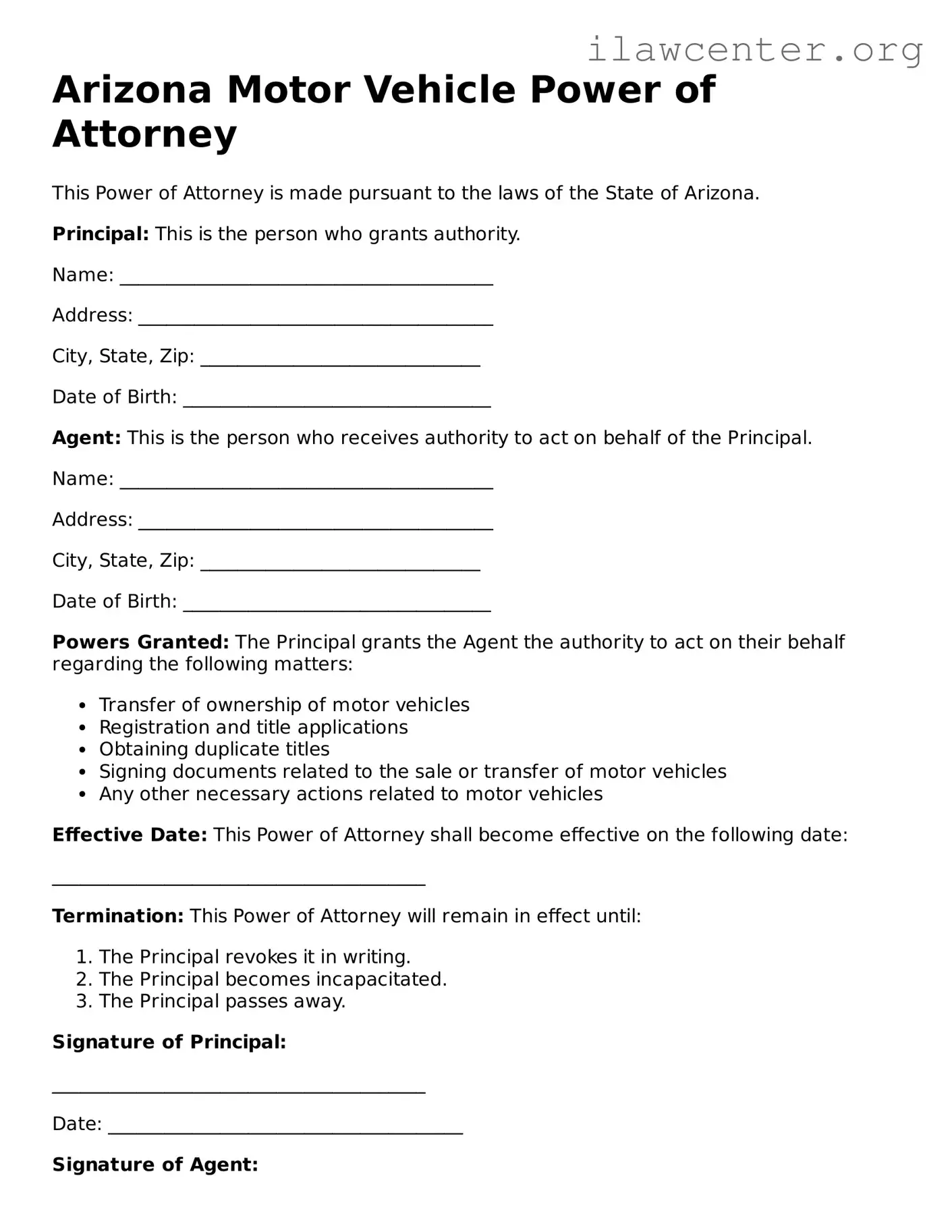
Arizona Motor Vehicle Power of Attorney Preview

Arizona Motor Vehicle Power of Attorney

This Power of Attorney is made pursuant to the laws of the State of Arizona.

Principal: This is the person who grants authority.

Name: ________________________________________

Address: ______________________________________

City, State, Zip: ______________________________

Date of Birth: _________________________________

Agent: This is the person who receives authority to act on behalf of the Principal.

Name: ________________________________________

Address: ______________________________________

City, State, Zip: ______________________________

Date of Birth: _________________________________

Powers Granted: The Principal grants the Agent the authority to act on their behalf regarding the following matters:

  • Transfer of ownership of motor vehicles
  • Registration and title applications
  • Obtaining duplicate titles
  • Signing documents related to the sale or transfer of motor vehicles
  • Any other necessary actions related to motor vehicles

Effective Date: This Power of Attorney shall become effective on the following date:

________________________________________

Termination: This Power of Attorney will remain in effect until:

  1. The Principal revokes it in writing.
  2. The Principal becomes incapacitated.
  3. The Principal passes away.

Signature of Principal:

________________________________________

Date: ______________________________________

Signature of Agent:

________________________________________

Date: ______________________________________

Witnesses:

1. Name: ________________________________ Signature: ________________________ Date: _____________

2. Name: ________________________________ Signature: ________________________ Date: _____________

This document must be notarized to be valid.

PDF Form Characteristics

Fact Name Description
Purpose The Arizona Motor Vehicle Power of Attorney form allows an individual to designate another person to handle motor vehicle transactions on their behalf.
Governing Law This form is governed by Arizona Revised Statutes, specifically Title 28, Chapter 10.
Signatures Required The form must be signed by the principal and may require notarization for certain transactions.
Revocation The power of attorney can be revoked at any time by the principal, provided they notify the agent in writing.
Usage Limitations This form is specifically for motor vehicle-related matters and cannot be used for other legal or financial decisions.

Instructions on Utilizing Arizona Motor Vehicle Power of Attorney

Once you have the Arizona Motor Vehicle Power of Attorney form, you will need to fill it out accurately to ensure it is valid. This process involves providing specific information about both the principal and the agent, as well as detailing the powers being granted. Follow these steps carefully to complete the form.

  1. Obtain the Arizona Motor Vehicle Power of Attorney form from a reliable source, such as the Arizona Department of Transportation website or a legal office.
  2. Begin by entering the full name and address of the principal (the person granting authority) in the designated section.
  3. Next, provide the full name and address of the agent (the person receiving authority) in the appropriate fields.
  4. Specify the powers being granted to the agent. This may include tasks such as signing documents, transferring ownership, or handling vehicle registration.
  5. Indicate the effective date of the power of attorney. This can be immediate or set for a future date.
  6. Sign and date the form in the space provided. The principal's signature is essential for the form to be valid.
  7. If required, have the form notarized. This step may depend on the specific requirements of the Arizona Department of Transportation.
  8. Make copies of the completed form for both the principal and the agent for their records.

Important Facts about Arizona Motor Vehicle Power of Attorney

What is a Motor Vehicle Power of Attorney in Arizona?

A Motor Vehicle Power of Attorney (POA) in Arizona allows you to appoint someone else to handle specific tasks related to your vehicle. This can include signing documents, transferring ownership, or registering a vehicle on your behalf. It is useful if you cannot be present for these transactions due to time constraints or other reasons.

Who can be appointed as an agent in the Motor Vehicle Power of Attorney?

Any adult can be appointed as your agent. This can be a family member, friend, or even a professional, like a lawyer. It is important to choose someone you trust, as they will have the authority to make decisions regarding your vehicle.

How do I complete the Motor Vehicle Power of Attorney form?

To complete the form, you will need to provide your name, the name of your agent, and details about the vehicle, such as the make, model, and VIN (Vehicle Identification Number). Make sure to sign and date the form. It is advisable to have the document notarized to ensure its validity.

Is there a specific format for the Motor Vehicle Power of Attorney form?

Yes, Arizona has a specific form that must be used for a Motor Vehicle Power of Attorney. You can usually find this form on the Arizona Department of Transportation (ADOT) website or at your local motor vehicle division office. Using the correct form helps ensure that it will be accepted by the authorities.

Does the Motor Vehicle Power of Attorney expire?

The Motor Vehicle Power of Attorney does not automatically expire unless you specify an expiration date on the form. However, it is a good idea to review the document periodically and revoke it if you no longer need it or if your agent is no longer suitable for the role.

Common mistakes

Filling out the Arizona Motor Vehicle Power of Attorney form can seem straightforward, but many people make common mistakes that can complicate the process. One frequent error is not providing complete information about the principal and the agent. It's crucial to include full names, addresses, and contact details. Missing even a small piece of information can lead to delays or the rejection of the form.

Another common mistake is failing to sign the form. While it may seem obvious, some individuals forget to provide their signature, or they might sign in the wrong place. Each signature is a declaration of intent, and without it, the document lacks validity.

Some people overlook the importance of specifying the powers granted to the agent. The form should clearly outline what actions the agent can take on behalf of the principal. If the powers are vague or too broad, it could lead to confusion or misuse of authority.

Additionally, individuals sometimes forget to date the form. A date is essential as it indicates when the authority was granted. Without a date, there could be questions about the timeline of the agent’s powers, especially if disputes arise later.

Another mistake is not having the form notarized when required. While notarization may not always be necessary, certain situations or transactions might require it to ensure authenticity. Failing to have the document notarized can lead to complications when trying to use it.

People also tend to ignore the instructions provided with the form. Each section is designed for specific information, and not adhering to these guidelines can result in incomplete or incorrect submissions. Taking the time to read the instructions can save a lot of hassle later on.

Moreover, some individuals do not keep copies of the completed form. It is wise to retain a copy for personal records. If questions arise in the future, having a copy can provide clarity and peace of mind.

Another mistake is neglecting to inform the agent about their responsibilities. It is essential for the principal to communicate clearly with the agent regarding the powers granted and any specific instructions. Without this communication, the agent may not act in the best interest of the principal.

Finally, many people underestimate the importance of reviewing the form before submission. Errors can easily go unnoticed, and a thorough review can help catch mistakes that could lead to complications. Taking a moment to double-check the information can make a significant difference in ensuring the form is processed smoothly.

Documents used along the form

When dealing with vehicle-related transactions in Arizona, it is often necessary to use various forms and documents alongside the Motor Vehicle Power of Attorney. These documents help streamline processes and ensure that all legal requirements are met. Below is a list of commonly used forms that may accompany the Power of Attorney.

  • Arizona Vehicle Registration Application: This form is used to register a vehicle in Arizona. It includes details about the vehicle and the owner, ensuring that the vehicle is legally recognized by the state.
  • Bill of Sale: A bill of sale serves as a receipt for the sale of a vehicle. It outlines the terms of the sale, including the purchase price and the names of the buyer and seller.
  • Title Application: This document is necessary when applying for a new title for a vehicle. It provides information about the vehicle and the new owner, facilitating the transfer of ownership.
  • Affidavit of Loss or Theft: If a vehicle title is lost or stolen, this affidavit allows the owner to declare the loss officially. It is often required when applying for a duplicate title.
  • Vehicle Emissions Compliance Certificate: In certain areas of Arizona, vehicles must pass emissions tests. This certificate verifies that the vehicle meets state emissions standards.
  • Insurance Verification Form: This form confirms that the vehicle is insured. It is often required when registering a vehicle or applying for a title.
  • Release of Liability: This document protects the seller from future liability related to the vehicle after it has been sold. It ensures that the seller is no longer responsible for the vehicle.
  • VIN Verification Form: This form is used to verify the vehicle identification number (VIN) for registration purposes. It is especially important for vehicles coming from out of state.
  • Application for Duplicate Title: If the original title is lost, this application is used to request a duplicate. It requires information about the vehicle and the owner.

Having these documents prepared and organized can simplify the process of managing vehicle transactions in Arizona. It is always advisable to ensure that all necessary forms are completed accurately to avoid potential delays or complications.

Similar forms

The Motor Vehicle Power of Attorney (POA) form allows an individual to designate another person to act on their behalf regarding vehicle-related matters. Several other documents serve similar purposes, empowering individuals to delegate authority in various contexts. Below are eight documents that share similarities with the Motor Vehicle Power of Attorney form:

  • General Power of Attorney: This document grants broad authority to an agent to manage financial and legal matters, similar to how a Motor Vehicle POA allows for vehicle-related decisions.
  • Limited Power of Attorney: This form restricts the agent's authority to specific tasks or timeframes, akin to the specific vehicle-related powers granted in a Motor Vehicle POA.
  • Durable Power of Attorney: This document remains effective even if the principal becomes incapacitated, just like a Motor Vehicle POA can be utilized regardless of the principal's availability.
  • Healthcare Power of Attorney: This allows an agent to make medical decisions on behalf of the principal, paralleling the authority given in a Motor Vehicle POA for vehicle matters.
  • Financial Power of Attorney: Similar to a General POA, this document specifically focuses on financial decisions, much like how the Motor Vehicle POA centers on vehicle transactions.
  • Real Estate Power of Attorney: This document empowers an agent to handle real estate transactions, resembling the Motor Vehicle POA's focus on vehicle ownership and transfers.
  • Trustee Authorization: In a trust context, this document allows a trustee to manage trust assets, similar to how a Motor Vehicle POA allows for the management of a vehicle.
  • Business Power of Attorney: This grants authority to manage business-related decisions, paralleling the Motor Vehicle POA in its delegation of authority for specific actions.

Each of these documents serves to empower individuals to act on behalf of another, ensuring that important decisions can be made even when the principal is unavailable or unable to act. Understanding the nuances of these documents can help individuals choose the right one for their specific needs.

Dos and Don'ts

When filling out the Arizona Motor Vehicle Power of Attorney form, it’s essential to follow certain guidelines to ensure accuracy and compliance. Here are seven important things to keep in mind:

  • Do read the entire form carefully before starting to fill it out.
  • Don't leave any required fields blank; incomplete forms may be rejected.
  • Do provide clear and legible information to avoid confusion.
  • Don't sign the form until you are in front of a notary public, if required.
  • Do double-check the names and addresses for accuracy.
  • Don't use abbreviations unless specified on the form.
  • Do keep a copy of the completed form for your records.

Taking these steps will help ensure that your Power of Attorney is valid and effective. Timeliness and attention to detail are crucial in this process.

Misconceptions

There are several misconceptions surrounding the Arizona Motor Vehicle Power of Attorney form. Understanding these can help individuals navigate the process more effectively.

  • It can only be used for buying and selling vehicles. Many believe that this form is limited to transactions like buying or selling. However, it can also be used for other purposes, such as registering a vehicle or transferring title.
  • Only attorneys can fill out the form. Some think that only legal professionals can complete the form. In reality, any individual can fill it out, as long as they follow the necessary guidelines.
  • It must be notarized to be valid. While notarization adds an extra layer of authenticity, it is not always required for the form to be valid. Certain situations may allow for a simple signature without a notary.
  • Once signed, it cannot be revoked. There is a belief that the Power of Attorney is permanent. In fact, individuals can revoke the form at any time, provided they follow the proper procedures.
  • It is only valid in Arizona. Some assume that this form is only applicable within Arizona. However, it can be recognized in other states, depending on specific circumstances and local laws.
  • It can be used for any type of vehicle. A common misconception is that the form applies to all vehicles. However, it is specifically designed for motor vehicles, which may exclude certain types of vehicles like trailers or boats.

Key takeaways

When dealing with the Arizona Motor Vehicle Power of Attorney form, it is essential to understand its purpose and how to use it effectively. Here are some key takeaways to keep in mind:

  1. Purpose of the Form: The Arizona Motor Vehicle Power of Attorney allows an individual to designate someone else to handle motor vehicle transactions on their behalf.
  2. Who Can Be Designated: You can choose any adult as your agent, but it is advisable to select someone trustworthy and reliable.
  3. Specific Powers: The form can grant specific powers, such as signing title transfers, registering vehicles, or obtaining license plates.
  4. Revocation: You have the right to revoke the power of attorney at any time, as long as you notify your agent and any relevant authorities.
  5. Notarization: While notarization is not always required, having the form notarized can provide an extra layer of authenticity.
  6. Filling Out the Form: Complete the form carefully, ensuring all required fields are filled out accurately to avoid delays.
  7. Submission: Once completed, submit the form to the Arizona Department of Transportation or the relevant local agency handling motor vehicle matters.
  8. Duration: The power of attorney remains effective until revoked or until the specified tasks are completed.
  9. Limitations: Be aware that the powers granted are limited to motor vehicle transactions and do not extend to other legal matters.
  10. Consultation: If unsure about the process, consider consulting with a legal professional to ensure compliance with all requirements.

Understanding these key points can help ensure a smooth experience when using the Arizona Motor Vehicle Power of Attorney form.