Attorney-Verified  Notary Acknowledgement Document for Arizona

Attorney-Verified Notary Acknowledgement Document for Arizona

The Arizona Notary Acknowledgement form is a legal document that verifies the identity of a signer and confirms that they willingly signed a document. This form plays a crucial role in ensuring the authenticity of various legal transactions in Arizona. To complete your own notary acknowledgement, click the button below.

Article Guide

The Arizona Notary Acknowledgement form plays a crucial role in the notarization process, ensuring that documents are executed properly and with the necessary legal recognition. This form is typically used when an individual, known as the signer, needs to verify their identity and confirm that they are signing a document willingly and without coercion. The notary public, a state-appointed official, is responsible for witnessing the signature and adding their seal to the document. This act of acknowledgment helps to prevent fraud and adds an extra layer of credibility to the signed document. It is important to note that the form includes specific information, such as the date of the acknowledgment, the name of the signer, and the notary's details. Understanding the components and requirements of the Arizona Notary Acknowledgement form is essential for anyone looking to navigate legal documents effectively in the state.

Arizona Notary Acknowledgement Preview

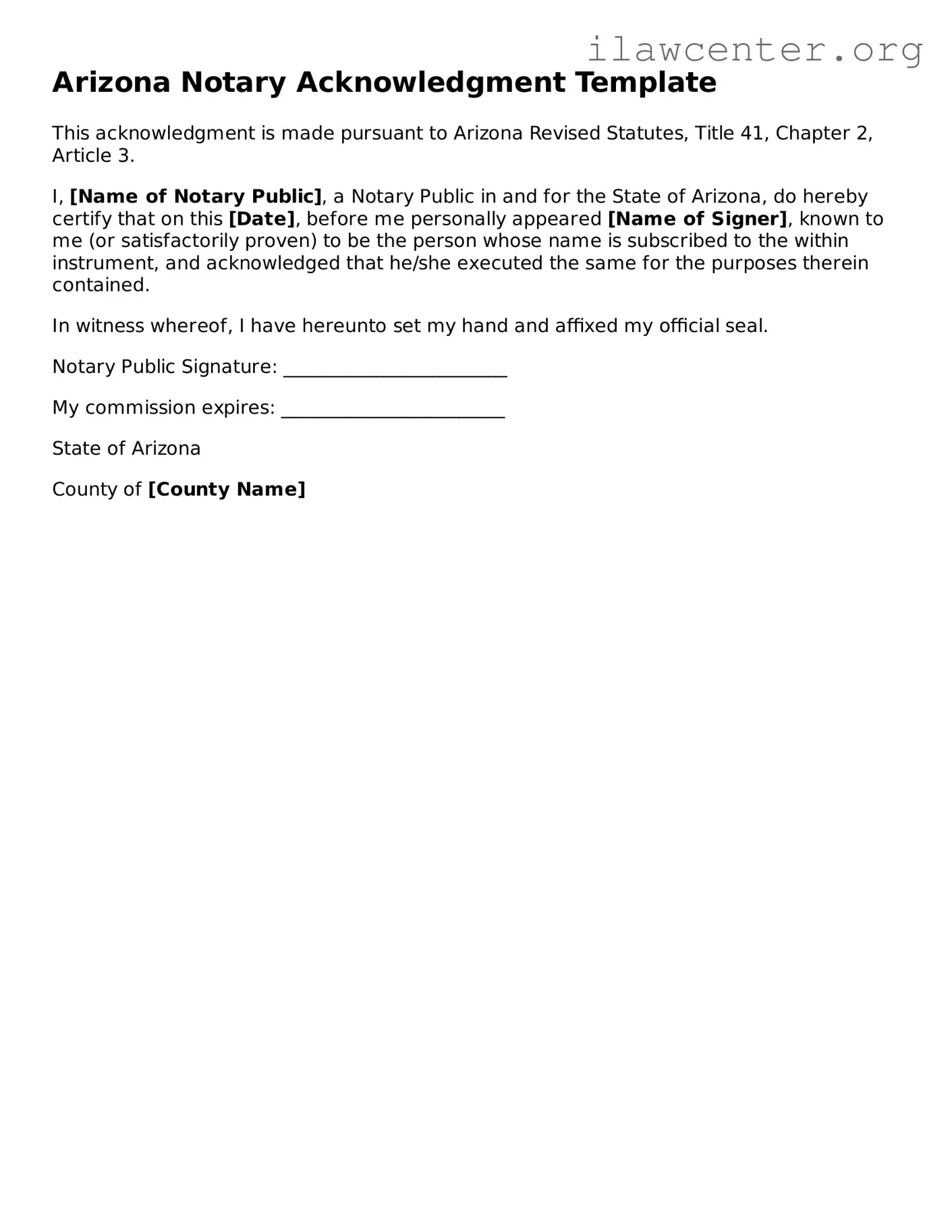
Arizona Notary Acknowledgment Template

This acknowledgment is made pursuant to Arizona Revised Statutes, Title 41, Chapter 2, Article 3.

I, [Name of Notary Public], a Notary Public in and for the State of Arizona, do hereby certify that on this [Date], before me personally appeared [Name of Signer], known to me (or satisfactorily proven) to be the person whose name is subscribed to the within instrument, and acknowledged that he/she executed the same for the purposes therein contained.

In witness whereof, I have hereunto set my hand and affixed my official seal.

Notary Public Signature: ________________________

My commission expires: ________________________

State of Arizona

County of [County Name]

PDF Form Characteristics

Fact Name Details
Purpose The Arizona Notary Acknowledgement form is used to verify the identity of a signer and confirm that they signed a document willingly.
Governing Law This form is governed by Arizona Revised Statutes, Title 41, Chapter 3, which covers notaries public.
Signature Requirement The signer must appear in person before the notary at the time of signing the document.
Identification The notary must verify the signer's identity using a government-issued photo ID or other acceptable forms of identification.
Record Keeping Notaries are required to keep a record of each acknowledgment in their notary journal.
Expiration The notary acknowledgment does not expire but is tied to the document it accompanies.

Instructions on Utilizing Arizona Notary Acknowledgement

After gathering the necessary information, you are ready to fill out the Arizona Notary Acknowledgment form. This form requires specific details that must be accurately completed to ensure its validity. Follow the steps below to complete the form correctly.

  1. Start by entering the date on which the acknowledgment is being made.
  2. In the section for the signer’s name, write the full legal name of the person whose signature is being acknowledged.
  3. Next, indicate the type of identification used by the signer. This could be a driver’s license, passport, or another form of ID.
  4. Provide the state and county where the acknowledgment is taking place.
  5. Leave space for the notary public's signature, which will be added later.
  6. Finally, fill in the notary's printed name and title, along with their commission expiration date.

Once the form is completed, it will need to be signed by the notary public in the designated area. Ensure that all information is clear and legible to avoid any issues later on.

Important Facts about Arizona Notary Acknowledgement

What is an Arizona Notary Acknowledgement form?

The Arizona Notary Acknowledgement form is a legal document that serves to confirm the identity of a signer. It is typically used when someone is signing a document and a notary public needs to verify that the individual is who they claim to be. This form includes information about the signer, the notary, and the document being acknowledged.

When is a Notary Acknowledgement necessary in Arizona?

A Notary Acknowledgement is necessary when a document requires notarization to be considered valid. This is common for legal documents such as deeds, mortgages, and powers of attorney. Notarization adds an extra layer of authenticity and can be crucial in legal proceedings.

Who can serve as a notary public in Arizona?

In Arizona, a notary public must be at least 18 years old, a resident of the state, and not have a felony conviction. Additionally, they must complete an application process that includes passing a background check and obtaining a notary bond. Once these requirements are met, the individual can perform notarial acts.

What information is required on the Notary Acknowledgement form?

The form typically requires the name and signature of the signer, the date of the acknowledgment, the name of the notary, and the notary's signature and seal. It may also include details about the document being acknowledged. Accurate information is crucial to ensure the validity of the notarization.

Can a Notary Acknowledgement be done remotely in Arizona?

Yes, Arizona allows for remote notarization under specific conditions. Notaries must use approved technology to verify the identity of the signer through audio-visual communication. This flexibility can be beneficial for individuals unable to meet in person, but it is essential to follow the state's regulations closely.

How long is a Notary Acknowledgement valid in Arizona?

A Notary Acknowledgement does not have an expiration date in itself. However, the underlying document may have its own validity period. It is wise to check the specific requirements for the document being acknowledged to ensure it remains enforceable.

What happens if a Notary Acknowledgement is improperly completed?

If a Notary Acknowledgement is not completed correctly, it may render the notarization invalid. This can lead to complications, especially if the document is challenged in court. It is critical for both the notary and the signer to ensure that all required information is accurate and complete.

Are there fees associated with notarizing a document in Arizona?

Yes, notaries in Arizona are allowed to charge a fee for their services. The maximum fee for an acknowledgment is set by state law. It is advisable to confirm the fee with the notary beforehand to avoid any surprises.

Where can I find a notary public in Arizona?

Notaries can be found in various locations, including banks, law offices, and postal service centers. Additionally, online directories and state resources can help locate a notary public. It is essential to ensure that the notary is properly commissioned and in good standing.
Common mistakes

When filling out the Arizona Notary Acknowledgment form, many individuals make common mistakes that can lead to delays or rejections. One frequent error is failing to include the correct date. The acknowledgment must reflect the date when the notary performed the act. If this date is missing or incorrect, it can invalidate the document.

Another common mistake is neglecting to provide the signer’s name exactly as it appears on the identification. This is crucial for ensuring that the notary can accurately verify the identity of the signer. Any discrepancies can raise questions about the legitimacy of the acknowledgment.

People often overlook the requirement for the signer to be present during the notarization. Acknowledgments must be made in the presence of the notary. If the signer is not physically present, the notary cannot complete the acknowledgment, rendering it ineffective.

In addition, some individuals forget to include the notary’s official seal. The seal is a vital part of the acknowledgment process. Without it, the document may not be considered valid. Ensure that the seal is clear and legible to avoid issues.

Another mistake involves not providing the proper venue. The acknowledgment should specify where the notarization took place. Omitting this information can lead to confusion and may cause the document to be questioned later.

Many people also fail to sign the acknowledgment form in the designated area. This can lead to the form being incomplete. Each signature must be placed where indicated to ensure that the acknowledgment is properly executed.

Lastly, individuals sometimes forget to check for any additional requirements specific to the document being notarized. Different documents may have unique stipulations that must be adhered to. Always review the requirements before submitting the acknowledgment form.

Documents used along the form

When dealing with notarization in Arizona, several forms and documents often accompany the Arizona Notary Acknowledgment form. These documents serve various purposes, ensuring that transactions are legally sound and properly documented. Below are some common forms you may encounter alongside the Notary Acknowledgment.

  • Power of Attorney (POA): This document allows one person to act on behalf of another in legal or financial matters. It grants authority to the agent to make decisions, sign documents, and manage affairs as specified by the principal.
  • Affidavit: An affidavit is a written statement confirmed by oath or affirmation, used as evidence in court. It typically includes facts that the affiant (the person making the statement) swears to be true.
  • Deed: A deed is a legal document that transfers ownership of real property from one party to another. The notary's acknowledgment helps verify that the parties involved signed the deed willingly and with full understanding.
  • Living Will: This document outlines an individual's preferences regarding medical treatment in the event they become unable to communicate their wishes. Notarization can help ensure the document is recognized and respected by healthcare providers.

Understanding these documents can help individuals navigate legal processes more effectively. Each serves a unique purpose, but they all contribute to the integrity and clarity of legal transactions in Arizona.

Similar forms

  • Affidavit: An affidavit is a written statement confirmed by oath or affirmation. Like a notary acknowledgment, it requires a signature and is often used to verify the truthfulness of information.
  • Power of Attorney: This document allows one person to act on behalf of another. Both require notarization to ensure authenticity and prevent fraud.
  • Deed: A deed transfers ownership of property. It must be signed and notarized to be legally binding, similar to the notary acknowledgment process.
  • Mortgage Document: This document secures a loan with real property. Notarization is necessary to validate the agreement, akin to a notary acknowledgment.
  • Living Will: A living will outlines medical decisions. Notarization adds a layer of legitimacy, much like a notary acknowledgment confirms the identity of the signer.
  • Certificate of Acknowledgment: This document verifies that a person has signed a document in the presence of a notary. It serves a similar purpose to the notary acknowledgment form.
  • Trust Agreement: A trust agreement outlines how assets will be managed. Notarization is often required to ensure the document's validity, paralleling the notary acknowledgment.
  • Bill of Sale: This document transfers ownership of personal property. Notarization can be used to confirm the transaction, similar to how a notary acknowledgment functions.
  • Release of Liability: This document protects one party from legal claims. Notarization adds credibility, akin to the notary acknowledgment process.
  • Settlement Agreement: A settlement agreement resolves disputes. Notarization may be required to ensure all parties are bound to the terms, similar to the notary acknowledgment.

Dos and Don'ts

When filling out the Arizona Notary Acknowledgement form, it is important to follow specific guidelines to ensure accuracy and compliance. Here are some key do's and don'ts to consider:

  • Do ensure that the signer is present when the acknowledgment is being completed.
  • Do verify the identity of the signer with a valid form of identification.
  • Do complete all required fields on the form, including the date and location of the acknowledgment.
  • Do use clear and legible handwriting or type the information directly onto the form.
  • Don't sign the form until the signer is present.
  • Don't alter any information on the form after it has been signed.
  • Don't forget to include your notary seal and signature where required.

By adhering to these guidelines, you can help ensure that the notarization process is smooth and legally valid.

Misconceptions

There are several misconceptions surrounding the Arizona Notary Acknowledgment form. Understanding these misconceptions can help individuals navigate the notarization process more effectively. Below is a list of common misunderstandings:

  • Notaries can provide legal advice. Many people believe that notaries are qualified to offer legal guidance. In reality, notaries are not authorized to give legal advice and should not be relied upon for such matters.
  • All notarizations are the same. Some individuals think that all notarization processes are identical. However, different types of notarizations, such as acknowledgments and jurats, serve distinct purposes and require different procedures.
  • The signer must appear in person. A common belief is that the signer can be notarized without being physically present. In Arizona, the signer must be present for the notary to perform the acknowledgment.
  • Notaries can refuse to notarize any document. While notaries have the discretion to refuse a notarization, they must have valid reasons, such as a lack of proper identification or if they suspect fraud.
  • Notary acknowledgments are only for real estate transactions. Many assume that acknowledgments are exclusively for real estate documents. In fact, acknowledgments can be used for a variety of documents, including contracts and affidavits.
  • Notaries are responsible for the content of the document. Some people mistakenly believe that notaries must verify the accuracy of the document being signed. Notaries only confirm the identity of the signer and their willingness to sign.
  • Once notarized, a document is automatically valid. It is a misconception that notarization guarantees a document's legality. Notarization does not validate the content; it only verifies the signing process.
  • Notaries can charge any fee they want. There is a belief that notaries can set their own fees without limitation. In Arizona, notaries must adhere to the fee schedule established by state law.

Addressing these misconceptions can help individuals better understand the role of notaries and the importance of the acknowledgment process in Arizona.

Key takeaways

When filling out and using the Arizona Notary Acknowledgement form, consider the following key points:

  • The form must include the name of the person signing the document and their signature.
  • It is essential to provide the date on which the acknowledgment is made.
  • The notary public must sign the form and affix their official seal to validate the acknowledgment.
  • Ensure that the form is completed in full, as incomplete forms may not be accepted.