Attorney-Verified  Promissory Note Document for Arizona

Attorney-Verified Promissory Note Document for Arizona

A Promissory Note is a written promise to pay a specified amount of money to a designated person or entity at a future date or on demand. In Arizona, this form serves as a crucial legal document that outlines the terms of a loan agreement, ensuring both parties understand their obligations. If you're ready to create your own Promissory Note, click the button below to get started.

Article Guide

The Arizona Promissory Note form serves as a crucial document in financial transactions, providing a clear outline of the terms under which a borrower agrees to repay a loan to a lender. This form typically includes essential details such as the principal amount, interest rate, payment schedule, and the maturity date. It also specifies the consequences of default, ensuring that both parties understand their rights and obligations. The format is designed to be straightforward, making it accessible for individuals and businesses alike. By utilizing this form, parties can establish a legally binding agreement that protects their interests while facilitating the lending process. Additionally, the Arizona Promissory Note can be tailored to suit various types of loans, whether they are personal, business-related, or for real estate transactions, ensuring flexibility in its application.

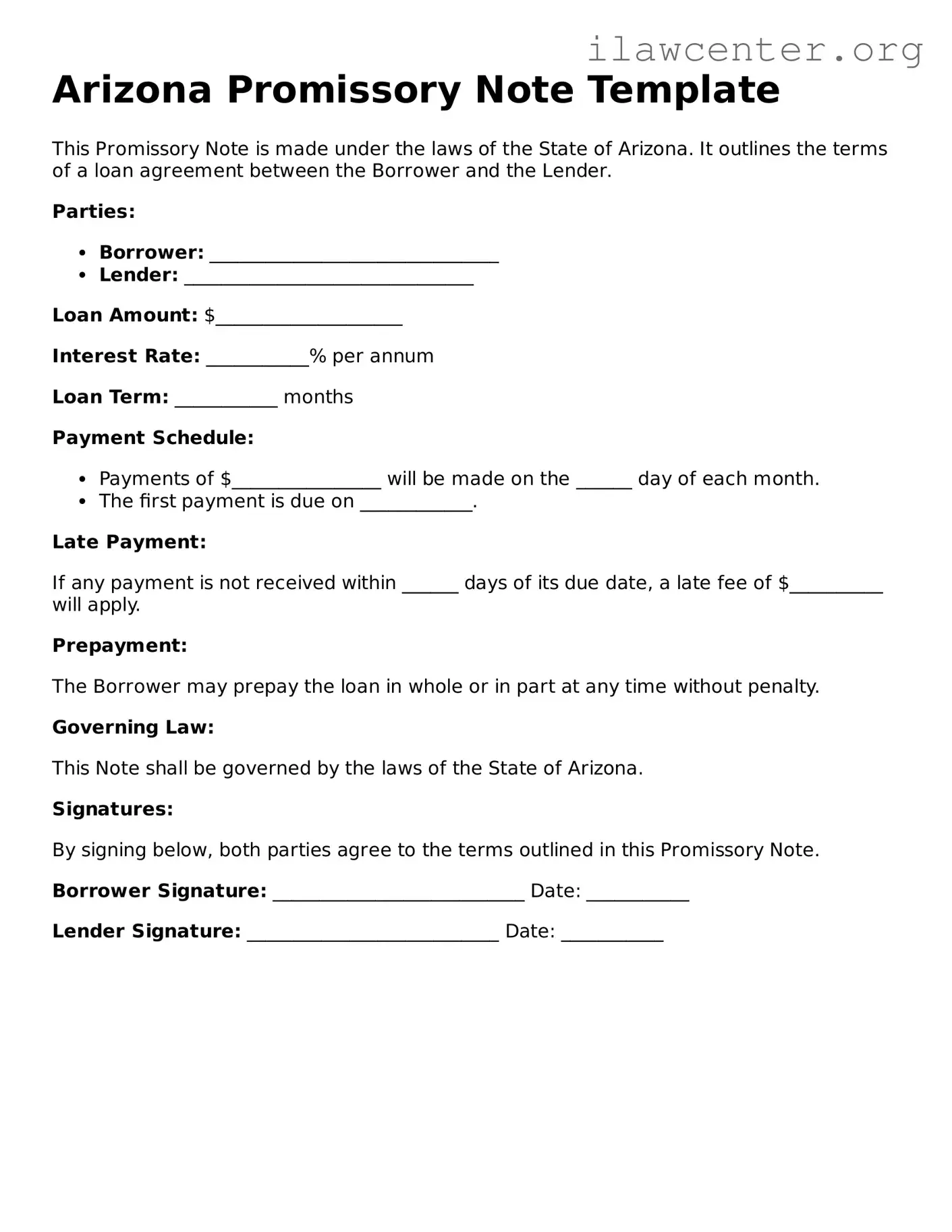
Arizona Promissory Note Preview

Arizona Promissory Note Template

This Promissory Note is made under the laws of the State of Arizona. It outlines the terms of a loan agreement between the Borrower and the Lender.

Parties:

  • Borrower: _______________________________
  • Lender: _______________________________

Loan Amount: $____________________

Interest Rate: ___________% per annum

Loan Term: ___________ months

Payment Schedule:

  • Payments of $________________ will be made on the ______ day of each month.
  • The first payment is due on ____________.

Late Payment:

If any payment is not received within ______ days of its due date, a late fee of $__________ will apply.

Prepayment:

The Borrower may prepay the loan in whole or in part at any time without penalty.

Governing Law:

This Note shall be governed by the laws of the State of Arizona.

Signatures:

By signing below, both parties agree to the terms outlined in this Promissory Note.

Borrower Signature: ___________________________ Date: ___________

Lender Signature: ___________________________ Date: ___________

PDF Form Characteristics

Fact Name Description
Definition An Arizona Promissory Note is a written promise to pay a specified amount of money to a designated person or entity at a certain time.
Governing Law The Arizona Revised Statutes, specifically Title 47 (Uniform Commercial Code), govern promissory notes in Arizona.
Parties Involved The document typically involves two parties: the borrower (maker) and the lender (payee).
Interest Rate The note may specify an interest rate, which can be fixed or variable, depending on the agreement between the parties.
Payment Terms Payment terms should be clearly outlined, including the due date and any installment arrangements.
Default Conditions Conditions under which the borrower may be considered in default should be included to protect the lender's interests.
Signatures Required Both the borrower and the lender must sign the note for it to be legally binding.
Enforceability Promissory notes are generally enforceable in court, provided they meet legal requirements.

Instructions on Utilizing Arizona Promissory Note

After you gather all necessary information, you will be ready to complete the Arizona Promissory Note form. This document will outline the terms of the loan, including the amount borrowed, interest rate, and repayment schedule. Follow these steps carefully to ensure accuracy.

  1. Enter the date: Write the date on which you are completing the form at the top.
  2. Identify the borrower: Fill in the full name and address of the person or entity borrowing the money.
  3. Identify the lender: Provide the full name and address of the person or entity lending the money.
  4. State the loan amount: Clearly write the total amount being borrowed in both numbers and words.
  5. Set the interest rate: Specify the annual interest rate for the loan.
  6. Define the repayment terms: Outline how and when the borrower will repay the loan. Include payment frequency and due dates.
  7. Include any late fees: If applicable, indicate any fees for late payments.
  8. Signatures: Both the borrower and lender must sign and date the form to make it legally binding.

Once completed, keep a copy for your records. The lender should retain the original signed document. This will help ensure both parties understand their obligations under the agreement.

Important Facts about Arizona Promissory Note

What is a Promissory Note in Arizona?

A Promissory Note is a legal document that outlines a borrower's promise to repay a loan to a lender. In Arizona, this document serves as a written record of the loan agreement, detailing the amount borrowed, the interest rate, repayment schedule, and any other relevant terms. It is a crucial tool for both parties, providing clarity and protection in financial transactions.

What are the essential elements of an Arizona Promissory Note?

To be valid, an Arizona Promissory Note must include several key components. First, it should clearly state the names of the borrower and lender. Second, it must specify the loan amount and the interest rate. Additionally, the repayment terms, including the schedule and method of payment, should be outlined. Finally, both parties should sign the document to indicate their agreement to the terms.

Is a Promissory Note legally binding in Arizona?

Yes, a Promissory Note is legally binding in Arizona, provided it meets the necessary requirements. Once signed, it creates an obligation for the borrower to repay the loan as specified. If the borrower defaults, the lender has the right to take legal action to recover the owed amount, making it an important tool for enforcing financial agreements.

Do I need a lawyer to create a Promissory Note in Arizona?

While it is not required to have a lawyer draft a Promissory Note, consulting with one can be beneficial. A legal professional can help ensure that the document complies with Arizona laws and adequately protects your interests. If the loan amount is substantial or if the terms are complex, seeking legal advice is often a wise decision.

Can a Promissory Note be modified after it is signed?

Yes, a Promissory Note can be modified after it is signed, but both parties must agree to the changes. It is advisable to document any modifications in writing and have both parties sign the amended agreement. This helps prevent misunderstandings and ensures that the new terms are enforceable.

What happens if the borrower defaults on the Promissory Note?

If the borrower defaults, the lender has several options. They may choose to negotiate a new repayment plan, pursue legal action to recover the owed amount, or, in some cases, initiate foreclosure proceedings if the loan is secured by collateral. The specific actions taken will depend on the terms outlined in the Promissory Note and the nature of the default.

Are there any state-specific requirements for Promissory Notes in Arizona?

Arizona does not impose overly complex requirements for Promissory Notes, but it is important to ensure that the document is clear and unambiguous. While notarization is not mandatory, having the document notarized can enhance its credibility and may be beneficial in case of disputes. Always check for any updates to state laws that may affect the creation and enforcement of Promissory Notes.
Common mistakes

Filling out a Promissory Note form in Arizona can seem straightforward, but many individuals make common mistakes that can lead to complications down the line. Understanding these pitfalls can help ensure that the document is completed correctly and serves its intended purpose.

One frequent error is failing to include all necessary parties. The form should clearly identify both the borrower and the lender. Omitting a name or using incorrect spelling can create confusion and may affect the enforceability of the note. Always double-check the names to ensure accuracy.

Another mistake is neglecting to specify the loan amount. The amount borrowed should be stated clearly in both numerical and written form. This redundancy helps avoid misunderstandings. If only one format is used, it could lead to disputes about the actual amount owed.

Many people also overlook the importance of including the interest rate. If the loan carries interest, it must be explicitly stated. Not doing so can result in legal ambiguity. If the interest rate is left blank, it may default to a statutory rate, which might not reflect the lender's intentions.

Additionally, individuals often forget to set a repayment schedule. The Promissory Note should outline when payments are due and how they will be made. Without this information, both parties may have different expectations, leading to potential conflicts.

Another common error is failing to sign the document. A Promissory Note is not legally binding without the signatures of both the borrower and lender. It’s essential to ensure that all parties sign the form in the appropriate places. Forgetting this step can render the agreement unenforceable.

Some individuals make the mistake of not including a default clause. This clause outlines what happens if the borrower fails to make payments. Without it, the lender may have limited options for recourse in the event of a default, which can complicate recovery efforts.

Lastly, many people do not keep a copy of the signed Promissory Note. After filling out the form, it’s crucial to retain a copy for personal records. This ensures that both parties have access to the same information and can refer back to the terms of the agreement if necessary.

By being aware of these common mistakes, individuals can fill out the Arizona Promissory Note form more effectively. Taking the time to review each section carefully can prevent future misunderstandings and ensure that the agreement is clear and enforceable.

Documents used along the form

When entering into a lending agreement in Arizona, a Promissory Note is often accompanied by several other important documents. These documents help clarify the terms of the loan, protect the interests of both the lender and the borrower, and ensure that all parties understand their obligations. Below is a list of commonly used forms that complement the Arizona Promissory Note.

  • Loan Agreement: This document outlines the specific terms and conditions of the loan, including the interest rate, repayment schedule, and any collateral involved. It serves as a comprehensive contract between the lender and borrower, detailing all expectations and responsibilities.
  • Security Agreement: If the loan is secured by collateral, this document specifies what the collateral is and how it can be used. It protects the lender’s interests by providing a legal claim to the collateral if the borrower defaults on the loan.
  • Disclosure Statement: This form provides essential information about the loan, including fees, interest rates, and the total cost of borrowing. It ensures that borrowers are fully informed about the financial implications of their loan agreement.
  • Default Notice: In the event that the borrower fails to make payments as agreed, this document serves as a formal notification of default. It outlines the consequences of default and may include options for the borrower to remedy the situation.

Understanding these documents is crucial for anyone involved in a loan transaction. They work together to establish a clear framework for the lending relationship, ensuring that all parties are aware of their rights and responsibilities. By having these documents in place, both lenders and borrowers can navigate the lending process with greater confidence and security.

Similar forms

A Promissory Note is a financial document that outlines a borrower's promise to repay a specified sum of money to a lender under agreed-upon terms. Several other documents share similarities with a Promissory Note in terms of their purpose and structure. Here are nine documents that are comparable:

  • Loan Agreement: Like a Promissory Note, a loan agreement details the terms of borrowing, including the amount, interest rate, and repayment schedule. However, it often includes additional clauses regarding collateral and default conditions.
  • Mortgage: A mortgage is a specific type of loan agreement secured by real estate. It functions similarly to a Promissory Note in that it outlines repayment obligations but also includes the property as collateral.
  • Credit Agreement: This document outlines the terms of a credit facility, including the borrowing limit and repayment terms. It shares the same foundational purpose of documenting a borrower's commitment to repay.
  • Installment Agreement: An installment agreement specifies the repayment of a loan in fixed amounts over time. This is akin to a Promissory Note, which also establishes a repayment plan.
  • Personal Loan Agreement: This is a contract between individuals that specifies the loan amount, interest rate, and repayment schedule, mirroring the structure of a Promissory Note.
  • Business Loan Agreement: Similar to a personal loan agreement, this document outlines the terms of a loan taken out by a business, including repayment terms and interest rates, akin to a Promissory Note.
  • Lease Agreement: While primarily used for renting property, a lease agreement can resemble a Promissory Note in that it outlines payment obligations over a specified term.
  • Debt Settlement Agreement: This document outlines the terms under which a borrower agrees to repay a debt, often for less than the full amount owed, sharing the repayment focus found in a Promissory Note.
  • Loan Modification Agreement: This document alters the terms of an existing loan, including payment amounts or interest rates. It retains the essence of a Promissory Note by continuing to document the borrower's repayment obligations.

Each of these documents plays a vital role in financial transactions, ensuring clarity and legal protection for both borrowers and lenders.

Dos and Don'ts

When filling out the Arizona Promissory Note form, attention to detail is crucial. Below are four essential dos and don’ts to guide you through the process.

  • Do ensure all parties' names are spelled correctly.
  • Do clearly state the loan amount and interest rate.
  • Don't leave any blank spaces; fill in all required fields.
  • Don't forget to date and sign the document.

Misconceptions

Understanding the Arizona Promissory Note form is essential for individuals entering into lending agreements. However, several misconceptions can lead to confusion. Below is a list of common misconceptions regarding this form:

  • All Promissory Notes Are the Same: Many believe that all promissory notes have identical terms and conditions. In reality, each note can be tailored to fit the specific agreement between the lender and borrower.
  • A Promissory Note Must Be Notarized: Some assume that notarization is a requirement for a promissory note to be valid. While notarization can add an extra layer of authenticity, it is not legally required in Arizona.
  • Only Loans with Interest Require a Promissory Note: It is a common misconception that promissory notes are only necessary for loans that involve interest. In fact, a promissory note can also be used for interest-free loans.
  • Verbal Agreements Are Sufficient: Some individuals think that a verbal agreement is enough to establish a loan. However, without a written promissory note, enforcing the terms of the agreement can be challenging.
  • Promissory Notes Are Only for Large Loans: Many people believe that promissory notes are only necessary for significant amounts of money. In truth, they can be used for any loan amount, regardless of size.
  • Once Signed, a Promissory Note Cannot Be Changed: There is a belief that a signed promissory note is set in stone. However, parties can amend the terms of the note if both agree, provided the changes are documented properly.

Addressing these misconceptions can help individuals navigate the complexities of lending agreements more effectively.

Key takeaways

When filling out and using the Arizona Promissory Note form, keep these key points in mind:

  • Clearly state the loan amount. This amount is the principal that the borrower agrees to repay.
  • Specify the interest rate. Indicate whether it is fixed or variable, and include the percentage.
  • Define the repayment schedule. Include due dates and the frequency of payments, such as monthly or annually.
  • Include the names and addresses of both the borrower and lender. This ensures proper identification of the parties involved.
  • Clearly outline any late fees or penalties for missed payments. This can help avoid disputes later on.
  • State the purpose of the loan. This can clarify the agreement and provide context for the transaction.
  • Sign and date the document. Both parties must sign to validate the agreement.
  • Consider having the document notarized. This adds an extra layer of authenticity and can be beneficial in case of disputes.
  • Keep a copy of the signed note. Both the borrower and lender should retain copies for their records.