Attorney-Verified  Divorce Settlement Agreement Document for Arkansas

Attorney-Verified Divorce Settlement Agreement Document for Arkansas

The Arkansas Divorce Settlement Agreement form is a legal document that outlines the terms of a divorce settlement between spouses. This form addresses crucial aspects such as property division, child custody, and support obligations, ensuring both parties reach a mutual understanding. To begin your divorce process, fill out the form by clicking the button below.

Article Guide

When navigating the emotional and often complex process of divorce, having a clear understanding of the necessary legal documents can significantly ease the transition. One essential document in Arkansas is the Divorce Settlement Agreement form, which outlines the terms agreed upon by both parties regarding various critical aspects of their separation. This form typically addresses issues such as the division of marital property, child custody arrangements, child support obligations, and spousal support, ensuring that both individuals have a mutual understanding of their responsibilities moving forward. By detailing these agreements, the form helps to minimize potential conflicts and provides a structured framework for the future. It is crucial for both parties to carefully consider the terms included in this agreement, as it will serve as a binding contract once filed with the court. Understanding the significance of each section within the form can empower individuals to make informed decisions that reflect their best interests and those of their children.

Arkansas Divorce Settlement Agreement Preview

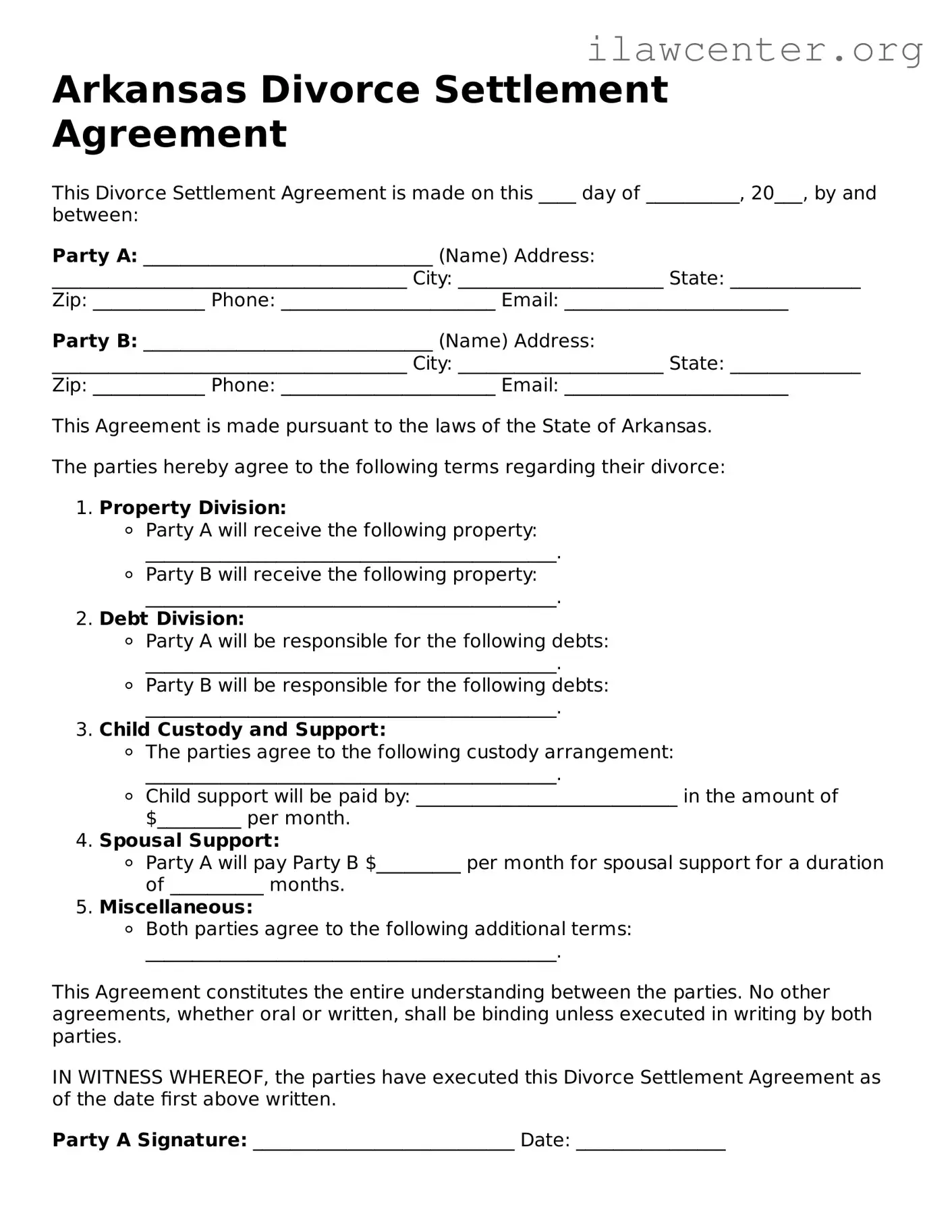
Arkansas Divorce Settlement Agreement

This Divorce Settlement Agreement is made on this ____ day of __________, 20___, by and between:

Party A: _______________________________ (Name) Address: ______________________________________ City: ______________________ State: ______________ Zip: ____________ Phone: _______________________ Email: ________________________

Party B: _______________________________ (Name) Address: ______________________________________ City: ______________________ State: ______________ Zip: ____________ Phone: _______________________ Email: ________________________

This Agreement is made pursuant to the laws of the State of Arkansas.

The parties hereby agree to the following terms regarding their divorce:

  1. Property Division:
    • Party A will receive the following property: ____________________________________________.
    • Party B will receive the following property: ____________________________________________.
  2. Debt Division:
    • Party A will be responsible for the following debts: ____________________________________________.
    • Party B will be responsible for the following debts: ____________________________________________.
  3. Child Custody and Support:
    • The parties agree to the following custody arrangement: ____________________________________________.
    • Child support will be paid by: ____________________________ in the amount of $_________ per month.
  4. Spousal Support:
    • Party A will pay Party B $_________ per month for spousal support for a duration of __________ months.
  5. Miscellaneous:
    • Both parties agree to the following additional terms: ____________________________________________.

This Agreement constitutes the entire understanding between the parties. No other agreements, whether oral or written, shall be binding unless executed in writing by both parties.

IN WITNESS WHEREOF, the parties have executed this Divorce Settlement Agreement as of the date first above written.

Party A Signature: ____________________________ Date: ________________

Party B Signature: ____________________________ Date: ________________

Witness Signature: ____________________________ Date: ________________

PDF Form Characteristics

Fact Name Description
Governing Law The Arkansas Divorce Settlement Agreement is governed by Arkansas law, specifically under Title 9, Chapter 12 of the Arkansas Code.
Purpose This form is used to outline the terms of a divorce settlement between spouses, including division of property, debts, and child custody arrangements.
Eligibility Any couple seeking a divorce in Arkansas can use this form, provided they agree on the terms of their separation.
Filing Requirement The completed agreement must be filed with the court as part of the divorce proceedings.
Signature Requirement Both parties must sign the agreement to indicate their acceptance of the terms.
Notarization While notarization is not always required, it is recommended to add an extra layer of authenticity.
Modification The agreement can be modified later if both parties consent to the changes in writing.
Child Support If children are involved, the agreement must include details about child support payments and custody arrangements.
Legal Advice It is advisable for both parties to seek legal advice before finalizing the agreement to ensure their rights are protected.

Instructions on Utilizing Arkansas Divorce Settlement Agreement

Completing the Arkansas Divorce Settlement Agreement form is an essential step in finalizing a divorce. After filling out this form, you will be able to submit it to the court, which will help in the resolution of various issues such as property division, child custody, and support arrangements.

  1. Begin by downloading the Arkansas Divorce Settlement Agreement form from the official state website or obtain a physical copy from the local courthouse.
  2. Carefully read the instructions provided with the form to understand the requirements.
  3. In the first section, fill in your full name and address as the petitioner, along with the name and address of your spouse as the respondent.
  4. Provide the date of marriage and the date of separation in the designated fields.
  5. Outline the details of property division. List all marital assets and debts, specifying how they will be divided between both parties.
  6. Address child custody arrangements if applicable. Include the names and birth dates of any children involved, and describe the proposed custody and visitation schedule.
  7. Detail child support obligations, including the amount to be paid and the frequency of payments.
  8. Include any spousal support arrangements, specifying if one party will pay the other and the terms of those payments.
  9. Both parties should sign and date the form at the bottom, indicating their agreement to the terms outlined.
  10. Make copies of the completed form for your records and for your spouse.
  11. File the original form with the appropriate court, paying any necessary filing fees.

After submitting the form, you may need to attend a court hearing where a judge will review the agreement. If everything is in order, the judge will approve the settlement, finalizing your divorce process.

Important Facts about Arkansas Divorce Settlement Agreement

What is an Arkansas Divorce Settlement Agreement form?

This form is a legal document that outlines the terms of a divorce settlement between two parties. It typically includes details about property division, child custody, child support, and alimony. Both spouses must agree to the terms before submitting it to the court.

Do I need a lawyer to complete the Divorce Settlement Agreement?

How do I fill out the Divorce Settlement Agreement form?

Start by gathering all necessary information, such as financial records and details about any children involved. Fill out the form with clear and specific terms. Be sure to include how you plan to divide assets and handle child-related issues. After completing the form, both parties must sign it in front of a notary public.

What happens if we can’t agree on the terms?

If you and your spouse cannot reach an agreement, you may need to go to mediation or court. Mediation involves a neutral third party who can help facilitate discussions. If mediation fails, a judge will make decisions for you based on what is fair and in the best interest of any children involved.

Can I modify the Divorce Settlement Agreement after it’s signed?

How long does it take to finalize a divorce after submitting the agreement?

Is the Divorce Settlement Agreement legally binding?

What if one party doesn’t comply with the agreement?

Where can I find the Arkansas Divorce Settlement Agreement form?

Common mistakes

Filling out the Arkansas Divorce Settlement Agreement form can be a daunting task, and many individuals make common mistakes that can complicate the divorce process. One frequent error is failing to provide complete and accurate information. Each section of the form requires specific details about assets, debts, and personal circumstances. Omitting or misrepresenting this information can lead to delays or even legal disputes later on.

Another common mistake involves not understanding the implications of the terms being agreed upon. For instance, individuals may agree to certain custody arrangements or financial responsibilities without fully grasping the long-term consequences. This lack of understanding can result in regret and the need for modifications in the future, which can be both time-consuming and costly.

Many people also neglect to consider the tax implications of their agreements. Issues such as alimony or the division of retirement accounts can have significant tax consequences. Without consulting a financial advisor or tax professional, individuals may inadvertently agree to terms that are not in their best financial interest.

Inadequate attention to detail is another prevalent issue. Simple errors, such as typos or incorrect calculations, can undermine the entire agreement. For example, miscalculating child support or failing to accurately list assets can lead to disputes that require court intervention. Ensuring that all figures are correct and that the form is free of errors is essential.

People often overlook the importance of including all relevant assets and debts in the agreement. Some may forget to list certain properties, bank accounts, or debts, believing they are insignificant. However, even minor assets can have a bearing on the overall settlement and may be subject to division.

Additionally, individuals may rush through the process, especially if they are eager to finalize the divorce. This haste can lead to incomplete sections or poorly thought-out agreements. Taking the time to carefully consider each aspect of the settlement is crucial for ensuring a fair and comprehensive resolution.

Finally, failing to seek legal advice can be a significant mistake. While it is possible to fill out the form independently, having a knowledgeable attorney review the agreement can help identify potential issues and provide guidance on legal rights and responsibilities. An attorney can offer insights that individuals may not have considered, ensuring that the agreement is not only fair but also legally sound.

Documents used along the form

When navigating the process of divorce in Arkansas, several forms and documents may accompany the Divorce Settlement Agreement. Each document serves a specific purpose in ensuring a comprehensive resolution to the matters at hand. Below is a list of commonly used forms that may be relevant in your situation.

  • Petition for Divorce: This is the initial document filed by the spouse seeking the divorce. It outlines the grounds for the divorce and requests the court to grant the dissolution of the marriage.
  • Summons: This document notifies the other spouse that a divorce action has been initiated. It provides information about the time frame for responding to the petition.
  • Financial Affidavit: This form details the financial situation of each spouse, including income, expenses, assets, and debts. It helps the court in determining equitable distribution and support obligations.
  • Child Custody Agreement: If children are involved, this document outlines the proposed arrangements for custody and visitation. It prioritizes the best interests of the children.
  • Child Support Worksheet: This form calculates the amount of child support one parent may owe to the other based on state guidelines and the financial circumstances of both parents.
  • Property Settlement Agreement: This document details how marital property and debts will be divided between the spouses. It is often included as part of the Divorce Settlement Agreement.
  • Request for Temporary Orders: If immediate decisions are needed regarding custody, support, or property during the divorce process, this request can be filed to ask the court for temporary relief.
  • Notice of Hearing: This document informs all parties involved about the date and time of court hearings related to the divorce proceedings.
  • Final Decree of Divorce: This is the court's final ruling that officially ends the marriage. It includes the terms of the divorce, including custody, support, and property division.
  • Affidavit of Service: This document confirms that the other spouse has been properly served with the divorce papers, which is a necessary step in the legal process.

Understanding these documents can significantly aid in the divorce process. Each form plays a crucial role in ensuring that all aspects of the divorce are addressed fairly and comprehensively. It is advisable to seek guidance to navigate these forms effectively.

Similar forms

The Divorce Settlement Agreement form is an important document in the divorce process. It outlines the terms agreed upon by both parties regarding various aspects of their separation. There are several other documents that share similarities with this form. Each serves a distinct purpose but often overlaps in content or function. Here are six documents that are similar to the Divorce Settlement Agreement:

  • Separation Agreement: This document is created when a couple decides to live apart but is not yet divorced. It outlines the terms of their separation, including financial responsibilities and child custody arrangements, similar to what a Divorce Settlement Agreement would cover.
  • Child Custody Agreement: This specific agreement focuses on the custody and visitation rights of children involved in a divorce. Like the Divorce Settlement Agreement, it aims to provide clarity and structure to parenting arrangements post-divorce.
  • Property Settlement Agreement: When a couple separates, they need to divide their assets and debts. This document details how property will be divided, akin to the property division section of a Divorce Settlement Agreement.
  • Marital Settlement Agreement: This document is often used interchangeably with the Divorce Settlement Agreement. It outlines the terms of the divorce, including alimony, child support, and asset division, thus serving a similar purpose.
  • Alimony Agreement: This agreement specifically addresses the financial support one spouse will provide to the other after separation or divorce. It is a critical component often included in a Divorce Settlement Agreement.
  • Child Support Agreement: This document stipulates the financial support one parent must provide for their child after a divorce. It is a key part of ensuring the child's needs are met and is often included in the Divorce Settlement Agreement.

Understanding these documents and their similarities to the Divorce Settlement Agreement can help individuals navigate the complexities of divorce more effectively. Each document plays a crucial role in ensuring that all parties are clear on their rights and responsibilities.

Dos and Don'ts

When filling out the Arkansas Divorce Settlement Agreement form, it is important to approach the process with care. Here are some essential dos and don'ts to consider:

  • Do read the entire form carefully before starting. Understanding the requirements will help you provide accurate information.
  • Do be honest and transparent about your assets and debts. Full disclosure is crucial for a fair settlement.
  • Do seek assistance if you have questions. Consulting with a legal professional can clarify complex issues.
  • Do keep a copy of the completed form for your records. This can be useful for future reference.
  • Do ensure that both parties sign the agreement. This is necessary for the document to be legally binding.
  • Don't rush through the form. Take your time to ensure that all information is accurate and complete.
  • Don't omit any significant details about your financial situation. This could lead to complications later on.
  • Don't ignore deadlines. Timeliness is important in divorce proceedings.
  • Don't make assumptions about what the other party will agree to. Clear communication is essential.
  • Don't hesitate to ask for help if you feel overwhelmed. Support is available during this challenging time.

Misconceptions

Understanding the Arkansas Divorce Settlement Agreement form is essential for anyone navigating the divorce process. However, several misconceptions can lead to confusion. Here are ten common misconceptions, along with clarifications for each.

  1. Only one party needs to sign the agreement.

    Both spouses must sign the Divorce Settlement Agreement for it to be valid. This ensures that both parties have agreed to the terms outlined in the document.

  2. The agreement is final and cannot be changed.

    While the agreement is binding once signed, it can be modified if both parties agree to the changes. A court must approve any modifications to ensure they are legally enforceable.

  3. All property must be divided equally.

    Arkansas follows equitable distribution laws, meaning property is divided fairly but not necessarily equally. Factors such as the length of the marriage and each party's financial situation are considered.

  4. Child support is automatically included in the agreement.

    Child support must be explicitly stated in the Divorce Settlement Agreement. If it is not included, the court may not enforce it later.

  5. The form can be filled out without legal advice.

    While it is possible to complete the form independently, seeking legal advice is highly recommended. A lawyer can help ensure that all necessary terms are included and that rights are protected.

  6. Once filed, the agreement cannot be contested.

    Although the agreement is binding, it can be contested in court under certain circumstances, such as fraud or coercion during the signing process.

  7. The agreement only addresses property division.

    In addition to property division, the Divorce Settlement Agreement can cover child custody, visitation rights, and spousal support, making it a comprehensive document.

  8. It is not necessary to have a witness present.

    While a witness is not always required, having one can add an extra layer of validity to the agreement. It is advisable to consult local laws regarding witness requirements.

  9. The agreement can be verbal.

    For the agreement to be enforceable, it must be in writing and signed by both parties. Verbal agreements are difficult to prove and may not hold up in court.

  10. Filing the agreement is optional.

    Filing the Divorce Settlement Agreement with the court is necessary for it to be enforceable. This step ensures that the terms are recognized legally.

Key takeaways

Filling out the Arkansas Divorce Settlement Agreement form can be straightforward if you keep a few important points in mind. Here are some key takeaways:

  • Understand the purpose: This form outlines the terms of your divorce, including division of property, debts, and custody arrangements.
  • Be thorough: Provide complete and accurate information. Missing details can lead to delays or complications.
  • Use clear language: Write in simple terms. Avoid ambiguous phrases that could lead to misunderstandings later.
  • Consult with a professional: If you're unsure about any section, consider seeking legal advice to ensure everything is correct.
  • Review before submission: Double-check all entries for accuracy. Errors can affect the final outcome of your divorce.
  • Keep copies: Always make copies of the completed form for your records. This can be helpful for future reference.
  • Follow local rules: Be aware of any specific requirements or procedures in your county regarding the submission of the form.

By keeping these points in mind, you can navigate the process more smoothly and ensure that your interests are well-represented in the agreement.