Fillable Army Letter of Recommendation Document

Fillable Army Letter of Recommendation Document

The Army Letter of Recommendation form is an essential document used to support an individual's application for various opportunities within the Army, such as promotions or special programs. This form allows supervisors, peers, or mentors to provide insights into the applicant's character, skills, and accomplishments. To ensure your application stands out, consider filling out the form by clicking the button below.

Article Guide

The Army Letter of Recommendation form serves as a crucial document in the military recruitment and evaluation process. This form is typically utilized by individuals seeking to join the Army or advance within its ranks. It provides a structured way for endorsers to communicate their support for the candidate, highlighting key attributes such as leadership abilities, character, and professional competence. The form includes specific sections that guide the recommender in providing relevant information, ensuring that the evaluation is both comprehensive and focused. Additionally, it may require personal anecdotes or examples that illustrate the candidate's qualifications and potential for success in a military environment. The recommendations are often submitted alongside other application materials, playing a significant role in the decision-making process. By adhering to the guidelines set forth in the form, recommenders can help candidates present their best selves to military officials.

Army Letter of Recommendation Preview

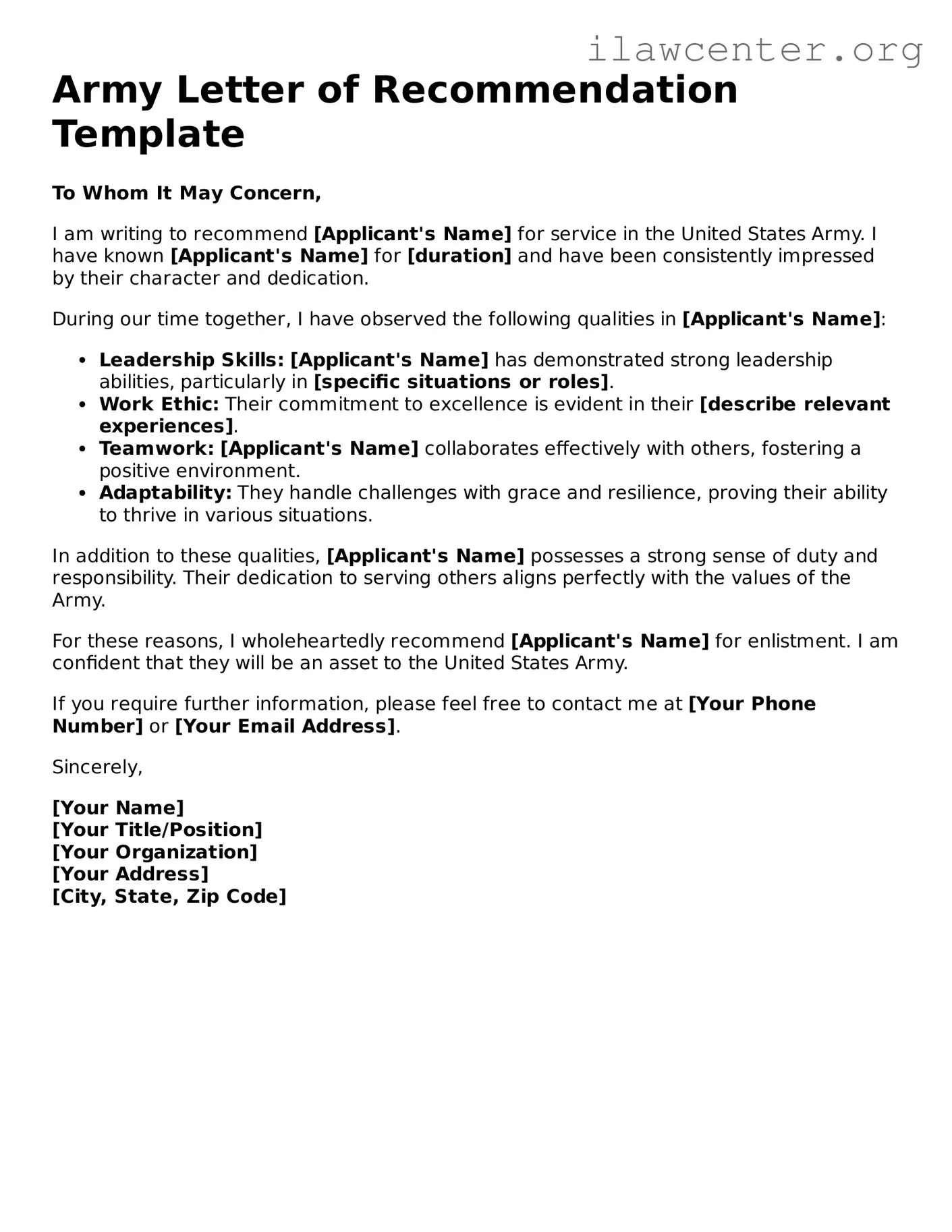
Army Letter of Recommendation Template

To Whom It May Concern,

I am writing to recommend [Applicant's Name] for service in the United States Army. I have known [Applicant's Name] for [duration] and have been consistently impressed by their character and dedication.

During our time together, I have observed the following qualities in [Applicant's Name]:

  • Leadership Skills: [Applicant's Name] has demonstrated strong leadership abilities, particularly in [specific situations or roles].
  • Work Ethic: Their commitment to excellence is evident in their [describe relevant experiences].
  • Teamwork: [Applicant's Name] collaborates effectively with others, fostering a positive environment.
  • Adaptability: They handle challenges with grace and resilience, proving their ability to thrive in various situations.

In addition to these qualities, [Applicant's Name] possesses a strong sense of duty and responsibility. Their dedication to serving others aligns perfectly with the values of the Army.

For these reasons, I wholeheartedly recommend [Applicant's Name] for enlistment. I am confident that they will be an asset to the United States Army.

If you require further information, please feel free to contact me at [Your Phone Number] or [Your Email Address].

Sincerely,

[Your Name]
[Your Title/Position]
[Your Organization]
[Your Address]
[City, State, Zip Code]

PDF Form Characteristics

Fact Name Description
Purpose The Army Letter of Recommendation is used to support an individual's application for various positions within the Army.
Format The letter should be typed and follow a formal business letter format.
Content Requirements It should include specific examples of the individual's qualifications, skills, and character.
Signature The letter must be signed by the person providing the recommendation.
Length A typical letter of recommendation is one to two pages long.
Submission The completed letter should be submitted according to the instructions provided by the Army.
Confidentiality It is recommended that the letter be kept confidential between the recommender and the reviewing authority.
State-Specific Forms Some states may have additional requirements or forms; check local regulations for compliance.
Governing Laws In some states, the governing laws may include military service regulations and state employment laws.

Instructions on Utilizing Army Letter of Recommendation

Filling out the Army Letter of Recommendation form is an important step in supporting a candidate’s application. This process requires attention to detail and clarity to ensure that the recommendation is both compelling and informative. Once you have completed the form, it will be submitted as part of the candidate's application package.

  1. Begin by downloading the Army Letter of Recommendation form from the official Army website or your designated source.
  2. Open the form and review the instructions provided to familiarize yourself with the required sections.
  3. Fill in your personal information at the top of the form, including your name, rank, and contact information.
  4. Identify the candidate you are recommending by entering their name, rank, and the position they are applying for.
  5. Provide a detailed assessment of the candidate’s qualifications, skills, and character. Be specific about their achievements and how they align with the Army's values.
  6. Include any relevant experiences you have had with the candidate that support your recommendation.
  7. Review your completed form for clarity and accuracy, ensuring there are no spelling or grammatical errors.
  8. Sign and date the form at the designated area to validate your recommendation.
  9. Submit the completed form according to the submission guidelines provided, whether electronically or via mail.

Important Facts about Army Letter of Recommendation

What is an Army Letter of Recommendation?

An Army Letter of Recommendation is a formal document that endorses an individual's skills, character, and accomplishments. This letter is often used to support a soldier's application for promotions, special assignments, or military schools. It highlights the individual's qualifications and contributions to the Army.

Who can write an Army Letter of Recommendation?

Typically, a letter can be written by a supervisor, commanding officer, or any individual who has direct knowledge of the soldier's performance and character. It’s important that the writer has a credible relationship with the soldier and can provide specific examples of their achievements.

What should be included in the letter?

The letter should include the writer's contact information, a brief introduction of their relationship with the soldier, specific examples of the soldier’s accomplishments, and a strong endorsement of their abilities. It should also conclude with an invitation for further contact if needed.

How long should the letter be?

While there is no strict length requirement, a well-crafted letter typically ranges from one to two pages. It should be concise yet detailed enough to effectively convey the soldier's strengths and qualifications.

Is there a specific format to follow?

Yes, the letter should be formatted in a professional manner. This includes using a formal salutation, a clear introduction, body paragraphs that detail the soldier’s qualifications, and a formal closing. It’s best to use standard fonts and sizes to maintain readability.

Can I use a template for the letter?

Using a template can be helpful as a starting point, but it’s essential to personalize the content. Tailoring the letter to reflect the soldier's unique experiences and qualities will make it more impactful and genuine.

How do I submit the letter?

The submission process may vary depending on the purpose of the letter. Typically, it can be submitted directly to the soldier for inclusion in their application package or sent to the relevant military authority or organization as specified in the application instructions.

Are there any restrictions on who can receive a letter?

Generally, any soldier seeking advancement or special consideration can receive a letter of recommendation. However, it’s important to ensure that the letter is relevant to the specific opportunity the soldier is pursuing.

How far in advance should I write the letter?

It’s best to write the letter well in advance of any deadlines. This allows time for revisions and ensures that the soldier has all necessary documents ready for submission. Aim for at least a few weeks before the due date.

Can I include personal anecdotes in the letter?

Yes, including personal anecdotes can enhance the letter. Specific stories that illustrate the soldier's skills or character traits make the recommendation more relatable and convincing. Just ensure that these anecdotes are relevant and appropriate.
Common mistakes

Filling out the Army Letter of Recommendation form can be a critical step in a military career. However, many individuals make common mistakes that can hinder the effectiveness of their recommendation. One frequent error is failing to provide specific examples of the candidate's achievements. General statements may not convey the true capabilities of the individual being recommended.

Another mistake is neglecting to follow the required format. Each section of the form serves a purpose, and omitting information or not adhering to the structure can lead to confusion. It is essential to read the instructions carefully and ensure that every section is completed as required.

Some recommenders overlook the importance of using clear and concise language. While it might be tempting to use elaborate phrases, straightforward and direct wording often makes a stronger impact. Additionally, using jargon or overly technical terms can alienate those who are unfamiliar with specific terminology.

Another common issue is not tailoring the recommendation to the specific role or opportunity. Each position may have unique requirements, and a generic recommendation may not highlight the candidate's most relevant skills. It is beneficial to align the recommendation with the expectations of the role.

Providing inaccurate or outdated information is also a mistake that can affect the credibility of the recommendation. Double-checking dates, titles, and other details ensures that the information presented is correct and up-to-date.

Some individuals fail to include their contact information. This omission can prevent decision-makers from reaching out for further clarification or questions regarding the recommendation. Including a phone number and email address is a simple yet crucial step.

Another error is not reviewing the completed form before submission. Typos and grammatical errors can detract from the professionalism of the letter. Taking the time to proofread can help present a polished and credible recommendation.

Additionally, failing to express genuine enthusiasm for the candidate can weaken the recommendation. A lack of enthusiasm may suggest that the recommender does not truly believe in the candidate's abilities. Using positive language and expressing confidence in the candidate's potential can enhance the letter.

Some recommenders may also forget to provide context about their relationship with the candidate. Detailing how long they have known the individual and in what capacity can help the reader understand the perspective from which the recommendation is made.

Lastly, neglecting to submit the form on time can result in missed opportunities. Timeliness is crucial in many military applications, and ensuring that the recommendation is submitted by the deadline is vital for the candidate's success.

Documents used along the form

The Army Letter of Recommendation form is a vital document used to support a soldier's application for various opportunities, such as promotions, assignments, or awards. Alongside this form, several other documents are commonly utilized to provide a comprehensive view of a soldier's qualifications and achievements. Below is a list of these documents, each serving a unique purpose in the evaluation process.

  • Enlisted Record Brief (ERB): This document summarizes a soldier's career, including personal information, assignments, training, and awards. It provides a quick overview of the soldier's qualifications.
  • Officer Record Brief (ORB): Similar to the ERB, the ORB outlines an officer's career details. It includes information on education, assignments, and accomplishments, helping to assess the officer's suitability for new roles.
  • NCOER (Non-Commissioned Officer Evaluation Report): This report evaluates the performance and potential of non-commissioned officers. It includes feedback from superiors and is crucial for promotion considerations.
  • OER (Officer Evaluation Report): The OER assesses an officer's performance and potential for future assignments. It is a key document in an officer's career progression.
  • DA Form 2-1: This form is a personnel record that tracks a soldier's assignments, training, and other career-related information. It serves as a historical record throughout a soldier's service.
  • DA Form 1059: This document is used to record a soldier's completion of military training courses. It is essential for showcasing additional qualifications and skills.
  • DA Form 4187: This form is used to request changes in a soldier's status, such as duty assignments or promotions. It is often required in conjunction with a recommendation letter.
  • Career Management Field (CMF) documentation: This includes various forms and records related to a soldier's specific career field, detailing qualifications and training relevant to their role.
  • Personal Statement: A personal statement allows the soldier to articulate their goals, motivations, and reasons for seeking a particular opportunity, providing a personal touch to the application.

Each of these documents complements the Army Letter of Recommendation form, collectively presenting a well-rounded picture of a soldier's capabilities and readiness for advancement. Properly compiling and submitting these forms can significantly enhance a soldier's prospects for success in their military career.

Similar forms

  • Military Performance Evaluation Report: This document assesses a service member's performance, similar to how the Army Letter of Recommendation highlights specific achievements and qualifications.
  • Personal Reference Letter: A personal reference letter provides insight into an individual's character and abilities, akin to the Army Letter of Recommendation's focus on personal qualities and accomplishments.
  • Job Recommendation Letter: A job recommendation letter serves to endorse a candidate for employment, much like the Army Letter of Recommendation supports a service member's career progression.
  • College Recommendation Letter: This type of letter is used for college admissions, showcasing a student's strengths and potential, paralleling the Army Letter of Recommendation's role in highlighting a soldier's capabilities.
  • Professional Reference Letter: A professional reference letter is written by a colleague or supervisor to vouch for someone's skills and work ethic, similar to how the Army Letter of Recommendation validates a service member's qualifications.
  • Character Reference Letter: This document speaks to an individual's character traits and integrity, reflecting the personal attributes emphasized in the Army Letter of Recommendation.

Dos and Don'ts

When filling out the Army Letter of Recommendation form, it is important to follow certain guidelines to ensure the recommendation is effective and meets the necessary standards. Below is a list of things to do and avoid.

  • Do provide accurate and truthful information.
  • Do clearly state the relationship to the candidate.
  • Do highlight specific achievements and qualities of the candidate.
  • Do use a professional tone throughout the letter.
  • Do proofread the letter for spelling and grammatical errors.
  • Don't include irrelevant personal opinions or biases.
  • Don't exaggerate the candidate's abilities or accomplishments.
  • Don't use informal language or slang.
  • Don't forget to sign and date the letter.

Misconceptions

There are several misconceptions surrounding the Army Letter of Recommendation form. Understanding these can help individuals navigate the process more effectively.

  • Misconception 1: The form is only for high-ranking officials.
  • This is not true. While it is common for senior officers to write recommendations, anyone familiar with the candidate's abilities and character can complete the form. This includes peers, subordinates, and other military personnel.

  • Misconception 2: A specific format must be followed.
  • While there are guidelines for content, the Army Letter of Recommendation does not require a strict format. The focus should be on the quality of the recommendation rather than adhering to a particular template.

  • Misconception 3: Letters of recommendation are optional.
  • In many cases, letters of recommendation are essential for promotions or special assignments. They provide valuable insights into a candidate's qualifications and character, making them a critical part of the evaluation process.

  • Misconception 4: Only negative feedback should be included.
  • Recommendations should highlight both strengths and areas for improvement. A balanced perspective is more helpful and provides a fuller picture of the candidate's capabilities.

Key takeaways

Filling out the Army Letter of Recommendation form is an important task that requires attention to detail. Here are some key takeaways to consider:

  • Understand the Purpose: The letter serves as a formal endorsement of an individual’s qualifications and character, which can significantly impact their military career.
  • Be Specific: Provide detailed examples of the individual's skills, accomplishments, and leadership qualities. General statements may not convey the full extent of their capabilities.
  • Follow Guidelines: Adhere to any specific instructions regarding format and content. This ensures that the letter meets the expectations of the reviewing authority.
  • Proofread Carefully: Errors can undermine the credibility of the recommendation. Review the letter for spelling and grammatical mistakes before submission.