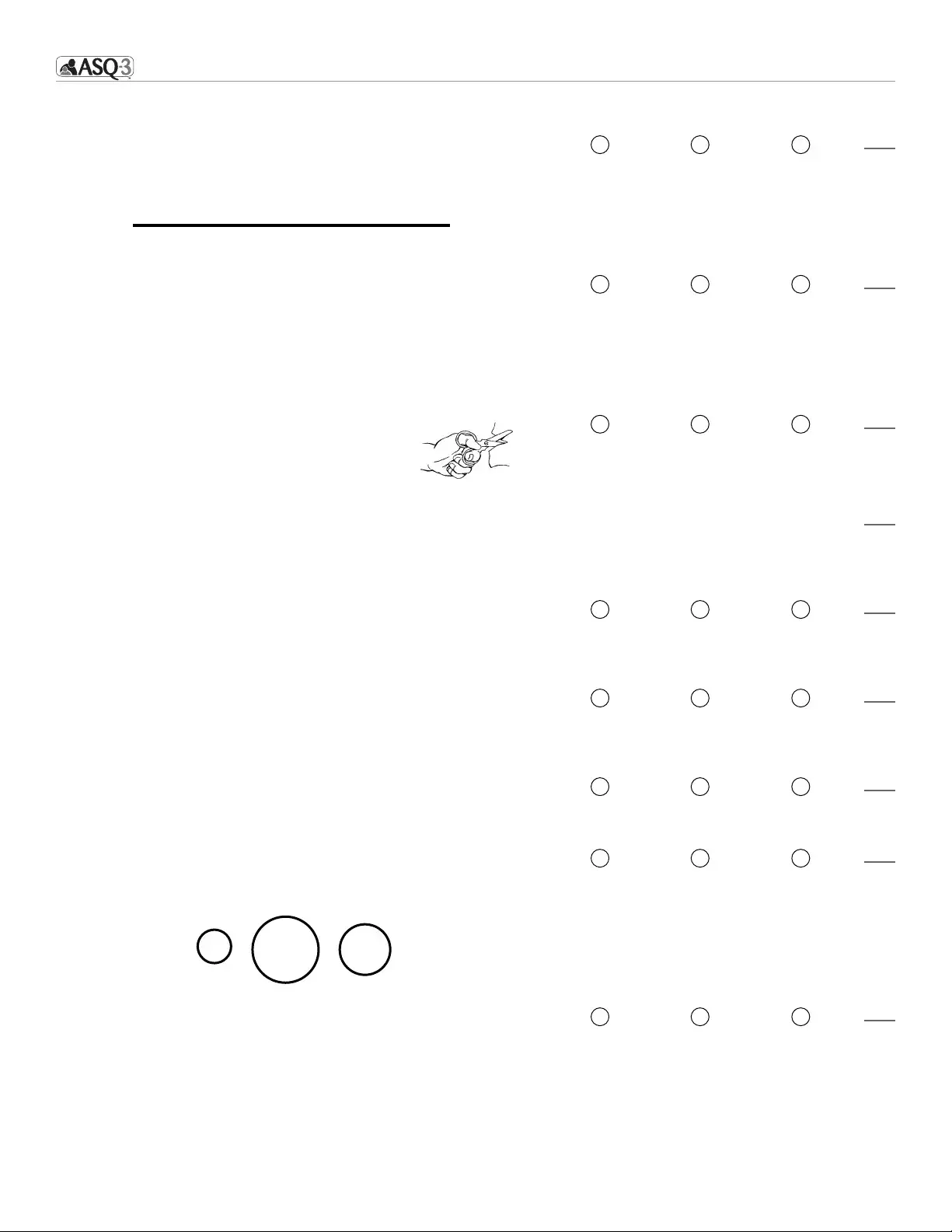
Asq 54 Month Questionnaire PDF Template

Asq 54 Month Questionnaire PDF Template

The Ages & Stages Questionnaires® 54 Month Questionnaire is a valuable tool designed to assess the developmental progress of children aged 51 months to 56 months. This questionnaire enables parents and caregivers to evaluate various aspects of a child's growth, including communication, motor skills, problem-solving abilities, and personal-social interactions. By engaging with this form, you can gain insights into your child's development and identify areas where additional support may be beneficial.

To contribute to your child's growth, please fill out the form by clicking the button below.

Article Guide

The Ages & Stages Questionnaires® 54 Month Questionnaire is a valuable tool designed for parents, guardians, and caregivers to assess the developmental milestones of children aged 51 months to 56 months. This form provides a structured way to gather important information about a child's growth in various areas, including communication, gross motor skills, fine motor skills, problem-solving abilities, and personal-social interactions. As you fill out the questionnaire, you'll answer questions about your child's everyday activities, marking whether they can perform specific tasks regularly, sometimes, or not yet. It’s important to make the process enjoyable and engaging for your child, as this can lead to more accurate responses. The form also collects essential details about the child and the person completing the questionnaire, ensuring that the information is tailored to the right context. By completing the ASQ, you contribute to a better understanding of your child's developmental progress, helping identify any areas that may need further attention or support.

Asq 54 Month Questionnaire Preview

Ages & Stages Questionnaires®, Third Edition (ASQ-3
),
Squires & Bricker
© 2009 Paul H. Brookes Publishing Co. All rights reserved.
P101540100
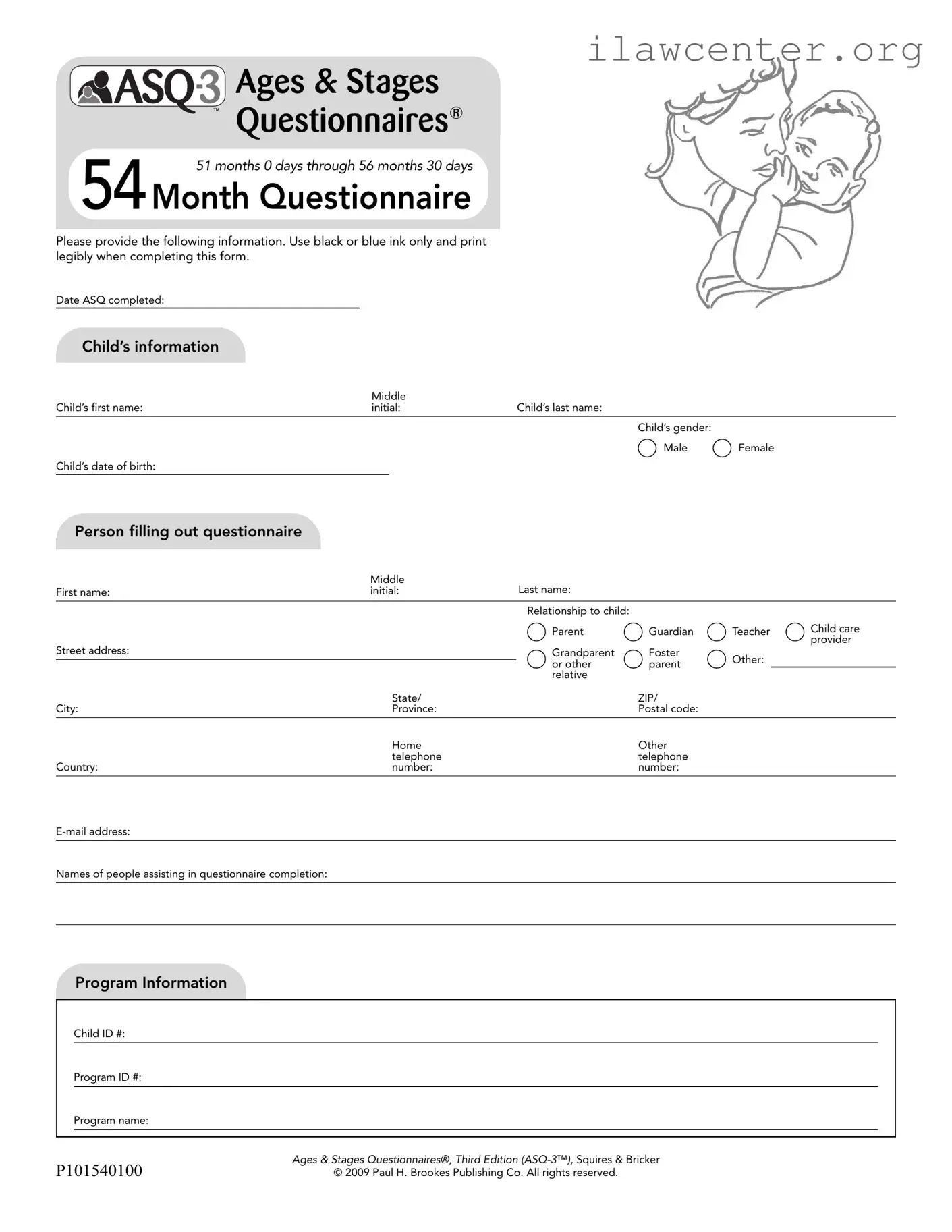
Person filling out questionnaire
Child’s information
Date ASQ completed:
Relationship to child:
Parent
Street address:
Names of people assisting in questionnaire completion:
Grandparent
or other
relative
Guardian
Foster
parent
Teacher
Child care
provider
Other:
Ages & Stages
Questionnaires
®
Month Questionnaire
51 months 0 days through 56 months 30 days
Please provide the following information. Use black or blue ink only and print
legibly when completing this form.
54
Child’s first name: Child’s last name:
Child’s date of birth:
First name:
Last name:
Middle
initial:
City:
Home
telephone
number:
State/
Province:
ZIP/
Postal code:
Other
telephone
number:
E-mail address:
Child’s gender:
Male Female
Middle
initial:
Country:
Program Information
Child ID #:
Program ID #:
Program name:
Ages & Stages Questionnaires®, Third Edition (ASQ-3
),
Squires & Bricker
© 2009 Paul H. Brookes Publishing Co. All rights reserved.
page 2 of 7
E101540200
Month Questionnaire
54
51 months 0 days
through 56 months 30 days
Important Points to Remember:
Try each activity with your child before marking a response.
Make completing this questionnaire a game that is fun for
you and your child.
Make sure your child is rested and fed.
Please return this questionnaire by _______________.
Notes:
____________________________________________
____________________________________________
____________________________________________
____________________________________________
On the following pages are questions about activities children may do. Your child may have already done some of the activities
described here, and there may be some your child has not begun doing yet. For each item, please fill in the circle that indicates
whether your child is doing the activity regularly, sometimes, or not yet.
COMMUNICATION
1. Does your child tell you at least two things about common objects? For
example, if you say to your child, “Tell me about your ball,” does she
say something like, “It’s round. I throw it. It’s big”?
2. Does your child use all of the words in a sentence (for example, “a,”
“the,” “am,” “is,” and “are”) to make complete sentences, such as “I
am
going to
the
park,” “
Is
there
a
toy to play with?” or “
Are
you com-
ing, too?”
3. Does your child use endings of words, such as “-s,” “-ed,” and “-ing”?
For example, does your child say things like, “I see two cat
s
,” “I am
play
ing
,” or “I kick
ed
the ball”?
4. Without giving your child help by pointing or repeating directions,
does he follow three directions that are
unrelated
to one another? Give
all three directions before your child starts. For example, you may ask
your child, “Clap your hands, walk to the door, and sit down,” or “Give
me the pen, open the book, and stand up.”
5. Does your child use four- and five-word sentences? For example, does
your child say, “I want the car”? Please write an example:
6. When talking about something that already happened, does your child
use words that end in “-ed,” such as “walk
ed,
” “jump
ed,
” or “play
ed
”?
Ask your child questions, such as “How did you get to the store?” (“We
walk
ed.
”) “What did you do at your friend’s house?” (“We play
ed.
”)
Please write an example:
YES SOMETIMES NOT YET
COMMUNICATION TOTAL
Ages & Stages Questionnaires®, Third Edition (ASQ-3
),
Squires & Bricker
© 2009 Paul H. Brookes Publishing Co. All rights reserved.
54 Month Questionnaire
page 3 of 7
E101540300
YES SOMETIMES NOT YET
GROSS MOTOR TOTAL
YES SOMETIMES NOT YET
GROSS MOTOR
1. Does your child hop up and down on either the right foot or the left
foot at least one time without losing her balance or falling?
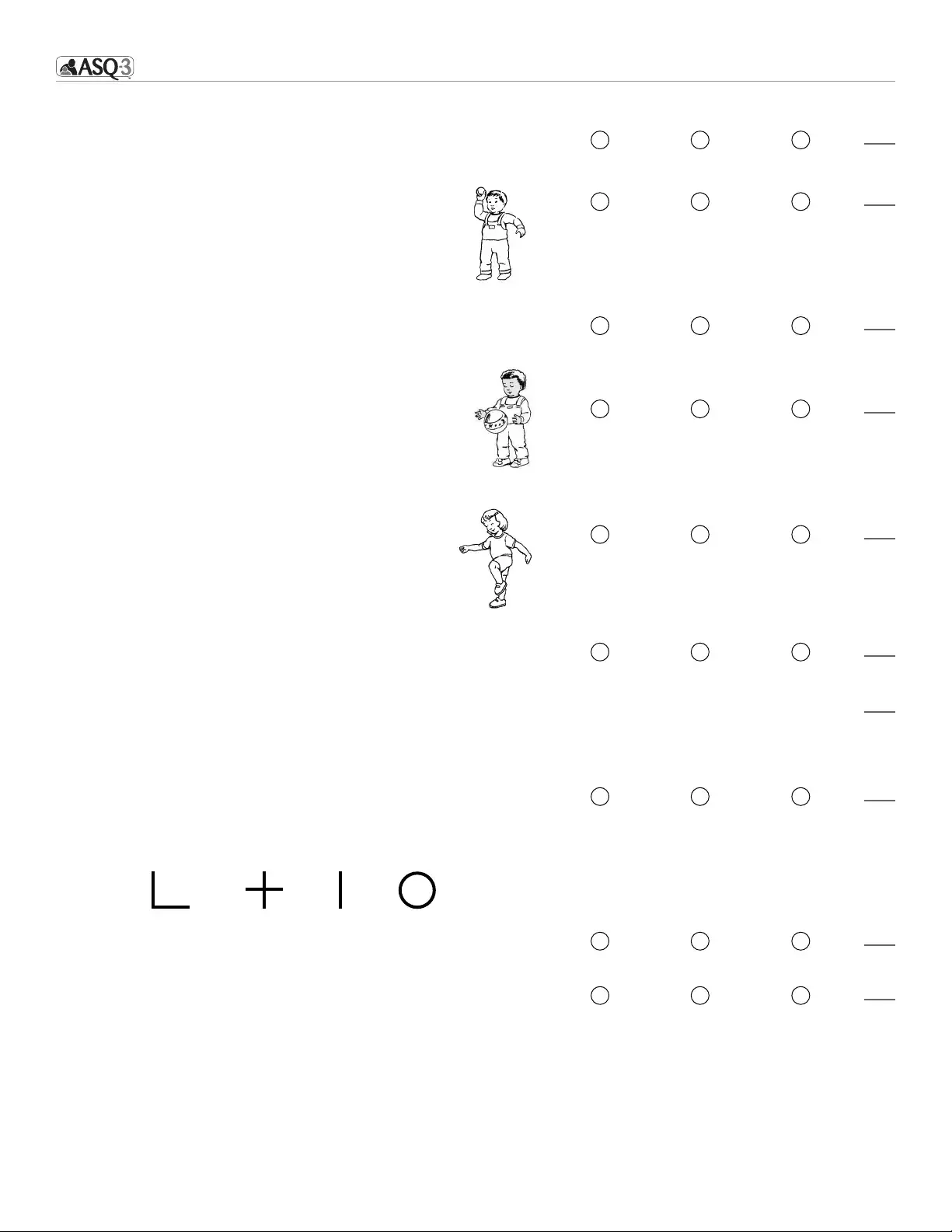
2. While standing, does your child throw a ball
overhand
in the
direction of a person standing at least 6 feet away? To throw
overhand, your child must raise his arm to shoulder height
and throw the ball forward.
(Dropping the ball or throwing
the ball underhand should be scored as “not yet.”)
3. Does your child jump forward a distance of 20 inches from a standing
position, starting with her feet together?
4. Does your child catch a large ball with both hands?
(You
should stand about 5 feet away and give your child two or
three tries before you mark the answer.)
5. Without holding onto anything, does your child stand on
one foot for at least 5 seconds without losing her balance
and putting her foot down?
(You may give your child two or
three tries before you mark the answer.)
6. Does your child walk on his tiptoes for 15 feet (about the length of a
large car)?
(You may show him how to do this.)
FINE MOTOR
1. Using the shapes below to look at, does your child copy at least three
shapes onto a large piece of paper using a pencil, crayon, or pen, with-
out tracing?
(Your child’s drawings should look similar to the design of
the shapes below, but they may be different in size.)
2. Does your child unbutton one or more buttons? Your child may use his
own clothing or a doll’s clothing.
3. Does your child color mostly within the lines in a coloring book or
within the lines of a 2-inch circle that you draw?
(Your child should not
go more than 1⁄4 inch outside the lines on most of the picture.)
FINE MOTOR
(continued)
4. Ask your child to trace on the line below with a pencil. Does your child
trace on the line without going off the line more than two times?
(Mark
“sometimes” if your child goes off the line three times.)
5. Ask your child to draw a picture of a person on a blank sheet of paper.
You may ask your child, “Draw a picture of a girl or a boy.” If your child
draws a person with head, body, arms,
and
legs, mark “yes.” If your
child draws a person with only three parts (head, body, arms, or legs),
mark “sometimes.” If your child draws a person with two or fewer parts
(head, body, arms, or legs), mark “not yet.” Be sure to include the
sheet of paper with your child’s drawing with this questionnaire.
6. Draw a line across a piece of paper. Using child-safe
scissors, does your child cut the paper in half on a
more or less straight line, making the blades go up
and down?
(Carefully watch your child’s use of
scissors for safety reasons.)
PROBLEM SOLVING
1. When shown objects and asked, “What color is this?” does your child
name five different colors, like red, blue, yellow, orange, black, white,
or pink?
(Mark “yes” only if your child answers the question correctly
using five colors.)
2. Does your child dress up and “play-act,” pretending to be someone or
something else? For example, your child may dress up in different
clothes and pretend to be a mommy, daddy, brother, sister, or an imag-
inary animal or figure.
3. If you place five objects in front of your child, can she count them by
saying, “One, two, three, four, five” in order?
(Ask this question without
providing help by pointing, gesturing, or naming.)
4. When asked, “Which circle is smallest?” does your child point to the
smallest circle?
(Ask this question without providing help by pointing,
gesturing, or looking at the smallest circle.)
5. Does your child count up to 15 without making mistakes? If so, mark
“yes.” If your child counts to 12 without making mistakes, mark “some-
times.”
Ages & Stages Questionnaires®, Third Edition (ASQ-3
),
Squires & Bricker
© 2009 Paul H. Brookes Publishing Co. All rights reserved.
54 Month Questionnaire
page 4 of 7
E101540400
YES SOMETIMES NOT YET
FINE MOTOR TOTAL
YES SOMETIMES NOT YET
PROBLEM SOLVING
(continued)
6. Does your child know the names of numbers?
(Mark “yes” if he identi-
fies the three numbers below. Mark “sometimes” if he identifies two
numbers.)
312
PERSONAL-SOCIAL
1. Does your child wash her hands using soap and water and dry off with
a towel without help?
2. Does your child tell you the names of two or more playmates, not in-
cluding brothers and sisters?
(Ask this question without providing help
by suggesting names of playmates or friends.)
3. Does your child brush his teeth by putting toothpaste on the tooth-
brush and brushing all of his teeth without help?
(You may still need to
check and rebrush your child’s teeth.)
4. Does your child serve herself, taking food from one container to an-
other, using utensils?
(For example, does your child use a large spoon
to scoop applesauce from a jar into a bowl?)
5. Does your child tell you at least four of the following? Please mark the
items your child knows.
a. First name d. Last name
b. Age e. Boy or girl
c. City he lives in f. Telephone number
6. Does your child dress and undress herself, including buttoning
medium-size buttons and zipping front zippers?
Ages & Stages Questionnaires®, Third Edition (ASQ-3
),
Squires & Bricker
© 2009 Paul H. Brookes Publishing Co. All rights reserved.
54 Month Questionnaire
page 5 of 7
E101540500
YES SOMETIMES NOT YET
PROBLEM SOLVING TOTAL
YES SOMETIMES NOT YET
PERSONAL-SOCIAL TOTAL
OVERALL
Parents and providers may use the space below for additional comments.
1. Do you think your child hears well? If no, explain:
YES NO
Ages & Stages Questionnaires®, Third Edition (ASQ-3
),
Squires & Bricker
© 2009 Paul H. Brookes Publishing Co. All rights reserved.
54 Month Questionnaire
page 6 of 7
E101540600
OVERALL
(continued)
2. Do you think your child talks like other children her age? If no, explain:
3. Can you understand most of what your child says? If no, explain:
4. Can other people understand most of what your child says? If no, explain:
5. Do you think your child walks, runs, and climbs like other children his age?
If no, explain:
6. Does either parent have a family history of childhood deafness or hearing
impairment? If yes, explain:
7. Do you have any concerns about your child’s vision? If yes, explain:
YES NO
YES NO
YES NO
YES NO
YES NO
YES NO
Ages & Stages Questionnaires®, Third Edition (ASQ-3
),
Squires & Bricker
© 2009 Paul H. Brookes Publishing Co. All rights reserved.
54 Month Questionnaire
page 7 of 7
E101540700
OVERALL
(continued)
8. Has your child had any medical problems in the last several months? If yes, explain:
9. Do you have any concerns about your child’s behavior? If yes, explain:
10. Does anything about your child worry you? If yes, explain:
YES NO
YES NO
YES NO
Ages & Stages Questionnaires®, Third Edition (ASQ-3
),
Squires & Bricker
© 2009 Paul H. Brookes Publishing Co. All rights reserved.
P101540800
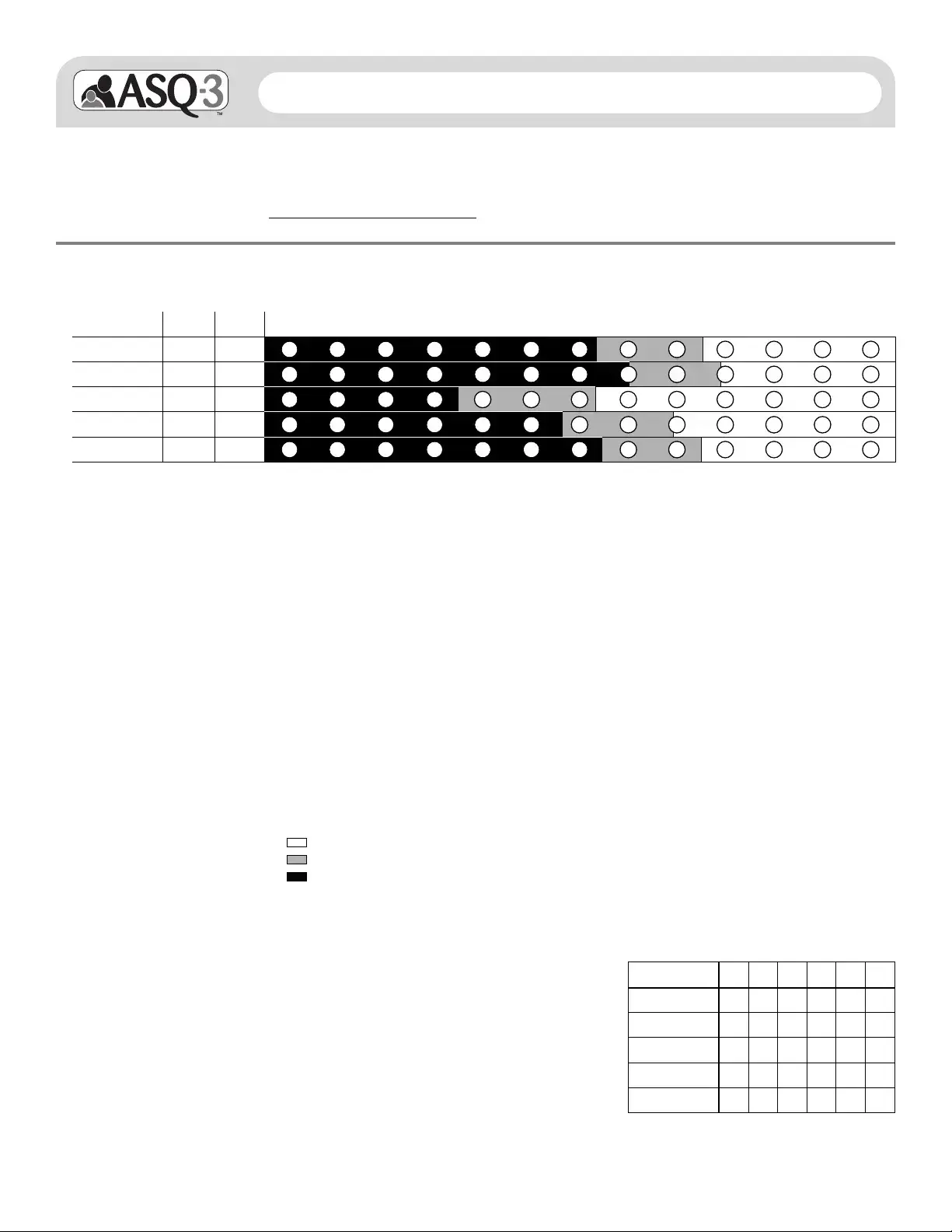
3. ASQ SCORE INTERPRETATION AND RECOMMENDATION FOR FOLLOW-UP: You must consider total area scores, overall
responses, and other considerations, such as opportunities to practice skills, to determine appropriate follow-up.
If the child’s total score is in the area, it is above the cutoff, and the child’s development appears to be on schedule.
If the child’s total score is in the area, it is close to the cutoff. Provide learning activities and monitor.
If the child’s total score is in the area, it is below the cutoff. Further assessment with a professional may be needed.
Child’s name: ________________________________________________________
Child’s ID #: ______________________________________________________
Administering program/provider:
Date ASQ completed: __________________________________________
Date of birth: ______________________________________________
Month ASQ-3 Information Summary
54
51 months 0 days through
56 months 30 days
Communication
Gross Motor
Fine Motor
Problem Solving
Personal-Social
123456
2. TRANSFER OVERALL RESPONSES: Bolded uppercase responses require follow-up. See
ASQ-3 User’s Guide,
Chapter 6.
1. SCORE AND TRANSFER TOTALS TO CHART BELOW: See
ASQ-3 User’s Guide
for details, including how to adjust scores if item
responses are missing. Score each item (YES = 10, SOMETIMES = 5, NOT YET = 0). Add item scores, and record each area total.
In the chart below, transfer the total scores, and fill in the circles corresponding with the total scores.
4. FOLLOW-UP ACTION TAKEN: Check all that apply.
______ Provide activities and rescreen in _____ months.
______ Share results with primary health care provider.
______ Refer for (circle all that apply) hearing, vision, and/or behavioral screening.
______ Refer to primary health care provider or other community agency (specify
reason): __________________________________________________________.
______ Refer to early intervention/early childhood special education.
______ No further action taken at this time
______ Other (specify): ____________________________________________________
5. OPTIONAL: Transfer item responses
(Y = YES, S = SOMETIMES, N = NOT YET,
X = response missing).
Communication
Gross Motor
Fine Motor
Problem Solving
Personal-Social
0 5 10 15 20 25 30 35 40 45 50 55 60
Total
Area Cutoff Score
31.85
35.18
17.32
28.12
32.33
1. Hears well? Yes NO
Comments:
2. Talks like other children his age? Yes NO
Comments:
3. Understand most of what your child says? Yes NO
Comments:
4. Others understand most of what your child says? Yes NO
Comments:
5. Walks, runs, and climbs like other children? Yes NO
Comments:
6. Family history of hearing impairment? YES No
Comments:
7. Concerns about vision? YES No
Comments:
8. Any medical problems? YES No
Comments:
9. Concerns about behavior? YES No
Comments:
10. Other concerns? YES No
Comments:

File Properties

Fact Name Description
Age Range The ASQ 54 Month Questionnaire is designed for children aged 51 months 0 days through 56 months 30 days.
Purpose This questionnaire assesses various developmental areas, including communication, gross motor skills, fine motor skills, problem-solving, and personal-social skills.
Completion Instructions Respondents should use black or blue ink and print legibly. It is recommended to make the process enjoyable for the child.
Assistance Parents, guardians, teachers, or childcare providers can assist in completing the questionnaire, ensuring accurate responses.
Return Deadline The questionnaire must be returned by a specified date, which is left blank for the respondent to fill in.

Instructions on Utilizing Asq 54 Month Questionnaire

Completing the ASQ 54 Month Questionnaire is an important step in understanding your child's development. This form requires specific information about your child and prompts you to assess various skills through simple activities. Follow the steps below to ensure you fill out the questionnaire accurately and completely.

  1. Use black or blue ink to fill out the form. Print legibly.
  2. Enter the date you complete the questionnaire at the top of the form.
  3. Provide your child's information:
    • First name, middle initial, and last name.
    • Gender (select either Male or Female).
    • Date of birth.
  4. Fill in your information as the person completing the questionnaire:
    • First name, middle initial, and last name.
    • Relationship to the child (e.g., Parent, Guardian, Teacher).
    • Provide your address, including city, state, and ZIP code.
    • Enter your contact numbers and email address.
  5. List any individuals assisting you in completing the questionnaire.
  6. Fill in the program information, including Child ID #, Program ID #, and Program name.
  7. Review the questions about your child's activities. For each question, indicate whether your child does the activity:
    • Regularly (YES)
    • Sometimes
    • Not yet
  8. Make sure to try each activity with your child before marking a response.
  9. Once completed, ensure you return the questionnaire by the specified date.

Important Facts about Asq 54 Month Questionnaire

What is the Ages & Stages Questionnaires® 54 Month Questionnaire?

The Ages & Stages Questionnaires® 54 Month Questionnaire is a developmental screening tool designed for children aged 51 months to 56 months. It helps parents and caregivers assess a child's development in areas such as communication, gross motor skills, fine motor skills, problem-solving, and personal-social skills.

Who should fill out the questionnaire?

Parents, guardians, teachers, or childcare providers can complete the questionnaire. Anyone who knows the child well and can observe their skills in different areas is suitable for filling it out.

How do I complete the questionnaire?

To complete the questionnaire, provide the child's information and answer questions about various activities. You will mark whether the child does each activity regularly, sometimes, or not yet. It's helpful to try the activities with the child before marking your responses.

What should I keep in mind while filling out the questionnaire?

Make sure your child is rested and fed. Try to make the process enjoyable by turning it into a game. It's important to observe the child during the activities to provide accurate answers.

What happens after I complete the questionnaire?

Once you finish the questionnaire, return it by the specified date. The information will be used to assess the child's development and may help identify any areas where additional support might be needed.

What if my child is not doing some of the activities?

It is normal for children to develop skills at different rates. If your child is not doing some activities, it does not necessarily indicate a problem. The questionnaire is a tool to help understand where your child is in their development.

Can I get help with the questionnaire?

Yes, you can ask for assistance from a healthcare provider, teacher, or childcare professional if you have questions about the questionnaire or how to answer specific items.

Is there a deadline for returning the questionnaire?

Yes, the questionnaire should be returned by the date indicated on the form. Timely submission is important for ensuring that your child's developmental assessment is completed on schedule.

What should I do if I have concerns about my child's development?

If you have concerns about your child's development after completing the questionnaire, consider discussing these with a healthcare professional or early childhood educator. They can provide guidance and resources to support your child's development.

Common mistakes

Filling out the ASQ 54 Month Questionnaire form can be a straightforward process, but many people make common mistakes that can lead to inaccurate results. One of the most frequent errors is not following instructions carefully. The form explicitly states to use black or blue ink and to print legibly. If the instructions are overlooked, the responses may be difficult to read, which can cause delays or confusion when the results are processed. It’s essential to take a moment to review the guidelines before starting to ensure clarity.

Another mistake occurs when individuals rush through the questionnaire without engaging their child in the activities described. The form encourages parents or guardians to try the activities with their child before marking a response. Skipping this step can lead to inaccurate assessments of the child's abilities. Taking the time to play and interact with the child not only makes the process enjoyable but also provides a more accurate picture of the child’s development.

Some people also fail to consider the child’s state when completing the questionnaire. The instructions suggest ensuring that the child is well-rested and fed. If a child is tired or hungry, they may not perform tasks as well as they would under normal circumstances. This can lead to responses that do not accurately reflect the child’s true capabilities. Parents should plan to fill out the form when their child is in a good mood and ready to participate.

Additionally, many individuals neglect to include all relevant information in the personal details section. Missing information, such as the child’s full name or date of birth, can hinder the processing of the questionnaire. It’s important to double-check that all fields are filled out completely and accurately before submitting the form. This ensures that the results are linked correctly to the right child.

Lastly, some parents may not take advantage of the additional comments section at the end of the questionnaire. This space is valuable for providing context about the child’s development or any specific concerns. Leaving this section blank means missing an opportunity to share important insights that could help professionals better understand the child’s unique situation. Including thoughtful comments can enhance the overall assessment and lead to more tailored support for the child.

Documents used along the form

The Ages & Stages Questionnaires® (ASQ) 54 Month Questionnaire is a vital tool for assessing a child's development. Along with this questionnaire, several other forms and documents are commonly used to provide a comprehensive view of a child's growth and needs. Each of these documents plays a unique role in the assessment process, helping parents and professionals understand various aspects of child development.

  • ASQ-3™ Questionnaire: This is the third edition of the Ages & Stages Questionnaires, focusing on children from 1 month to 5 years. It assesses developmental milestones across five areas: communication, gross motor, fine motor, problem-solving, and personal-social skills.
  • ASQ:SE-2™ Questionnaire: The Social-Emotional version of the ASQ, this tool specifically evaluates a child's social and emotional development. It helps identify potential behavioral concerns and social skills.
  • Developmental History Form: This document gathers information about a child's medical history, family background, and early developmental milestones. It provides context for understanding current developmental assessments.
  • Parent Consent Form: Before conducting assessments, obtaining consent from parents or guardians is essential. This form ensures that parents are informed about the process and agree to the evaluation.
  • Referral Form: If a child requires further evaluation or services, a referral form is used to direct them to appropriate specialists or programs. It includes essential details about the child's needs and background.
  • Observation Checklist: This checklist allows teachers or caregivers to document specific behaviors and skills observed in a child during everyday activities. It complements formal assessments by providing real-world insights.
  • Individualized Education Plan (IEP): For children identified with developmental delays or disabilities, an IEP outlines specific educational goals and services tailored to their needs. It is a critical document for ensuring appropriate support.
  • Progress Report: This report tracks a child's development over time, summarizing progress toward goals outlined in the IEP or other developmental plans. It helps parents and educators monitor growth and make necessary adjustments.

Utilizing these forms and documents alongside the ASQ 54 Month Questionnaire can provide a well-rounded perspective on a child's development. Together, they help caregivers and professionals support children in reaching their full potential.

Similar forms

  • Denver Developmental Screening Test (DDST) - Similar to the ASQ, the DDST assesses the developmental milestones of children from birth to 6 years old, focusing on personal-social, fine motor, language, and gross motor skills.
  • Bayley Scales of Infant and Toddler Development - This tool evaluates cognitive, language, motor, social-emotional, and adaptive behavior in children from 1 month to 42 months, paralleling the ASQ's comprehensive approach to developmental milestones.
  • Developmental Indicators for the Assessment of Learning (DIAL-4) - The DIAL-4 assesses children aged 2.5 to 5 years, focusing on personal-social, motor, language, and cognitive skills, similar to the ASQ's holistic evaluation of development.
  • Child Development Inventory (CDI) - This questionnaire targets children from birth to 6 years and evaluates developmental milestones across various domains, akin to the ASQ's structured assessment format.
  • Battelle Developmental Inventory (BDI) - The BDI assesses children from birth to 8 years, examining areas such as cognitive, social-emotional, communication, and motor skills, much like the ASQ's focus on comprehensive development.
  • Parent's Evaluation of Developmental Status (PEDS) - PEDS is a parent-completed questionnaire that screens children from birth to 8 years for developmental and behavioral issues, similar to the ASQ's reliance on caregiver input.
  • Ages and Stages Questionnaires: Social-Emotional (ASQ:SE) - This version focuses specifically on social-emotional development in children from 1 month to 6 years, paralleling the ASQ's emphasis on various developmental domains.
  • Mullen Scales of Early Learning - This assessment tool evaluates cognitive abilities in children from birth to 68 months, focusing on language, visual reception, and fine motor skills, similar to the ASQ's developmental focus.
  • Vineland Adaptive Behavior Scales - This tool measures adaptive behavior in children and adolescents, assessing communication, daily living skills, and socialization, akin to the ASQ's holistic view of child development.
  • Early Screening Inventory (ESI) - The ESI screens children aged 3 to 6 years for developmental delays in motor, cognitive, language, and social-emotional skills, similar to the ASQ's comprehensive assessment approach.

Dos and Don'ts

When filling out the ASQ 54 Month Questionnaire form, follow these guidelines to ensure accuracy and clarity.

  • Do: Use black or blue ink only.
  • Do: Print legibly to avoid confusion.
  • Do: Complete the questionnaire in a quiet environment.
  • Do: Ensure your child is well-rested and fed before starting.
  • Do: Make the process enjoyable for your child.
  • Don't: Rush through the questions; take your time.
  • Don't: Provide hints or help your child with answers.
  • Don't: Forget to return the questionnaire by the specified date.
  • Don't: Leave any sections blank; complete every question.

Misconceptions

The Ages & Stages Questionnaires® 54 Month Questionnaire is a valuable tool for assessing child development, yet several misconceptions can cloud its purpose and usage. Here are four common misunderstandings:

  • It is a test that determines if a child is "smart" or "dumb." Many parents mistakenly view the questionnaire as a definitive measure of intelligence. In reality, it is designed to gauge developmental milestones across various domains, such as communication and motor skills, rather than to label a child's cognitive abilities.
  • Only professionals should complete the questionnaire. Some believe that only trained professionals can accurately fill out the ASQ. However, the questionnaire is intended for parents, guardians, and caregivers who know the child best. Their insights are crucial for a comprehensive assessment.
  • It must be completed in one sitting. A common misconception is that the questionnaire should be filled out all at once. In fact, it can be completed over multiple sessions. This flexibility allows caregivers to observe and engage with the child in various contexts, leading to more accurate responses.
  • The results are final and cannot be changed. Some parents worry that once the questionnaire is submitted, the results are set in stone. However, the ASQ is a tool for ongoing assessment. If concerns arise after initial completion, further discussions with a healthcare provider or educator can lead to additional evaluations or interventions.

Understanding these misconceptions can help caregivers approach the ASQ 54 Month Questionnaire with the right mindset, ultimately supporting their child's developmental journey more effectively.

Key takeaways

  • Complete the form accurately: Use black or blue ink and print clearly to ensure that all information is legible. This helps avoid confusion and ensures that your child's details are recorded correctly.

  • Engage your child: Make filling out the questionnaire a fun activity. Play games and encourage your child to participate in the process. This can help you get more accurate responses about their abilities.

  • Be observant: Before marking your answers, try each activity with your child. This allows you to assess their skills accurately and provides a better understanding of their development.

  • Return the questionnaire on time: Make sure to submit the completed form by the specified date. Timely submission helps ensure that your child's developmental progress is assessed without delays.