
Backflow Test Report PDF Template

Backflow Test Report PDF Template

The Backflow Test Report form is a document used to record the results of backflow prevention device testing. This form captures essential information such as the device's specifications, test results, and the tester's details. Accurate completion of this form is crucial for ensuring compliance and maintaining safe water systems; fill out the form by clicking the button below.

Article Guide

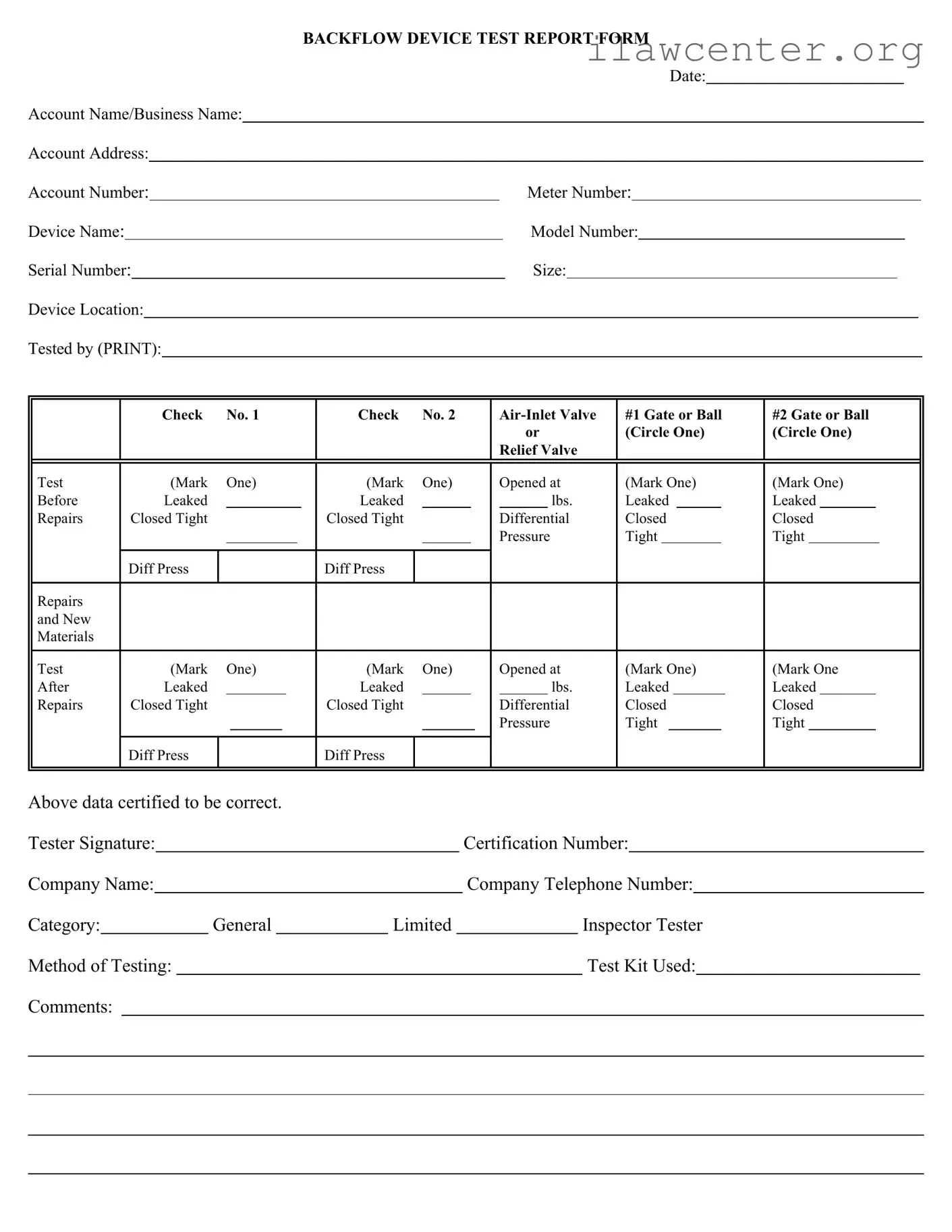
The Backflow Test Report form is a crucial document for ensuring the safety and reliability of water systems. It captures essential information about the backflow prevention device being tested, including the date of the test, the account name or business name, and the specific details of the device, such as its model number, serial number, and size. The form also provides a designated space for the tester's information, including their certification number and company details, which helps establish accountability. During the testing process, various checks are conducted, such as assessing the air-inlet valve and the condition of gate or ball valves. The results of these tests are meticulously recorded, indicating whether the device opened or leaked at specific pressure levels. Additionally, any repairs made or new materials used are documented, ensuring a comprehensive overview of the device's condition. This report not only serves as a record of compliance but also plays a vital role in maintaining the integrity of water supply systems.

Backflow Test Report Preview

BACKFLOW DEVICE TEST REPORT FORM
Date:
Account Name/Business Name:
Account Address:
Account Number: Meter Number:
Device Name: Model Number:
Serial Number: Size:
Device Location:
Tested by (PRINT):
Check No. 1 Check No. 2 Air-Inlet Valve #1 Gate or Ball #2 Gate or Ball
or (Circle One) (Circle One)
Relief Valve
Test (Mark One) (Mark One) Opened at (Mark One) (Mark One)
Before Leaked Leaked lbs. Leaked Leaked
Repairs Closed Tight Closed Tight Differential Closed Closed
Pressure Tight Tight
Diff Press Diff Press
Repairs
and New
Materials
Test (Mark One) (Mark One) Opened at (Mark One) (Mark One
After Leaked Leaked lbs. Leaked Leaked
Repairs Closed Tight Closed Tight Differential Closed Closed
Pressure Tight Tight
Diff Press Diff Press
Above data certified to be correct.
Tester Signature:
Certification Number:
Company Name: Company Telephone Number:
Category: General Limited Inspector Tester
Method of Testing:
Test Kit Used:
Comments:

File Properties

Fact Name Description
Date The report must include the date when the backflow test was conducted, ensuring accurate record-keeping.
Account Information Details such as account name, address, and number are essential for identifying the customer and their location.
Device Details Information about the backflow device, including its name, model number, serial number, and size, is necessary for tracking and compliance.
Test Results The form includes sections to indicate whether the device passed or failed the test, including specific measurements of pressure and leaks.
Tester Information The tester's name, certification number, and company details must be provided to ensure accountability and traceability.
Method of Testing The form requires the method used for testing and the test kit utilized, which aids in standardizing procedures.
Comments Section There is a space for additional comments, allowing testers to note any unusual findings or recommendations for repairs.
Governing Laws In many states, backflow testing is governed by local plumbing codes and regulations, ensuring public health and safety.

Instructions on Utilizing Backflow Test Report

Once you have gathered all the necessary information, you can begin filling out the Backflow Test Report form. This document is essential for documenting the results of backflow testing and ensuring compliance with local regulations. Follow these steps carefully to complete the form accurately.

  1. Enter the Date at the top of the form.
  2. Fill in the Account Name/Business Name.
  3. Provide the Account Address.
  4. Write the Account Number.
  5. Input the Meter Number.
  6. Specify the Device Name.
  7. List the Model Number.
  8. Include the Serial Number.
  9. Indicate the Size of the device.
  10. Describe the Device Location.
  11. Print the name of the person Tested by.
  12. For CHECK NO. 1, mark the appropriate options for AIR-INLET VALVE #1, GATE OR BALL #2, and RELIEF VALVE.
  13. Mark the results for the test: Opened at, Leaked, Closed Tight, and any repairs made.
  14. Repeat the previous step for CHECK NO. 2.
  15. Certify the data by signing your name as Tester Signature.
  16. Provide your Certification Number.
  17. Fill in your Company Name.
  18. List your Company Telephone Number.
  19. Select a Category from the options provided: General, Limited, Inspector, Tester.
  20. Specify the Method of Testing.
  21. Indicate the Test Kit Used.
  22. Include any Comments related to the testing process.

Important Facts about Backflow Test Report

What is the purpose of the Backflow Test Report form?

The Backflow Test Report form is used to document the testing of backflow prevention devices. These devices are crucial for ensuring that contaminated water does not flow back into the clean water supply. By completing this form, testers provide a record of the device's performance and any necessary repairs, helping to maintain public health and safety.

What information is required on the form?

The form requires several key pieces of information, including the date of the test, account name, account address, account number, and device details such as name, model number, and serial number. Additionally, testers must include their name, signature, certification number, and the company’s contact information. This ensures that all relevant parties can be easily identified and contacted if needed.

How do I know if my backflow device passed the test?

The test results will indicate whether the device passed or failed based on various checks. For example, the form includes sections for checking the air-inlet valve, gate or ball valves, and relief valve. If the device is marked as "Closed Tight" and does not show any leaks at the specified pressure, it has passed the test. Any repairs needed will also be documented on the form.

Who is qualified to perform the backflow test?

Only certified testers can perform backflow tests. These individuals have undergone training and have the necessary qualifications to ensure that the testing process is conducted accurately and safely. The tester’s certification number should be included on the report to verify their credentials.

What should I do if my backflow device fails the test?

If a backflow device fails the test, it is essential to address the issues promptly. The report will detail any repairs needed. Contact a qualified professional to perform the necessary repairs or replacements. Once the device has been fixed, it must be retested, and a new report should be completed to confirm that it is functioning correctly.

How often should backflow devices be tested?

Backflow devices should typically be tested annually, though local regulations may vary. It is important to check with your local water authority for specific requirements in your area. Regular testing helps ensure that your device is working properly and protects the water supply from potential contamination.

Common mistakes

Filling out the Backflow Test Report form correctly is crucial for ensuring compliance and maintaining safe water systems. However, many people make common mistakes that can lead to complications down the line. Here are five frequent errors to avoid.

One major mistake is failing to provide complete information. Each section of the form is important. For instance, leaving out the Account Name or Device Location can create confusion. Ensure every field is filled in accurately. This helps in tracking and verifying the test results later.

Another common error is neglecting to mark the appropriate options in the check sections. For example, if you skip marking whether the Air-Inlet Valve opened or leaked, the report may be deemed incomplete. Always double-check that you’ve made the necessary selections, as these details are vital for understanding the device's performance.

People often overlook the importance of the tester's signature. This is not just a formality; it serves as verification of the test results. Without a signature, the report lacks credibility. Make sure to print your name clearly and provide your Certification Number to validate your qualifications.

Additionally, some individuals forget to include comments or notes that could clarify the test results. If there were any unusual findings or repairs made during the testing, documenting these can provide valuable context. A simple note can prevent misunderstandings later.

Lastly, be cautious with the method of testing and the test kit used. If this information is not filled out correctly, it could lead to questions about the reliability of the test. Always ensure that the Method of Testing and Test Kit Used sections are completed accurately to maintain the integrity of the report.

Documents used along the form

The Backflow Test Report form is a crucial document for ensuring the safety and integrity of water systems. However, it is often accompanied by several other forms and documents that serve various purposes in the testing and maintenance process. Below is a list of these related documents, each with a brief description.

  • Backflow Prevention Device Installation Form: This form records the details of the installation of a backflow prevention device, including location, type of device, and installer information. It ensures that the device is properly documented from the start.
  • Maintenance Log: This log keeps track of all maintenance activities performed on the backflow device. It includes dates, types of service, and any issues encountered, helping to maintain a comprehensive history of the device's performance.
  • Testing Schedule: A document that outlines the frequency and timeline for testing backflow devices. It ensures compliance with local regulations and helps in planning necessary inspections.
  • Repair Authorization Form: This form is used to authorize repairs on the backflow device. It includes details about the repairs needed and must be signed by the property owner or authorized representative.
  • Compliance Certificate: After testing, a compliance certificate may be issued to confirm that the backflow device meets all local codes and regulations. This document is often required for record-keeping and inspections.
  • Inspection Report: This report provides a detailed account of the inspection conducted on the backflow device. It includes findings, recommendations, and any necessary follow-up actions.
  • Notification Letter: A letter sent to property owners or managers informing them of upcoming tests or maintenance work. It ensures that all parties are aware of the schedule and can prepare accordingly.

These documents work together to create a thorough record of backflow prevention device management. Keeping them organized and accessible is essential for compliance and safety in water systems.

Similar forms

The Backflow Test Report form shares similarities with several other documents commonly used in various industries. Below is a list of eight documents that have comparable features, along with explanations of how they relate to the Backflow Test Report form.

  • Inspection Report: Like the Backflow Test Report, an inspection report details the condition of a device or system. It includes findings, observations, and recommendations, often requiring signatures for validation.
  • Maintenance Log: A maintenance log records the upkeep and servicing of equipment. Similar to the Backflow Test Report, it includes dates, actions taken, and the personnel involved, ensuring accountability and tracking of service history.
  • Service Agreement: This document outlines the terms of service between a provider and a client. It often includes details about testing and maintenance schedules, akin to the requirements found in the Backflow Test Report.
  • Certification Form: A certification form verifies that a device or system meets specific standards. This is similar to the Backflow Test Report, which certifies that the backflow prevention device has been tested and is functioning correctly.
  • Repair Report: A repair report documents the repairs made to a device. It shares similarities with the Backflow Test Report in that it details the issues found, actions taken, and outcomes, often requiring a signature from the technician.
  • Compliance Report: This report assesses adherence to regulations. Like the Backflow Test Report, it includes specific data points and results that demonstrate compliance with safety and operational standards.
  • Installation Checklist: An installation checklist verifies that all steps were followed during the setup of equipment. It resembles the Backflow Test Report by including a series of checks and confirmations that ensure proper installation and function.
  • Test Result Form: This form presents the outcomes of various tests conducted on equipment. It parallels the Backflow Test Report in that it captures test results, conditions, and any necessary follow-up actions, ensuring clarity and thoroughness.

Dos and Don'ts

When filling out the Backflow Test Report form, consider the following guidelines:

  • Do ensure all fields are filled out completely and accurately.
  • Do use clear handwriting or type the information to avoid any confusion.
  • Don't leave any required sections blank, as this may delay processing.
  • Don't use abbreviations that may not be universally understood.

Misconceptions

Understanding the Backflow Test Report form is essential for compliance and safety. However, several misconceptions can lead to confusion. Here are nine common misunderstandings:

  1. Misconception 1: The form is only necessary for commercial properties.

    In reality, all properties with a backflow prevention device, whether residential or commercial, require testing and documentation.

  2. Misconception 2: The report is only needed if there is a problem with the backflow device.

    Regular testing is mandatory regardless of whether issues are suspected. This ensures the device functions properly and protects the water supply.

  3. Misconception 3: Any plumber can complete the test and fill out the form.

    The tester must be certified specifically for backflow prevention to ensure accurate testing and compliance with regulations.

  4. Misconception 4: The form does not need to be submitted to any authority.

    Most jurisdictions require that the completed report be submitted to the local water authority or regulatory body.

  5. Misconception 5: The test results do not affect water service.

    Failure to pass the test can lead to penalties, including the potential interruption of water service until repairs are made and the device is retested.

  6. Misconception 6: The form is overly complicated and not user-friendly.

    While it may seem detailed, the form is structured to ensure all necessary information is captured clearly and efficiently.

  7. Misconception 7: Once the device is tested, it does not need to be tested again for several years.

    Most regulations require annual testing, so regular checks are essential to maintain compliance.

  8. Misconception 8: The comments section is optional and can be ignored.

    This section is important for noting any specific issues or observations during the test, which can be valuable for future reference.

  9. Misconception 9: The certification number is not important.

    The certification number verifies that the tester is qualified and should always be included on the report for validation purposes.

By addressing these misconceptions, property owners can better understand the importance of the Backflow Test Report form and ensure compliance with local regulations.

Key takeaways

Filling out the Backflow Test Report form is a critical step in ensuring the safety and compliance of your water system. Here are some key takeaways to keep in mind:

  • Accurate Information: Always provide precise details for each section of the form. This includes the date, account name, and device specifics.
  • Device Identification: Clearly state the device name, model number, and serial number. This helps in tracking and maintaining records.
  • Testing Details: When marking the test results, be sure to circle the appropriate options for each check. Indicate whether the valves leaked or were closed tight.
  • Pressure Readings: Document the differential pressure accurately. This information is crucial for assessing the device's performance.
  • Repairs and Maintenance: If any repairs were made, note them in the designated section. This helps maintain a clear history of the device's condition.
  • Certification: Ensure that the tester's signature and certification number are included. This validates the report and confirms the qualifications of the tester.
  • Method of Testing: Specify the method and test kit used. This information can be valuable for future reference and compliance checks.

By following these guidelines, you can ensure that your Backflow Test Report form is completed accurately and effectively, promoting the safety of your water supply.