
Baker Act PDF Template

Baker Act PDF Template

The Baker Act form is a legal document used in Florida to initiate involuntary mental health examinations. This form must be completed by a qualified professional who has personally examined the individual and believes they meet specific criteria for involuntary care. If you need to fill out this important form, please click the button below.

Article Guide

The Baker Act form serves as a critical tool within Florida’s mental health care system, facilitating the involuntary examination of individuals who may pose a danger to themselves or others due to mental illness. This form is designed to be completed by a qualified professional, such as a psychiatrist or mental health counselor, who has personally evaluated the individual within the preceding 48 hours. It requires the professional to certify their credentials and provide details about the individual’s mental health status, including any diagnoses and recent behaviors that support the need for involuntary examination. The form includes specific criteria that must be met, such as the individual’s refusal of voluntary examination or their inability to recognize the necessity for such an assessment. Additionally, it allows for documentation of non-compliance with previous outpatient treatment orders, if applicable. The Baker Act form also collects vital information for law enforcement, ensuring that individuals can be safely transported to receiving facilities for further evaluation and care. By encompassing various sections that address the individual’s condition, supporting evidence, and necessary identification details, the form plays a pivotal role in the mental health intervention process.

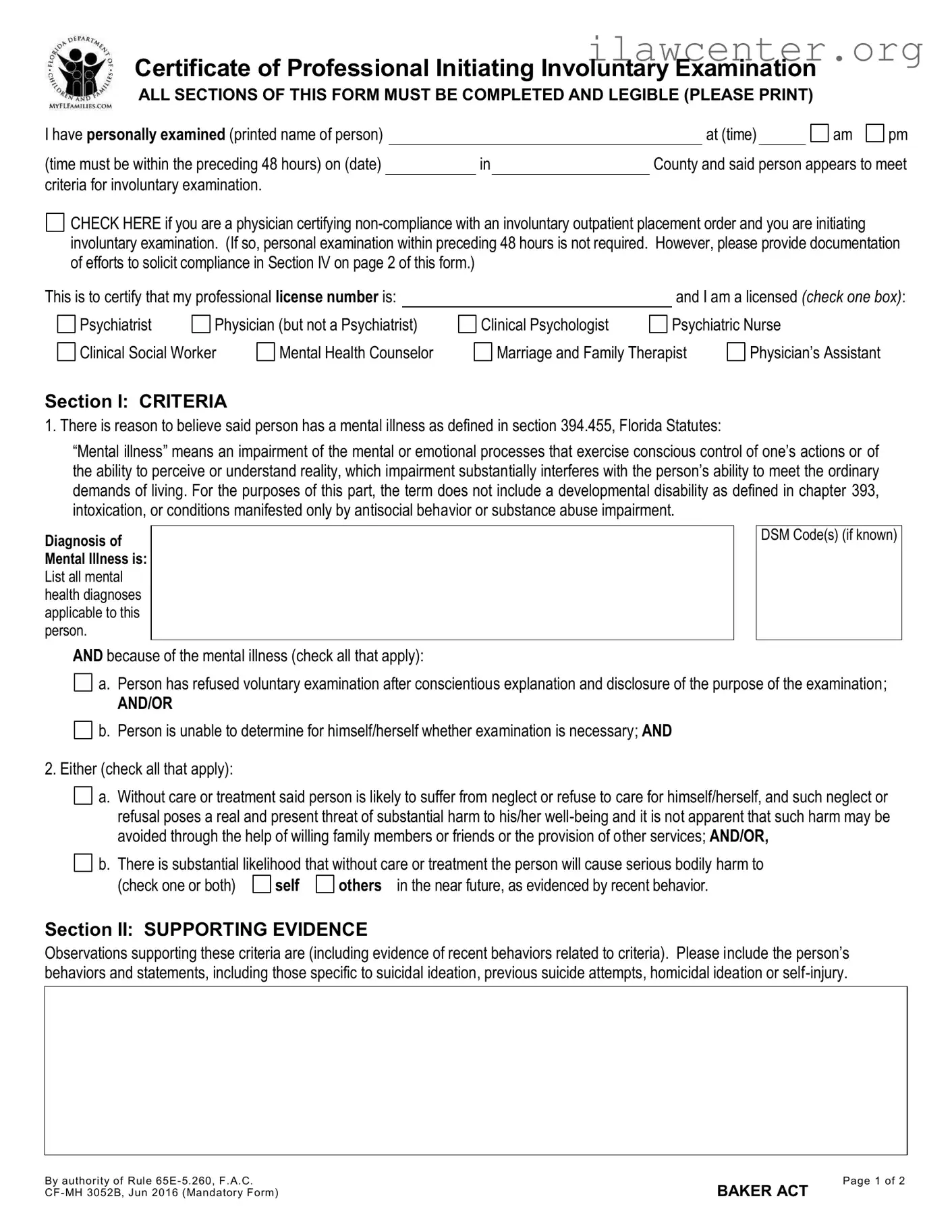
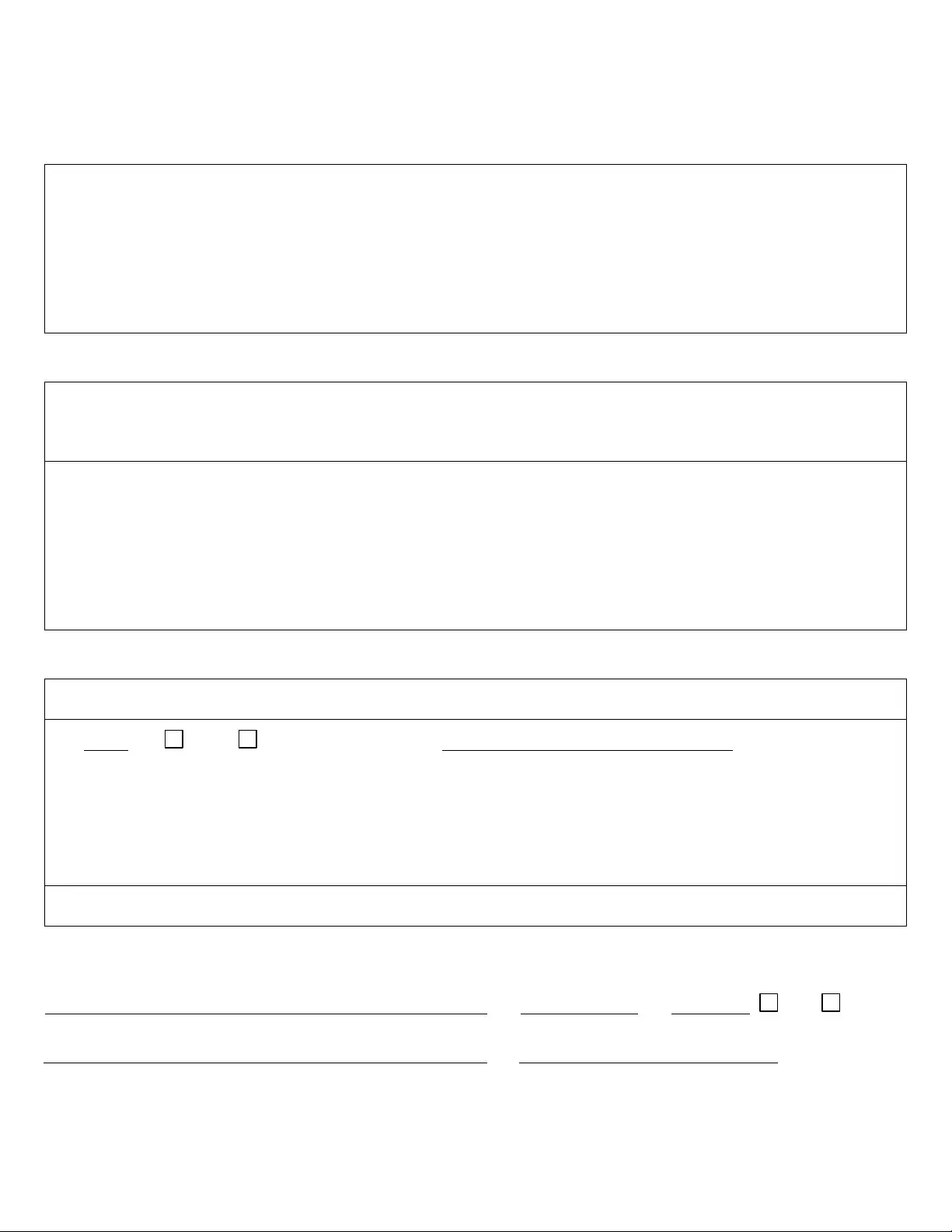
Baker Act Preview

By authority of Rule 65E-5.260, F.A.C. Page 1 of 2
CF-MH 3052B, Jun 2016 (Mandatory Form) BAKER ACT
Certificate of Professional Initiating Involuntary Examination
ALL SECTIONS OF THIS FORM MUST BE COMPLETED AND LEGIBLE (PLEASE PRINT)
I have personally examined (printed name of person)
at (time)
am pm
(time must be within the preceding 48 hours) on (date)
County and said person appears to meet
criteria for involuntary examination.
CHECK HERE if you are a physician certifying non-compliance with an involuntary outpatient placement order and you are initiating
involuntary examination. (If so, personal examination within preceding 48 hours is not required. However, please provide documentation
of efforts to solicit compliance in Section IV on page 2 of this form.)
This is to certify that my professional license number is:
and I am a licensed (check one box):
Psychiatrist Physician (but not a Psychiatrist) Clinical Psychologist Psychiatric Nurse
Clinical Social Worker Mental Health Counselor Marriage and Family Therapist Physician’s Assistant
Section I: CRITERIA
1. There is reason to believe said person has a mental illness as defined in section 394.455, Florida Statutes:
“Mental illness means an impairment of the mental or emotional processes that exercise conscious control of one’s actions or of
the ability to perceive or understand reality, which impairment substantially interferes with the person’s ability to meet the ordinary
demands of living. For the purposes of this part, the term does not include a developmental disability as defined in chapter 393,
intoxication, or conditions manifested only by antisocial behavior or substance abuse impairment.
Diagnosis of
Mental Illness is:
List all mental
health diagnoses
applicable to this
person.
DSM Code(s) (if known)
AND because of the mental illness (check all that apply):
a. Person has refused voluntary examination after conscientious explanation and disclosure of the purpose of the examination;
AND/OR
b. Person is unable to determine for himself/herself whether examination is necessary; AND
2. Either (check all that apply):
a. Without care or treatment said person is likely to suffer from neglect or refuse to care for himself/herself, and such neglect or
refusal poses a real and present threat of substantial harm to his/her well-being and it is not apparent that such harm may be
avoided through the help of willing family members or friends or the provision of other services; AND/OR,
b. There is substantial likelihood that without care or treatment the person will cause serious bodily harm to
(check one or both)
self others in the near future, as evidenced by recent behavior.
Section II: SUPPORTING EVIDENCE
Observations supporting these criteria are (including evidence of recent behaviors related to criteria). Please include the person’s
behaviors and statements, including those specific to suicidal ideation, previous suicide attempts, homicidal ideation or self-injury.
Certificate of Professional Initiating Involuntary Examination
By authority of Rule 65E-5.260, F.A.C. Page 2 of 2
CF-MH 3052B, Jun 2016 (Mandatory Form) BAKER ACT
Section III: OTHER INFORMATION
Other information, including source relied upon to reach this conclusion is as follows. If information is obtained from other persons,
describe these sources (e.g., reports of family, friends, other mental health professionals or law enforcement officers, as well as medical or
mental health records, etc.).
Section IV: NON-COMPLIANCE WITH INVOLUNTARY OUTPATIENT PLACEMENT ORDER
Complete this section if you are a physician who is documenting non-compliance with an involuntary outpatient placement
order: This is to certify that I am a physician, as defined in Florida Statutes 394.455, F.S. and in my clinical judgment, the person has
failed or has refused to comply with the treatment ordered by the court, and the following efforts have been made to solicit compliance
with the treatment plan:
Section V: INFORMATION FOR LAW ENFORCEMENT
Provide identifying information (if known) if requested by law enforcement to find the person so he/she may be taken into custody for
examination:
Age:
Male Female Race/ethnicity:
Other details (such as height, weight, hair color, what wearing when last seen, where last seen):
If relevant, information such as access to weapon, recent violence or pending criminal charges:
This form must be transported with the person to the receiving facility to be retained in the clinical record. Copies may be
retained by the initiating professional and by the law enforcement agency transporting the person to the receiving facility.
Section VI: SIGNATURE
am pm
Signature of Professional
Date Signed
Time
Printed Name of Professional Phone Number (including area code))

File Properties

Fact Name Details
Purpose The Baker Act form is used to initiate involuntary examination for individuals believed to have a mental illness.
Governing Law The form is governed by Florida Statutes, specifically section 394.455.
Professional Requirement The form must be completed by a licensed professional, such as a psychiatrist or mental health counselor.
Timeframe for Examination The professional must have personally examined the individual within the preceding 48 hours before completing the form.
Criteria for Involuntary Examination Criteria include refusal of voluntary examination and inability to determine the necessity of examination.
Supporting Evidence Observations and behaviors supporting the need for examination must be documented on the form.
Non-Compliance Section A specific section is dedicated to documenting non-compliance with involuntary outpatient placement orders.
Law Enforcement Information Identifying information for law enforcement must be provided if requested to locate the individual.
Retention of Form The completed form must accompany the individual to the receiving facility and be retained in the clinical record.
Signature Requirement The form must be signed and dated by the professional completing it, including their printed name and contact information.

Instructions on Utilizing Baker Act

Filling out the Baker Act form requires careful attention to detail. Each section must be completed accurately and legibly to ensure that the necessary information is conveyed effectively. After completing the form, it is essential to transport it with the individual to the receiving facility, where it will be retained in their clinical record.

  1. Begin with your professional information: Print your name, the time of examination (within the last 48 hours), the date, and the county where the examination took place.
  2. Check the appropriate box: Indicate if you are certifying non-compliance with an involuntary outpatient placement order.
  3. Provide your professional license number: Indicate your professional title, such as psychiatrist or clinical social worker, and check the appropriate box for your specific qualifications.
  4. Complete Section I: Criteria: State the mental illness diagnosis and list all applicable mental health diagnoses, including DSM codes if known. Indicate whether the person has refused voluntary examination or is unable to determine the necessity of the examination.
  5. Assess the risk: In the same section, check all applicable boxes regarding the likelihood of neglect or self-harm, or the potential for causing serious bodily harm to themselves or others.
  6. Fill out Section II: Supporting Evidence: Describe observations and behaviors that support your criteria, including any relevant statements made by the individual regarding suicidal or homicidal thoughts.
  7. Provide additional information in Section III: Include any sources of information that contributed to your conclusions, such as reports from family or law enforcement.
  8. If applicable, complete Section IV: Document efforts made to solicit compliance with an involuntary outpatient placement order, if you are a physician.
  9. Fill out Section V: Information for Law Enforcement: Provide identifying information about the individual, including age, gender, race/ethnicity, and any relevant details that could assist law enforcement in locating them.
  10. Sign the form: Include your signature, the date signed, and the time. Print your name and provide your phone number.

Important Facts about Baker Act

What is the Baker Act form?

The Baker Act form is a legal document used in Florida to initiate an involuntary examination of an individual believed to be experiencing a mental health crisis. It is completed by a qualified mental health professional who certifies that the person meets the criteria for involuntary examination as defined by Florida law.

Who can complete the Baker Act form?

The form can be completed by various licensed professionals, including psychiatrists, physicians, clinical social workers, mental health counselors, clinical psychologists, psychiatric nurses, marriage and family therapists, and physician assistants. Each professional must have the appropriate credentials to assess the individual in question.

What criteria must be met for an involuntary examination?

To initiate an involuntary examination, the professional must determine that the individual has a mental illness that substantially interferes with their ability to meet ordinary demands of living. Additionally, the individual must either refuse voluntary examination or be unable to determine if examination is necessary. There must also be a risk of harm to themselves or others if they do not receive treatment.

What information is required on the Baker Act form?

The form requires detailed information, including the individual's mental health diagnoses, observations supporting the criteria for examination, and any other relevant information from family, friends, or other professionals. It also includes sections for documenting non-compliance with outpatient treatment orders, if applicable.

How recent must the examination be before completing the form?

The professional must have personally examined the individual within the preceding 48 hours to certify that they meet the criteria for involuntary examination. If the professional is certifying non-compliance with an outpatient placement order, the personal examination is not required, but documentation of compliance efforts must be provided.

What happens after the form is completed?

Once the form is completed, it must be transported with the individual to the receiving facility where they will undergo the examination. It is important that copies of the form are retained by both the initiating professional and the law enforcement agency involved in the transport.

Can family members or friends influence the decision to initiate a Baker Act?

Yes, family members or friends can provide information that may influence the decision. Their observations and reports regarding the individual's behavior can be critical in determining whether the criteria for involuntary examination are met.

What if the individual has a history of violence?

If the individual has a history of violence or poses a risk of harm to themselves or others, this information should be included in the supporting evidence section of the Baker Act form. Such details are essential for assessing the level of risk and the need for immediate intervention.

Is there a time limit for initiating the Baker Act process?

While there is no specific time limit for when the Baker Act can be initiated, it is crucial that the examination occurs promptly after the individual is assessed to ensure their safety and well-being. The professional should act swiftly if there is a perceived risk of harm.

What rights does the individual have during the Baker Act process?

Individuals undergoing the Baker Act process have rights, including the right to be informed about the examination and treatment, the right to legal representation, and the right to appeal the decision for involuntary treatment. It is essential for professionals to communicate these rights clearly to the individual involved.

Common mistakes

Completing the Baker Act form accurately is crucial for ensuring the proper treatment and care of individuals in crisis. However, many people make common mistakes that can lead to delays or complications. Understanding these errors can help facilitate a smoother process.

One frequent mistake is failing to complete all sections of the form. Each section must be filled out completely and legibly. Incomplete forms can result in confusion and may hinder the examination process. It is essential to ensure that every part of the form is addressed, especially the criteria that justify the need for involuntary examination.

Another common issue is not providing a clear diagnosis of the mental illness. The form requires specific mental health diagnoses and DSM codes, if known. Omitting this information can lead to misunderstandings about the individual's condition and the urgency of their situation. Accurate and detailed information is vital for the professionals involved in the case.

Additionally, individuals often neglect to document observations supporting the criteria for involuntary examination. This section should include specific behaviors and statements made by the person, particularly those related to suicidal or homicidal ideation. Without this evidence, it may be challenging for mental health professionals to assess the situation appropriately.

People sometimes overlook the importance of detailing the sources relied upon to reach their conclusions. This includes information from family members, friends, or other professionals. Providing this context can strengthen the case for involuntary examination and help convey the urgency of the situation.

Another mistake is failing to check the appropriate boxes indicating the reasons for involuntary examination. This section is critical in outlining the immediate risks to the individual or others. If the reasons are not clearly articulated, it may create ambiguity about the necessity of the examination.

Finally, some professionals forget to sign and date the form. The signature is a crucial element that verifies the authenticity of the document. Without it, the form may not be considered valid, which can lead to unnecessary delays in treatment.

In summary, careful attention to detail when filling out the Baker Act form is essential. Avoiding these common mistakes can significantly impact the effectiveness of the involuntary examination process and ultimately ensure that individuals receive the care they need in a timely manner.

Documents used along the form

The Baker Act is a critical legal document used in Florida for the involuntary examination of individuals believed to be experiencing a mental health crisis. Alongside this form, several other documents are often utilized to ensure a comprehensive approach to mental health care. Below is a list of these documents, each serving a unique purpose in the process.

  • Involuntary Examination Order: This court order authorizes law enforcement to take an individual into custody for a mental health evaluation. It is typically issued when a person poses a danger to themselves or others due to a mental illness.
  • Patient Consent Form: This form is used to obtain consent from the patient for treatment or evaluation. It ensures that the individual is informed about their rights and the nature of the treatment being proposed.
  • Clinical Assessment Report: A document prepared by a mental health professional that outlines the findings from the evaluation. It includes details about the individual's mental state, history, and recommendations for treatment.
  • Discharge Summary: This report is completed when an individual is released from a mental health facility. It summarizes the treatment received, progress made, and any follow-up care needed to support ongoing recovery.

These documents work together to create a framework for addressing mental health crises effectively. Understanding their roles can help ensure that individuals receive the appropriate care and support they need during challenging times.

Similar forms

The Baker Act form, which is used for initiating involuntary examinations in Florida, shares similarities with several other important documents in the mental health and legal fields. Below is a list of nine documents that have comparable purposes or functions:

  • Involuntary Commitment Application: This document requests the court to authorize the involuntary commitment of an individual due to mental health concerns. Like the Baker Act, it requires evidence of mental illness and potential harm to self or others.
  • Emergency Detention Order: This order allows law enforcement to detain an individual for a short period based on observed behaviors indicating a risk of harm. It parallels the Baker Act's focus on immediate safety and mental health evaluation.
  • Consent for Treatment Form: This form is used when an individual voluntarily agrees to receive mental health treatment. While the Baker Act is for involuntary examination, both documents involve mental health care decisions.
  • Advance Directive for Mental Health Care: This document outlines an individual's preferences for mental health treatment in case they become unable to make decisions. Similar to the Baker Act, it addresses mental health needs but emphasizes the individual's rights and choices.
  • Physician's Report for Involuntary Treatment: This report provides detailed clinical observations and recommendations for treatment. It shares the Baker Act's requirement for professional input regarding an individual's mental health status.
  • Assessment and Evaluation Report: This document contains findings from a mental health evaluation and is used to guide treatment plans. Like the Baker Act, it relies on professional assessment to determine the appropriate care for the individual.
  • Risk Assessment Form: Used to evaluate the potential for self-harm or harm to others, this form is similar to the Baker Act in its focus on assessing immediate risks associated with mental health issues.
  • Release of Information Form: This form allows mental health professionals to share information about a client with other parties. While it serves a different purpose, it is often used in conjunction with the Baker Act to ensure proper communication among care providers.
  • Law Enforcement Transport Form: This document is used by law enforcement when transporting individuals for mental health evaluations. It aligns with the Baker Act's requirements for documentation during involuntary examinations.

Dos and Don'ts

When filling out the Baker Act form, it’s essential to approach the task with care and attention to detail. Here’s a list of things you should and shouldn’t do to ensure the form is completed correctly.

  • Do ensure all sections of the form are completed and legible.
  • Do provide accurate and detailed information about the individual being examined.
  • Do check the appropriate boxes regarding the criteria for involuntary examination.
  • Do document any observations and supporting evidence clearly.
  • Do include your professional license number and title in the appropriate section.
  • Don't leave any sections blank; all must be filled out.
  • Don't use vague language; be specific about the individual’s behaviors and statements.
  • Don't forget to sign and date the form before submission.
  • Don't provide incomplete or unclear information regarding the individual's mental health history.
  • Don't neglect to transport the form with the individual to the receiving facility.

Misconceptions

The Baker Act is a law in Florida that allows for the involuntary examination of individuals who may be experiencing a mental health crisis. However, there are several misconceptions surrounding the Baker Act form that can lead to confusion. Here are nine common misconceptions:

  • The Baker Act can be used by anyone. Many believe that any person can initiate a Baker Act. In reality, only qualified professionals, such as licensed mental health practitioners, can complete the form.
  • Involuntary examination means hospitalization. Some think that being Baker Acted automatically leads to hospitalization. This is not the case; the examination is meant to assess the individual's needs and determine the appropriate level of care.
  • The person must have a diagnosed mental illness. It is a misconception that a formal diagnosis is required for the Baker Act. The criteria focus on behaviors and risks rather than a specific diagnosis.
  • Consent is always required. Many people believe that consent from the individual is necessary for the Baker Act to be initiated. However, if a person is unable to determine their need for examination, consent may not be required.
  • The form can be filled out at any time. Some think that the Baker Act form can be completed at any time. In fact, it must be filled out based on a personal examination that occurs within the preceding 48 hours.
  • Once initiated, the process cannot be stopped. There is a belief that once the Baker Act process starts, it cannot be halted. However, professionals can reassess the situation and decide to withdraw the Baker Act if appropriate.
  • The Baker Act is only for severe cases. Some individuals think that the Baker Act is only for extreme situations. In truth, it can be utilized in various scenarios where a person poses a risk to themselves or others, regardless of the severity.
  • Law enforcement must always be involved. It is a common myth that law enforcement must be present for a Baker Act. While they may be involved in some cases, it is not a requirement for every situation.
  • The Baker Act is a permanent solution. Many assume that being Baker Acted leads to long-term treatment or commitment. However, the Baker Act is intended for immediate assessment and does not dictate long-term care.

Understanding these misconceptions can help clarify the purpose and process of the Baker Act, ensuring that individuals receive the appropriate care they need in times of crisis.

Key takeaways

Understanding the Baker Act form is crucial for professionals involved in mental health evaluations. Here are some key takeaways to keep in mind:

  • Complete All Sections: Ensure that every section of the form is filled out completely and legibly. This is essential for clarity and compliance.
  • Timeliness is Key: The examination must occur within 48 hours prior to completing the form. This timeframe is critical for the validity of the evaluation.
  • Documentation of Non-Compliance: If you are certifying non-compliance with an involuntary outpatient placement order, include documentation of efforts made to solicit compliance.
  • Criteria for Mental Illness: Familiarize yourself with the definition of mental illness as per Florida Statutes. This includes understanding the implications of impairment on daily living.
  • Behavioral Evidence: Provide specific observations that support the criteria for involuntary examination. Include any relevant behaviors or statements made by the individual.
  • Sources of Information: Clearly document any sources of information that contributed to your conclusions, such as reports from family or other professionals.
  • Law Enforcement Information: If law enforcement is involved, provide all necessary identifying information to assist in locating the individual.
  • Transporting the Form: The completed form must accompany the individual to the receiving facility. This ensures that all relevant information is available for their care.
  • Signature Requirements: The form must be signed and dated by the professional initiating the examination. This adds credibility and accountability to the process.

By keeping these points in mind, professionals can effectively utilize the Baker Act form in their practice, ensuring that individuals receive the necessary care and support.