Basketball Evaluation PDF Template

Basketball Evaluation PDF Template

The Basketball Evaluation Form is a comprehensive tool designed to assess a player's performance across various skills and attributes. This evaluation helps coaches and evaluators identify strengths and areas for improvement, ensuring that players receive the feedback they need to enhance their game. To contribute to the development of young athletes, consider filling out the form by clicking the button below.

Article Guide

The Basketball Evaluation form serves as a comprehensive tool for assessing a player's skills and potential on the court. This form is designed to capture key aspects of a player's performance, from shooting and defense to dribbling and athletic ability. Evaluators will provide ratings in various categories, such as shooting mechanics, defensive positioning, and passing accuracy, using a simple scale that ranges from needs improvement to outstanding. Each section allows for detailed feedback, ensuring that strengths and areas for growth are clearly identified. Additionally, evaluators can note a player’s overall strengths, coachability, and game play, providing a well-rounded view of the athlete’s capabilities. Comments and recommendations section further enhance the evaluation, allowing for personalized insights that can guide training and development. With this structured approach, coaches can make informed decisions about player placement and development, ultimately fostering a stronger team dynamic.

Basketball Evaluation Preview

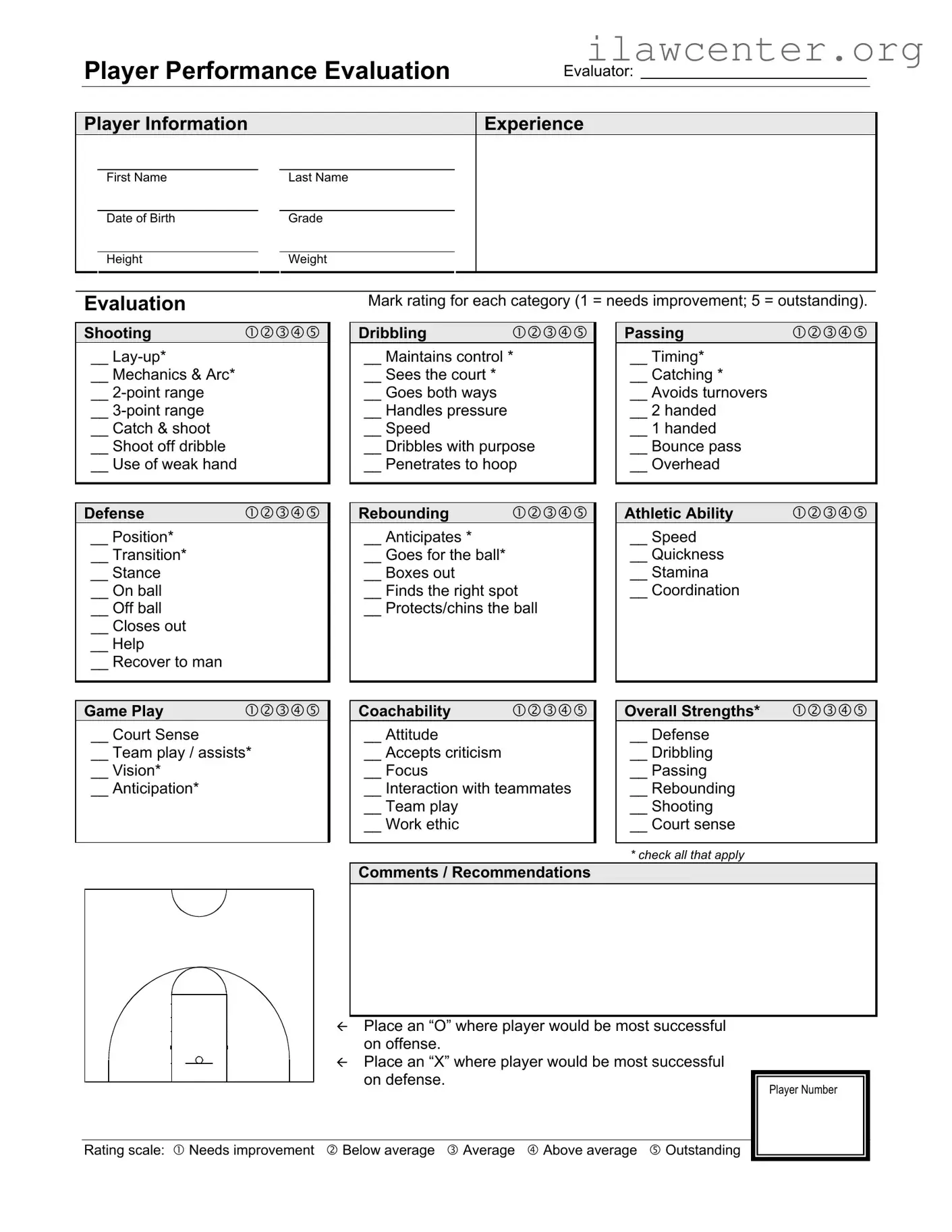
Player Performance Evaluation
Rating scale: c Needs improvement d Below average e Average f Above average g Outstanding
Evaluator:
Player Information Experience
First Name Last Name
Date of Birth Grade
Height Weight
Evaluation
Mark rating for each category (1 = needs improvement; 5 = outstanding).
Shooting cdefg
Dribbling cdefg
Passing cdefg
__ Lay-up*
__ Mechanics & Arc*
__ 2-point range
__ 3-point range
__ Catch & shoot
__ Shoot off dribble
__ Use of weak hand
__ Maintains control *
__ Sees the court *
__ Goes both ways
__ Handles pressure
__ Speed
__ Dribbles with purpose
__ Penetrates to hoop
__ Timing*
__ Catching *
__ Avoids turnovers
__ 2 handed
__ 1 handed
__ Bounce pass
__ Overhead
Defense cdefg
Rebounding cdefg
Athletic Ability cdefg
__ Position*
__ Transition*
__ Stance
__ On ball
__ Off ball
__ Closes out
__ Help
__ Recover to man
__ Anticipates *
__ Goes for the ball*
__ Boxes out
__ Finds the right spot
__ Protects/chins the ball
__ Speed
__ Quickness
__ Stamina
__ Coordination
Game Play cdefg
Coachability cdefg
Overall Strengths* cdefg
__ Court Sense
__ Team play / assists*
__ Vision*
__ Anticipation*
__ Attitude
__ Accepts criticism
__ Focus
__ Interaction with teammates
__ Team play
__ Work ethic
__ Defense
__ Dribbling
__ Passing
__ Rebounding
__ Shooting
__ Court sense
* check all that apply
Comments / Recommendations
Å Place an “O” where player would be most successful
on offense.
Å Place an “X” where player would be most successful
on defense.
Player Number

File Properties

Fact Name Fact Description
Evaluator Information The form requires the evaluator's name, ensuring accountability and clarity in the evaluation process.
Player Details Key player information, including first name, last name, date of birth, grade, height, and weight, is collected to provide context for the evaluation.
Performance Categories The evaluation assesses multiple performance categories such as shooting, defense, dribbling, rebounding, passing, athletic ability, game play, and coachability.
Rating Scale Each category is rated on a scale from 1 to 5, where 1 indicates a need for improvement and 5 signifies outstanding performance.
Strengths Identification Evaluators can highlight overall strengths by marking specific skills, which helps in identifying areas for player development.
Comments Section A dedicated space for comments and recommendations allows evaluators to provide personalized feedback and insights.
Offensive and Defensive Markings Evaluators are instructed to mark an "O" for offensive strengths and an "X" for defensive strengths, aiding in strategic placement of the player.
Experience Level The form includes a section to indicate the player’s experience, which can influence their evaluation and development path.
State-Specific Compliance Different states may have specific governing laws regarding youth sports evaluations, ensuring adherence to safety and fairness standards.

Instructions on Utilizing Basketball Evaluation

After completing the Basketball Evaluation form, the evaluator will have a comprehensive overview of the player's abilities and areas for improvement. This information will assist coaches and trainers in developing tailored training plans and strategies.

  1. Start by entering the Evaluator name at the top of the form.
  2. Fill in the Player Information section with the player's First Name, Last Name, Date of Birth, Grade, Height, and Weight.
  3. For each performance category, mark the rating from 1 to 5 based on the player's performance. Categories include:
    • Shooting
    • Defense
    • Dribbling
    • Rebounding
    • Passing
    • Athletic Ability
    • Game Play
    • Coachability
  4. In the Overall Strengths section, check all that apply to the player.
  5. Provide any Comments / Recommendations that may help the player improve or highlight their strengths.
  6. Indicate the player’s offensive position by placing an “O” and defensive position by placing an “X” in the appropriate areas.

Important Facts about Basketball Evaluation

What is the purpose of the Basketball Evaluation form?

The Basketball Evaluation form is designed to assess a player's performance across various skills and attributes. Coaches and evaluators use this tool to provide a comprehensive overview of a player's strengths and areas for improvement. The evaluation helps in determining the player's potential and suitability for different positions and roles on the team.

Who completes the Basketball Evaluation form?

The form is typically completed by coaches, evaluators, or trainers who have observed the player's performance during practices or games. Their insights and assessments are crucial in providing an accurate evaluation of the player's skills and overall abilities.

What categories are included in the evaluation?

The evaluation covers several key areas, including shooting, defense, dribbling, rebounding, passing, athletic ability, game play, and coachability. Each category contains specific skills that are rated on a scale from 1 to 5, allowing for a detailed analysis of the player's performance.

How is the rating scale structured?

The rating scale ranges from 1 to 5, where 1 indicates "needs improvement" and 5 signifies "outstanding." This scale helps evaluators provide clear and concise feedback on each skill, making it easier to identify where a player excels and where they may need additional focus or training.

What should be included in the comments and recommendations section?

In the comments and recommendations section, evaluators should provide specific feedback regarding the player's performance. This may include suggestions for improvement, observations about the player's attitude and work ethic, or notes on how the player can be best utilized on the court. Marking an "O" for offensive strengths and an "X" for defensive strengths can also help clarify the player's optimal positions.

Can the evaluation form be used for players of all ages?

Yes, the Basketball Evaluation form is versatile and can be utilized for players of all ages and skill levels. Whether assessing youth players or more experienced athletes, the form provides a structured way to evaluate performance and development needs.

How can the evaluation results be used?

The results from the evaluation can be used in various ways. Coaches may use them to make informed decisions about team placements, training focuses, and player development plans. Additionally, players can review their evaluations to understand their strengths and areas needing improvement, guiding their practice and training efforts.
Common mistakes

When filling out the Basketball Evaluation form, individuals often overlook important details that can affect the overall assessment of a player. One common mistake is failing to provide complete player information. Missing details such as the player’s first name, last name, or date of birth can lead to confusion and may hinder the evaluation process. It is essential to ensure that all fields are filled out accurately to maintain clarity.

Another frequent error occurs in the evaluation of player performance categories. Evaluators sometimes forget to use the rating scale consistently. For instance, marking a player as “outstanding” in one category while rating them as “needs improvement” in another can create inconsistencies. Each category should be assessed with careful consideration, ensuring that the ratings reflect the player’s true abilities.

Some evaluators may also neglect to check all applicable skills in the evaluation form. For example, when assessing shooting, it is important to indicate all relevant areas such as lay-ups, mechanics, and shooting off the dribble. Omitting these checks can lead to an incomplete picture of the player's capabilities. A thorough evaluation should capture the full range of a player’s skills.

Additionally, evaluators often skip the comments and recommendations section. This part of the form provides valuable insights that go beyond numerical ratings. By not including specific observations or suggestions, evaluators miss the opportunity to highlight strengths and areas for improvement. This feedback is crucial for players to understand their development needs.

Lastly, some evaluators may forget to indicate where the player would be most successful on the court. Placing an “O” for offensive strengths and an “X” for defensive capabilities is essential for understanding the player's role. Neglecting this step can lead to misunderstandings about the player’s optimal positioning during games. Accurate placement helps coaches make informed decisions about player assignments.

Documents used along the form

When assessing a basketball player's skills and potential, the Basketball Evaluation form is just one of several important documents that can be utilized. Each of these forms serves a unique purpose and helps coaches, players, and parents understand areas of strength and opportunities for improvement. Below is a list of other commonly used forms that complement the Basketball Evaluation form.

  • Player Registration Form: This document collects essential information about the player, including contact details, emergency contacts, and any medical conditions. It ensures that the organization has accurate records for communication and safety.
  • Practice Attendance Sheet: Coaches use this form to track player attendance at practices. It helps monitor commitment levels and can inform decisions about playing time and team dynamics.
  • Game Schedule: This document outlines the dates, times, and locations of upcoming games. It keeps players and parents informed and helps in planning transportation and attendance.
  • Injury Report Form: If a player gets injured during practice or a game, this form documents the incident. It provides details about the injury and any treatment received, ensuring proper follow-up care.
  • Parent Consent Form: This form secures permission from parents or guardians for their child's participation in the sport. It often includes waivers for liability and acknowledges understanding of the risks involved.
  • Team Roster: This document lists all team members, their positions, and contact information. It fosters communication among players and helps build team cohesion.
  • Game Performance Report: After each game, coaches may fill out this report to assess individual and team performance. It can highlight successes and areas needing improvement, guiding future practices.
  • Skill Development Plan: This personalized plan outlines specific skills a player should focus on improving. It serves as a roadmap for both players and coaches to track progress over time.
  • Feedback Form: Coaches and players can use this form to provide constructive feedback about practices and games. It encourages open communication and helps identify areas for enhancement.

Using these forms in conjunction with the Basketball Evaluation form creates a comprehensive framework for player development. Each document plays a vital role in fostering a supportive environment that encourages growth, teamwork, and skill enhancement.

Similar forms

  • Player Performance Assessment Form: Similar to the Basketball Evaluation form, this document evaluates various skills and attributes of an athlete. It includes categories such as strength, agility, and teamwork, providing a comprehensive overview of the player's abilities.
  • Coaching Feedback Form: This form gathers insights from coaches regarding a player's performance during practices and games. It often includes sections for strengths and areas for improvement, similar to the evaluation categories in the Basketball Evaluation form.
  • Physical Fitness Assessment: This document assesses an athlete's physical capabilities, including endurance, strength, and flexibility. Like the Basketball Evaluation form, it uses a rating system to quantify performance levels.
  • Skill Development Tracker: This tool is used to monitor a player's progress over time in specific skills such as shooting, dribbling, and defense. It shares the same goal of identifying strengths and weaknesses as the Basketball Evaluation form.
  • Game Performance Review: This document analyzes a player's performance in specific games. It focuses on metrics like scoring, assists, and defensive plays, paralleling the evaluation criteria found in the Basketball Evaluation form.
  • Team Evaluation Form: This form assesses the overall performance of the team, including individual contributions. It may include sections on teamwork and communication, which are also considered in the Basketball Evaluation form.
  • Player Development Plan: This document outlines specific goals and strategies for a player's improvement. It often references areas identified in evaluations, similar to the Basketball Evaluation form's focus on skill enhancement.

Dos and Don'ts

When filling out the Basketball Evaluation form, it's important to be thorough and thoughtful. Here’s a list of things you should and shouldn't do to ensure the evaluation is as accurate and helpful as possible.

  • Do provide honest ratings for each category. Your feedback will help the player improve.
  • Do take your time when assessing each skill. Rushing can lead to inaccurate evaluations.
  • Do use specific examples when writing comments. This gives context to your ratings.
  • Do consider the player’s overall performance, not just their strengths.
  • Do communicate with the player about their strengths and areas for improvement.
  • Don't inflate ratings just to be nice. Honest feedback is crucial for growth.
  • Don't skip categories. Every skill is important for a well-rounded evaluation.
  • Don't focus solely on the negatives. Balance your feedback with positive notes.
  • Don't forget to fill in the player information completely. Missing details can create confusion.

Following these guidelines will help ensure that the evaluation is constructive and beneficial for the player. Remember, the goal is to support their development and help them succeed on the court.

Misconceptions

There are several misconceptions surrounding the Basketball Evaluation form that can lead to misunderstandings about its purpose and use. Here are nine common misconceptions, along with explanations to clarify each one.

  • The form is only for coaches. Many believe that only coaches should fill out the evaluation form. In reality, it can be beneficial for players, parents, and trainers to provide input as well.
  • It only assesses physical skills. While the form does evaluate physical abilities like shooting and dribbling, it also considers mental aspects, such as game sense and coachability.
  • All categories are equally important. Some may think that every category on the form carries the same weight. However, the importance of each category can vary depending on the player's position and team needs.
  • Ratings are permanent. A common belief is that the ratings given on the evaluation are set in stone. In fact, they can change over time as players develop their skills and improve.
  • Players should only focus on their weaknesses. Many players assume that they should concentrate solely on areas needing improvement. It is equally important to recognize and build upon their strengths.
  • The evaluation is only for competitive players. Some think that only players on competitive teams need to be evaluated. However, evaluations can be useful for players of all skill levels to track their progress.
  • The form is too complicated to understand. While the form may seem detailed, it is designed to be straightforward. Each section provides clear criteria for evaluation.
  • Feedback is not important. Some players may believe that the evaluation is merely a formality. In reality, constructive feedback is crucial for growth and improvement.
  • The form is only used once a season. It is a misconception that evaluations are conducted only at the beginning or end of a season. Regular evaluations can help monitor progress throughout the season.

Understanding these misconceptions can help players, coaches, and parents utilize the Basketball Evaluation form more effectively. By recognizing its true purpose, everyone involved can work together to foster player development.

Key takeaways

When filling out and utilizing the Basketball Evaluation form, several key considerations can enhance its effectiveness. Here are the essential takeaways:

  • Understand the Rating Scale: Familiarize yourself with the rating scale before you begin. Ratings range from 1 (needs improvement) to 5 (outstanding), providing a clear framework for evaluation.
  • Be Objective: Strive for impartiality when assessing each player. Personal biases can skew the evaluation, leading to inaccurate results.
  • Focus on Specific Categories: Pay close attention to each category, such as shooting, defense, and passing. This specificity allows for a comprehensive understanding of a player’s strengths and weaknesses.
  • Utilize Comments Effectively: Use the comments section to provide detailed feedback. This can help players understand areas for improvement and highlight their strengths.
  • Mark Offense and Defense: Remember to place an “O” for offensive strengths and an “X” for defensive capabilities. This visual aid clarifies where a player excels.
  • Encourage Player Development: Use the evaluation as a tool for growth. Discuss the results with players to create actionable plans for improvement.
  • Review and Reflect: After completing the evaluations, take time to review them. Reflecting on the assessments can lead to better insights for future evaluations.