Basketball Scoresheet PDF Template

Basketball Scoresheet PDF Template

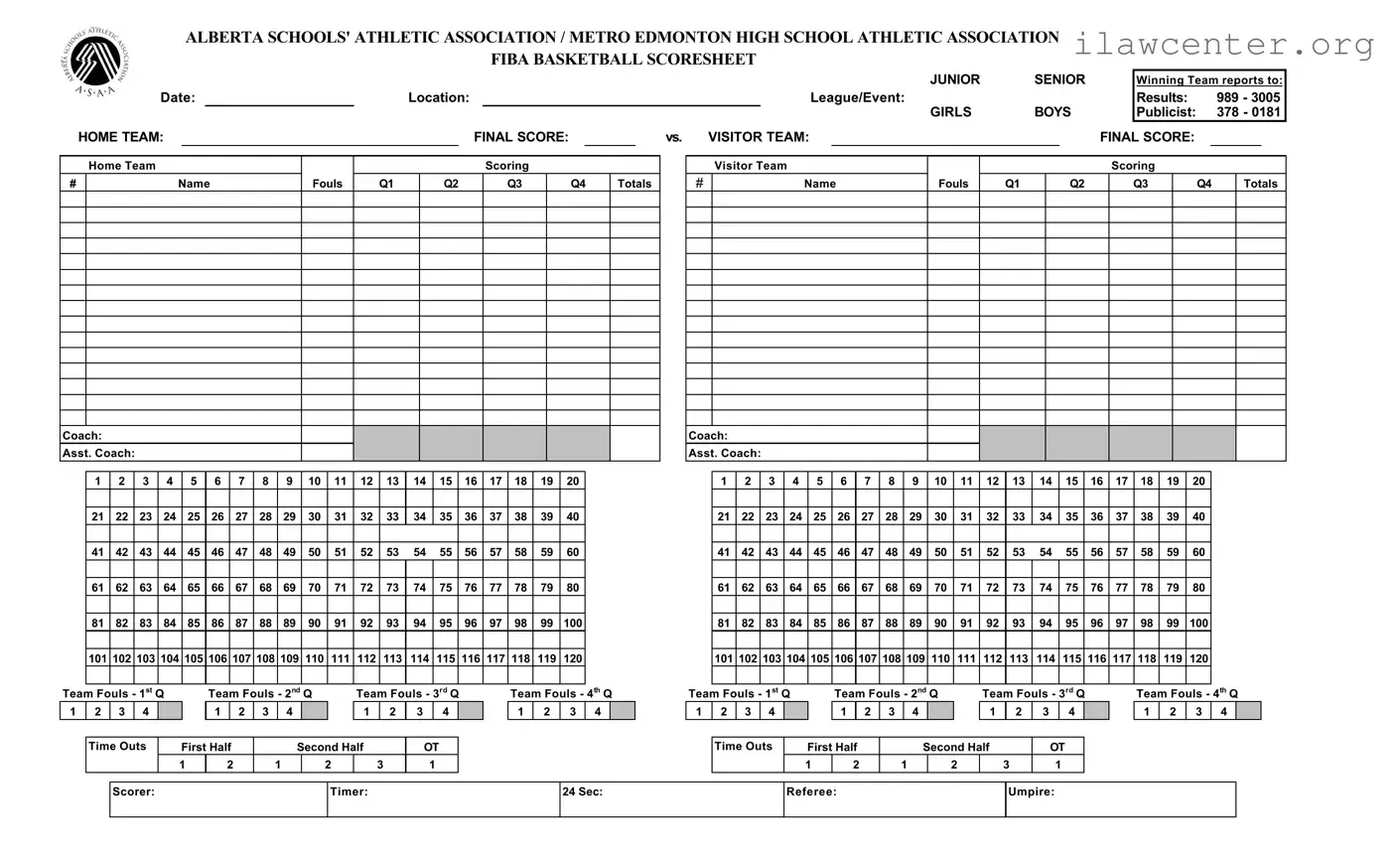
The Basketball Scoresheet is an essential tool used to record the details of a basketball game, including player statistics, team fouls, and final scores. This form not only aids in tracking performance but also serves as an official record for schools and leagues. Ready to keep your game organized? Fill out the form by clicking the button below.

Article Guide

The Basketball Scoresheet form serves as an essential tool for tracking the progress and statistics of basketball games at various levels, including junior and senior leagues. This comprehensive document captures vital information such as the teams involved, the date and location of the game, and the final scores for both the home and visitor teams. Each team's roster is detailed, allowing for the recording of player statistics, including points scored and fouls committed throughout the game. The scoresheet is divided into quarters, enabling coaches and officials to monitor performance in a structured manner. Additionally, it includes sections for team fouls, timeouts, and the names of key personnel such as coaches and referees. By providing a clear and organized format, the Basketball Scoresheet form not only facilitates accurate record-keeping but also enhances the overall experience for players, coaches, and fans alike.

Basketball Scoresheet Preview

JUNIOR SENIOR Winning Team reports to:
Date: Location: League/Event: Results: 989 - 3005
GIRLS
BOYS
Publicist: 378 - 0181
vs.
Home Team Visitor Team
# Name # Name
Coach: Coach:
Asst. Coach: Asst. Coach:
1 2 3 4 5 6 7 8 9 10 11 12 13 15 16 17 18 20 1 2 3 4 5 6 7 8 9 10 11 12 13 15 16 17 18 20
21 22 23 24 25 26 27 28 29 30 31 32 33 35 36 37 38 40 21 22 23 24 25 26 27 28 29 30 31 32 33 35 36 37 38 40
41 42 43 44 45 46 47 48 49 50 51 52 53 55 56 57 58 60 41 42 43 44 45 46 47 48 49 50 51 52 53 55 56 57 58 60
61 62 63 64 65 66 67 68 69 70 71 72 73 75 76 77 78 80 61 62 63 64 65 66 67 68 69 70 71 72 73 75 76 77 78 80
81 82 83 84 85 86 87 88 89 90 91 92 93 95 96 97 98 100 81 82 83 84 85 86 87 88 89 90 91 92 93 95 96 97 98 100
101 102 103 104 105 106 107 108 109 110 111 112 113 115 116 117 118 120 101 102 103 104 105 106 107 108 109 110 111 112 113 115 116 117 118 120
Team Fouls - 1
st
Q Team Fouls - 2
nd
Q Team Fouls - 3
rd
Q Team Fouls - 4
th
Q Team Fouls - 1
st
Q Team Fouls - 2
nd
Q Team Fouls - 3
rd
Q Team Fouls - 4
th
Q
1 2 3 4 1 2 3 4 1 2 4 1 3 4 1 2 3 4 1 2 3 4 1 2 4 1 3 4
Time Outs Time Outs
1 2 1 2 1 2 1 2
Scorer: Timer: 24 Sec: Referee: Umpire:
2
Totals Q4
34 39
Fouls
54 59
119
2 3
114114
VISITOR TEAM:
Q1 Q2
Scoring
94
79
HOME TEAM: FINAL SCORE: FINAL SCORE:
First Half
Q1 Q2 Q3Fouls
14
OT
13
Second Half
3 1
Scoring
First HalfOT Second Half
74
99
3
Q3 Q4
34
54
19
39
59
Totals
14 19
74 79
ALBERTA SCHOOLS' ATHLETIC ASSOCIATION / METRO EDMONTON HIGH SCHOOL ATHLETIC ASSOCIATION
FIBA BASKETBALL SCORESHEET
119
94 99

File Properties

Fact Name Description
Purpose The Basketball Scoresheet is used to record the details of a basketball game, including player statistics, team fouls, and final scores.
Components Key components include sections for home and visitor team scoring, fouls by quarter, and timeouts. Each player has a designated space for recording performance.
Governing Body This scoresheet is governed by the Alberta Schools' Athletic Association and the Metro Edmonton High School Athletic Association, which oversee high school athletics in Alberta.
Usage Coaches and scorekeepers use the scoresheet during games to ensure accurate record-keeping and to support fair play and sportsmanship.

Instructions on Utilizing Basketball Scoresheet

Filling out the Basketball Scoresheet is an essential task for keeping track of the game’s progress and results. Once you have the scoresheet ready, you can proceed to document the necessary details as the game unfolds. Here’s how to fill out the form step by step.

  1. At the top of the scoresheet, fill in the Winning Team and the Date of the game.
  2. Enter the Location and the League/Event where the game is taking place.
  3. Indicate whether the game is for Girls or Boys by checking the appropriate box.
  4. Write the names of the Home Team and Visitor Team in their respective sections.
  5. Fill in the FINAL SCORE for both teams after the game concludes.
  6. List the players for the Home Team in the scoring section, including their number, name, and fouls for each quarter (Q1, Q2, Q3, Q4).
  7. Record the totals for each player at the end of their row.
  8. Repeat the same process for the Visitor Team, ensuring to fill in the same details.
  9. Document the Team Fouls for each quarter for both teams in the designated sections.
  10. Track the Time Outs taken by each team during the first half, second half, and any overtime periods.
  11. Finally, fill in the names of the Scorer, Timer, Referee, and Umpire at the bottom of the scoresheet.

Important Facts about Basketball Scoresheet

What is the purpose of the Basketball Scoresheet form?

The Basketball Scoresheet form is designed to record essential game information during basketball matches. It captures scores, fouls, team details, and other statistics that are important for tracking game progress and outcomes.

Who is responsible for filling out the scoresheet?

The home team's designated scorer is typically responsible for completing the scoresheet. This individual should have a clear understanding of the game rules and scoring methods to ensure accuracy.

What information is required on the scoresheet?

Essential information includes the date, location, league or event, team names, final scores, player details (including fouls and points scored), and the names of coaches. Additionally, team fouls per quarter and timeouts taken should be noted.

How are player fouls recorded on the scoresheet?

Player fouls are recorded in a dedicated section for each player. The scorer must track the number of fouls committed by each player throughout the game, noting them in the appropriate quarter columns.

What should be done if a mistake is made on the scoresheet?

If an error is identified, it should be corrected immediately. Strikethroughs can be used to indicate the mistake, followed by the correct information. It is important to ensure that all corrections are clear to maintain the integrity of the scoresheet.

How are timeouts recorded on the scoresheet?

Timeouts are recorded in designated sections for both halves and any overtime periods. The scorer should indicate the number of timeouts taken by each team during the respective periods to keep track of their remaining timeouts.

What happens to the completed scoresheet after the game?

Once the game concludes, the completed scoresheet should be submitted to the league or event organizer. This ensures that all game statistics are officially recorded and can be referenced for future games or standings.

Can the scoresheet be used for both junior and senior games?

Yes, the Basketball Scoresheet form is designed to accommodate both junior and senior games. The form includes sections to specify whether the game is for junior or senior teams, allowing for accurate record-keeping across different levels of play.

Is there a specific format for entering player names and numbers?

Players should be listed in numerical order, with their corresponding names filled in next to their assigned jersey numbers. This format helps in quickly identifying players during the game and ensures consistency in record-keeping.

Who should be listed as officials on the scoresheet?

The scoresheet should include the names of the referee and umpire officiating the game, as well as the scorer and timer. This information is important for accountability and can be referenced in case of any disputes regarding game conduct.
Common mistakes

Filling out a Basketball Scoresheet form can be straightforward, but many people make common mistakes that can lead to confusion or inaccuracies. One frequent error is neglecting to fill in the date and location of the game. These details are crucial for record-keeping and ensuring that the scoresheet is valid for future reference. Without this information, the scoresheet may be incomplete, making it difficult to track the game later.

Another mistake often made is failing to record the final scores for both the home and visitor teams. It's essential to ensure that these scores are clearly marked at the end of the game. Omitting this information can lead to disputes about the game's outcome and affect standings in the league. Additionally, double-checking the scores before submitting the form can prevent errors that might arise from simple miscalculations.

People also frequently overlook the importance of documenting player fouls accurately. Each player’s fouls should be recorded in the appropriate quarters. If fouls are not noted correctly, it can lead to misunderstandings regarding player eligibility and game rules. Keeping track of fouls helps coaches make informed decisions about player substitutions during the game.

Another common issue is related to the team fouls section. Many individuals forget to tally the team fouls for each quarter. This information is vital for understanding the flow of the game and managing player fouls effectively. If team fouls are not recorded, it can lead to confusion about when players are at risk of fouling out.

Lastly, errors can occur in the time out sections. Some scorers fail to accurately record the timeouts taken by each team. This oversight can impact game strategy and player management. It is essential to keep a precise count of timeouts, as they play a critical role in the game's pacing and decision-making.

Documents used along the form

In the world of basketball, accurate record-keeping is essential for fair play and accountability. Alongside the Basketball Scoresheet form, several other documents are commonly utilized to ensure that games run smoothly and that all relevant information is captured. Below is a list of these forms and a brief description of each.

  • Game Roster: This document lists all players participating in the game, including their jersey numbers and positions. It helps officials verify eligibility and track player participation.
  • Team Statistics Sheet: This form compiles various statistics for both teams, such as points scored, rebounds, assists, and turnovers. Coaches use this data to analyze performance and make strategic decisions.
  • Player Evaluation Form: Coaches often fill out this form to assess individual player performance during the game. It may include ratings on skills, attitude, and teamwork, providing valuable feedback for player development.
  • Incident Report: In the event of a dispute or unusual occurrence during the game, this document records details about the incident. It is crucial for any necessary follow-up or disciplinary actions.
  • Referee Report: After the game, referees complete this report to summarize their observations, including any fouls or violations that occurred. This documentation supports transparency and accountability in officiating.

These forms work together to create a comprehensive system for tracking and analyzing basketball games. By utilizing these documents, teams and officials can ensure a fair and organized sporting experience for everyone involved.

Similar forms

The Basketball Scoresheet form shares similarities with several other sports-related documents. Here’s a list of eight documents that are comparable:

  • Game Summary Report: Like the scoresheet, this document summarizes the key events of the game, including scores and player statistics.
  • Player Statistics Sheet: This sheet tracks individual player performance, similar to how the scoresheet records scoring and fouls for each player.
  • Team Roster: Both documents list players and coaches, providing essential information about the team members involved in the game.
  • Referee Report: This document details the officials' observations during the game, much like the scoresheet tracks fouls and violations.
  • Scoreboard Display: The scoreboard shows real-time scores and fouls during the game, paralleling the scoresheet's function of recording these details.
  • Game Schedule: Similar to the scoresheet, this document outlines the teams playing, the date, and the location of the game.
  • Attendance Sheet: This document records who was present at the game, just as the scoresheet keeps track of players and coaches involved.
  • Post-Game Analysis Report: This report evaluates the game’s outcome and player performance, akin to the scoresheet's detailed breakdown of scoring and fouls.

Dos and Don'ts

When filling out the Basketball Scoresheet form, there are important things to keep in mind. Here’s a simple list of what you should and shouldn't do:

  • Do write clearly and legibly to avoid confusion.
  • Do fill in all required sections, including team names and final scores.
  • Do record player statistics accurately for each quarter.
  • Do double-check the totals for each player and team.
  • Do ensure that the winning team reports their information promptly.
  • Don't leave any blank spaces where information is required.
  • Don't forget to include the date and location of the game.

Following these guidelines will help ensure that the scoresheet is filled out correctly and efficiently. Good luck with your game!

Misconceptions

Understanding the Basketball Scoresheet form can be challenging, especially for those new to the sport or the administrative side of it. Here are ten common misconceptions about this form, along with clarifications to help clear up any confusion.

  • The scoresheet is only for official games. Many people think that scoresheets are only necessary for sanctioned games. However, they can also be useful for practice sessions and scrimmages to track player performance.
  • Only the winning team fills out the scoresheet. This is not true. Both teams are responsible for completing their sections of the scoresheet to ensure accurate record-keeping.
  • Fouls are only tracked for players who are penalized. In reality, all players' fouls should be recorded, regardless of whether they are called during the game or not. This helps in understanding player discipline and strategy.
  • The scoresheet is not important after the game. Some believe that once the game ends, the scoresheet loses its value. However, it serves as an official record for statistics and can be referenced later for various purposes.
  • Scoring only includes points made from field goals and free throws. While these are the primary ways to score, the scoresheet can also reflect assists, rebounds, and other statistics that contribute to a player's overall performance.
  • All players have to play a minimum number of minutes. There is no rule that mandates a minimum playtime for players in a game. Coaches often decide on playing time based on strategy and player performance.
  • Timeouts are only recorded for the second half. This is a misconception. Timeouts should be recorded for both halves and any overtime periods to keep track of each team's available timeouts.
  • Only the head coach needs to sign the scoresheet. In fact, both the head coach and the assistant coach should sign to confirm the accuracy of the recorded information.
  • The scoresheet is standardized across all leagues. While many leagues use similar formats, there can be variations. It's essential to be familiar with the specific requirements of the league in which you are participating.
  • Players can be added to the scoresheet at any time. Once the game has started, players cannot be added to the scoresheet. It is crucial to ensure that all players are listed before the game begins.

By understanding these misconceptions, individuals involved in basketball can better appreciate the importance of the scoresheet and its role in the game. Accurate record-keeping not only enhances the experience for players and coaches but also contributes to the overall integrity of the sport.

Key takeaways

Filling out and using the Basketball Scoresheet form is essential for accurately tracking the game's progress and outcomes. Here are some key takeaways to keep in mind:

  • Identify the Teams and Coaches: Clearly write the names of both the home and visitor teams at the top of the scoresheet. Include the names of the coaches for better communication and record-keeping.
  • Record Player Information: For each player, fill in their number, name, and fouls. This helps in tracking individual performances and any fouls committed throughout the game.
  • Track Scoring by Quarter: The scoresheet allows you to record points scored in each quarter. Be diligent about entering these scores accurately to maintain a clear record of the game’s progression.
  • Monitor Team Fouls: Each quarter has a section for team fouls. Keep an eye on these numbers, as they can influence game strategy and player availability.
  • Utilize Timeouts Effectively: The scoresheet provides spaces to record timeouts taken by each team. This can be crucial for managing the game and making strategic decisions.

By following these guidelines, you can ensure that the Basketball Scoresheet is filled out correctly and serves its purpose effectively during the game.