Bbb Complaint PDF Template

Bbb Complaint PDF Template

The BBB Complaint Form is a tool designed for consumers to report issues with businesses and seek resolution through the Better Business Bureau. By filling out this form, individuals can share their experiences and potentially help others in the community. If you’re ready to take action, fill out the form by clicking the button below.

Article Guide

The BBB Complaint form serves as a crucial tool for consumers seeking to resolve issues with businesses. This form allows individuals to detail their grievances, providing essential information such as the nature of the complaint, the business involved, and any attempts made to resolve the issue directly. Users are prompted to include their contact information to facilitate communication and updates regarding the complaint's status. The form also encourages the submission of relevant documentation, which can strengthen the case. By filling out this form, consumers not only seek resolution but also contribute to the overall accountability of businesses, fostering a fair marketplace. Understanding how to properly complete this form can significantly impact the outcome of a complaint, making it vital for consumers to approach the process with care and attention to detail.

Bbb Complaint Preview

With
Trust
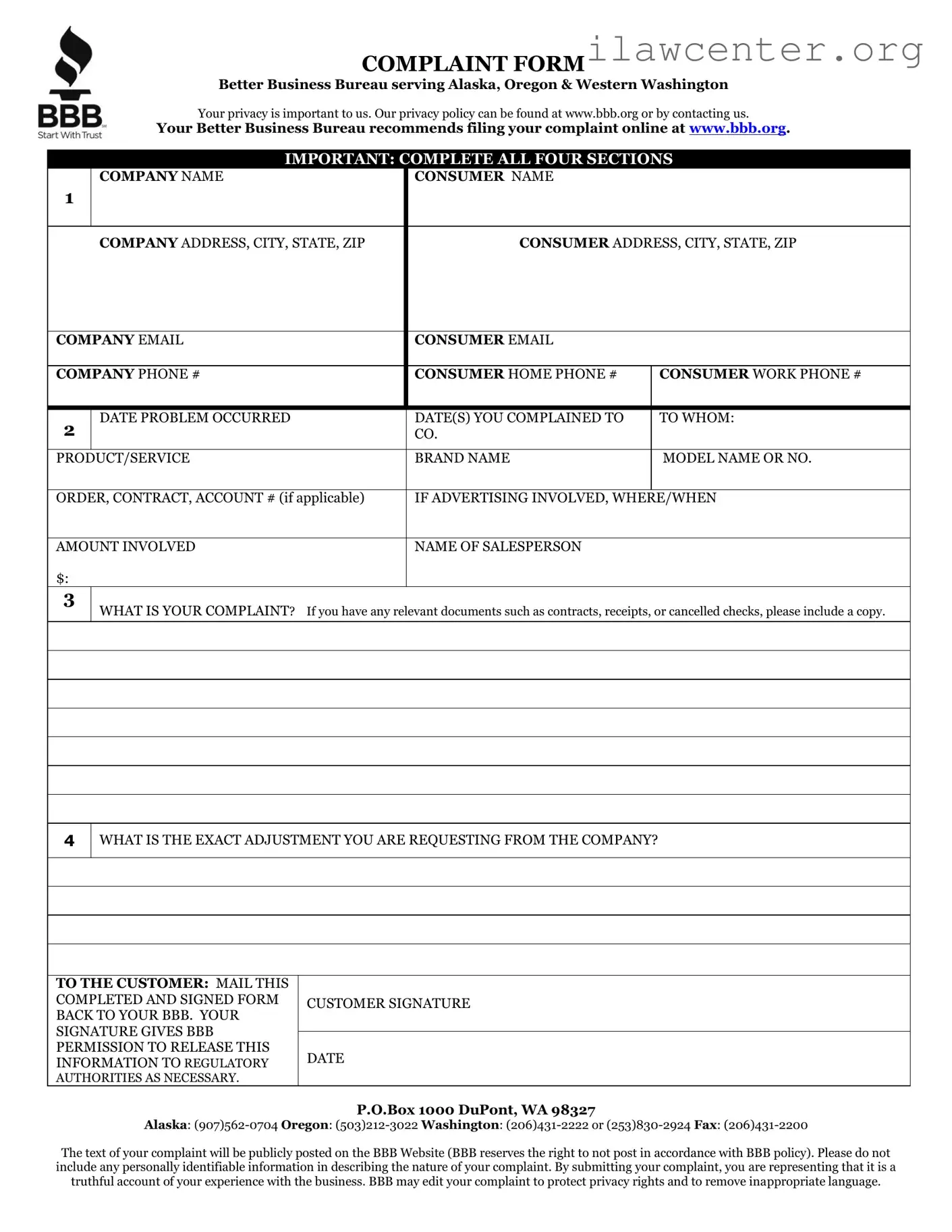
COMPLAINT FORM
Better Business Bureau serving Alaska, Oregon & Western Washington
Your privacy is important to us. Our privacy policy can be found at www.bbb.org or by contacting us.
Your Better Business Bureau recommends filing your complaint online at www.bbb.org.
IMPORTANT: COMPLETE ALL FOUR SECTIONS
1
COMPANY NAME
CONSUMER NAME
COMPANY ADDRESS, CITY, STATE, ZIP
CONSUMER ADDRESS, CITY, STATE, ZIP
COMPANY EMAIL
CONSUMER EMAIL
COMPANY PHONE #
CONSUMER WORK PHONE #
2
DATE PROBLEM OCCURRED
DATE(S) YOU COMPLAINED TO
CO.
TO WHOM:
PRODUCT/SERVICE
BRAND NAME
MODEL NAME OR NO.
ORDER, CONTRACT, ACCOUNT # (if applicable)
IF ADVERTISING INVOLVED, WHERE/WHEN
AMOUNT INVOLVED
$:
NAME OF SALESPERSON
3
WHAT IS YOUR COMPLAINT? If you have any relevant documents such as contracts, receipts, or cancelled checks, please include a copy.
4
WHAT IS THE EXACT ADJUSTMENT YOU ARE REQUESTING FROM THE COMPANY?
TO THE CUSTOMER: MAIL THIS
COMPLETED AND SIGNED FORM
BACK TO YOUR BBB. YOUR
SIGNATURE GIVES BBB
PERMISSION TO RELEASE THIS
INFORMATION TO REGULATORY
AUTHORITIES AS NECESSARY.
CUSTOMER SIGNATURE
DATE
P.O.Box 1000 DuPont, WA 98327
Alaska: (907)562-0704 Oregon: (503)212-3022 Washington: (206)431-2222 or (253)830-2924 Fax: (206)431-2200
The text of your complaint will be publicly posted on the BBB Website (BBB reserves the right to not post in accordance with BBB policy). Please do not
include any personally identifiable information in describing the nature of your complaint. By submitting your complaint, you are representing that it is a
truthful account of your experience with the business. BBB may edit your complaint to protect privacy rights and to remove inappropriate language.

File Properties

Fact Name Description
Purpose The BBB Complaint Form allows consumers to report issues with businesses and seek resolution.
Accessibility The form is available online, making it easy for consumers to file complaints from anywhere.
Information Required Consumers must provide details such as their contact information, the business's name, and a description of the issue.
Response Time Businesses typically have 14 days to respond to a complaint submitted through the form.
State-Specific Forms Some states may have specific requirements or additional forms based on local laws.
Governing Laws Each state has its own consumer protection laws that govern the complaint process.
Confidentiality Personal information may be kept confidential, but the complaint details can be made public.
Resolution Process The BBB acts as a mediator between the consumer and the business to facilitate resolution.
Follow-Up Consumers can follow up on their complaints to check the status of their case.
Impact on Business Complaints filed can affect a business's BBB rating and overall reputation.

Instructions on Utilizing Bbb Complaint

Filling out the BBB Complaint form is a straightforward process that allows you to express your concerns about a business. This form will guide you through providing necessary information to ensure your complaint is properly documented and addressed. Follow these steps carefully to complete the form accurately.

  1. Begin by visiting the BBB website where the complaint form is located.
  2. Look for the section dedicated to filing a complaint.
  3. Click on the "Start a Complaint" button to access the form.
  4. Fill in your personal information, including your name, address, and contact details.
  5. Provide the name of the business you are complaining about.
  6. Include the business's address, if known, to help identify it clearly.
  7. Describe your complaint in detail. Be specific about the issue and include relevant dates and events.
  8. Attach any supporting documents, such as receipts or correspondence, if applicable.
  9. Review your information to ensure everything is accurate and complete.
  10. Submit the form by clicking the "Submit" button.

Once you have submitted your complaint, you will receive a confirmation that it has been received. The BBB will then review your submission and take the appropriate steps to address your concerns.

Important Facts about Bbb Complaint

What is the BBB Complaint Form?

The BBB Complaint Form is a tool provided by the Better Business Bureau (BBB) that allows consumers to report their grievances against businesses. It is designed to help individuals express their concerns and seek resolution. By submitting a complaint, consumers can alert the BBB to potential issues with a business's practices and help others make informed decisions.

Who can file a complaint using the BBB Complaint Form?

Any consumer who has had a negative experience with a business can file a complaint. This includes individuals who have purchased goods or services and feel that they have not received what was promised. The BBB encourages all consumers to voice their concerns to promote fair business practices.

What information do I need to provide when filling out the complaint form?

When completing the BBB Complaint Form, you will need to provide specific details about your experience. This includes your contact information, the name of the business, a description of the issue, and any attempts you have made to resolve the problem. The more detailed your account, the better the BBB can assist you.

Is there a fee to file a complaint?

No, filing a complaint with the BBB is free of charge. The organization aims to support consumers and promote ethical business practices without imposing financial barriers. This allows everyone to have a voice in the marketplace.

What happens after I submit my complaint?

Once you submit your complaint, the BBB will review it and forward it to the business in question. The business will then have the opportunity to respond. The BBB will facilitate communication between you and the business to help reach a resolution. You will be kept informed throughout the process.

How long does it take to resolve a complaint?

The time it takes to resolve a complaint can vary. Some issues may be resolved quickly, while others may take longer, depending on the complexity of the situation and the responsiveness of the business. The BBB strives to facilitate a resolution as efficiently as possible.

Can I withdraw my complaint after submitting it?

Yes, you can withdraw your complaint at any time. If you feel that the issue has been resolved or you no longer wish to pursue the matter, simply contact the BBB and inform them of your decision. Your satisfaction is important, and the BBB respects your choice.

Will my complaint be made public?

Complaints filed with the BBB are generally made public. However, personal information, such as your name and contact details, will be kept confidential. The BBB publishes summaries of complaints to help other consumers make informed choices, but your privacy is a priority.

Can I file a complaint against a business located outside the United States?

The BBB primarily handles complaints against businesses operating within the United States. If you have an issue with an international business, you may need to contact consumer protection agencies in that specific country. However, the BBB can provide guidance on how to proceed.

What if my complaint is not resolved?

If your complaint remains unresolved after working with the BBB, you may consider other options. This could include seeking legal advice or reporting the business to other consumer protection agencies. The BBB can provide resources and guidance on alternative steps you can take to address your concerns.
Common mistakes

Filing a complaint with the Better Business Bureau (BBB) can be an important step in addressing issues with a business. However, many individuals make common mistakes that can hinder the process. Understanding these pitfalls can help ensure your complaint is effective.

One frequent mistake is providing insufficient details about the issue. Complaints that lack specific information, such as dates, transaction amounts, and descriptions of the problem, may not be taken seriously. The BBB needs clear and concise information to investigate your claim properly.

Another error is failing to include relevant documentation. Supporting documents, such as receipts, emails, or photographs, can strengthen your case. Without these materials, your complaint may lack the necessary evidence to support your claims.

Some individuals also overlook the importance of being respectful and professional in their tone. Using aggressive language or making personal attacks can detract from the validity of your complaint. A calm and factual approach is more likely to yield a positive response.

Additionally, many complainants forget to specify what resolution they seek. Clearly stating your desired outcome helps the BBB understand your expectations and may lead to a quicker resolution. Whether it’s a refund, repair, or an apology, clarity is key.

Another mistake is submitting the complaint too soon without attempting to resolve the issue directly with the business. The BBB encourages consumers to first contact the business to address their concerns. This step can often lead to a satisfactory resolution without needing to escalate the matter.

Some people also fail to follow up on their complaints. After submitting your complaint, it’s important to monitor its status and respond to any requests for additional information from the BBB. Staying engaged can help keep your complaint moving forward.

Lastly, individuals sometimes neglect to review their complaint for errors before submission. Typos, incorrect information, or unclear statements can confuse the reader and undermine the effectiveness of your complaint. Taking a moment to review your submission can make a significant difference.

Avoiding these common mistakes can enhance the likelihood of a favorable outcome when filing a complaint with the BBB. Being thorough, respectful, and clear in your communication can help ensure your concerns are addressed properly.

Documents used along the form

The Better Business Bureau (BBB) Complaint form is a vital tool for consumers wishing to report issues with businesses. However, it is often accompanied by several other documents that can enhance the effectiveness of the complaint process. Below is a list of forms and documents commonly used alongside the BBB Complaint form, each serving a specific purpose in the complaint process.

  • Evidence of Purchase: This document includes receipts, invoices, or any proof of transaction that demonstrates the consumer's relationship with the business. It establishes that a legitimate transaction took place.
  • Correspondence Records: Any emails, letters, or messages exchanged with the business can be included. These records show the efforts made to resolve the issue directly with the company.
  • Photographic Evidence: Images or videos that illustrate the problem can be powerful. For instance, if a product was defective, photos can provide clear evidence of the issue.
  • Witness Statements: If there are others who can corroborate the consumer's experience, their written statements can strengthen the complaint. These can be friends, family, or even other customers.
  • Previous Complaints: If the consumer has filed similar complaints against the same business, including these can show a pattern of behavior. This can be particularly relevant if the business has a history of unresolved issues.
  • Refund or Resolution Requests: Documentation of any requests for refunds or resolutions made to the business can demonstrate the consumer's attempts to rectify the situation prior to filing a complaint.
  • Legal Notices: If any formal legal actions or notices have been initiated, including these documents can provide context for the complaint. This could include small claims court filings or cease and desist letters.
  • Consumer Protection Agency Complaints: If the consumer has filed complaints with other agencies, such as the Federal Trade Commission (FTC) or state consumer protection offices, these can be relevant. They show that the consumer is taking multiple steps to address the issue.

Using these documents in conjunction with the BBB Complaint form can significantly bolster a consumer's case. Each piece of evidence adds depth and credibility to the complaint, increasing the likelihood of a satisfactory resolution. By being thorough and organized, consumers can effectively advocate for their rights and seek the justice they deserve.

Similar forms

The BBB Complaint form is a valuable tool for consumers seeking to resolve issues with businesses. Several other documents serve similar purposes in facilitating consumer feedback and dispute resolution. Below is a list of nine documents that share similarities with the BBB Complaint form:

  • Consumer Complaint Form: This form allows individuals to report grievances against businesses, much like the BBB Complaint form. It gathers essential information to help resolve disputes.
  • Online Review Platforms: Websites like Yelp and Google Reviews enable consumers to share their experiences with businesses. These platforms collect feedback and help others make informed decisions.
  • Consumer Protection Agency Complaints: Agencies such as the Federal Trade Commission (FTC) accept complaints about unfair business practices. These complaints aim to protect consumers and promote fair competition.
  • State Attorney General Complaint Form: Each state has an Attorney General's office that handles consumer complaints. This form allows consumers to report issues at the state level, similar to the BBB process.
  • Product Recall Reports: When a product is deemed unsafe, companies often issue recall reports. These documents inform consumers about the issue and the steps to take, paralleling the BBB's focus on consumer safety.
  • Warranty Claims Forms: These forms allow consumers to report issues with products covered under warranty. They facilitate communication between consumers and manufacturers, akin to the BBB Complaint form.
  • Dispute Resolution Agreements: Many companies include these agreements in their contracts. They outline the process for resolving disputes, similar to the BBB's mediation approach.
  • Customer Feedback Surveys: Businesses often use surveys to gather consumer opinions. These surveys help companies improve their services, much like the feedback collected through the BBB Complaint form.
  • Social Media Complaints: Consumers frequently use platforms like Twitter and Facebook to voice their concerns about businesses. These posts can prompt swift responses, reflecting the informal nature of the BBB Complaint form.

Each of these documents plays a role in consumer advocacy and dispute resolution, ensuring that voices are heard and issues are addressed.

Dos and Don'ts

When filling out the BBB Complaint form, it is essential to approach the process thoughtfully. Your input can significantly impact the resolution of your issue. Below are some important dos and don’ts to consider.

  • Do provide clear and concise information about your complaint. This helps the BBB understand your issue better.
  • Do include all relevant details, such as dates, names, and specific transactions. Accurate information is crucial.
  • Do remain polite and professional in your tone. A respectful approach can lead to a more favorable response.
  • Do keep a copy of your complaint for your records. This will help you track the progress of your case.
  • Don’t use inflammatory language or make personal attacks. This can detract from your message and weaken your case.
  • Don’t submit incomplete information. Omissions can delay the process or result in your complaint being dismissed.
  • Don’t expect an immediate resolution. The process may take time, and patience is important.

By following these guidelines, you can enhance the effectiveness of your complaint and contribute to a more positive outcome. Your voice matters, and taking the right steps can lead to meaningful resolutions.

Misconceptions

Many people have misunderstandings about the BBB Complaint form. Here are nine common misconceptions, along with clarifications to help you navigate the process more effectively.

  1. Filing a complaint guarantees a resolution.

    While the BBB aims to mediate disputes, there is no guarantee that your complaint will lead to a resolution. The outcome depends on the business's response and willingness to cooperate.

  2. All complaints are published publicly.

    Not all complaints are made public. The BBB may choose to keep some complaints confidential, especially if they involve sensitive information.

  3. You must be a member to file a complaint.

    Anyone can file a complaint with the BBB, regardless of whether the business is a member. Membership does not affect your ability to submit a complaint.

  4. The BBB can take legal action against businesses.

    The BBB does not have the authority to take legal action. Its role is to facilitate communication between consumers and businesses.

  5. The complaint process is quick and simple.

    The process can take time. After filing, it may take several weeks to receive a response from the business.

  6. You can only complain about local businesses.

    You can file complaints against businesses nationwide, not just local ones. The BBB operates across the United States and Canada.

  7. The BBB is a government agency.

    The BBB is a private, nonprofit organization. It is not affiliated with any government body.

  8. Filing a complaint is the only way to resolve an issue.

    While filing a complaint is one option, you can also reach out to the business directly or seek other dispute resolution methods.

  9. Once filed, you cannot withdraw your complaint.

    You can withdraw your complaint at any time before it is resolved. Just contact the BBB to let them know.

Understanding these misconceptions can help you use the BBB Complaint form more effectively and set realistic expectations for the outcome of your complaint.

Key takeaways

When filling out and utilizing the BBB Complaint form, it is essential to keep several important points in mind to ensure your concerns are addressed effectively.

  • Be Clear and Concise: Clearly articulate your complaint. Provide specific details about the issue you encountered, including dates, names, and any relevant transactions.
  • Include Supporting Documentation: Attach any supporting documents that can help substantiate your claim. This may include receipts, emails, or photographs related to the complaint.
  • Stay Professional: Maintain a respectful and professional tone throughout your complaint. This approach can foster a more constructive response from the business and the BBB.
  • Follow Up: After submitting your complaint, monitor its status. The BBB may contact you for additional information or updates, so staying engaged is important.

By keeping these key takeaways in mind, individuals can enhance their experience with the BBB Complaint form and increase the likelihood of a satisfactory resolution.