









Biomedical Waste Operating Plan PDF Template

Biomedical Waste Operating Plan PDF Template

The Biomedical Waste Operating Plan form serves as a crucial document for facilities managing biomedical waste, outlining the procedures and responsibilities for safe handling and disposal. This plan is designed to help ensure compliance with state regulations, specifically Chapter 64E-16 of the Florida Administrative Code. By following the guidelines in this form, facilities can effectively manage biomedical waste and protect public health.

Ready to ensure your facility is compliant? Fill out the Biomedical Waste Operating Plan form by clicking the button below.

Article Guide

The Biomedical Waste Operating Plan form serves as a crucial tool for facilities managing biomedical waste, ensuring compliance with state regulations. It encompasses various sections, guiding users through the essential components of waste management. Key aspects include detailed instructions on completing the plan, the purpose of the document, and the necessary training for personnel involved in handling biomedical waste. The form outlines the definition, identification, and segregation of biomedical waste, emphasizing the importance of proper containment, labeling, and storage procedures. Additionally, it addresses the protocols for transporting waste and decontaminating spills, as well as the contingency plans that should be in place for emergencies. The form also includes attachments that provide training outlines and attendance records, reinforcing the commitment to employee education. By following the guidelines in this form, facilities can effectively manage biomedical waste while adhering to Chapter 64E-16 of the Florida Administrative Code and other relevant statutes.

Biomedical Waste Operating Plan Preview

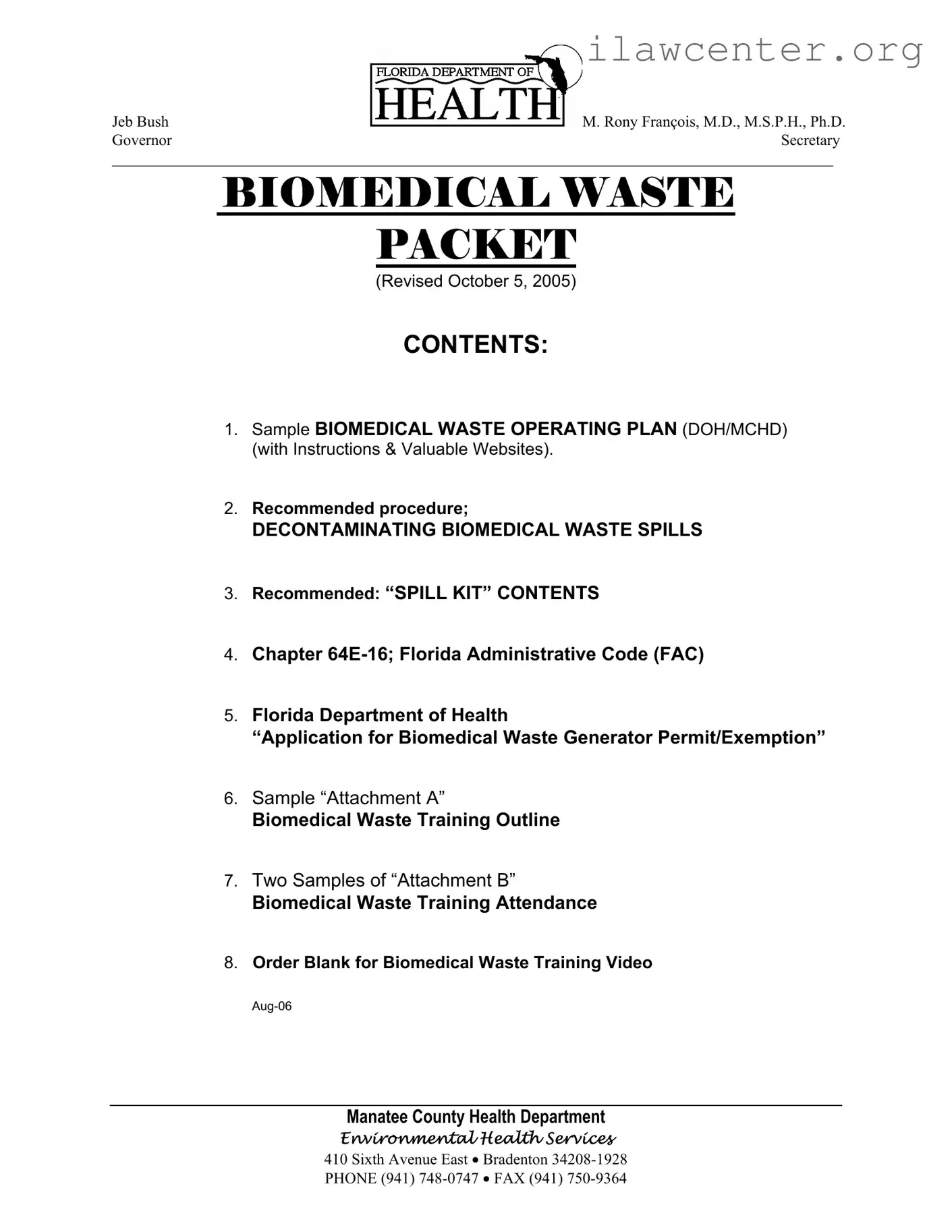
Jeb Bush M. Rony François, M.D., M.S.P.H., Ph.D.
Governor Secretary
____________________________________________________________________________________________
Manatee County Health Department
Environmental Health Services
410 Sixth Avenue East Bradenton 34208-1928
PHONE (941) 748-0747 FAX (941) 750-9364
BIOMEDICAL WASTE
PACKET
(Revised October 5, 2005)
CONTENTS:
1. Sample BIOMEDICAL WASTE OPERATING PLAN (DOH/MCHD)
(with Instructions & Valuable Websites).
2. Recommended procedure;
DECONTAMINATING BIOMEDICAL WASTE SPILLS
3. Recommended: “SPILL KIT” CONTENTS
4. Chapter 64E-16; Florida Administrative Code (FAC)
5. Florida Department of Health
“Application for Biomedical Waste Generator Permit/Exemption”
6. Sample “Attachment A”
Biomedical Waste Training Outline
7.
Two Samples of “Attachment B”
Biomedical Waste Training Attendance
8. Order Blank for Biomedical Waste Training Video
Aug-06
Aug-06 Page 2 of 27
BIOMEDICAL WASTE OPERATING PLAN
FACILITY NAME (
1)
TABLE OF CONTENTS
I. DIRECTIONS FOR COMPLETING THE BIOMEDICAL WASTE PLAN
II. PURPOSE
III. TRAINING FOR PERSONNEL
IV. DEFINITION, IDENTIFICATION, AND SEGREGATION OF BIOMEDICAL WASTE
V. CONTAINMENT
VI. LABELING
VII. STORAGE
VIII. TRANSPORT
IX. PROCEDURE FOR DECONTAMINATING BIOMEDICAL WASTE SPILLS
X. CONTINGENCY PLAN
XI. BRANCH OFFICES
XII. MISCELLANEOUS
ATTACHMENT A: BIOMEDICAL WASTE TRAINING OUTLINE
ATTACHMENT B: BIOMEDICAL WASTE TRAINING ATTENDANCE
ATTACHMENT C: PLAN FOR TREATMENT OF BIOMEDICAL WASTE
(Not Included; Available upon request)
Use of this plan format is voluntary and not required by the Department of Health. It is provided as a
service to assist biomedical waste facilities in complying with the requirements of Chapter 64E-16,
F.A.C.
Aug-06 Page 3 of 27
I. DIRECTIONS FOR COMPLETING THE BIOMEDICAL WASTE PLAN
Blank 1: Enter the name of your facility.
Blank 2: Enter where you keep your employee training records.
Blank 3: List the items of biomedical waste that are produced in your facility and the location where
each waste item is generated.
Blank 4: Enter the name of the manufacturer of your facility’s red bags. This company must be
on the Department of Health (DOH) list of compliant red bags (this list can be obtained from the
following website:
www.doh.state.fl.us/environment/community/biomedical/red_bags.htm) or
from your DOH biomedical waste coordinator OR you must have results supplied by the bag
manufacturer from an independent laboratory that indicate that your red bags meet the
bag construction requirements of Chapter 64E-16, Florida Administrative Code (F.A.C.). If your
facility does not use red bags, enter N/A.
Blank 5: Indicate where the documentation for the construction standards of your facility’s red
bags is kept. or if your facility does not use red bags, enter N/A.
Blank 6: Indicate where unused, red biomedical waste bags are kept in operational areas (not in stock or
in central storage) so that working staff can get them quickly when they need them. If your
facility does not use red bags, enter N/A.
Blank 7: Enter the place where your biomedical waste is stored. 1.How is this area “Washable”?
2. Is this area “Out of the Client Traffic Area” (how)?
3. How is this area’s access restricted?
If your biomedical waste is picked up by a licensed biomedical waste transporter
but you have no storage area, indicate your procedure for preparing your biomedical waste for
pick-up. If you have no pick-up and no storage area, enter N/A.
Blank 8: Enter all the required information about your registered biomedical waste transporter. The
website
www.doh.state.fl.us/environment/community/biomedical/transporters.htm has a list of
such transporters. If you do not use a transporter, enter N/A.
Blank 9: Enter the name(s) of the employee(s) designated to transport your facility’s untreated
biomedical waste to another facility. If your facility does not transport your own biomedical
waste, enter N/A.
Blank 10: Enter the name of the facility to which your facility transports your own untreated biomedical
waste. If your facility does not transport your own biomedical waste, enter N/A.
Blank 11: Describe the procedure and products your facility will use to decontaminate a spill or leak of
biomedical waste.
Blank 12: Enter the required information about the registered biomedical waste transporter who
will transport your biomedical waste on a contingency basis.
Blank 13: If personnel from your facility also work at a branch office of your facility, enter the name
of the branch office. If you have no branch office, enter N/A.
Blank 14: Enter the street address, city, and state of the branch office named in (13). If you have no
branch office, enter N/A.
Aug-06 Page 4 of 27
Blank 15: Enter the weekdays the branch office named in (13) is open. If you have no branch
office, enter N/A.
Blank 16: Enter the normal work hours for each day the branch office named in (13) is open. If you have
no branch office, enter N/A.
Blank 17: Indicate where a copy of this biomedical waste operating plan will be kept in your facility.
Blank 18: Indicate where the current biomedical waste permit or exemption document will be kept in your
facility.
Blank 19: Indicate where your facility will keep its current copy of the biomedical waste rules,
Chapter 64E-16, F.A.C.
Blank 20: Indicate where your facility will keep copies of its biomedical waste inspections from
at least the last three (3) years.
Blank 21: If your facility transports your own biomedical waste, indicate where your transport log is kept.
If you do not transport your own biomedical waste, enter N/A.
Attachment A:
Activities addressed should be those from Section III that are carried out in your
facility.
Attachment B:
Enter the required information to document training sessions.
Attachment C: To be completed only if your facility treats biomedical waste. If your facility has
untreated biomedical waste removed by a registered transporter or you transport your own
untreated waste, do not complete this attachment.
Aug-06 Page 5 of 27
II. PURPOSE
The purpose of this Biomedical Waste Operating Plan is to provide guidance and
describe requirements for the proper management of biomedical waste in our facility.
Guidelines for management of biomedical waste are found in Chapter 64E-16, Florida
Administrative Code (F.A.C.), and in section 381.0098, Florida Statutes.
III. TRAINING FOR PERSONNEL
Biomedical waste training will be scheduled as required by paragraph 64E-
16.003(2)(a), F.A.C. Training sessions will detail compliance with this operating plan
and with Chapter 64E-16, F.A.C. Training sessions will include all of the following
activities that are carried out in our facility:
Definition and Identification of Biomedical Waste
Segregation
Storage
Labeling
Transport
Procedure for Decontaminating Biomedical Waste Spills
Contingency Plan for Emergency Transport
Procedure for Containment
Treatment Method
Training for the activities that are carried out in our facility is outlined in Attachment A.
Our facility must maintain records of employee training. These records will be kept
(2)
Training records will be kept for participants in all training sessions for a minimum of
three (3) years and will be available for review by Department of Health (DOH)
inspectors. An example of an attendance record is appended in Attachment B.
IV. DEFINITION, IDENTIFICATION, AND SEGREGATION OF BIOMEDICAL WASTE
Biomedical waste is any solid or liquid waste which may present a threat of infection
to humans. Biomedical waste is further defined in subsection 64E-16.002(2), F.A.C.
Items of sharps and non-sharps biomedical waste generated in this facility and the
locations at which they are generated are:
(3)
If biomedical waste is in a liquid or semi-solid form and aerosol formation is minimal,
the waste may be disposed into a sanitary sewer system or into another system
approved to receive such waste by the Department of Environmental Protection or the
DOH.
Aug-06 Page 6 of 27
V. CONTAINMENT
Red bags for containment of biomedical waste will comply with the required physical
properties.
Our red bags are manufactured by
(4)
Our documentation of red bag construction standards is kept
(5)
Working staff can quickly get red bags at
(6)
Sharps will be placed into sharps containers at the point of origin.
Filled red bags and filled sharps containers will be sealed at the point of origin. Red
bags, sharps containers, and outer containers of biomedical waste, when sealed, will
not be reopened in this facility. Ruptured or leaking packages of biomedical waste will
be placed into a larger container without disturbing the original seal.
VI. LABELING
All sealed biomedical waste red bags and sharps containers will be labeled with this
facility’s name and address prior to offsite transport. If a sealed red bag or sharps
container is placed into a larger red bag prior to transport, placing the facility’s name
and address only on the exterior bag is sufficient.
Outer containers must be labeled with our transporter’s name, address, registration
number, and 24-hour phone number.
VII. STORAGE
When sealed, red bags, sharps containers, and outer containers will be stored in areas
that are restricted through the use of locks, signs, or location. The 30-day storage time
period will commence when the first non-sharps item of biomedical waste is placed into
a red bag or sharps container, or when a sharps container that contains only sharps is
sealed.
Indoor biomedical waste storage areas will be constructed of smooth, easily cleanable
materials that are impervious to liquids. These areas will be regularly maintained in a
sanitary condition. The storage area will be vermin/insect free. Outdoor storage areas
also will be conspicuously marked with a six-inch international biological hazard symbol
and will be secure from vandalism.
Biomedical waste will be stored and restricted in the following manner:
(7)
Aug-06 Page 7 of 27
VIII. TRANSPORT
We will negotiate for the transport of biomedical waste only with a DOH-registered
company. If we contract with such a company, we will have on file the pick-up receipts
provided to us for the last three (3) years. Transport for our facility is provided by:
a. The following registered biomedical waste transporter:
Company name (8)
Address
Phone
Registration number
Place pick-up receipts are kept
OR
b. An employee of this facility who works under the following guidelines:
We will transport our own biomedical waste. For tracking purposes, we
will maintain a log of all biomedical waste transported by any employee
for the last three (3) years. The log will contain waste amounts, dates,
and documentation that the waste was accepted by a permitted facility.
Name of employee(s) who is(are) assigned transport duty:
(9)
Biomedical waste will be transported to:
(10)
Aug-06 Page 8 of 27
IX. PROCEDURE FOR DECONTAMINATING BIOMEDICAL WASTE SPILLS
(11)
X. CONTINGENCY PLAN
If our registered biomedical waste transporter is unable to transport this facility’s
biomedical waste, or if we are unable temporarily to treat our own waste, then the
following registered biomedical waste transporter will be contacted:
Company name (12)
Address
Phone
Registration number
XI. BRANCH OFFICES
The personnel at our facility work at the following branch offices during the days and
times indicated:
1) Office name (13)
Office address (14)
Days of operation (15)
Hours of operation (16)
2) Office name (13)
Office address (14)
Days of operation (15)
Hours of operation (16)
Aug-06 Page 9 of 27
XII. MISCELLANEOUS
For easy access by all of our staff, a copy of this biomedical waste operating plan
will be kept in the following place:
(17)
The following items will be kept where indicated:
a. Current DOH biomedical waste permit/ exemption document
(18)
b. Current copy of Chapter 64E-16, F.A.C.
(19)
c. Copies of biomedical waste inspection reports from last three (3) years
(20)
d. Transport log
(21)
Aug-06 Page 10 of 27
ATTACHMENT A: BIOMEDICAL WASTE TRAINING OUTLINE
Facility Name:
Trainer’s Name:
Outline:

File Properties

Fact Name Details
Governing Law The Biomedical Waste Operating Plan is governed by Chapter 64E-16 of the Florida Administrative Code (FAC) and section 381.0098 of the Florida Statutes.
Purpose This plan provides guidance for the proper management of biomedical waste within facilities to ensure safety and compliance.
Voluntary Use Utilizing this plan format is voluntary and not mandated by the Department of Health.
Training Requirement Facilities must schedule biomedical waste training sessions as required by paragraph 64E-16.003(2)(a), F.A.C.
Record Keeping Training records must be maintained for a minimum of three years and be available for inspection by Department of Health (DOH) inspectors.
Contents Overview The packet includes a sample operating plan, recommended procedures for spills, and training outlines, among other resources.
Segregation of Waste Facilities must define, identify, and properly segregate biomedical waste to minimize the risk of infection.
Storage Guidelines Specific guidelines are provided for the containment, labeling, and storage of biomedical waste to ensure safety.
Emergency Procedures A contingency plan must be established for emergencies, including procedures for decontaminating biomedical waste spills.

Instructions on Utilizing Biomedical Waste Operating Plan

Filling out the Biomedical Waste Operating Plan form is an essential step in managing biomedical waste effectively. Proper completion of this form ensures compliance with health regulations and helps maintain a safe environment for both staff and patients. Below are the steps to complete the form accurately.

  1. Enter the name of your facility in Blank 1.
  2. In Blank 2, specify where you keep your employee training records.
  3. List the items of biomedical waste produced in your facility and their locations in Blank 3.
  4. For Blank 4, provide the name of the manufacturer of your facility’s red bags. Ensure this company is on the Department of Health’s compliant list or has independent lab results.
  5. Indicate in Blank 5 where the documentation for the construction standards of your red bags is kept. If not applicable, enter N/A.
  6. In Blank 6, state where unused red biomedical waste bags are kept for easy access by staff. If not applicable, enter N/A.
  7. Enter the location of your biomedical waste storage in Blank 7 and answer the questions about its washability, traffic area, and access restrictions.
  8. Provide the required information about your registered biomedical waste transporter in Blank 8. Enter N/A if you do not use a transporter.
  9. List the name(s) of employees designated to transport untreated biomedical waste in Blank 9. If not applicable, enter N/A.
  10. In Blank 10, enter the name of the facility to which you transport untreated biomedical waste. If not applicable, enter N/A.
  11. Describe the procedure and products used for decontaminating spills in Blank 11.
  12. Provide information about the registered biomedical waste transporter for contingency transport in Blank 12.
  13. If applicable, enter the name of any branch office in Blank 13. If not applicable, enter N/A.
  14. Fill in the street address, city, and state of the branch office in Blank 14. If not applicable, enter N/A.
  15. In Blank 15, enter the weekdays the branch office is open. If not applicable, enter N/A.
  16. Specify the normal work hours for each day the branch office is open in Blank 16. If not applicable, enter N/A.
  17. Indicate where a copy of this operating plan will be kept in your facility in Blank 17.
  18. In Blank 18, indicate where the current biomedical waste permit or exemption document will be kept.
  19. Specify where your facility will keep its current copy of the biomedical waste rules in Blank 19.
  20. Indicate where copies of biomedical waste inspections from the last three years will be kept in Blank 20.
  21. If your facility transports its own biomedical waste, indicate where your transport log is kept in Blank 21. If not applicable, enter N/A.
  22. Complete Attachment A with activities from Section III carried out in your facility.
  23. Document training sessions in Attachment B.
  24. Complete Attachment C only if your facility treats biomedical waste.

Important Facts about Biomedical Waste Operating Plan

What is the purpose of the Biomedical Waste Operating Plan form?

The Biomedical Waste Operating Plan form serves as a guideline for facilities to manage biomedical waste properly. It outlines the requirements set forth in Chapter 64E-16 of the Florida Administrative Code and section 381.0098 of the Florida Statutes. By following this plan, facilities can ensure they are compliant with state regulations while safeguarding public health and the environment.

Who needs to complete the Biomedical Waste Operating Plan?

Any facility that generates biomedical waste must complete the Biomedical Waste Operating Plan. This includes hospitals, clinics, laboratories, and any other establishments that produce waste that could pose a risk of infection. The plan helps these facilities manage their waste responsibly and in accordance with state regulations.

What information is required in the plan?

The plan requires several key pieces of information, including the facility name, details about biomedical waste generated, storage locations, and the names of designated personnel responsible for waste management. Additionally, it includes sections for training records and procedures for decontaminating spills, among other necessary details.

How often should personnel training be conducted?

Personnel training should be scheduled as required by state regulations, specifically paragraph 64E-16.003(2)(a) of the Florida Administrative Code. Training sessions must cover various topics, including the identification, segregation, and proper handling of biomedical waste. Records of this training must be maintained for at least three years.

What should be included in the contingency plan?

The contingency plan outlines procedures to follow in case of emergencies, such as spills or accidents involving biomedical waste. This plan should detail how staff will respond to incidents, including the products used for decontamination and the steps taken to ensure safety and compliance with regulations.

Are there specific labeling requirements for biomedical waste?

Yes, biomedical waste must be labeled clearly to indicate its hazardous nature. Labels should comply with the standards set forth in Chapter 64E-16, ensuring that all staff and personnel can easily identify and handle the waste appropriately. This reduces the risk of accidental exposure and enhances safety within the facility.

What is the significance of using compliant red bags?

Using compliant red bags is crucial for the safe containment of biomedical waste. These bags are specifically designed to meet construction standards that prevent leaks and spills. Facilities must ensure that their red bags are from manufacturers listed by the Department of Health or provide independent laboratory results confirming compliance with the necessary standards.

How should biomedical waste be stored?

Biomedical waste should be stored in a designated area that is clean, accessible, and away from client traffic. The storage area must be washable and have restricted access to prevent unauthorized entry. Proper storage helps minimize the risk of exposure and ensures that waste is managed safely until it can be transported for treatment or disposal.

Where can I find additional resources related to biomedical waste management?

Additional resources can be found on the Florida Department of Health's website, which provides valuable information on biomedical waste management, including lists of compliant red bag manufacturers and registered biomedical waste transporters. These resources can assist facilities in maintaining compliance with state regulations and ensuring safe practices.

Common mistakes

Completing the Biomedical Waste Operating Plan form can be a straightforward process, but many people stumble along the way. One common mistake is failing to accurately enter the facility name. This information is crucial for identification purposes, and any errors can lead to significant delays or issues in compliance. Double-checking this detail can save time and frustration later.

Another frequent oversight is neglecting to specify where employee training records are kept. This section is vital for demonstrating that staff have received the necessary training on handling biomedical waste. Without this information, it becomes challenging to verify compliance during inspections.

Listing the items of biomedical waste produced in the facility is another area where mistakes often occur. Some people forget to provide a comprehensive list or fail to identify the specific locations where each type of waste is generated. This information is essential for proper waste management and should be detailed clearly.

Many individuals also overlook the importance of documenting the manufacturer of the red bags used in the facility. If the bags are not compliant, it could lead to serious repercussions. Ensure that the manufacturer is on the Department of Health’s approved list or provide independent lab results proving compliance.

Failing to indicate where the documentation for the construction standards of the red bags is stored is another mistake. This documentation serves as proof that the bags meet required standards. Without this information, facilities may face challenges in demonstrating compliance.

Additionally, some people forget to specify where unused red biomedical waste bags are kept. This detail is crucial for ensuring that staff can access bags quickly when needed. If this information is not provided, it could hinder the efficiency of waste management procedures.

Another common error involves not properly describing the procedure for decontaminating spills. This section is critical for maintaining safety and compliance. A vague or incomplete description can lead to confusion during an emergency situation.

Lastly, many people fail to provide the required information about the registered biomedical waste transporter. This information is necessary for ensuring that waste is handled and transported properly. Omitting this detail could result in significant compliance issues.

Documents used along the form

In managing biomedical waste, several forms and documents complement the Biomedical Waste Operating Plan. Each of these documents plays a crucial role in ensuring compliance with regulations and promoting safety within healthcare facilities. Below is a list of these essential documents, along with a brief description of their purpose.

  • Decontaminating Biomedical Waste Spills Procedure: This document outlines the recommended steps for effectively cleaning up and decontaminating any spills of biomedical waste. It is vital for minimizing health risks and ensuring a safe environment for staff and patients.
  • Spill Kit Contents: This list details the necessary items to include in a spill kit designed for biomedical waste. Having the right materials readily available can significantly enhance the response to any accidental spills.
  • Application for Biomedical Waste Generator Permit/Exemption: Facilities must submit this application to the Florida Department of Health to obtain a permit or exemption for generating biomedical waste. It is essential for legal compliance and operational legitimacy.
  • Biomedical Waste Training Outline: This document provides a structured framework for training personnel on the proper handling, storage, and disposal of biomedical waste. Comprehensive training is crucial for maintaining safety standards and regulatory compliance.
  • Biomedical Waste Training Attendance Records: These records track attendance at training sessions. Maintaining accurate attendance logs is necessary for demonstrating compliance with training requirements during inspections by health authorities.

Understanding and utilizing these documents will support your facility in managing biomedical waste responsibly. By adhering to established guidelines, you contribute to a safer environment for everyone involved.

Similar forms

  • Biomedical Waste Generator Permit Application: This document is similar as it provides the necessary application process for facilities generating biomedical waste. Both documents focus on compliance with health regulations and proper waste management practices.
  • Decontaminating Biomedical Waste Spills Procedure: This document outlines procedures for managing spills, similar to the spill management section in the Biomedical Waste Operating Plan. Both emphasize safety and proper response to accidents involving biomedical waste.
  • Biomedical Waste Training Outline: This outline details training requirements for personnel handling biomedical waste. It is akin to the training sections in the Operating Plan, both ensuring staff are educated on safe practices.
  • Biomedical Waste Training Attendance Records: These records track participation in training sessions. They relate to the Operating Plan’s requirement for documentation of employee training, ensuring compliance and accountability.
  • Plan for Treatment of Biomedical Waste: This document outlines methods for treating biomedical waste. It aligns with the Operating Plan’s focus on waste management and treatment protocols to minimize health risks.
  • Contingency Plan for Emergency Situations: Similar to the Operating Plan, this document provides guidelines for emergency scenarios involving biomedical waste, ensuring preparedness and safety in unexpected situations.
  • Storage Guidelines for Biomedical Waste: This document specifies how to store biomedical waste properly. It parallels the storage section of the Operating Plan, focusing on safety and compliance in waste containment.
  • Labeling Requirements for Biomedical Waste: This document outlines necessary labeling practices for biomedical waste containers. It is comparable to the labeling section in the Operating Plan, both ensuring clear identification and safety measures are in place.

Dos and Don'ts

When filling out the Biomedical Waste Operating Plan form, it is essential to follow specific guidelines to ensure accuracy and compliance. Below is a list of things you should and shouldn't do.

  • Do enter the full name of your facility in the designated space.
  • Do accurately list all types of biomedical waste produced in your facility.
  • Do ensure that the manufacturer of your red bags is compliant with Department of Health standards.
  • Do keep training records accessible and maintain them for at least three years.
  • Do describe your procedures for decontaminating spills clearly and thoroughly.
  • Don't leave any blank spaces on the form; complete all required fields.
  • Don't use red bags from non-compliant manufacturers without proper documentation.
  • Don't forget to indicate where your biomedical waste is stored and how access is restricted.
  • Don't overlook the importance of keeping a copy of the operating plan available at your facility.

Misconceptions

Misconceptions about the Biomedical Waste Operating Plan form can lead to confusion and non-compliance. Here are nine common misunderstandings:

  • It is mandatory to use this specific form. Many believe that using the Biomedical Waste Operating Plan form is a requirement. In reality, its use is voluntary and meant to assist facilities in compliance.
  • All facilities must use red bags for biomedical waste. Some think that red bags are the only option for biomedical waste containment. However, if a facility does not use red bags, it can indicate "N/A" in the relevant sections.
  • The plan is only for large healthcare facilities. Smaller facilities often assume they are exempt from the plan. All types of facilities generating biomedical waste must consider the guidelines outlined in the plan.
  • Training is optional for staff. Many assume that training personnel on biomedical waste management is not necessary. In fact, training is a requirement and should be documented.
  • Compliance is a one-time effort. Some believe that once they submit the plan, they are done. Continuous compliance and regular updates to the plan are essential.
  • Only one person needs to be trained. It is a misconception that only one employee can be trained on biomedical waste procedures. All personnel involved must receive training and maintain records.
  • Documentation can be kept anywhere. Some think that training records and other documentation can be stored haphazardly. In fact, there are specific locations within the facility where these records must be kept.
  • Spills do not need a detailed response plan. Many facilities underestimate the importance of having a spill response plan. A clear procedure for decontaminating spills is critical for safety and compliance.
  • Branch offices are exempt from these requirements. Some assume that if they have branch offices, they do not need to follow the same guidelines. All branches must adhere to the same standards and maintain proper documentation.

Key takeaways

Key Takeaways for Filling Out and Using the Biomedical Waste Operating Plan Form:

  • Clearly identify your facility by entering its name and keeping training records accessible.
  • List all biomedical waste items generated in your facility, specifying their locations to ensure proper management.
  • Document compliance by verifying that your red bags meet the necessary construction standards, keeping relevant information readily available.
  • Ensure that all personnel receive appropriate training on biomedical waste management, maintaining records for at least three years for review by inspectors.