BOS PDF Template

BOS PDF Template

The BOS form, or Basic Operating Statement form, is a document used to provide essential information about a business's operations. This form helps streamline various processes, making it easier for businesses to communicate their operational status. To get started on filling out the BOS form, click the button below.

Article Guide

The BOS form, or Board of Supervisors form, plays a crucial role in various administrative processes within local governments. It is primarily used to document decisions made by the board regarding specific actions, policies, or approvals. This form typically includes sections for identifying the subject matter, detailing the rationale behind decisions, and outlining any relevant financial implications. Additionally, it may require signatures from board members to validate the decisions made during meetings. The BOS form ensures transparency and accountability in governance, serving as an official record that can be referenced in the future. Understanding its components and significance can help citizens and officials alike navigate the complexities of local government operations more effectively.

BOS Preview

Form
1957
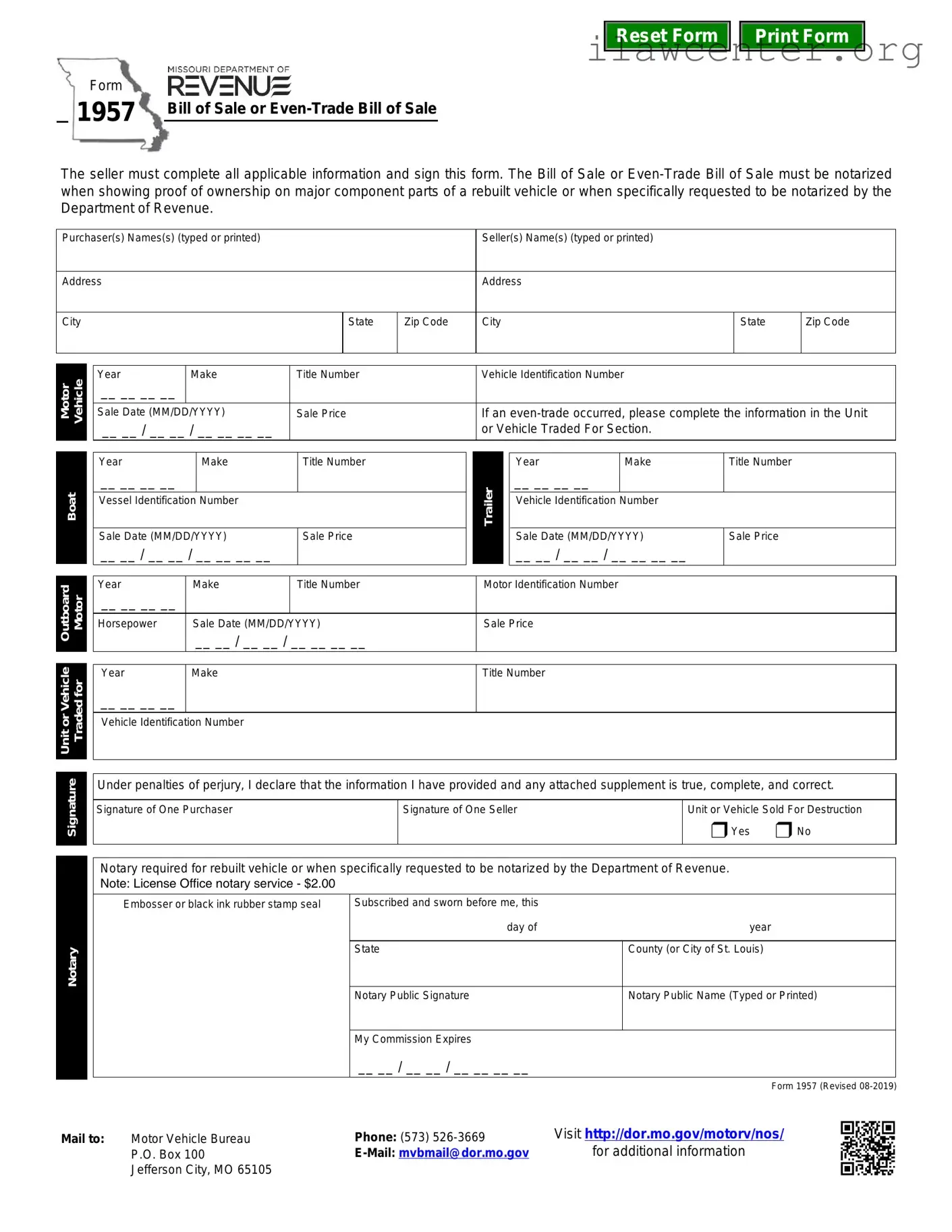
Bill of Sale or Even-Trade Bill of Sale
The seller must complete all applicable information and sign this form. The Bill of Sale or Even-Trade Bill of Sale must be notarized
when showing proof of ownership on major component parts of a rebuilt vehicle or when specifically requested to be notarized by the
Department of Revenue.
Purchaser(s) Names(s) (typed or printed) Seller(s) Name(s) (typed or printed)
Address Address
City State Zip Code City State Zip Code
Subscribed and sworn before me, this
day of year
State County (or City of St. Louis)
Notary Public Signature Notary Public Name (Typed or Printed)
My Commission Expires
Notary
Embosser or black ink rubber stamp seal
Year Make Title Number Vehicle Identification Number
Sale Date (MM/DD/YYYY)
Sale Price
If an even-trade occurred, please complete the information in the Unit
or Vehicle Traded For Section.
__ __ / __ __ / __ __ __ __
__ __ __ __
Motor
Vehicle
Year Make Title Number
Vehicle Identification Number
__ __ __ __
Unit or Vehicle
Traded for
Signature of One Purchaser Signature of One Seller Unit or Vehicle Sold For Destruction
r Yes r No
Under penalties of perjury, I declare that the information I have provided and any attached supplement is true, complete, and correct.
Signature
Year Make Title Number Motor Identification Number
Horsepower Sale Date (MM/DD/YYYY) Sale Price
__ __ __ __
__ __ / __ __ / __ __ __ __
Outboard
Motor
Notary required for rebuilt vehicle or when specifically requested to be notarized by the Department of Revenue.
Note: License Ofce notary service - $2.00
Year Make Title Number Year Make Title Number
Vessel Identification Number Vehicle Identification Number
Sale Date (MM/DD/YYYY) Sale Price Sale Date (MM/DD/YYYY) Sale Price
__ __ __ __ __ __ __ __
__ __ / __ __ / __ __ __ __ __ __ / __ __ / __ __ __ __
Boat
Trailer
__ __ / __ __ / __ __ __ __
Form 1957 (Revised 08-2019)
Mail to: Motor Vehicle Bureau
Phone: (573) 526-3669
Visit http://dor.mo.gov/motorv/nos/
P.O. Box 100
E-Mail: mvbmail@dor.mo.gov
for additional information
Jefferson City, MO 65105
Reset Form
Print Form

File Properties

Fact Name Description
Definition The BOS form, or Bill of Sale, is a legal document used to transfer ownership of personal property from one party to another.
Purpose This form serves as proof of the transaction and can protect both the buyer and seller in case of disputes.
Governing Law Each state has its own laws regarding the use of BOS forms, often governed by the Uniform Commercial Code (UCC).
Requirements Typically, the BOS form should include the names and addresses of both parties, a description of the property, and the sale price.
Notarization Some states may require the BOS to be notarized to be considered valid, while others do not.
Use Cases BOS forms are commonly used in vehicle sales, real estate transactions, and the sale of personal items like furniture or electronics.
Retention Both parties should keep a copy of the BOS for their records, as it may be needed for tax purposes or future disputes.

Instructions on Utilizing BOS

Filling out the BOS form is an important step in the process that follows. It requires careful attention to detail to ensure that all necessary information is accurately provided. Below are the steps to complete the form effectively.

  1. Begin by gathering all required personal information, including your full name, address, and contact details.
  2. Read through the form carefully to understand each section before you start filling it out.
  3. Fill in your name at the top of the form, ensuring it matches your identification documents.
  4. Provide your current address, making sure to include the city, state, and ZIP code.
  5. Enter your phone number and email address in the designated fields.
  6. Complete any additional sections that apply to your situation, such as employment information or relevant case details.
  7. Review the form for any errors or missing information. Double-check all entries for accuracy.
  8. Sign and date the form at the bottom where indicated.
  9. Make a copy of the completed form for your records before submitting it.
  10. Submit the form according to the instructions provided, whether by mail or in person.

Important Facts about BOS

What is the BOS form?

The BOS form, or Bill of Sale, is a legal document that serves as proof of the transfer of ownership of an item or property from one party to another. It typically includes details such as the names of the buyer and seller, a description of the item being sold, and the sale price. This document is important for both parties as it provides a record of the transaction and can help prevent disputes in the future.

When should I use a BOS form?

A BOS form should be used whenever a significant item or property is being sold or transferred. This includes vehicles, real estate, or valuable personal items. Using a Bill of Sale is especially important for high-value transactions, as it establishes clear ownership and can protect both the buyer and seller in case of any legal issues that may arise later.

What information is required on the BOS form?

The BOS form generally requires specific information to be effective. This includes the full names and addresses of both the buyer and seller, a detailed description of the item being sold (including serial numbers or VIN for vehicles), the sale price, and the date of the transaction. Some forms may also include a section for warranties or disclosures, depending on the nature of the sale.

Is the BOS form legally binding?

Yes, once both parties have signed the BOS form, it becomes a legally binding document. This means that both the buyer and seller are obligated to adhere to the terms outlined in the form. It is essential that all information is accurate and that both parties fully understand the agreement before signing.

Do I need a witness or notarization for the BOS form?

While not all states require a witness or notarization for a Bill of Sale, having one can provide additional protection. A witness or notary can help verify the identities of both parties and confirm that the transaction was conducted fairly. Check your state’s specific requirements to determine if this step is necessary for your situation.

Can I use a BOS form for online sales?

Absolutely. A BOS form can be used for online sales just as it would for in-person transactions. It is advisable to complete the form before shipping the item to the buyer. This ensures that both parties have a clear understanding of the sale and can refer back to the document if any issues arise after the transaction is completed.

What should I do if I lose my BOS form?

If you lose your BOS form, it is important to try to obtain a copy if possible. You may reach out to the other party involved in the transaction to request a duplicate. If that is not feasible, consider creating a new Bill of Sale that includes all the original details, and have both parties sign it again. This can help maintain a clear record of the transaction.

Where can I find a BOS form template?

BOS form templates can often be found online through legal websites, government resources, or document creation services. It is essential to choose a template that is specific to your state, as requirements can vary. Ensure that the template includes all necessary fields and complies with local laws to make the document valid.

Common mistakes

When completing the BOS form, individuals often encounter various pitfalls that can lead to complications or delays in processing. One common mistake is providing incomplete information. Each section of the form requires specific details, and omitting any required fields can result in the form being rejected or returned for correction. Always double-check to ensure that all necessary information is included before submission.

Another frequent error involves the use of incorrect or outdated information. People sometimes forget to update their personal details, such as addresses or contact numbers. This can cause significant issues, especially if the form is related to legal or financial matters. It is essential to ensure that all information is current and accurate.

Additionally, many individuals fail to read the instructions thoroughly. The BOS form often comes with guidelines that clarify how to fill it out correctly. Ignoring these instructions can lead to misunderstandings about what is required, resulting in mistakes that could have been easily avoided. Taking the time to read and understand the directions is crucial.

Moreover, some people neglect to sign or date the form. A signature is often a necessary component that validates the submission. Without it, the form may not be considered official, which could lead to further complications. Always remember to sign and date the document before sending it off.

Finally, individuals may rush through the process, leading to careless errors. Filling out the form in a hurry can result in typos or misinterpretations of questions. Taking a moment to review the completed form can help catch these mistakes before submission. A careful approach can save time and prevent frustration in the long run.

Documents used along the form

The Bill of Sale (BOS) form is a key document in many transactions, particularly in the sale of personal property. However, several other forms and documents often accompany it to ensure clarity and legal protection for both parties involved. Below is a list of these documents, each serving a specific purpose in the transaction process.

  • Purchase Agreement: This document outlines the terms of the sale, including price, payment method, and delivery details. It serves as a contract between the buyer and seller.
  • Title Transfer Document: When dealing with vehicles or real estate, this document transfers ownership from the seller to the buyer officially. It is often required by state law.
  • Affidavit of Identity: This sworn statement verifies the identity of the seller. It can help prevent fraud by confirming that the seller is who they claim to be.
  • Inspection Report: For used items, especially vehicles, this report details the condition of the item. It can provide assurance to the buyer about the quality of the purchase.
  • Warranty Document: If applicable, this document outlines any guarantees provided by the seller regarding the item's condition or performance after the sale.
  • Release of Liability: This document protects the seller from future claims related to the item sold. It states that the buyer assumes responsibility once the sale is complete.
  • Payment Receipt: This serves as proof of payment for the transaction. It can be useful for both parties for record-keeping purposes.
  • Notarized Statement: In some cases, having a notary public witness the signing of the BOS can add an extra layer of authenticity and legal weight to the document.
  • Sales Tax Form: Depending on the jurisdiction, this form may be necessary to report and pay sales tax on the transaction. It ensures compliance with local tax laws.

Each of these documents plays a crucial role in facilitating a smooth and legally sound transaction. Understanding their purposes can help both buyers and sellers navigate the process more effectively.

Similar forms

The BOS form shares similarities with several other important documents. Here are four such documents:

  • Power of Attorney (POA): Like the BOS form, a POA allows an individual to designate someone else to act on their behalf. Both documents require clear identification of the parties involved and the scope of authority granted.
  • Last Will and Testament: Similar to the BOS form, a will outlines specific wishes regarding the distribution of assets. Both documents need to be executed with proper formalities to ensure they are legally binding.
  • Living Will: A living will specifies an individual's medical preferences in case they become unable to communicate. Like the BOS form, it is a critical document that reflects personal choices and must be clear and precise.
  • Trust Agreement: This document establishes a trust and outlines how assets should be managed. Similar to the BOS form, it involves the transfer of authority and requires careful attention to detail in its drafting.

Dos and Don'ts

When filling out the BOS form, it's important to be mindful of certain practices to ensure accuracy and compliance. Here are some guidelines to follow:

  • Do double-check your information. Ensure that all details are accurate and up-to-date to avoid any potential issues.
  • Don't rush through the process. Take your time to read the instructions carefully and understand what is required.
  • Do keep a copy of the completed form. This will serve as a reference and can be useful for future needs or questions.
  • Don't leave any sections blank. If a question does not apply to you, write "N/A" instead of leaving it empty.

Following these recommendations can help facilitate a smoother experience when submitting your BOS form.

Misconceptions

When dealing with the BOS form, several misconceptions can lead to confusion. Here are seven common misunderstandings and clarifications to help you navigate this important document.

  1. Misconception 1: The BOS form is only for businesses that are large or well-established.

    This is not true. The BOS form can be used by businesses of all sizes, including startups and small enterprises.

  2. Misconception 2: Completing the BOS form is optional.

    In many cases, submitting the BOS form is a requirement for compliance with local regulations, making it essential for legal operation.

  3. Misconception 3: The information on the BOS form is not confidential.

    While some details may be public, sensitive information is typically protected under privacy laws.

  4. Misconception 4: The BOS form must be filed annually.

    Filing frequency can vary. Some jurisdictions may require annual submissions, while others may have different timelines.

  5. Misconception 5: Only certain types of businesses need to fill out the BOS form.

    Most businesses, regardless of their industry, may be required to complete the form depending on local laws.

  6. Misconception 6: The BOS form is the same in every state.

    This is incorrect. Each state has its own version of the BOS form, with unique requirements and guidelines.

  7. Misconception 7: Once the BOS form is submitted, it cannot be changed.

    In fact, if there are errors or changes in business information, you can often amend the form, but it’s best to check local regulations.

Understanding these misconceptions can help ensure that you correctly complete the BOS form and remain compliant with applicable laws.

Key takeaways

Filling out and using the BOS form requires attention to detail and understanding of its purpose. Here are six key takeaways to consider:

  • Ensure all required fields are completed accurately to avoid delays in processing.
  • Review the form for any errors before submission; corrections can be time-consuming.
  • Keep a copy of the submitted form for your records; it may be needed for future reference.
  • Be aware of the deadlines associated with the BOS form to ensure compliance.
  • Consult with a knowledgeable individual if there are questions about the form's content.
  • Use clear and concise language when filling out the form to enhance clarity.