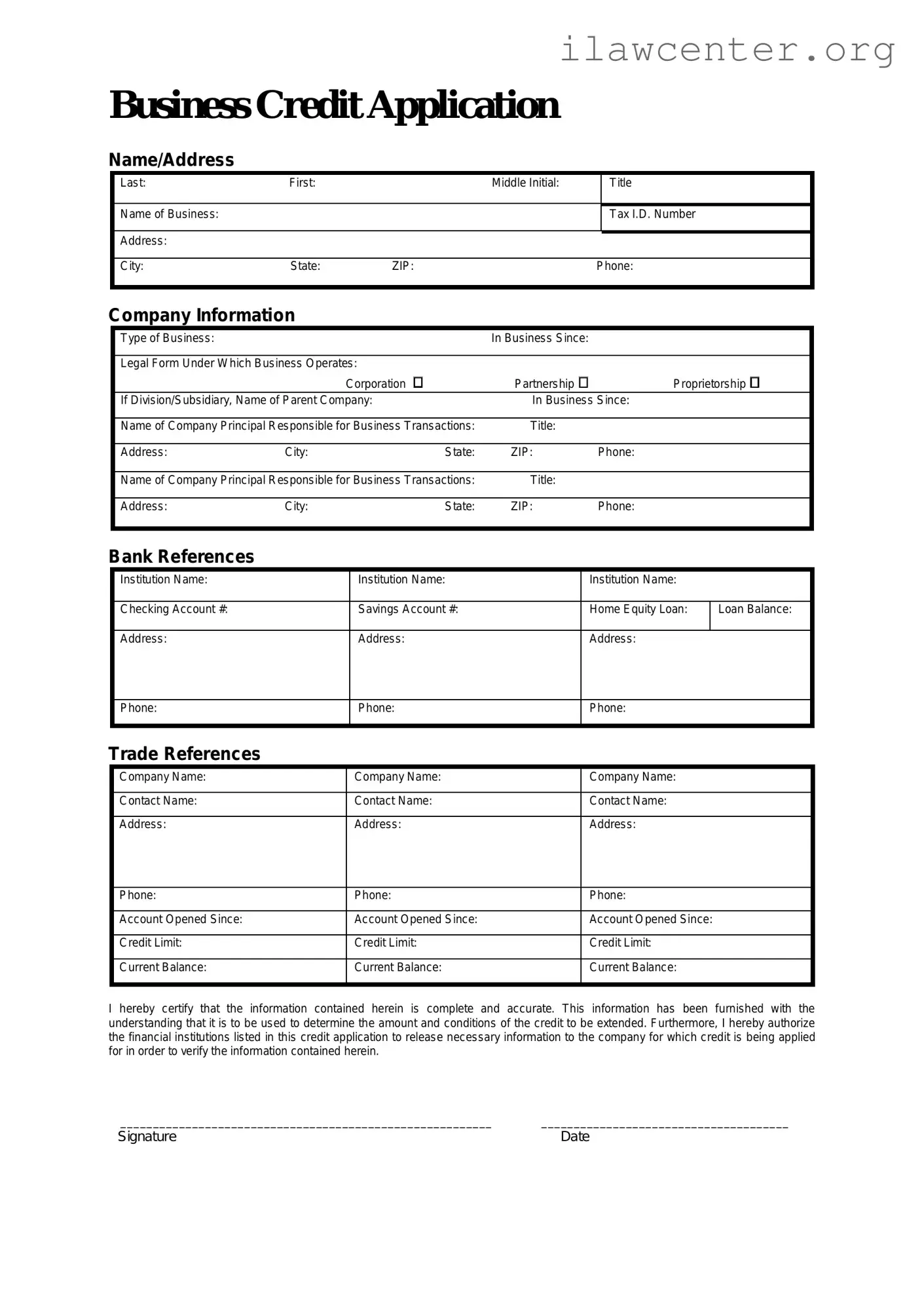

Business Credit Application PDF Template

Business Credit Application PDF Template

A Business Credit Application form is a document that allows businesses to apply for credit from suppliers or financial institutions. This form typically gathers essential information about the business, including its financial history and creditworthiness. Completing this form accurately can significantly enhance your chances of securing favorable credit terms, so take the next step by filling it out today.

Click the button below to get started!

Article Guide

In today's competitive business environment, securing credit is essential for growth and sustainability. A Business Credit Application form serves as a critical tool for companies seeking to establish or enhance their creditworthiness with suppliers and financial institutions. This form typically requests vital information such as the business's legal name, address, and contact details, as well as the owner's personal information. Additionally, it often includes sections for financial history, credit references, and banking relationships, which help lenders assess the risk involved in extending credit. By providing a clear picture of the business's financial health, the application facilitates informed decision-making by creditors. Completing this form accurately and thoroughly is crucial, as it can significantly impact the terms and availability of credit. Understanding each component of the Business Credit Application form can empower businesses to present themselves favorably and secure the necessary funding to thrive.

Business Credit Application Preview

Business Credit Application

Name/Address

Last:

First:


Middle Initial:


Title


Name of Business:


Tax I.D. Number


Address:


City:

State:

ZIP:


Phone:


Company Information


Type of Business:


In Business Since:


Legal Form Under Which Business Operates:


Corporation ￿

Partnership ￿

Proprietorship ￿


If Division/Subsidiary, Name of Parent Company:

In Business Since:


Name of Company Principal Responsible for Business Transactions:

Title:


Address:

City:


State:

ZIP:

Phone:


Name of Company Principal Responsible for Business Transactions:

Title:


Address:

City:


State:

ZIP:

Phone:


Bank References


Institution Name:


Institution Name:


Institution Name:


Checking Account #:


Savings Account #:


Home Equity Loan:

ILoan Balance:


Address:


Address:


Address:


Phone:

Phone:

Phone:

Trade References

Company Name:

Company Name:

Company Name:


Contact Name:

Contact Name:

Contact Name:


Address:

Address:

Address:


Phone:

Phone:

Phone:


Account Opened Since:

Account Opened Since:

Account Opened Since:


Credit Limit:

Credit Limit:

Credit Limit:


Current Balance:

Current Balance:

Current Balance:


I hereby certify that the information contained herein is complete and accurate. This information has been furnished with the understanding that it is to be used to determine the amount and conditions of the credit to be extended. Furthermore, I hereby authorize the financial institutions listed in this credit application to release necessary information to the company for which credit is being applied for in order to verify the information contained herein.

_________________________________________________________ ______________________________________

Signature

Date

File Properties

Fact Name Description
Purpose The Business Credit Application form is used by businesses to apply for credit from suppliers or lenders.
Information Required Typically, the form requires details such as business name, address, ownership structure, and financial information.
Governing Laws State-specific forms may be governed by laws such as the Uniform Commercial Code (UCC) and state contract laws.
Credit Evaluation Submitting the application allows the lender or supplier to evaluate the creditworthiness of the business.
Signature Requirement The form usually requires the signature of an authorized representative of the business, affirming the accuracy of the information provided.
Confidentiality Information submitted is often kept confidential, but applicants should check the specific terms related to privacy and data use.

Instructions on Utilizing Business Credit Application

Filling out the Business Credit Application form is an important step in establishing a credit line for your business. Completing this form accurately will help facilitate the approval process, allowing you to access the financial resources you need. Follow these steps to ensure that you provide all necessary information clearly and concisely.

  1. Start with the basic information. Fill in your business name, address, and contact information. Make sure these details are correct to avoid any delays.
  2. Provide your business structure. Indicate whether your business is a sole proprietorship, partnership, corporation, or LLC.
  3. List your business tax ID number or Social Security number if applicable. This information is crucial for credit verification.
  4. Include the years in business. This helps lenders assess the stability and experience of your company.
  5. Detail your annual revenue. Provide an accurate estimate to give a clear picture of your business's financial health.
  6. Identify the primary business activity. Describe what your business does to help lenders understand your operations.
  7. List any previous credit relationships. Mention banks or financial institutions you have worked with in the past.
  8. Sign and date the application. Ensure that you are authorized to apply for credit on behalf of your business.

Once you have completed the form, review it for any errors or omissions. Submitting a well-prepared application can significantly improve your chances of obtaining the credit you seek.

Important Facts about Business Credit Application

What is a Business Credit Application form?

A Business Credit Application form is a document that businesses fill out to apply for credit from a lender or supplier. This form collects essential information about the business, such as its legal structure, financial history, and creditworthiness. By submitting this form, a business seeks to establish a credit line or secure financing for operations, purchases, or expansion.

Why do I need to complete a Business Credit Application?

Completing a Business Credit Application is crucial for accessing credit. Lenders and suppliers use this information to evaluate your business's financial health and determine if they can extend credit. A well-filled application can enhance your chances of getting approved and may even lead to better terms, such as lower interest rates or higher credit limits.

What information is typically required on the application?

Most Business Credit Application forms require basic information about your business, including its name, address, and contact details. You will also need to provide information about your business structure (e.g., LLC, corporation), ownership details, and financial statements. Additionally, personal information about the business owners may be required, such as Social Security numbers and personal credit histories.

How long does the application process take?

The length of the application process can vary significantly. Some lenders may provide a decision within a few hours, while others may take several days or even weeks to review the application. Factors that influence this timeline include the lender's policies, the completeness of your application, and the complexity of your business's financial situation.

What happens after I submit the application?

After you submit your Business Credit Application, the lender will review the information provided. They may conduct a credit check and assess your business's financial health. If additional information is needed, they will reach out to you. Once they complete their review, you will receive a decision regarding your application, which may include an approval, a request for more information, or a denial.

Can I apply for business credit if my personal credit is poor?

While having poor personal credit can complicate the process, it does not automatically disqualify you from obtaining business credit. Some lenders may consider your business's financial health more than your personal credit score. However, be prepared for the possibility of higher interest rates or lower credit limits if your personal credit history is not strong.

What should I do if my application is denied?

If your application is denied, don’t be discouraged. First, request an explanation from the lender to understand the reasons behind the decision. This feedback can help you address any issues. You may also want to improve your business's financial standing or personal credit score before reapplying. Additionally, consider seeking alternative lenders or financing options that may be more accommodating.

Common mistakes

Filling out a Business Credit Application form can seem straightforward, but many applicants make critical mistakes that can delay or even jeopardize their credit approval. One common error is providing incomplete information. Applicants often overlook sections that require details about the business structure or ownership. Missing this information can lead to automatic rejection.

Another frequent mistake involves inaccuracies in the financial data provided. Some applicants may misrepresent their revenue or expenses, either intentionally or out of misunderstanding. This discrepancy can raise red flags for lenders, leading to a lack of trust in the applicant's financial integrity.

Failing to disclose existing debts is another significant oversight. Lenders want a clear picture of an applicant's financial obligations. If applicants do not fully disclose their current debts, it may result in an unfavorable assessment of their creditworthiness.

Many applicants also neglect to include the necessary supporting documentation. This can include tax returns, bank statements, or financial projections. Without these documents, lenders may question the applicant's seriousness or ability to repay the credit sought.

Additionally, some individuals mistakenly submit the application without reviewing it for errors. Typos or incorrect information can lead to misunderstandings and delay the approval process. Taking the time to proofread can save considerable time and hassle.

Another common pitfall is not understanding the terms of the credit being applied for. Applicants may fail to grasp the implications of interest rates, repayment terms, or fees associated with the credit. This lack of understanding can lead to unpleasant surprises later on.

Lastly, many overlook the importance of providing accurate contact information. If lenders cannot reach the applicant for follow-up questions or clarifications, it may stall the application process. Ensuring that all contact details are correct is essential for smooth communication.

Documents used along the form

When applying for business credit, several forms and documents may accompany the Business Credit Application form. Each of these documents plays a vital role in assessing the creditworthiness of a business. Below is a list of commonly used forms that can help streamline the application process.

  • Personal Guarantee Form: This document requires a business owner to personally guarantee the repayment of the credit. It provides lenders with additional security in case the business defaults.
  • Tax Identification Number (TIN) Certificate: This form verifies the business's tax identification number, which is essential for tax reporting and compliance.
  • Financial Statements: Typically including balance sheets and income statements, these documents give lenders insight into the business's financial health and performance over a specific period.
  • Business Plan: A detailed outline of the business's goals, strategies, and market analysis, a business plan helps lenders understand the purpose of the credit request.
  • Trade References: A list of suppliers or vendors that the business has worked with, trade references help establish credibility and payment history.
  • Credit Report: A comprehensive report detailing the business's credit history, it allows lenders to assess the risk associated with extending credit.
  • Articles of Incorporation: This document outlines the business's formation and structure, providing proof of its legal existence and operational authority.
  • Operating Agreement: For LLCs, this document defines the management structure and operating procedures, offering clarity on ownership and responsibilities.

Providing these documents alongside the Business Credit Application can enhance the application’s credibility and facilitate a smoother review process. Each piece of information contributes to a comprehensive understanding of the business's financial status and operational integrity.

Similar forms

The Business Credit Application form shares similarities with several other important documents. Here are four of them:

  • Loan Application Form: Like the Business Credit Application, a loan application form collects essential information about the applicant's financial history and business operations. Both documents aim to assess creditworthiness.
  • Vendor Credit Application: This form is used when businesses seek credit from suppliers. Similar to the Business Credit Application, it requires details about the business and its financial standing to evaluate risk.
  • Lease Application: A lease application is submitted when a business wants to rent property. It gathers similar financial and operational information to determine the applicant's ability to meet lease obligations.
  • Partnership Agreement: While more focused on the relationship between partners, a partnership agreement outlines financial contributions and responsibilities. It, too, reflects the financial stability and commitments of the involved parties, similar to what is assessed in a Business Credit Application.

Dos and Don'ts

When filling out a Business Credit Application form, it's important to be thorough and accurate. Here are some dos and don'ts to keep in mind:

  • Do provide complete and accurate information. Ensure all fields are filled out correctly.
  • Do review your application before submission. Double-check for any errors or missing information.
  • Do include your business tax ID number. This helps verify your business identity.
  • Do be honest about your business's financial history. Transparency is key to building trust.
  • Don't leave any sections blank. Incomplete applications can lead to delays or rejections.
  • Don't provide misleading information. Misrepresentation can have serious consequences.
  • Don't forget to sign and date the application. An unsigned form may be considered invalid.

Misconceptions

Understanding the Business Credit Application form is crucial for business owners seeking credit. However, several misconceptions can lead to confusion and potential setbacks. Here are six common misconceptions:

  1. All businesses automatically qualify for credit.

    This is not true. Lenders assess each application based on various factors, including credit history and financial stability.

  2. The application is only for large businesses.

    Many small businesses can and should apply for credit. The application process is designed for businesses of all sizes.

  3. Providing personal information is unnecessary.

    Many lenders require personal information to assess the risk associated with lending to a business. This is a standard part of the process.

  4. Credit applications are the same across all lenders.

    Each lender may have different requirements and forms. It is essential to understand the specific criteria for each lender.

  5. Once submitted, the application cannot be changed.

    Applicants can often amend their information if needed. However, it is best to ensure accuracy before submission.

  6. The approval process is quick and straightforward.

    While some applications may be processed quickly, others can take time. Factors like thoroughness of the application and lender workload can affect timing.

Being aware of these misconceptions can help business owners navigate the credit application process more effectively.

Key takeaways

When filling out and using the Business Credit Application form, there are several important points to keep in mind to ensure a smooth process. Below are key takeaways that can help guide you through this task.

  • Accuracy is essential: Ensure that all information provided is correct and up-to-date. Inaccurate details can lead to delays in processing.
  • Complete all sections: Fill out every section of the application. Missing information may result in rejection or additional follow-up requests.
  • Provide supporting documents: Attach any required documents, such as financial statements or tax returns, to strengthen your application.
  • Understand credit terms: Familiarize yourself with the terms and conditions associated with the credit being applied for. This knowledge can help in making informed decisions.
  • Review your application: Before submission, double-check all entries for accuracy and completeness. A thorough review can prevent common mistakes.
  • Follow up: After submitting the application, follow up with the lender to confirm receipt and inquire about the timeline for processing.
  • Maintain communication: Keep lines of communication open with the lender. This can facilitate a smoother process and help address any questions that may arise.

By adhering to these takeaways, individuals can improve their chances of successfully obtaining business credit and navigating the application process more effectively.