Fillable Business Recommendation Letter Document

Fillable Business Recommendation Letter Document

A Business Recommendation Letter is a formal document that endorses an individual or a business, highlighting their skills, qualifications, and achievements. This letter serves as a powerful tool for job applications, partnerships, or business ventures, providing credibility and support from a trusted source. Ready to make a strong impression? Fill out the form by clicking the button below.

Article Guide

When seeking to establish credibility and trust in the business world, a Business Recommendation Letter can serve as a powerful tool. This form allows individuals or organizations to endorse a colleague, employee, or business partner, highlighting their skills, work ethic, and contributions. Typically, the letter includes essential details such as the writer's relationship to the person being recommended, specific examples of their achievements, and the qualities that make them a valuable asset. It often addresses the recipient directly, providing a personalized touch that can make a significant impact. By clearly outlining the strengths and capabilities of the individual or business, this letter not only enhances the recipient's reputation but also fosters professional connections and opportunities. Understanding how to effectively utilize this form can lead to stronger business relationships and greater success.

Business Recommendation Letter Preview

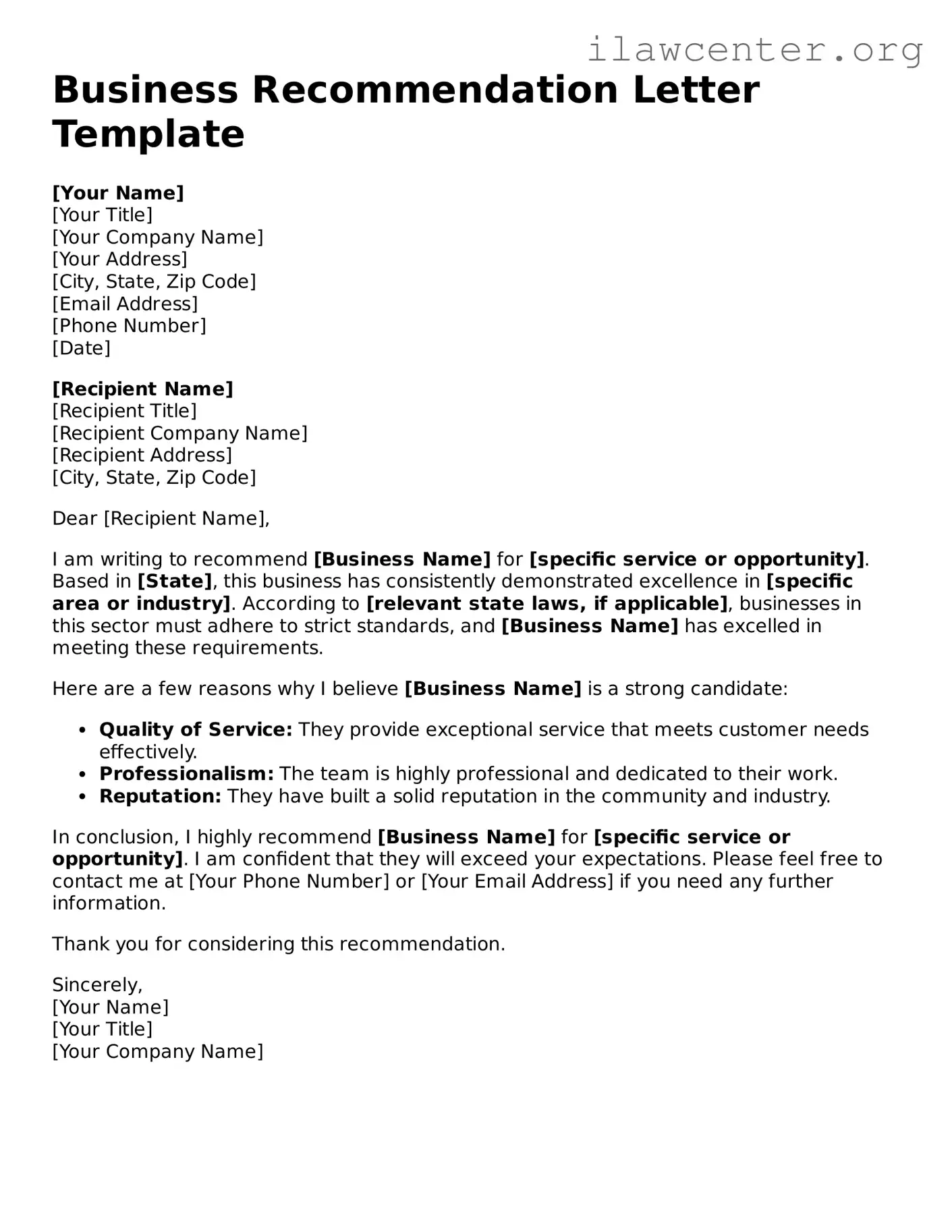
Business Recommendation Letter Template

[Your Name]
[Your Title]
[Your Company Name]
[Your Address]
[City, State, Zip Code]
[Email Address]
[Phone Number]
[Date]

[Recipient Name]
[Recipient Title]
[Recipient Company Name]
[Recipient Address]
[City, State, Zip Code]

Dear [Recipient Name],

I am writing to recommend [Business Name] for [specific service or opportunity]. Based in [State], this business has consistently demonstrated excellence in [specific area or industry]. According to [relevant state laws, if applicable], businesses in this sector must adhere to strict standards, and [Business Name] has excelled in meeting these requirements.

Here are a few reasons why I believe [Business Name] is a strong candidate:

  • Quality of Service: They provide exceptional service that meets customer needs effectively.
  • Professionalism: The team is highly professional and dedicated to their work.
  • Reputation: They have built a solid reputation in the community and industry.

In conclusion, I highly recommend [Business Name] for [specific service or opportunity]. I am confident that they will exceed your expectations. Please feel free to contact me at [Your Phone Number] or [Your Email Address] if you need any further information.

Thank you for considering this recommendation.

Sincerely,
[Your Name]
[Your Title]
[Your Company Name]

PDF Form Characteristics

Fact Name Description
Purpose A Business Recommendation Letter form is used to endorse a business or individual, highlighting their skills and reliability.
Format The letter should be formatted professionally, including the sender's and recipient's contact information, date, and a clear subject line.
State-Specific Requirements Some states may have specific guidelines on how a recommendation letter should be structured or what information must be included.
Governing Laws Depending on the state, laws such as the Uniform Commercial Code (UCC) may apply to business transactions and endorsements.

Instructions on Utilizing Business Recommendation Letter

Filling out the Business Recommendation Letter form is straightforward. Once you have the necessary information ready, you can proceed with the steps below to ensure everything is completed accurately.

  1. Start by entering the date at the top of the form. This should reflect the current date.
  2. Next, provide the recipient's name. Make sure to spell it correctly.
  3. Fill in the recipient's title or position, if applicable.
  4. Include the company name of the recipient. This helps in identifying the organization.
  5. Write the company address. Include the street address, city, state, and zip code.
  6. Now, move on to the salutation. Use "Dear [Recipient's Name]," to begin the letter.
  7. In the body of the letter, introduce yourself and your relationship with the individual or business you are recommending.
  8. Provide specific examples of the individual's skills or achievements that make them a strong candidate for the recommendation.
  9. Conclude the letter with a summary of your recommendation.
  10. Sign the letter at the bottom. Include your name and title, as well as your contact information.

After completing these steps, review the letter for any errors. Make sure all the details are accurate and that the tone is professional. Once satisfied, you can print or send the letter as needed.

Important Facts about Business Recommendation Letter

What is a Business Recommendation Letter?

A Business Recommendation Letter is a formal document that endorses an individual or a business. It highlights their skills, accomplishments, and character. Typically, these letters are used for job applications, business partnerships, or educational opportunities. A well-crafted letter can significantly enhance the recipient's chances of success.

Who should write a Business Recommendation Letter?

Ideally, the letter should come from someone who knows the individual or business well. This could be a supervisor, colleague, client, or business partner. The writer should have firsthand experience with the person’s work ethic, skills, and contributions. Their credibility will lend weight to the recommendation.

What should be included in the letter?

The letter should include specific examples of the individual's achievements and skills. It should also mention the writer’s relationship to the person being recommended. A strong letter often includes anecdotes that illustrate the individual’s strengths and contributions. Finally, it should conclude with a strong endorsement and the writer's contact information.

How long should a Business Recommendation Letter be?

Typically, a recommendation letter should be one page long. This length allows the writer to provide enough detail without overwhelming the reader. Conciseness is key; every sentence should serve a purpose. A focused letter is more likely to be read and appreciated.

Is there a specific format to follow?

While there is no strict format, a Business Recommendation Letter generally follows a professional structure. It should start with the writer’s address and date, followed by the recipient’s address. A salutation should precede the body of the letter, which should be clear and organized. Finally, a courteous closing and the writer's signature should conclude the letter.

Can I use a template for my Business Recommendation Letter?

Yes, using a template can be helpful, especially for those unfamiliar with writing such letters. However, it’s important to personalize the content. A generic letter may not convey the genuine support and specific examples that make a recommendation impactful. Tailoring the letter to the individual’s strengths is crucial.

How should I request a Business Recommendation Letter?

When asking someone for a recommendation, be polite and direct. Explain why you need the letter and provide context about the opportunity. It’s helpful to share your resume or details about the position or program. This information can guide the writer in crafting a more tailored and effective recommendation.

Common mistakes

Filling out a Business Recommendation Letter form can be a straightforward task, but many people make common mistakes that can undermine the effectiveness of the letter. One frequent error is failing to provide specific examples of the individual's skills and achievements. Instead of vague statements, concrete examples can paint a clearer picture of the person's qualifications.

Another mistake is neglecting to tailor the letter to the specific opportunity or position. A generic recommendation may not resonate with the reader. Personalizing the content shows that the writer has taken the time to consider the recipient's needs and the candidate's fit for the role.

Many people also forget to include their contact information. If the recipient wants to follow up for more details, they need a way to reach the writer. Omitting this crucial detail can lead to missed opportunities for the candidate.

In addition, some individuals fail to proofread the letter. Spelling and grammatical errors can detract from the professionalism of the recommendation. A well-written letter reflects positively on both the candidate and the writer.

Another common issue is using overly complex language. While it’s important to sound professional, clarity should always come first. Simple, direct language is often more effective than convoluted phrases.

People sometimes overlook the importance of the letter's tone. A recommendation should be enthusiastic yet honest. If the writer appears indifferent, it may raise questions about the candidate's qualifications.

Additionally, some individuals do not provide a clear relationship context. Explaining how the writer knows the candidate and in what capacity can add credibility to the recommendation. This context helps the reader understand the basis of the endorsement.

Another mistake is not following any specific guidelines provided by the organization requesting the letter. Each organization may have different requirements, and ignoring them can lead to disqualification.

Some recommenders may also forget to sign the letter. A signature adds a personal touch and authenticity to the document. Without it, the letter may seem less credible.

Finally, failing to submit the letter on time can be a significant oversight. Timeliness is crucial in business recommendations. A late letter may not only reflect poorly on the writer but also hinder the candidate’s chances.

Documents used along the form

When preparing a Business Recommendation Letter, several other documents can complement this form and enhance your business communication. Each of these documents serves a specific purpose, ensuring that your message is clear and professional. Below is a list of forms and documents that are often used in conjunction with a Business Recommendation Letter.

  • Cover Letter: This introductory letter accompanies the recommendation and provides context. It briefly outlines the purpose of the recommendation and introduces the parties involved.
  • Resume: Including a resume can provide additional details about the individual being recommended. It highlights their qualifications, work history, and relevant skills.
  • Business Proposal: If the recommendation is part of a larger business initiative, a proposal may be necessary. This document outlines the objectives, strategies, and potential benefits of the proposed business relationship.
  • Thank You Letter: After a recommendation has been made, sending a thank you letter to the recommender is a courteous gesture. It expresses gratitude for their support and reinforces professional relationships.
  • Follow-Up Email: This document serves as a reminder or check-in after the recommendation has been sent. It can help ensure that the recipient received the letter and may prompt further discussion.
  • Reference List: A list of additional references can be helpful. This document provides contact information for other individuals who can vouch for the candidate’s qualifications and character.

Utilizing these documents alongside the Business Recommendation Letter can create a comprehensive package that effectively communicates your message. Each form plays a vital role in presenting a well-rounded view of the individual or business being recommended, fostering trust and professionalism.

Similar forms

The Business Recommendation Letter form serves an important purpose in the world of professional relationships. It is similar to several other documents that also aim to support and endorse individuals or businesses. Below are seven documents that share similarities with the Business Recommendation Letter:

  • Letter of Recommendation: This document is often written by a teacher or employer to endorse a student or employee. Like the Business Recommendation Letter, it highlights the individual's strengths and qualifications.
  • Reference Letter: A reference letter is typically provided by someone who knows the candidate well. It serves to vouch for their character and abilities, similar to how a Business Recommendation Letter supports a business or individual.
  • Performance Evaluation: This document assesses an employee's work performance over a specific period. It shares the goal of providing insights into an individual’s capabilities, akin to a Business Recommendation Letter.
  • Endorsement Letter: An endorsement letter is used to support a candidate for a position or a product. It serves a similar function of validating the qualities or merits of the subject, much like a Business Recommendation Letter.
  • Testimonial: A testimonial is a statement from a client or customer that praises a service or product. It parallels the Business Recommendation Letter by offering a personal account of positive experiences.
  • Proposal Letter: This document outlines a plan or suggestion for a business project. It often includes endorsements of the team or individuals involved, similar to how a Business Recommendation Letter endorses a business.
  • Networking Letter: A networking letter helps individuals connect with others in their field. It may include recommendations or endorsements, akin to the supportive nature of a Business Recommendation Letter.

Dos and Don'ts

When filling out a Business Recommendation Letter form, it’s important to approach the task thoughtfully. Here are some key things to consider:

  • Do provide accurate and honest information about the business.
  • Don't exaggerate the achievements or qualities of the business.
  • Do include specific examples to support your recommendations.
  • Don't use vague language that lacks clarity.
  • Do proofread your letter for grammatical errors and typos.

Following these guidelines can help ensure your recommendation letter is effective and credible.

Misconceptions

Many people have misunderstandings about the Business Recommendation Letter form. Here are ten common misconceptions along with explanations to clarify them.

  1. It is only for job applications.

    This form can be used for various purposes, including college applications, professional networking, and business partnerships, not just for job applications.

  2. Anyone can write a recommendation letter.

    While anyone can technically write a letter, it is most effective when written by someone who knows the individual well and can speak to their skills and character.

  3. It must be lengthy to be effective.

    A concise letter that clearly highlights key points can be more impactful than a long, detailed one. Quality over quantity matters.

  4. The letter should only focus on professional achievements.

    Including personal qualities and character traits can provide a more well-rounded view of the individual and enhance the letter's effectiveness.

  5. It is unnecessary if the individual has a strong resume.

    A recommendation letter adds a personal touch and can provide insights that a resume cannot convey, making it a valuable addition.

  6. Formatting is not important.

    Proper formatting can enhance readability and professionalism. A well-structured letter makes a better impression.

  7. It should be written in a formal tone only.

    While professionalism is key, a friendly and genuine tone can make the letter more relatable and engaging.

  8. Only one letter is needed.

    Multiple letters from different individuals can provide a broader perspective and strengthen the overall recommendation.

  9. It is the same as a reference letter.

    Though similar, a recommendation letter usually focuses on specific skills and achievements, while a reference letter may simply confirm the individual's qualifications.

  10. It can be written without knowing the recipient's requirements.

    Understanding what the recipient is looking for can help tailor the letter to meet their needs, making it more effective.

Key takeaways

When filling out and using the Business Recommendation Letter form, consider the following key takeaways:

  • Clarity is essential. Ensure that the information provided is clear and concise. Ambiguities can lead to misunderstandings.
  • Be specific. Tailor the letter to the individual or organization. Highlight particular skills or experiences that are relevant to the recommendation.
  • Use a professional tone. Maintain a formal and respectful tone throughout the letter. This reflects the seriousness of the recommendation.
  • Proofread carefully. Spelling and grammatical errors can undermine the credibility of the letter. Take the time to review the document thoroughly.
  • Include contact information. Provide your contact details at the end of the letter. This allows the recipient to reach out for further information if needed.
  • Follow submission guidelines. Adhere to any specific instructions regarding how the letter should be submitted, whether electronically or in hard copy.