Ca Resale PDF Template

Ca Resale PDF Template

The California Resale Certificate is a form used by businesses to purchase items tax-free for resale purposes. This certificate verifies that the buyer holds a valid seller's permit and intends to resell the specified tangible personal property in the regular course of their business. To ensure compliance and avoid penalties, it is essential to fill out the form accurately.

Ready to complete your California Resale Certificate? Click the button below to get started.

Article Guide

The California Resale Certificate, formally known as CDTFA-230 REV. 1 (8-17), serves as a crucial document for businesses engaged in the sale of tangible personal property. This certificate allows purchasers to buy items without paying sales tax at the time of purchase, provided they intend to resell those items in the regular course of their business. The form requires the buyer to provide their valid seller's permit number and a description of the property being purchased for resale. It also specifies that the items must be resold before any use other than demonstration or display. Furthermore, the certificate outlines the legal implications of misuse, including potential misdemeanor charges and financial penalties for those who fail to adhere to its guidelines. By signing the form, the purchaser certifies their understanding of these terms, thereby ensuring compliance with California's tax regulations. This document is essential for maintaining the integrity of the resale process and safeguarding the interests of both sellers and buyers in the marketplace.

Ca Resale Preview

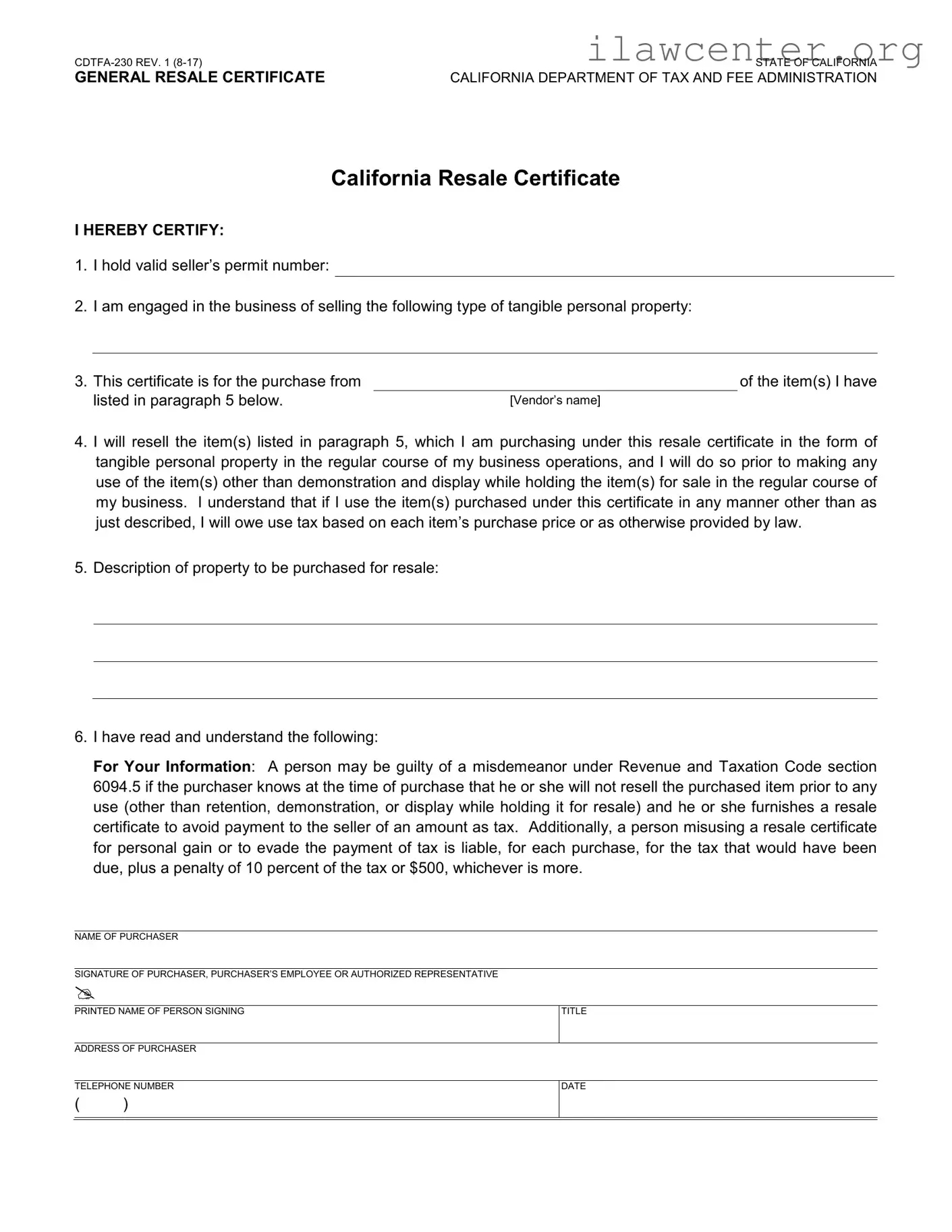
1. I hold valid seller’s permit number:
2. I am engaged in the business of selling the following type of tangible personal property:
3. This certificate is for the purchase from
of the item(s) I have
listed in paragraph 5 below.
[Vendor’s name]
5. Description of property to be purchased for resale:
NAME OF PURCHASER
ADDRESS OF PURCHASER
PRINTED NAME OF PERSON SIGNING TITLE
TELEPHONE NUMBER DATE
( )
I HEREBY CERTIFY:
CDTFA-230 REV. 1 (8-17) STATE OF CALIFORNIA
CALIFORNIA DEPARTMENT OF TAX AND FEE ADMINISTRATION
GENERAL RESALE CERTIFICATE
California Resale Certificate
4. I will resell the item(s) listed in paragraph 5, which I am purchasing under this resale certificate in the form of
tangible personal property in the regular course of my business operations, and I will do so prior to making any
use of the item(s) other than demonstration and display while holding the item(s) for sale in the regular course of
my business. I understand that if I us e the item(s) purchased under this certificate in any manner other than as
just described, I will owe use tax based on each item’s purchase price or as otherwise provided by law.
6.
I have read and understand the following:
For
Your
Information:
A
person may be guilty
of
a
misdemeanor
under
Revenue and
Taxation
Code section
6094.5 if the purchaser knows at the time of purchase that he or she will not resell
the purchased item prior to any
use (other
than retention,
demonstration, or
display
while holding it
for
resale)
and he or
she furnishes
a resale
certificate to avoid payment to the seller of an amount as tax.
Additionally, a person misusing a resale certificate
for personal
gain or to evade the payment
of tax
is liable, for
each purchase,
for the tax
that
would have been
due,
plus a penalty of 10 percent of the tax or $500,
whichever
is more.
SIGNATURE OF PURCHASER, PURCHASER’S EMPLOYEE OR AUTHORIZED REPRESENTATIVE

File Properties

Fact Name Details
Form Title California General Resale Certificate (CDTFA-230 REV. 1 (8-17))
Governing Authority California Department of Tax and Fee Administration (CDTFA)
Purpose This certificate allows businesses to purchase items tax-free for resale.
Seller's Permit A valid seller’s permit number is required to use this form.
Business Engagement The purchaser must be engaged in selling tangible personal property.
Use Restrictions Items must be resold without any prior use other than demonstration or display.
Consequences of Misuse Misusing the certificate can lead to penalties and tax liabilities.
Tax Liability Use tax applies if items are used outside the allowed scope before resale.
Legal Reference Revenue and Taxation Code section 6094.5 outlines penalties for misuse.
Signature Requirement The form must be signed by the purchaser or an authorized representative.

Instructions on Utilizing Ca Resale

To complete the California Resale Certificate (CDTFA-230), gather the necessary information before starting the form. This process involves providing details about your business and the items you plan to purchase for resale. Follow the steps outlined below to fill out the form accurately.

  1. Enter your valid seller’s permit number in the designated space.
  2. Describe the type of tangible personal property your business sells.
  3. Provide the vendor’s name from whom you are purchasing the items.
  4. Indicate that you will resell the items listed in the next step, ensuring you understand the conditions of resale.
  5. List the description of the property you intend to purchase for resale.
  6. Read the information provided regarding misuse of the resale certificate.
  7. Sign the form, including your printed name and title.
  8. Fill in your address and telephone number.
  9. Include the date of completion.

Important Facts about Ca Resale

What is the California Resale Certificate and why do I need it?

The California Resale Certificate is a document that allows businesses to purchase items intended for resale without paying sales tax at the time of purchase. By using this certificate, you can avoid upfront costs associated with sales tax, which you will collect from customers when you sell the items. It's essential for streamlining your business operations and maintaining cash flow.

Who can use the California Resale Certificate?

Any business that holds a valid seller’s permit in California can use the resale certificate. This includes retailers, wholesalers, and manufacturers who are engaged in selling tangible personal property. However, it’s crucial to ensure that the items you purchase are genuinely intended for resale and not for personal use.

What information do I need to provide on the form?

When filling out the California Resale Certificate, you must include your valid seller’s permit number, a description of the property you intend to purchase for resale, and the vendor’s name from whom you are buying the items. Additionally, you must sign the form, providing your printed name, title, address, and phone number. Accurate information is vital to avoid any potential issues with tax authorities.

What happens if I misuse the California Resale Certificate?

Misusing the resale certificate can lead to serious consequences. If you knowingly use the certificate for items you do not intend to resell, you may face penalties. The law states that you could be liable for the sales tax that would have been due, plus a penalty of 10% of the tax amount or $500, whichever is greater. Understanding the rules surrounding the use of this certificate is crucial to protect your business.

Can I use the California Resale Certificate for all types of purchases?

No, the resale certificate is specifically for tangible personal property that you intend to resell. It cannot be used for items intended for personal use, consumption, or any other purpose outside of resale. Always ensure that the items you are purchasing qualify under the terms of the resale certificate.

How long is the California Resale Certificate valid?

The California Resale Certificate does not have an expiration date, but it is important to keep it updated. If your business information changes, such as your seller’s permit number or business name, you should complete a new certificate. Always ensure that you have the most current information to avoid complications with tax authorities.

What should I do if I lose my California Resale Certificate?

If you lose your California Resale Certificate, you can simply fill out a new one. It’s advisable to keep a copy of the completed form for your records. This will help you maintain accurate documentation for your purchases and ensure compliance with tax regulations. If you have questions about the process, consider reaching out to a tax professional for assistance.
Common mistakes

Filling out the California Resale Certificate can be a straightforward process, but there are common mistakes that people often make. One significant error is failing to provide a valid seller’s permit number. This number is essential, as it verifies that the purchaser is authorized to buy items for resale. Without it, the certificate may be deemed invalid, leading to complications down the line.

Another frequent oversight is not clearly identifying the type of tangible personal property being sold. The form requires a description of the property in paragraph 5, and vague or incomplete descriptions can create confusion. Being specific helps ensure that both the seller and the purchaser understand the terms of the transaction.

People sometimes forget to include the vendor's name in the designated section. This detail is crucial because it identifies the seller from whom the items are being purchased. Omitting this information can lead to misunderstandings and may even result in the resale certificate being rejected.

Additionally, some individuals fail to read and understand the implications of using the resale certificate. It is vital to recognize that using the purchased items for anything other than resale can lead to tax liabilities. Ignoring this aspect can result in unexpected financial consequences, including penalties.

Another common mistake is neglecting to sign the form. A signature is not just a formality; it confirms that the purchaser agrees to the terms outlined in the certificate. Without a signature, the document lacks authenticity and may not be accepted by the seller.

People also often overlook the importance of providing accurate contact information. Including a current address and telephone number is essential for any follow-up communication. Incorrect or outdated information can lead to delays or issues that could have been easily avoided.

Lastly, many individuals do not take the time to double-check their entries before submitting the form. Simple typographical errors can cause significant problems. A careful review can help catch mistakes that might otherwise lead to complications, ensuring a smoother transaction process.

Documents used along the form

The California Resale Certificate is an important document for businesses that buy goods for resale. However, it is often accompanied by other forms that help clarify the transaction and ensure compliance with tax regulations. Below is a list of commonly used documents that complement the California Resale Certificate.

  • Seller's Permit: This document is issued by the California Department of Tax and Fee Administration (CDTFA) and allows businesses to collect sales tax from customers. It is a crucial requirement for any retailer in California and must be presented when applying for a resale certificate.
  • Purchase Order: A purchase order is a document created by the buyer to authorize a purchase transaction. It outlines the items being purchased, their quantities, and agreed prices. This document serves as a formal agreement between the buyer and seller, ensuring clarity in the order details.
  • Invoice: An invoice is a bill sent by the seller to the buyer after a sale. It details the products or services provided, along with the total amount due. Invoices are essential for record-keeping and can be used to verify the transaction when filing taxes.
  • Exemption Certificate: This document is used when a buyer is exempt from paying sales tax on certain purchases. It provides proof that the buyer qualifies for a tax exemption, ensuring compliance with tax laws while facilitating the purchase process.

Understanding these documents and their roles in the resale process can help businesses navigate their obligations more effectively. Proper documentation not only supports smooth transactions but also aids in maintaining compliance with tax regulations.

Similar forms

The California Resale Certificate (CDTFA-230) is a key document used in the resale of tangible personal property. Several other documents serve similar purposes in different contexts. Below is a list of six documents that share similarities with the California Resale Certificate:

  • Seller's Permit: This document allows a business to collect sales tax from customers. It verifies that the seller is authorized to sell taxable goods, similar to how the resale certificate confirms the buyer's intention to resell items.
  • Purchase Order: A purchase order outlines the details of a transaction between a buyer and a seller. Like the resale certificate, it includes specific information about the items being purchased, although it is typically used for direct transactions rather than resale purposes.
  • Bill of Sale: This document serves as a receipt for the transfer of ownership of goods. It includes details about the items sold, akin to the resale certificate, which also lists items intended for resale.
  • Tax Exempt Certificate: This certificate allows certain buyers, such as non-profit organizations, to purchase goods without paying sales tax. It functions similarly to the resale certificate by certifying that the buyer is not liable for sales tax under specific conditions.
  • Wholesale Certificate: This document is used by wholesalers to purchase goods without paying sales tax, as they intend to resell them. It parallels the resale certificate in that it confirms the buyer's intent to sell the purchased items.
  • Resale License: A resale license is often required for businesses to legally buy and sell goods. It is similar to the resale certificate in that it indicates the buyer's status as a seller and their intention to resell the items purchased.

Dos and Don'ts

When filling out the California Resale Certificate form, it's important to follow certain guidelines to ensure accuracy and compliance. Here are five things you should and shouldn't do:

  • Do provide a valid seller's permit number. This is essential for the form to be accepted.
  • Do clearly describe the type of tangible personal property you are selling. This helps clarify your business activities.
  • Do ensure that the vendor's name is correctly filled in. This identifies who you are purchasing from.
  • Don't use the resale certificate for items you do not plan to resell. Misuse can lead to penalties.
  • Don't forget to sign the form. An unsigned form may be considered invalid.

Following these guidelines will help you complete the form correctly and avoid potential issues down the line.

Misconceptions

Misconceptions about the California Resale Certificate can lead to confusion among businesses. Below are six common misunderstandings, along with clarifications for each.

  • Only retailers can use the resale certificate. Many believe that only retail businesses can utilize this form. In reality, any business that sells tangible personal property may qualify, including wholesalers and manufacturers.
  • The resale certificate exempts all purchases from tax. Some assume that presenting this certificate eliminates sales tax on all items purchased. However, it only applies to items intended for resale, not for personal or business use.
  • Once a resale certificate is issued, it can be used indefinitely. This is a common misconception. The certificate is valid only as long as the seller’s permit is active and should be updated if any business details change.
  • Using the resale certificate allows for any type of use of the purchased items. Some individuals think they can use items for personal reasons after purchase. The certificate strictly allows for resale or demonstration purposes only.
  • There are no penalties for misuse of the resale certificate. Many believe that misuse is inconsequential. In fact, misuse can result in significant penalties, including taxes owed plus a 10% penalty or a minimum of $500.
  • The information on the resale certificate is optional. Some may think that filling out the form is not essential. However, providing accurate information is crucial, as incomplete or incorrect details can lead to legal issues.

Key takeaways

Understanding the California Resale Certificate is crucial for anyone engaged in buying and selling tangible personal property. Here are some key takeaways to keep in mind:

  • Seller’s Permit Requirement: You must hold a valid seller’s permit number. This is essential for your resale activities.
  • Type of Property: Clearly state the type of tangible personal property you are selling. This helps ensure compliance and clarity.
  • Vendor Information: Include the vendor’s name from whom you are purchasing the items. This information is necessary for proper record-keeping.
  • Intended Use: You must resell the items listed in the certificate. Any use other than demonstration or display could result in tax liabilities.
  • Consequences of Misuse: Be aware that using the resale certificate for personal gain can lead to serious penalties, including fines.
  • Understanding Legal Obligations: Familiarize yourself with the legal ramifications of misusing a resale certificate, as ignorance is not a defense.
  • Signature and Contact Information: Ensure the form is signed by you or an authorized representative. Include your printed name, title, and contact details for verification purposes.

By following these guidelines, you can navigate the resale process more effectively and avoid potential pitfalls. Always keep your documentation accurate and up-to-date!