
California Affidavit of Death of a Trustee PDF Template

California Affidavit of Death of a Trustee PDF Template

The California Affidavit of Death of a Trustee is a legal document used to formally declare the death of a trustee, thereby facilitating the transfer of trust assets to the beneficiaries. This form serves as an essential tool for ensuring that the trust administration process continues smoothly after the loss of a trustee. If you need to navigate this important step, consider filling out the form by clicking the button below.

Article Guide

In California, when a trustee passes away, it's essential to address the implications of their death on the trust they managed. The California Affidavit of Death of a Trustee form serves as a crucial legal document in this process. This form is designed to provide a formal declaration of the trustee's death, ensuring that the trust can continue to operate smoothly and that the assets can be managed according to the trust's terms. By completing this affidavit, the successor trustee can assert their authority to act on behalf of the trust, helping to facilitate the transfer of responsibilities and assets without unnecessary delays. The form typically requires details such as the deceased trustee's name, date of death, and relevant trust information, along with the signature of the successor trustee. This document not only serves to notify beneficiaries and interested parties but also plays a vital role in maintaining the integrity of the trust and protecting the interests of those involved. Understanding the nuances of this form is essential for anyone navigating the complexities of trust management in California.

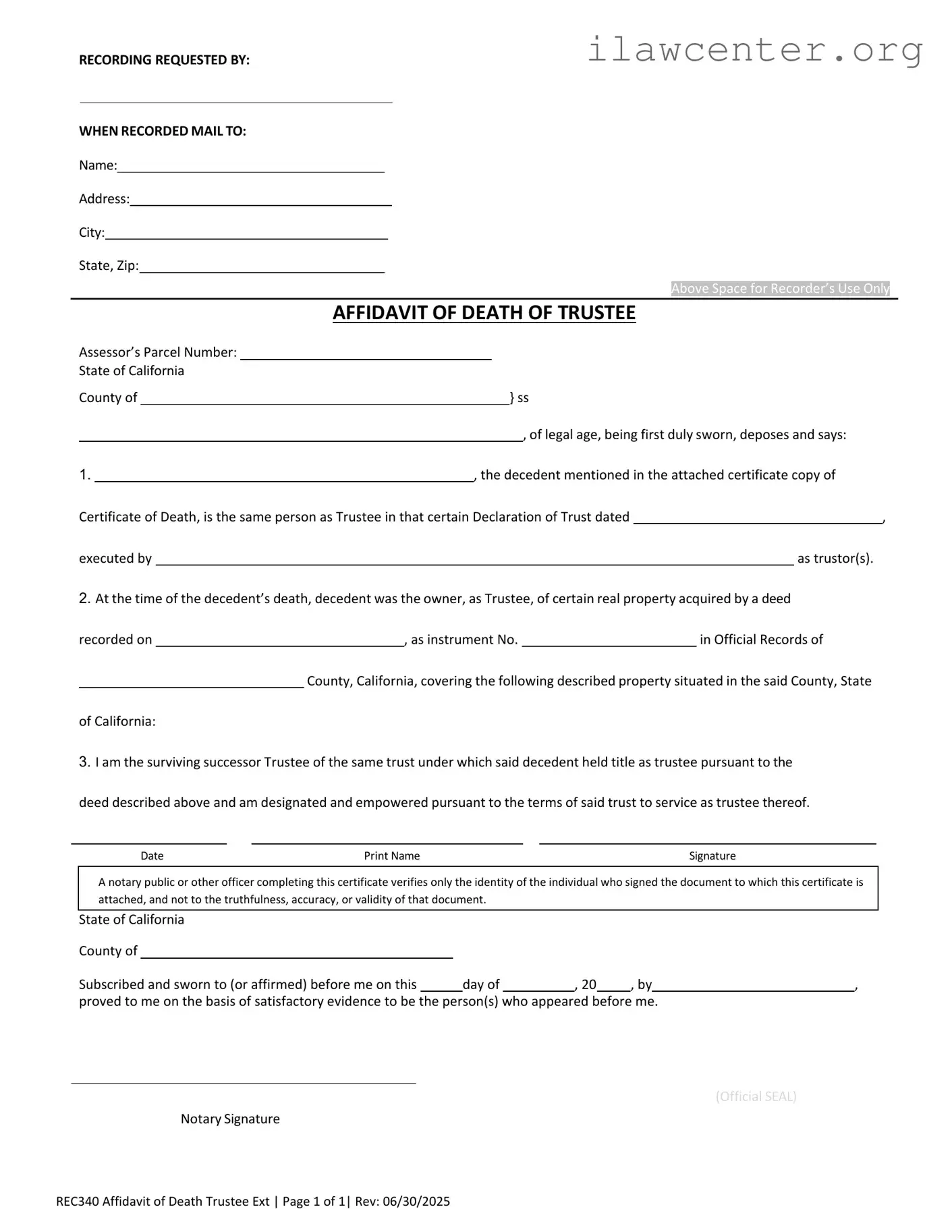
California Affidavit of Death of a Trustee Preview

REC340 Affidavit of Death Trustee Ext | Page 1 of 1| Rev: 06/30/2025
RECORDING REQUESTED BY:
WHEN RECORDED MAIL TO:
Name:
Address:
City:
State, Zip:
Above Space for Recorder’s Use Only
AFFIDAVIT OF DEATH OF TRUSTEE
Assessor’s Parcel Number:
State of California
County of } ss
, of legal age, being first duly sworn, deposes and says:
1.
, the decedent mentioned in the attached certificate copy of
Certificate of Death, is the same person as Trustee in that certain Declaration of Trust dated ,
executed by as trustor(s).
2.
At the time of the decedent’s death, decedent was the owner, as Trustee, of certain real property acquired by a deed
recorded on , as instrument No. in Official Records of
County, California, covering the following described property situated in the said County, State
of California:
3.
I am the surviving successor Trustee of the same trust under which said decedent held title as trustee pursuant to the
deed described above and am designated and empowered pursuant to the terms of said trust to service as trustee thereof.
Date
Print Name
Signature
A notary public or other officer completing this certificate verifies only the identity of the individual who signed the document to which this certificate is
attached, and not to the truthfulness, accuracy, or validity of that document.
State of California
County of
Subscribed and sworn to (or affirmed) before me on this day of , 20 , by ,
proved to me on the basis of satisfactory evidence to be the person(s) who appeared before me.
Notary Signature
(Official SEAL)

File Properties

Fact Name Description
Purpose The California Affidavit of Death of a Trustee form is used to officially document the death of a trustee in a trust.
Governing Law This form is governed by the California Probate Code, specifically sections relating to trusts and trustees.
Who Can File Any successor trustee or beneficiary of the trust can file this affidavit after the trustee's death.
Required Information The affidavit must include details about the deceased trustee, such as their name, date of death, and the trust's name.
Notarization The form must be notarized to be considered valid, ensuring the authenticity of the signatures.
Filing Location This affidavit is typically filed with the county recorder's office where the trust property is located.
Effect on Trust Filing the affidavit updates the trust records, allowing for the proper management of trust assets following the trustee's death.

Instructions on Utilizing California Affidavit of Death of a Trustee

After completing the California Affidavit of Death of a Trustee form, you will need to file it with the appropriate court or office. This step is crucial for updating the trust records and ensuring the legal status of the trust is clear.

  1. Obtain the California Affidavit of Death of a Trustee form. You can find it online or at your local courthouse.
  2. Enter the name of the deceased trustee in the designated space at the top of the form.
  3. Provide the date of death of the trustee. Make sure this date is accurate.
  4. Fill in the name of the trust that the deceased trustee was managing.
  5. Include the address of the trust. This should be the official address associated with the trust.
  6. List the names and addresses of all current trustees. This information helps clarify who is managing the trust now.
  7. Sign the affidavit in the presence of a notary public. The notary will verify your identity and witness your signature.
  8. Make copies of the signed affidavit for your records and for any other relevant parties.
  9. File the original affidavit with the appropriate court or office. Check local requirements for filing procedures.

Important Facts about California Affidavit of Death of a Trustee

What is the California Affidavit of Death of a Trustee form?

The California Affidavit of Death of a Trustee form is a legal document used to officially declare the death of a trustee in a trust. This form serves as a notice to beneficiaries and other interested parties that the trustee has passed away. It is an important step in the administration of a trust, as it allows for the appointment of a new trustee and ensures the proper management of the trust assets moving forward.

Who needs to file the Affidavit of Death of a Trustee?

What information is required on the form?

Where should the Affidavit of Death of a Trustee be filed?

Common mistakes

Filling out the California Affidavit of Death of a Trustee form can seem straightforward, but many people make common mistakes that can lead to delays or complications. One frequent error is failing to provide accurate information about the deceased trustee. This includes the full legal name, date of death, and other identifying details. Omitting or misrepresenting this information can create significant issues when the affidavit is processed.

Another mistake involves not including the correct date when the trustee passed away. The date is crucial, as it establishes the timeline for any trust-related actions. If the date is incorrect, it may raise questions about the validity of the affidavit. Similarly, some individuals neglect to attach a certified copy of the death certificate. This document serves as proof of the trustee's death and is often a required attachment.

People also frequently overlook the need for signatures. The form must be signed by the surviving trustee or the successor trustee, depending on the circumstances. Failing to sign the document, or having it signed by someone who is not authorized, can invalidate the affidavit. Additionally, forgetting to date the signature can lead to confusion about when the affidavit was executed.

Another common issue is not providing the necessary information about the trust itself. This includes the trust's name, date of establishment, and any other relevant details. Without this information, the affidavit may lack context, making it difficult for institutions or individuals to understand the implications of the trustee's death.

Some individuals also make the mistake of using outdated forms. It's important to ensure that the most current version of the affidavit is being used. Using an old form can result in rejection or requests for additional information. Additionally, people sometimes fail to double-check for typos or errors in the form. Simple mistakes, like misspellings or incorrect addresses, can complicate the processing of the affidavit.

Another oversight is not considering the implications of the trustee's death on the trust's administration. Individuals may fill out the form without fully understanding how the death affects the trust's operation. This can lead to confusion about who is responsible for managing the trust going forward.

Finally, many people underestimate the importance of consulting with a legal professional when completing the affidavit. While it may seem like a simple form, the implications of errors can be significant. Seeking guidance can help ensure that the affidavit is completed correctly and that all necessary steps are taken to manage the trust effectively.

Documents used along the form

When dealing with the passing of a trustee in California, several important documents may accompany the California Affidavit of Death of a Trustee. Each of these forms plays a crucial role in ensuring that the trust is administered properly and that the wishes of the deceased are honored. Below is a list of commonly used documents in this context.

  • Trust Agreement: This document outlines the terms and conditions of the trust, including the roles and responsibilities of the trustee and beneficiaries.
  • Death Certificate: A legal document that confirms the death of the trustee. It is often required to validate the Affidavit of Death.
  • Successor Trustee Acceptance Form: This form is used by the successor trustee to formally accept their role and responsibilities in managing the trust after the original trustee's death.
  • Notice to Beneficiaries: A document that informs all beneficiaries of the trust about the trustee's death and the subsequent steps in the trust administration process.
  • Trustee's Final Accounting: This report provides a detailed account of the trust's financial activities up to the date of the trustee's death, ensuring transparency for beneficiaries.
  • Petition for Probate: If the trust is part of a larger estate plan, this document may be necessary to initiate the probate process for any assets not held in the trust.
  • Power of Attorney Revocation: If the deceased trustee had previously granted power of attorney to someone, this document formally revokes that authority upon their death.
  • Beneficiary Designations: Documents that clarify how specific assets, such as life insurance or retirement accounts, should be distributed upon the trustee's death.
  • Trust Modification Documents: If the trust needs to be modified due to the trustee's death, these documents outline the changes to be made in accordance with the trust's provisions.
  • Affidavit of Identity: Sometimes required to confirm the identity of the deceased trustee, especially if there are discrepancies in documentation.

Understanding these documents can significantly ease the transition process following the death of a trustee. Each form serves a specific purpose in maintaining the integrity of the trust and ensuring that the wishes of the deceased are respected. Properly managing these documents can help avoid complications and facilitate a smoother administration of the trust.

Similar forms

The California Affidavit of Death of a Trustee form serves a specific purpose in the realm of estate planning and trust administration. However, it shares similarities with several other legal documents. Below is a list of six documents that are comparable to the Affidavit of Death of a Trustee, along with an explanation of how they are alike.

  • Affidavit of Death: This document confirms the death of an individual and is often used in various legal contexts, such as settling estates or transferring property titles. Like the Affidavit of Death of a Trustee, it serves to provide official proof of death.
  • Trustee's Deed: When a trustee transfers property from a trust to beneficiaries, a Trustee's Deed is executed. This document, similar to the Affidavit of Death of a Trustee, is essential in documenting the actions taken following the death of a trustee.
  • Certificate of Trust: This document provides information about the trust and its terms without revealing the entire trust document. It is often used to establish the authority of a trustee, much like the Affidavit of Death of a Trustee establishes the status of a deceased trustee.
  • Will: A will outlines the distribution of an individual's assets after death. While it serves a broader purpose, it shares the commonality of addressing the consequences of death, just as the Affidavit of Death of a Trustee does for a trustee's role.
  • Death Certificate: This official document records the fact of an individual’s death. Both the Death Certificate and the Affidavit of Death of a Trustee provide necessary proof of death in legal matters.
  • Notice of Death: This document is used to formally notify interested parties of a person's death. It is similar to the Affidavit of Death of a Trustee in that it communicates the critical information regarding an individual's passing.

Dos and Don'ts

When filling out the California Affidavit of Death of a Trustee form, it is important to follow specific guidelines to ensure accuracy and compliance. Here are some dos and don'ts to keep in mind:

  • Do provide accurate information about the deceased trustee.
  • Do include the date of death.
  • Do sign the affidavit in the presence of a notary public.
  • Do keep a copy of the completed form for your records.
  • Don't leave any required fields blank.
  • Don't use incorrect names or misspellings.
  • Don't forget to check for any additional requirements in your county.

Misconceptions

  • Misconception 1: The Affidavit of Death of a Trustee is only necessary if the trustee passed away without a will.
  • This is not true. The affidavit is required regardless of whether the trustee had a will or not. It serves to formally notify the beneficiaries and the court of the trustee's death, allowing for the proper administration of the trust.

  • Misconception 2: Anyone can file the Affidavit of Death of a Trustee.
  • Only certain individuals, such as a successor trustee or a beneficiary, can file this affidavit. It is crucial that the person filing has a legitimate interest in the trust and its administration.

  • Misconception 3: The affidavit must be filed in court.
  • This is a common misunderstanding. The affidavit is not filed in court but is typically recorded with the county recorder's office where the trust property is located. This makes the death of the trustee a matter of public record.

  • Misconception 4: The Affidavit of Death of a Trustee automatically transfers control of the trust.
  • While the affidavit does notify relevant parties of the trustee's death, it does not automatically transfer control. A successor trustee must be appointed according to the terms of the trust document.

  • Misconception 5: The form is the same for all states.
  • This is incorrect. Each state has its own requirements and forms for the affidavit. California's form is specific to its laws and may differ significantly from those in other states.

  • Misconception 6: The affidavit can be completed without legal assistance.
  • While it is possible to complete the affidavit without legal help, seeking guidance from an attorney can ensure that the form is filled out correctly and that all necessary steps are taken. This can prevent potential complications later on.

  • Misconception 7: Once the affidavit is filed, there are no further responsibilities for the successor trustee.
  • This is misleading. After the affidavit is filed, the successor trustee has ongoing responsibilities, including managing the trust assets, paying debts, and distributing assets to beneficiaries as outlined in the trust document.

Key takeaways

When filling out and using the California Affidavit of Death of a Trustee form, it is important to understand the following key points:

  • The form is used to officially declare the death of a trustee in a trust.
  • Accurate information is crucial; include the full name of the deceased trustee and the date of death.
  • Provide details about the trust, such as its name and the date it was established.
  • The affidavit must be signed by the successor trustee or another authorized individual.
  • Notarization is required to validate the affidavit, ensuring its acceptance by financial institutions and courts.
  • Once completed, the affidavit should be filed with the county recorder’s office where the trust is located.
  • Keep copies of the affidavit for personal records and for any future legal or financial matters related to the trust.

Understanding these points can help ensure that the process is completed smoothly and correctly.