Attorney-Verified  Affidavit of Death Document for California

Attorney-Verified Affidavit of Death Document for California

The California Affidavit of Death form is a legal document used to officially declare the passing of an individual. This form serves as a crucial step in settling the deceased's estate and transferring their assets. If you need to complete this form, click the button below to get started.

Article Guide

The California Affidavit of Death form serves as an essential legal document for individuals seeking to establish the fact of someone's death, particularly in matters related to estate management and property transfer. This form is typically used when a person passes away, and their estate needs to be settled. It aids in simplifying the process for heirs and beneficiaries by providing a clear declaration that can facilitate the transfer of assets without the need for probate in certain situations. The form requires specific information, including the decedent's name, date of death, and details about the affiant, who is often a close relative or an individual with knowledge of the death. By completing this affidavit, the affiant affirms the truthfulness of the information provided, thereby allowing financial institutions, property registries, and other entities to act on the declaration. Understanding how to properly complete and file this form is crucial for anyone navigating the complexities of post-death procedures in California.

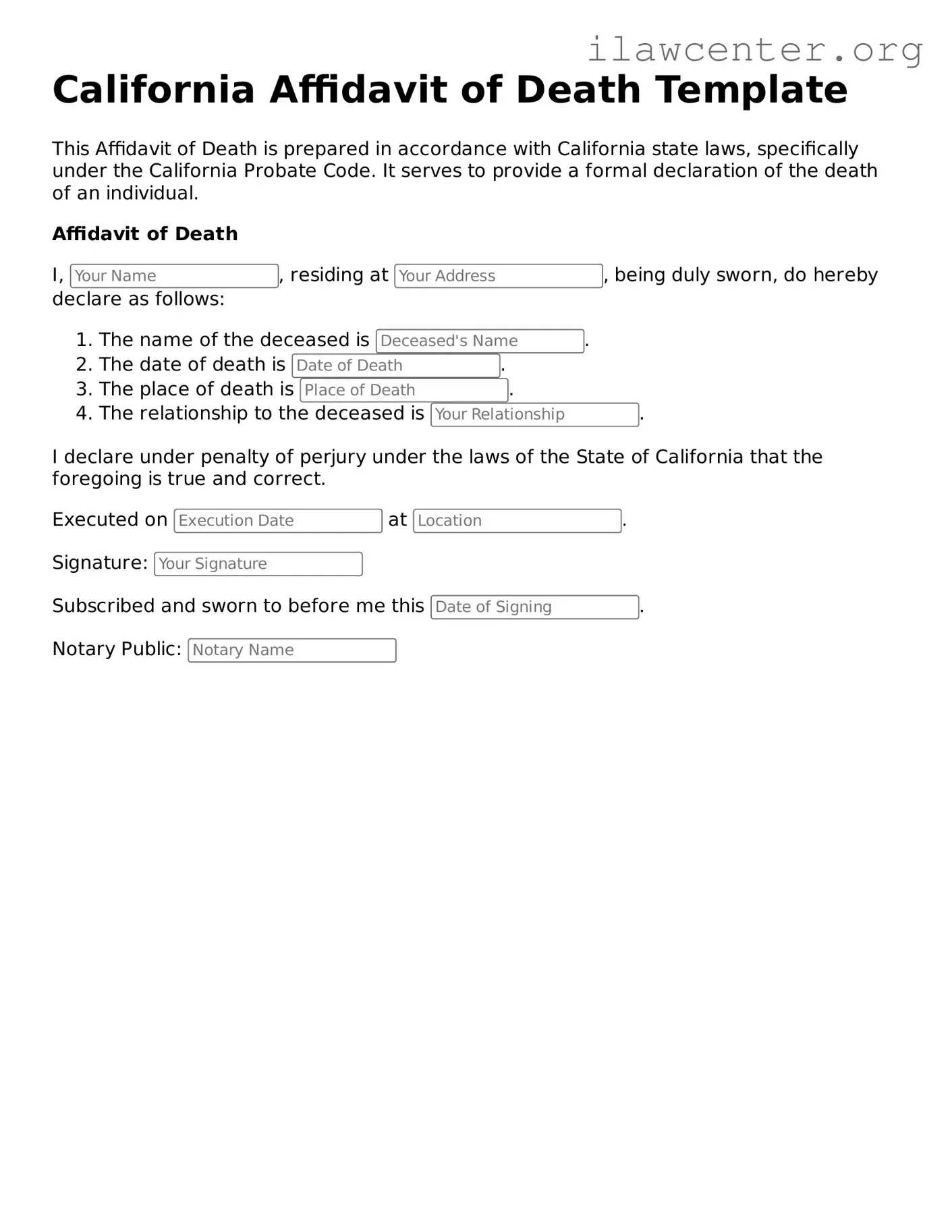
California Affidavit of Death Preview

California Affidavit of Death Template

This Affidavit of Death is prepared in accordance with California state laws, specifically under the California Probate Code. It serves to provide a formal declaration of the death of an individual.

Affidavit of Death

I, , residing at , being duly sworn, do hereby declare as follows:

  1. The name of the deceased is .
  2. The date of death is .
  3. The place of death is .
  4. The relationship to the deceased is .

I declare under penalty of perjury under the laws of the State of California that the foregoing is true and correct.

Executed on at .

Signature:

Subscribed and sworn to before me this .

Notary Public:

PDF Form Characteristics

Fact Name Description
Definition The California Affidavit of Death form is a legal document used to declare the death of an individual, typically for settling estates or transferring property.
Governing Law This form is governed by California Probate Code Sections 13100-13116, which outline the procedures for small estates and the transfer of property after death.
Eligibility The form can be used when the deceased's estate is valued at $166,250 or less, allowing for simplified probate procedures.
Required Information Key information includes the deceased's name, date of death, and details about the affiant (the person completing the form).
Signatures The form must be signed by the affiant and may require notarization, depending on the circumstances.
Filing Process After completion, the affidavit is typically filed with the county recorder's office where the deceased owned property.
Use of Form The affidavit serves as proof of death, allowing heirs or beneficiaries to claim assets without going through full probate.

Instructions on Utilizing California Affidavit of Death

After you complete the California Affidavit of Death form, you will need to file it with the appropriate county office. This step is crucial for officially recording the death and ensuring that any legal matters related to the deceased are addressed properly.

  1. Obtain a copy of the California Affidavit of Death form. You can find it online or at your local county clerk's office.
  2. Fill in the name of the deceased in the designated space at the top of the form.
  3. Provide the date of death. Ensure this is accurate as it is a critical piece of information.
  4. Include the place of death, specifying the city and county.
  5. List the name and address of the person completing the affidavit. This should be someone who has personal knowledge of the death.
  6. Sign the affidavit in the presence of a notary public. A notary will verify your identity and witness your signature.
  7. Make copies of the completed and notarized affidavit for your records.
  8. Submit the original affidavit to the appropriate county office, along with any required fees.

Important Facts about California Affidavit of Death

What is the California Affidavit of Death form?

The California Affidavit of Death form is a legal document used to officially declare the death of an individual. This form is often necessary for settling an estate, transferring property, or addressing financial matters after someone has passed away. It serves as a formal acknowledgment of the individual’s death and provides essential details, such as the date of death and the identity of the deceased.

Who needs to file the Affidavit of Death?

What information is required on the form?

How is the Affidavit of Death filed?

Are there any fees associated with filing the form?

What happens after the Affidavit of Death is filed?

Common mistakes

Filling out the California Affidavit of Death form can be a straightforward process, but several common mistakes can complicate matters. One frequent error is failing to provide complete information about the deceased. It is essential to include the full name, date of birth, and date of death. Omitting any of these details can lead to delays in processing the affidavit.

Another mistake involves inaccuracies in the identification of the affiant. The person completing the form must ensure that their name and relationship to the deceased are correctly stated. This information is vital for establishing credibility and authority to file the affidavit.

Many individuals overlook the requirement for signatures. The form must be signed by the affiant, and in some cases, witnesses may also be needed. Neglecting to sign the document or failing to have it properly witnessed can render the affidavit invalid.

Additionally, people often forget to date the affidavit. Including the date is crucial, as it provides context and establishes when the affidavit was completed. Without a date, the form may be questioned during processing.

Another common error is not providing supporting documentation. It is important to attach any necessary documents, such as a death certificate, to substantiate the claims made in the affidavit. Failure to include these documents can lead to complications or rejection of the affidavit.

Some individuals may also misinterpret the instructions on the form. Each section must be carefully read and followed. Misunderstanding the requirements can lead to incomplete or incorrect submissions.

Lastly, individuals may neglect to make copies of the completed affidavit. Keeping a copy for personal records is a prudent step. This can be beneficial for future reference or in case any issues arise with the filing.

Documents used along the form

The California Affidavit of Death form is a crucial document used to formally declare the death of an individual. It is often accompanied by other forms and documents that facilitate the legal processes surrounding estate management and the transfer of assets. Below is a list of commonly used documents in conjunction with the Affidavit of Death.

  • Death Certificate: This official document is issued by the state and serves as legal proof of an individual's death. It contains vital information such as the deceased's name, date of birth, date of death, and cause of death.
  • Will: A will is a legal document that outlines how a person's assets and affairs should be handled after their death. It may specify beneficiaries and can include instructions for the care of dependents.
  • Trust Document: If the deceased had established a trust, this document outlines the terms of the trust, including how assets should be managed and distributed. It can help avoid probate and streamline the transfer of assets.
  • Petition for Probate: This document is filed with the court to initiate the probate process. It requests the court to validate the deceased's will and appoint a personal representative to manage the estate.
  • Notice of Death: This document is often sent to notify interested parties, such as beneficiaries and creditors, of the individual's passing. It helps ensure that all parties are informed and can take necessary actions regarding the estate.

Understanding these documents can help individuals navigate the complexities of estate management following a death. Each document plays a vital role in ensuring that the deceased's wishes are honored and that the legal processes are conducted smoothly.

Similar forms

  • Death Certificate: This official document records the date, location, and cause of death. Like the Affidavit of Death, it serves as legal proof of a person's passing.
  • Will: A will outlines how a deceased person's assets should be distributed. Both documents are crucial in estate planning and administration.
  • Letter of Administration: This document grants authority to an administrator to manage the estate of a deceased person. It is similar to the Affidavit of Death in that it addresses the legal status of the deceased.
  • Probate Petition: A probate petition initiates the legal process to validate a will. It often requires proof of death, similar to what the Affidavit of Death provides.
  • Affidavit of Heirship: This document establishes the heirs of a deceased person. It is used in cases where no will exists, paralleling the Affidavit of Death in affirming the death.
  • Trust Document: A trust outlines how a person's assets will be managed during their lifetime and after death. Both documents are integral to estate planning.
  • Power of Attorney (POA): Although a POA is typically used while a person is alive, it can specify what happens after death, similar to the Affidavit of Death in addressing posthumous matters.
  • Certificate of Loss of Identity: This document is used in cases where a person is missing and presumed dead. It serves a similar purpose in establishing the status of a deceased individual.
  • Affidavit of Support: This document may be used in immigration processes to affirm financial support for an immigrant. While its purpose differs, it similarly involves a sworn statement regarding an individual's status.
  • Death Benefit Claim Form: This form is used to claim benefits from life insurance or other policies after a person's death. It requires proof of death, akin to the Affidavit of Death.

Dos and Don'ts

When filling out the California Affidavit of Death form, it’s important to approach the task with care. Here are some key do's and don'ts to consider:

  • Do ensure all information is accurate and complete. Double-check names, dates, and other details.
  • Do sign the affidavit in front of a notary public. This adds credibility to the document.
  • Do include any required supporting documents. This may help in verifying the information provided.
  • Don't rush through the form. Take your time to avoid mistakes that could cause delays.
  • Don't leave any fields blank unless specifically instructed. Incomplete forms may be rejected.

Following these guidelines can help ensure that your affidavit is processed smoothly and efficiently.

Misconceptions

Understanding the California Affidavit of Death form is important for anyone dealing with the passing of a loved one. However, several misconceptions can lead to confusion. Here are six common misconceptions:

  1. Anyone can fill out the form.

    While the form is designed to be accessible, it is best completed by someone with a clear understanding of the deceased's estate and the necessary legal requirements.

  2. The form is only needed for probate cases.

    This is not true. The Affidavit of Death can be used in various situations, including transferring property or assets without going through probate.

  3. It must be notarized.

    Notarization is not always required. However, some institutions may request a notarized version to ensure authenticity.

  4. Filing the form is a complicated process.

    While it may seem daunting, the process is straightforward. Clear instructions are provided, and assistance is available if needed.

  5. Only immediate family members can file the form.

    In reality, anyone with a legitimate interest in the deceased's affairs can complete and file the affidavit.

  6. The form is only relevant in California.

    Although this form is specific to California, similar affidavits exist in other states, each with its own requirements and procedures.

By clearing up these misconceptions, individuals can better navigate the process and ensure that they handle the affairs of their loved ones appropriately.

Key takeaways

The California Affidavit of Death form serves as a vital document in the process of settling the affairs of a deceased individual. Understanding how to properly fill out and utilize this form is essential for all parties involved. Here are key takeaways regarding the form:

  • The form must be completed accurately to ensure it is legally recognized.
  • It requires the name, date of birth, and date of death of the deceased.
  • The affiant, or person completing the affidavit, must provide their own information, including their relationship to the deceased.
  • Signature and notarization are necessary for the affidavit to be valid.
  • This document is often used to transfer property or assets that were solely in the name of the deceased.
  • Filing the affidavit with the appropriate county office is crucial for it to take effect.

Understanding these key points will aid in the effective use of the California Affidavit of Death form, ensuring a smoother process in managing the deceased's estate.