Attorney-Verified  Affidavit of Service Document for California

Attorney-Verified Affidavit of Service Document for California

The California Affidavit of Service form is a legal document used to confirm that a party has been properly served with court documents. This form serves as proof that the necessary legal notifications were delivered, ensuring that all parties are informed and can participate in the legal process. Understanding how to fill out this form correctly is crucial for maintaining the integrity of legal proceedings; start by clicking the button below to begin.

Article Guide

The California Affidavit of Service form plays a crucial role in the legal process by documenting the delivery of legal documents to involved parties. This form serves as proof that a specific document, such as a summons or complaint, has been properly served, ensuring that all parties are aware of the proceedings against them. It captures essential details, including the date and time of service, the method used for delivery, and information about the individual who performed the service. Accurate completion of this form is vital, as it can significantly impact the outcome of a case. By providing a clear record of service, the affidavit helps maintain transparency and fairness in legal proceedings, allowing the court to verify that all parties have received necessary notifications. Understanding how to fill out and file this form is essential for anyone involved in a legal matter in California.

California Affidavit of Service Preview

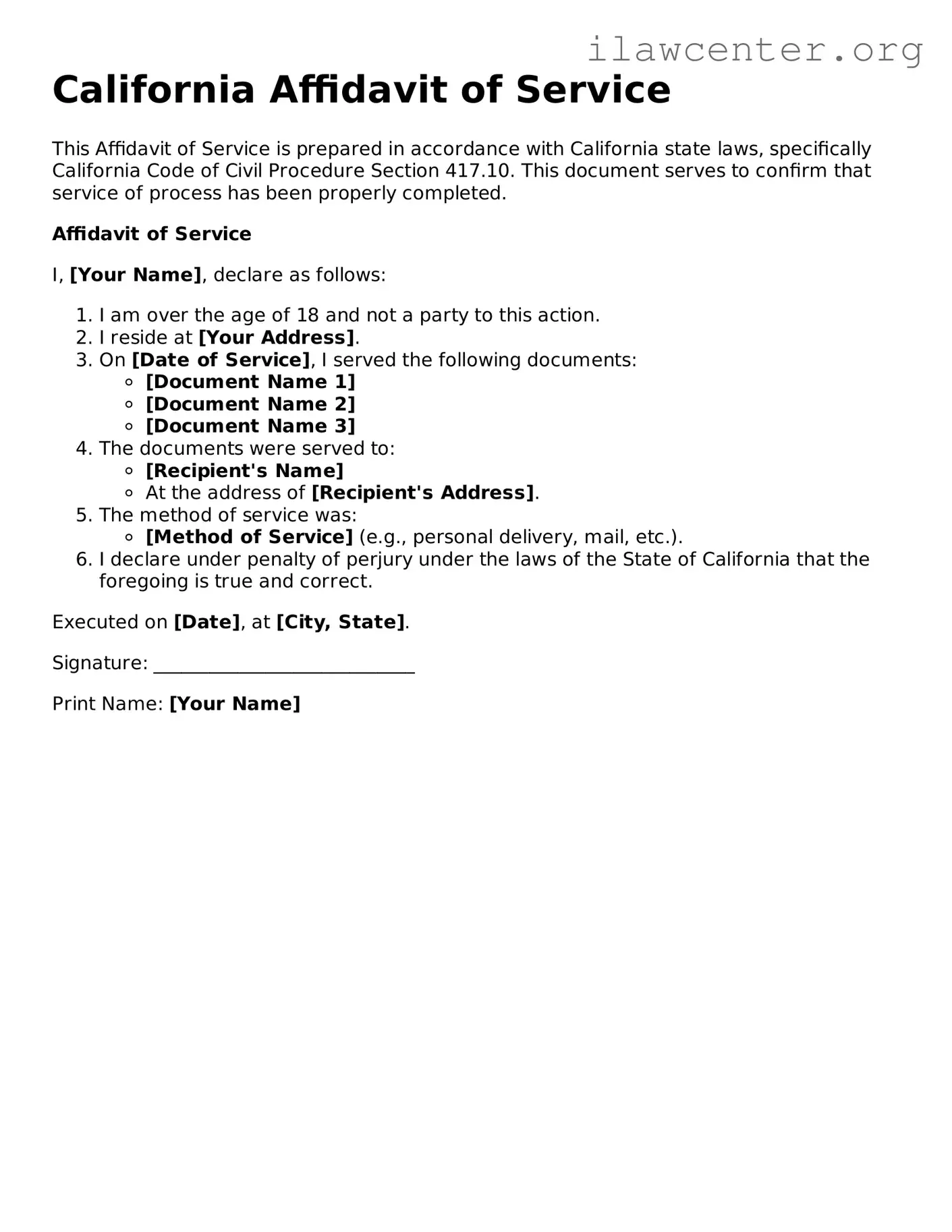
California Affidavit of Service

This Affidavit of Service is prepared in accordance with California state laws, specifically California Code of Civil Procedure Section 417.10. This document serves to confirm that service of process has been properly completed.

Affidavit of Service

I, [Your Name], declare as follows:

  1. I am over the age of 18 and not a party to this action.
  2. I reside at [Your Address].
  3. On [Date of Service], I served the following documents:
    • [Document Name 1]
    • [Document Name 2]
    • [Document Name 3]
  4. The documents were served to:
    • [Recipient's Name]
    • At the address of [Recipient's Address].
  5. The method of service was:
    • [Method of Service] (e.g., personal delivery, mail, etc.).
  6. I declare under penalty of perjury under the laws of the State of California that the foregoing is true and correct.

Executed on [Date], at [City, State].

Signature: ____________________________

Print Name: [Your Name]

PDF Form Characteristics

Fact Name Description
Definition The California Affidavit of Service is a legal document used to confirm that legal papers have been delivered to a party involved in a court case.
Governing Law This form is governed by California Code of Civil Procedure, specifically sections 415.10 through 417.40.
Purpose Its primary purpose is to provide proof that a defendant or other party has received the necessary legal documents.
Who Can Serve In California, any adult who is not a party to the case can serve the documents and complete the affidavit.
Filing Requirement The affidavit must be filed with the court to demonstrate that service was completed, typically before a hearing.
Types of Service Service can be performed in various ways, including personal service, substituted service, and service by mail.
Signature Requirement The person who served the documents must sign the affidavit, attesting to the accuracy of the information provided.
Deadline for Service California law sets specific deadlines for when service must be completed, often before a certain court date.
Consequences of Improper Service If service is not properly executed, it can lead to delays in the case or even dismissal of the action.
Availability The California Affidavit of Service form is widely available online and can often be obtained from court websites or legal aid organizations.

Instructions on Utilizing California Affidavit of Service

Once you have the California Affidavit of Service form ready, the next step involves accurately completing it to ensure proper documentation of service. This process is essential for maintaining the integrity of legal proceedings. Follow the steps below to fill out the form correctly.

  1. Begin by entering the name of the court at the top of the form.
  2. Provide the case number associated with the legal matter.
  3. Fill in the names of the parties involved in the case, including both the plaintiff and the defendant.
  4. Indicate the date on which the service was completed.
  5. Describe the method of service used, such as personal delivery, mail, or another approved method.
  6. Include the name of the person who was served.
  7. Provide the address where the service took place.
  8. Sign the affidavit, affirming that the information provided is accurate and truthful.
  9. Date your signature to confirm when the affidavit was completed.

After completing the form, it is advisable to keep a copy for your records. You may need to file the affidavit with the court as part of your legal documentation process.

Important Facts about California Affidavit of Service

What is the California Affidavit of Service form?

The California Affidavit of Service form is a legal document used to confirm that a specific legal document has been delivered to an individual or entity. This form is essential in legal proceedings, as it provides proof that all parties have been notified of actions being taken against them. The affidavit typically includes details such as the date of service, the method of delivery, and the identity of the person served.

Who can serve documents in California?

In California, documents can be served by a variety of individuals. This includes a registered process server, a sheriff, or a person who is at least 18 years old and not a party to the case. It is important that the person serving the documents is impartial and can provide an accurate account of the service. This helps ensure that the legal process is fair and transparent.

How do I fill out the Affidavit of Service form?

Filling out the Affidavit of Service form requires careful attention to detail. Start by entering the case number and the names of the parties involved. Next, provide information about the person served, including their name and address. Specify the date and method of service, whether it was personal delivery, mail, or another method. Finally, the server must sign the affidavit, affirming that the information provided is true and accurate.

What happens if the Affidavit of Service is not completed correctly?

If the Affidavit of Service is not filled out correctly, it may lead to complications in the legal process. A defective affidavit can result in delays, or even the dismissal of the case. Courts rely on this document to ensure that all parties have been properly notified. Therefore, it is crucial to double-check all information before submission and, if necessary, seek assistance to ensure compliance with legal requirements.

Common mistakes

Filling out the California Affidavit of Service form can be straightforward, but mistakes often occur. One common error is providing incorrect information about the person being served. It’s crucial to ensure that the name and address are accurate. A small typo can lead to delays or even dismissal of a case.

Another frequent mistake is failing to include the date of service. The form requires a specific date when the documents were served. Omitting this detail can create confusion and may result in complications during legal proceedings.

People sometimes forget to sign the affidavit. A signature is necessary to validate the document. Without it, the affidavit may be considered incomplete, which can undermine the entire service process.

Inaccurate descriptions of the documents served can also be problematic. The affidavit should clearly state what documents were delivered. Vague descriptions can lead to questions about whether the correct materials were served.

Some individuals neglect to provide their own contact information. Including a phone number or email address is important. This allows the court or other parties to reach out if there are questions about the service.

Finally, not keeping a copy of the completed affidavit is a mistake many make. It’s essential to retain a copy for personal records. This can be useful if there are any disputes or if proof of service is required later.

Documents used along the form

The California Affidavit of Service form is a crucial document used to confirm that legal papers have been delivered to the appropriate parties. Alongside this form, several other documents may be required to ensure compliance with legal procedures. Below is a list of commonly used forms and documents that often accompany the Affidavit of Service.

  • Summons: This document notifies the defendant that a legal action has been initiated against them and outlines their obligation to respond.
  • Complaint: The complaint details the plaintiff's claims against the defendant, providing the basis for the legal action.
  • Proof of Service: This document serves as evidence that the Affidavit of Service has been completed and outlines the specifics of how and when the documents were served.
  • Notice of Acknowledgment of Receipt: This form is used when the recipient acknowledges receiving the documents, providing a record of their acceptance.
  • Request for Entry of Default: If the defendant fails to respond within the specified time, this document requests the court to enter a default judgment against them.
  • Motion for Summary Judgment: This motion is filed when one party seeks to resolve the case without a trial, arguing that there are no material facts in dispute.
  • Declaration: A declaration is a written statement made under penalty of perjury, often used to provide factual evidence to the court.
  • Ex Parte Application: This application allows a party to request a court order on an urgent basis, often without the other party's presence.
  • Notice of Hearing: This document informs all parties involved of the date and time of a court hearing related to the case.

These documents collectively ensure that the legal process is followed correctly and that all parties are informed of their rights and obligations. Familiarity with these forms can significantly impact the efficiency and effectiveness of legal proceedings in California.

Similar forms

The Affidavit of Service is a vital document in the legal process, confirming that legal papers have been delivered to the appropriate parties. Several other documents serve similar purposes in various legal contexts. Here’s a list of nine documents that share similarities with the Affidavit of Service:

  • Proof of Service: This document also verifies that a party has received legal documents, often used in civil cases.
  • Certificate of Service: Similar to the Affidavit of Service, this certificate confirms that documents were served, typically filed with the court.
  • Return of Service: This document is filed by the server to indicate that they have delivered the documents, providing details about the service.
  • Notice of Service: This serves to inform the court and the involved parties that documents have been served, highlighting the date and method of service.
  • Service of Process: While this term refers to the overall procedure of delivering legal documents, it often includes the completion of an Affidavit of Service.
  • Summons: A summons is a legal document that informs a defendant of a lawsuit, often accompanied by an Affidavit of Service to confirm delivery.
  • Subpoena: This document compels a person to appear in court or produce evidence, and an Affidavit of Service can confirm that the subpoena was delivered.
  • Demand Letter: A demand letter requests action from the recipient, and proof of service may be included to show that the letter was received.
  • Motion for Default Judgment: This motion can be filed when a party fails to respond, and an Affidavit of Service may be attached to prove that they were properly served.

Understanding these documents can help clarify the legal process and ensure that all parties are informed and compliant with legal requirements.

Dos and Don'ts

When completing the California Affidavit of Service form, it's important to follow specific guidelines to ensure accuracy and compliance. Below is a list of things you should and shouldn't do while filling out this form.

  • Do read the instructions carefully before starting.
  • Do provide accurate information about the person being served.
  • Do include your own information as the server.
  • Do sign and date the affidavit after completing it.
  • Do keep a copy of the completed affidavit for your records.
  • Don't leave any required fields blank.
  • Don't use white-out or erase any information.
  • Don't submit the form without verifying all details are correct.
  • Don't forget to check the filing deadline for your case.

Following these guidelines can help ensure that the affidavit is properly completed and accepted by the court. Accuracy is crucial in legal documents, and taking the time to review your work can prevent potential issues later on.

Misconceptions

When it comes to the California Affidavit of Service, many people harbor misconceptions that can lead to confusion or even legal missteps. Here are eight common misunderstandings about this important document:

  1. It is only necessary for court cases. Many believe that the Affidavit of Service is only relevant in formal court proceedings. In reality, this document is essential in various legal situations, including family law matters, eviction notices, and other civil actions.
  2. Anyone can serve documents. While it is true that many individuals can serve documents, there are specific rules about who can do so. Generally, the person serving the documents must be at least 18 years old and not a party to the case.
  3. Proof of service is the same as an affidavit. Proof of service and an affidavit of service are not interchangeable. The proof of service is a statement confirming that the documents were delivered, while the affidavit is a sworn statement attesting to that delivery.
  4. Filing the affidavit is optional. Some people mistakenly think that filing the affidavit is optional. In most cases, it is a required step to ensure that the court recognizes that the other party has been properly notified.
  5. It can be filled out after the documents are served. The affidavit must be completed and filed after service has occurred. However, it is crucial to fill it out accurately and promptly to avoid any delays in the legal process.
  6. All affidavits of service are the same. Not all affidavits of service are created equal. Different types of cases may require specific forms or additional information, so it’s essential to use the correct version for your situation.
  7. Service by mail is sufficient in all cases. While service by mail is allowed in some situations, it is not always sufficient. Certain legal actions require personal service, meaning the documents must be handed directly to the individual.
  8. Once served, the case is automatically resolved. Serving documents does not mean the case is resolved. It merely ensures that the other party is aware of the legal action. Further steps, including court appearances or negotiations, may still be necessary.

Understanding these misconceptions can help individuals navigate the legal landscape more effectively. Proper knowledge of the Affidavit of Service can save time and prevent complications down the line.

Key takeaways

When filling out and using the California Affidavit of Service form, it's essential to keep several key points in mind:

  • Accuracy is crucial: Ensure all information is filled out correctly, including names, addresses, and dates. Mistakes can lead to delays or complications in your case.
  • Service methods matter: Specify the method of service used, whether personal, substituted, or by mail. This detail is important for the validity of the service.
  • Signature requirement: The affidavit must be signed by the person who performed the service. Without a signature, the document may not be accepted by the court.
  • Timeliness is key: File the affidavit promptly after serving the documents to ensure compliance with court timelines and procedures.