Attorney-Verified  Articles of Incorporation Document for California

Attorney-Verified Articles of Incorporation Document for California

The California Articles of Incorporation form is a legal document that establishes a corporation in the state of California. This form outlines essential information about the corporation, including its name, purpose, and structure. To get started on forming your corporation, fill out the form by clicking the button below.

Article Guide

In the state of California, the process of establishing a corporation begins with the completion of the Articles of Incorporation form. This critical document serves as the foundation for a new business entity, outlining essential information that defines its structure and purpose. Key aspects of the form include the corporation's name, which must be unique and comply with state regulations, and the designation of a registered agent responsible for receiving legal documents. Additionally, the form requires details about the corporation’s purpose, which can be general or specific, and information regarding the initial directors and their addresses. It also includes provisions for stock, such as the number of shares the corporation is authorized to issue. Filing this form with the California Secretary of State is a vital step that not only formalizes the existence of the corporation but also ensures compliance with state laws. Understanding the intricacies of the Articles of Incorporation is essential for anyone looking to navigate the complexities of starting a business in California.

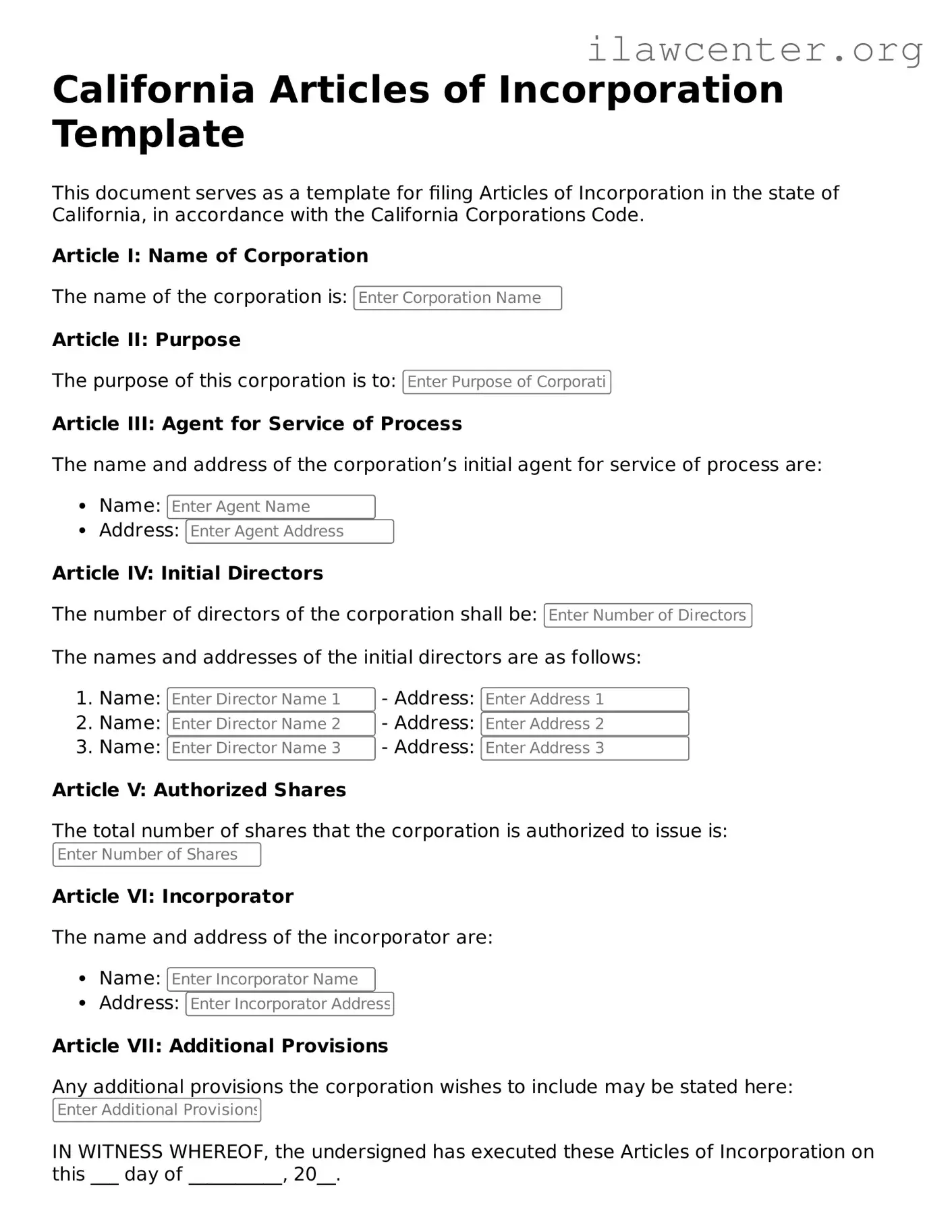
California Articles of Incorporation Preview

California Articles of Incorporation Template

This document serves as a template for filing Articles of Incorporation in the state of California, in accordance with the California Corporations Code.

Article I: Name of Corporation

The name of the corporation is:

Article II: Purpose

The purpose of this corporation is to:

Article III: Agent for Service of Process

The name and address of the corporation’s initial agent for service of process are:

  • Name:
  • Address:

Article IV: Initial Directors

The number of directors of the corporation shall be:

The names and addresses of the initial directors are as follows:

  1. Name: - Address:
  2. Name: - Address:
  3. Name: - Address:

Article V: Authorized Shares

The total number of shares that the corporation is authorized to issue is:

Article VI: Incorporator

The name and address of the incorporator are:

  • Name:
  • Address:

Article VII: Additional Provisions

Any additional provisions the corporation wishes to include may be stated here:

IN WITNESS WHEREOF, the undersigned has executed these Articles of Incorporation on this ___ day of __________, 20__.

Signature: ___________________________

Name:

PDF Form Characteristics

Fact Name Description
Governing Law The California Articles of Incorporation are governed by the California Corporations Code.
Purpose This form is used to officially create a corporation in California.
Filing Requirement Filing the Articles of Incorporation is required to legally establish a corporation.
Information Needed The form requires basic information such as the corporation's name, address, and purpose.
Corporate Name The name of the corporation must be unique and not too similar to existing entities.
Registered Agent A registered agent must be designated to receive legal documents on behalf of the corporation.
Incorporator The person or entity filing the Articles of Incorporation is known as the incorporator.
Filing Fee A filing fee is required when submitting the Articles of Incorporation to the state.
Effective Date The Articles can specify an effective date, which may be the filing date or a future date.
Amendments Changes to the Articles of Incorporation can be made through a formal amendment process.

Instructions on Utilizing California Articles of Incorporation

After completing the California Articles of Incorporation form, you will submit it to the Secretary of State. This is an important step in establishing your corporation legally in California. Make sure you have all necessary information ready before you begin filling out the form.

  1. Obtain the form: Download the California Articles of Incorporation form from the California Secretary of State’s website or request a hard copy.
  2. Enter the corporation name: Fill in the exact name of your corporation. Ensure it complies with California naming rules.
  3. Specify the purpose: Clearly state the purpose of your corporation. This can be a general purpose or a specific business activity.
  4. List the agent for service of process: Provide the name and address of your corporation's agent. This person or entity will receive legal documents on behalf of the corporation.
  5. Indicate the initial address: Fill in the initial street address of the corporation. This should be a physical address in California.
  6. State the number of shares: Indicate the total number of shares the corporation is authorized to issue.
  7. Provide incorporator information: List the name and address of the incorporator(s). This person is responsible for filing the Articles of Incorporation.
  8. Sign and date: The incorporator must sign and date the form to validate it.
  9. Prepare payment: Include the required filing fee. Check the current fee schedule on the Secretary of State’s website.
  10. Submit the form: Send the completed form and payment to the appropriate address for the California Secretary of State.

Important Facts about California Articles of Incorporation

What are the California Articles of Incorporation?

The California Articles of Incorporation is a legal document that establishes a corporation in the state of California. It outlines the basic information about the corporation, such as its name, purpose, and the address of its initial registered office. Filing this document with the California Secretary of State is the first step in forming a corporation in California.

Who needs to file Articles of Incorporation?

Anyone looking to form a corporation in California must file Articles of Incorporation. This includes individuals starting a new business, as well as existing businesses that want to change their structure to a corporation. It is essential for those seeking limited liability protection and a formal business structure.

What information is required in the Articles of Incorporation?

The form requires several key pieces of information. You will need to provide the name of the corporation, its purpose, the address of the initial registered office, and the name and address of the initial agent for service of process. Additionally, you may need to include the number of shares the corporation is authorized to issue.

How much does it cost to file the Articles of Incorporation?

The filing fee for the Articles of Incorporation in California is generally around $100. However, additional fees may apply if you choose expedited processing or if you are filing for a specific type of corporation, such as a nonprofit. Always check the California Secretary of State's website for the most current fee schedule.

How do I file the Articles of Incorporation?

You can file the Articles of Incorporation online, by mail, or in person at the California Secretary of State's office. If filing online, you’ll need to complete the form through their website and pay the fee electronically. For mail submissions, print the completed form, include your payment, and send it to the appropriate address. In-person filings can be made at designated locations.

How long does it take for the Articles of Incorporation to be processed?

Processing times can vary. Typically, it takes about 15 business days for the California Secretary of State to process Articles of Incorporation filed by mail. Online filings may be processed faster. If you need your documents urgently, consider requesting expedited service for an additional fee.

Can I amend the Articles of Incorporation after filing?

Yes, you can amend the Articles of Incorporation after they have been filed. To do this, you will need to file a Certificate of Amendment with the California Secretary of State. This process allows you to change various aspects of your corporation, such as its name or purpose, but it will require additional paperwork and fees.

Do I need a lawyer to file the Articles of Incorporation?

While it is not legally required to have a lawyer file the Articles of Incorporation, consulting with one can be beneficial. A lawyer can help ensure that all necessary information is included and that the document complies with state regulations. If you feel confident in completing the form yourself, you can certainly do so.

What happens after I file the Articles of Incorporation?

Once your Articles of Incorporation are approved, you will receive a stamped copy back from the Secretary of State. This document officially establishes your corporation. After that, you will need to obtain any necessary business licenses, set up a corporate bank account, and comply with ongoing reporting requirements to maintain your corporate status.
Common mistakes

When filling out the California Articles of Incorporation form, individuals often overlook critical details that can lead to delays or complications in the incorporation process. One common mistake is failing to provide a complete and accurate name for the corporation. The name must be unique and distinguishable from existing entities registered in California. If the name is not checked against the state’s database, applicants may find themselves needing to start over, wasting valuable time and resources.

Another frequent error involves the selection of the corporation's purpose. Many people opt for vague or overly broad descriptions instead of clearly defining the business's intended activities. The Articles of Incorporation require a specific purpose, and a lack of clarity can lead to confusion or misinterpretation by state officials. It is essential to articulate the purpose with precision to avoid future legal complications.

Additionally, applicants sometimes neglect to include the correct information regarding the registered agent. The registered agent serves as the corporation's official point of contact for legal documents. If the agent’s name and address are not accurately provided, it can result in missed communications or even legal notices. This oversight can have serious implications for the corporation’s standing and operations.

Finally, individuals often fail to review the entire form before submission. Incomplete forms or missing signatures can lead to rejection by the state. It is crucial to double-check all sections, ensuring that all required information is filled out and that the form is signed by the appropriate parties. Taking the time to thoroughly review the document can prevent unnecessary delays and help establish the corporation smoothly.

Documents used along the form

When forming a corporation in California, the Articles of Incorporation is a crucial document. However, it is not the only one required to ensure compliance with state regulations. Below are some additional forms and documents often used alongside the Articles of Incorporation.

  • Bylaws: Bylaws outline the internal rules and procedures for managing the corporation. They cover aspects such as the roles of directors and officers, meeting protocols, and voting procedures.
  • Statement of Information: This document provides the state with updated information about the corporation, including the names and addresses of its officers and directors. It must be filed within 90 days of incorporation and then every two years thereafter.
  • Employer Identification Number (EIN): Obtained from the IRS, an EIN is necessary for tax purposes. It functions like a Social Security number for the corporation and is required for opening a business bank account and hiring employees.
  • Initial Board of Directors Meeting Minutes: After incorporation, the initial meeting of the board of directors should be documented. These minutes outline decisions made, such as the adoption of bylaws and the appointment of officers.

Each of these documents plays a significant role in establishing and maintaining a corporation in California. Properly preparing and filing them helps ensure that the corporation operates smoothly and complies with state laws.

Similar forms

  • Bylaws: Bylaws outline the internal rules and regulations governing a corporation's operations. While the Articles of Incorporation establish the entity's existence, the bylaws provide details on management structure and procedures.
  • Operating Agreement: This document is similar for limited liability companies (LLCs). It details the management and operational procedures of the LLC, much like how the Articles of Incorporation define a corporation's structure.
  • Certificate of Formation: In some states, this document serves a similar purpose to the Articles of Incorporation. It officially establishes a business entity and includes basic information about the company.
  • Partnership Agreement: For partnerships, this agreement outlines the terms of the partnership, including roles and responsibilities, akin to how the Articles of Incorporation define the structure of a corporation.
  • Business Plan: While not a formal legal document, a business plan lays out the vision, goals, and operational strategies for a business. It provides a roadmap similar to how the Articles of Incorporation set the foundation for a corporation.
  • Shareholder Agreement: This document governs the relationship between shareholders, detailing their rights and obligations. It complements the Articles of Incorporation by addressing the management of shares and corporate governance.
  • Annual Report: Corporations are often required to file annual reports with the state. These reports provide updates on the corporation's activities and financial status, similar to how the Articles of Incorporation provide foundational information.
  • Certificate of Good Standing: This document confirms that a corporation is legally registered and compliant with state requirements. It reflects the status established by the Articles of Incorporation.
  • Tax Registration Documents: These documents are necessary for obtaining tax identification numbers and ensuring compliance with tax regulations. They are essential for operational legitimacy, much like the Articles of Incorporation.
  • Employment Agreements: These agreements outline the terms of employment for individuals working within the corporation. They establish roles and responsibilities, which is a fundamental aspect of the corporate structure defined in the Articles of Incorporation.

Dos and Don'ts

When filling out the California Articles of Incorporation form, it is important to follow certain guidelines to ensure accuracy and compliance. Here are some dos and don’ts to keep in mind:

  • Do provide the full name of the corporation as you want it to appear on official documents.
  • Do include the principal office address, ensuring it is a physical location, not a P.O. Box.
  • Do specify the purpose of your corporation clearly and concisely.
  • Do list the name and address of the initial agent for service of process.
  • Don’t leave any required fields blank; incomplete forms can lead to delays.
  • Don’t use abbreviations or informal language in the corporation's name.
  • Don’t forget to sign the form; an unsigned document is invalid.
  • Don’t submit the form without checking for errors or typos, as these can cause issues later.

Misconceptions

Understanding the California Articles of Incorporation form is essential for anyone looking to establish a corporation in the state. However, several misconceptions often arise regarding this important document. Below is a list of seven common misconceptions along with clarifications for each.

  1. All businesses must file Articles of Incorporation.

    Not all businesses are required to file Articles of Incorporation. Only those wishing to form a corporation must complete this form. Other business structures, such as sole proprietorships and partnerships, do not need to file this document.

  2. The Articles of Incorporation are the same as the business license.

    The Articles of Incorporation and a business license serve different purposes. The Articles establish the corporation as a legal entity, while a business license allows a business to operate legally within a specific jurisdiction.

  3. Filing Articles of Incorporation guarantees tax-exempt status.

    Filing Articles of Incorporation does not automatically grant tax-exempt status. Organizations seeking tax-exempt status must apply separately to the Internal Revenue Service and meet specific criteria.

  4. Once filed, Articles of Incorporation cannot be changed.

    This is not true. Amendments to the Articles of Incorporation can be made after the initial filing. However, such changes must follow the proper procedures as outlined by California law.

  5. Only California residents can file Articles of Incorporation in California.

    Individuals do not need to be California residents to file Articles of Incorporation in the state. Non-residents can also establish a corporation in California, provided they comply with all state requirements.

  6. All corporations must have a physical office in California.

    While California corporations must have a registered agent with a physical address in the state, they do not need to maintain a physical office. The registered agent can receive legal documents on behalf of the corporation.

  7. The Articles of Incorporation can be filed at any time.

    Although there is flexibility in filing, it is advisable to submit the Articles of Incorporation before commencing business activities. Delaying the filing can lead to legal complications and potential penalties.

Key takeaways

Filling out the California Articles of Incorporation form is an important step in starting your business. Here are some key takeaways to keep in mind:

  • Understand the Purpose: The Articles of Incorporation officially create your corporation in California.
  • Choose a Name: Your corporation's name must be unique and not already in use by another business in California.
  • Designate an Agent: You need to appoint a registered agent who will receive legal documents on behalf of your corporation.
  • Specify the Business Purpose: Clearly state what your corporation will do. This can be broad, but it should be specific enough to inform the public.
  • Decide on Stock Structure: Indicate the number of shares your corporation is authorized to issue and their par value, if any.
  • File with the Secretary of State: Submit your completed form to the California Secretary of State along with the required filing fee.
  • Understand the Processing Time: Be aware that it may take several weeks to process your filing, so plan accordingly.
  • Keep Copies: Always keep a copy of the filed Articles of Incorporation for your records.
  • Follow Up: After filing, check the status of your application to ensure everything is in order.

Taking these steps will help ensure that your corporation is set up properly and legally in California.