Attorney-Verified  ATV Bill of Sale Document for California

Attorney-Verified ATV Bill of Sale Document for California

The California ATV Bill of Sale form is a crucial document that records the transfer of ownership for all-terrain vehicles in the state. This form not only protects the buyer and seller but also ensures compliance with state regulations. To facilitate a smooth transaction, it's essential to fill out the form accurately; click the button below to get started.

Article Guide

In the vibrant landscape of California's off-road recreational activities, the ATV Bill of Sale form emerges as a crucial document for both buyers and sellers of all-terrain vehicles. This form serves not only as a receipt for the transaction but also as a vital record that ensures the legal transfer of ownership. When completed, it includes essential information such as the names and addresses of both parties, a detailed description of the ATV, and the sale price. Additionally, the form may require the seller's signature, affirming that the vehicle is free of liens and encumbrances, thus safeguarding the buyer from potential legal disputes. Properly documenting the sale with this form can prevent future complications, making it an indispensable part of any ATV transaction in California. The urgency to understand and utilize this form cannot be overstated, as it plays a pivotal role in protecting the interests of both parties involved in the sale.

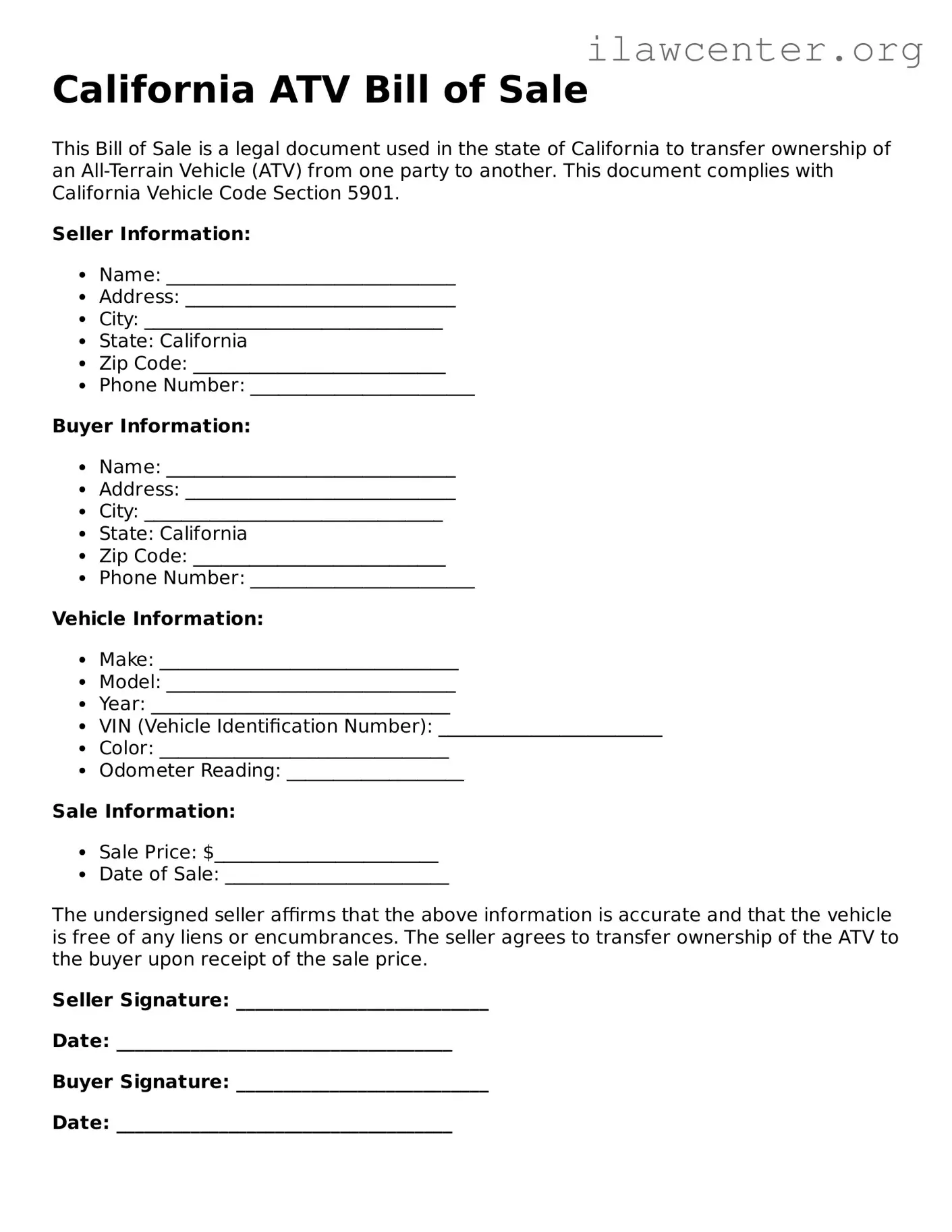
California ATV Bill of Sale Preview

California ATV Bill of Sale

This Bill of Sale is a legal document used in the state of California to transfer ownership of an All-Terrain Vehicle (ATV) from one party to another. This document complies with California Vehicle Code Section 5901.

Seller Information:

  • Name: _______________________________
  • Address: _____________________________
  • City: ________________________________
  • State: California
  • Zip Code: ___________________________
  • Phone Number: ________________________

Buyer Information:

  • Name: _______________________________
  • Address: _____________________________
  • City: ________________________________
  • State: California
  • Zip Code: ___________________________
  • Phone Number: ________________________

Vehicle Information:

  • Make: ________________________________
  • Model: _______________________________
  • Year: ________________________________
  • VIN (Vehicle Identification Number): ________________________
  • Color: _______________________________
  • Odometer Reading: ___________________

Sale Information:

  • Sale Price: $________________________
  • Date of Sale: ________________________

The undersigned seller affirms that the above information is accurate and that the vehicle is free of any liens or encumbrances. The seller agrees to transfer ownership of the ATV to the buyer upon receipt of the sale price.

Seller Signature: ___________________________

Date: ____________________________________

Buyer Signature: ___________________________

Date: ____________________________________

This document serves as proof of the sale and should be retained by both parties for their records.

PDF Form Characteristics

Fact Name Description
Purpose The California ATV Bill of Sale form serves as a legal document that records the transfer of ownership of an all-terrain vehicle (ATV) from one party to another.
Governing Law This form is governed by California Vehicle Code Section 5901, which outlines the requirements for vehicle sales and transfers in the state.
Essential Information The form typically includes details such as the buyer's and seller's names, contact information, ATV description, sale price, and date of sale.
Importance of Completion Completing the Bill of Sale is crucial for both parties, as it provides proof of the transaction and can help avoid disputes over ownership in the future.

Instructions on Utilizing California ATV Bill of Sale

Once you have the California ATV Bill of Sale form in hand, you are ready to document the sale of your all-terrain vehicle. Completing this form accurately is crucial for both the buyer and seller, as it serves as proof of the transaction and can be important for registration purposes.

  1. Gather Information: Collect all necessary details about the ATV, including its make, model, year, Vehicle Identification Number (VIN), and odometer reading.
  2. Seller Information: Fill in the seller's full name, address, and contact information. Ensure that this information is accurate to avoid any future issues.
  3. Buyer Information: Provide the buyer's full name, address, and contact information. Double-check for correctness.
  4. Sale Price: Enter the agreed-upon sale price of the ATV. Be clear and precise to prevent any misunderstandings.
  5. Date of Sale: Write the date when the transaction takes place. This date is essential for record-keeping.
  6. Signatures: Both the seller and buyer must sign the form. This step is vital, as it signifies that both parties agree to the terms of the sale.
  7. Additional Notes: If there are any special conditions or warranties, include them in the notes section of the form.

After completing the form, both parties should keep a copy for their records. This documentation will be beneficial for any future reference, especially when it comes to registration or potential disputes.

Important Facts about California ATV Bill of Sale

What is a California ATV Bill of Sale form?

A California ATV Bill of Sale form is a legal document that records the sale of an all-terrain vehicle (ATV) in California. It serves as proof of the transaction between the buyer and the seller. This document includes essential details such as the vehicle's identification number (VIN), make, model, year, and the sale price.

Why do I need a Bill of Sale for my ATV?

A Bill of Sale is important for several reasons. It protects both the buyer and seller by providing a written record of the transaction. It can help prevent disputes about ownership and serves as proof of purchase for the buyer. Additionally, it may be required for registration and title transfer with the California Department of Motor Vehicles (DMV).

What information is required on the Bill of Sale?

The Bill of Sale should include the following information: the names and addresses of both the buyer and seller, the date of the sale, the ATV's make, model, year, and VIN, the sale price, and any additional terms agreed upon by both parties. Both parties should sign the document to make it valid.

Do I need to have the Bill of Sale notarized?

No, notarization is not required for a Bill of Sale in California. However, having it notarized can add an extra layer of security and authenticity to the document. It is advisable to keep a copy for your records.

Can I use a generic Bill of Sale template?

You can use a generic Bill of Sale template, but it’s best to use one specifically designed for ATVs in California. This ensures that all necessary information is included and complies with state requirements. Customizing the template to fit your specific transaction is essential.

Is a Bill of Sale the same as a title?

No, a Bill of Sale is not the same as a title. The title is the legal document that proves ownership of the ATV. The Bill of Sale documents the transaction and may be needed to transfer the title at the DMV. Both documents are important in the buying and selling process.

What if I lose the Bill of Sale?

If you lose the Bill of Sale, it may be difficult to prove the transaction occurred. It’s important to keep a copy in a safe place. If you cannot find it, you may need to contact the seller to create a new Bill of Sale or draft a statement that outlines the details of the sale.

How does the Bill of Sale affect registration?

The Bill of Sale is often required when registering your ATV with the DMV. It provides proof of ownership and the sale price, which may be needed for tax purposes. Ensure that you have this document ready when you go to register your ATV.

Can I sell an ATV without a Bill of Sale?

What happens if there are liens on the ATV?

If there are liens on the ATV, the seller must disclose this information to the buyer. It is crucial to clear any liens before completing the sale. The Bill of Sale should indicate whether the ATV is sold free of liens. Buyers should conduct a title search to ensure there are no outstanding claims against the vehicle.
Common mistakes

When filling out the California ATV Bill of Sale form, many individuals make common mistakes that can lead to complications later on. One of the most frequent errors is failing to provide complete information. Buyers and sellers must ensure that all required fields are filled out accurately. Missing details such as the vehicle identification number (VIN), make, model, or year can result in delays or issues during registration.

Another common mistake is neglecting to include the sale price. The form requires a clear indication of the purchase price. Without this information, the transaction may be questioned by the Department of Motor Vehicles (DMV), potentially leading to problems with title transfer or tax assessments.

Many people also forget to sign the document. Both the buyer and seller must provide their signatures on the Bill of Sale for it to be valid. A missing signature can invalidate the transaction, leaving both parties without legal protection.

Additionally, some individuals overlook the importance of providing accurate contact information. Including phone numbers and addresses helps facilitate communication between the buyer and seller, especially if any issues arise post-sale. Incomplete contact details can hinder the resolution of disputes or questions regarding the transaction.

Another mistake occurs when individuals do not make copies of the completed Bill of Sale. Retaining a copy for personal records is essential. This document serves as proof of the transaction and can be crucial if questions about ownership arise in the future.

Lastly, people often fail to check for any local requirements or regulations that may apply to the sale of ATVs. While the state form provides a general framework, local jurisdictions may have specific rules or additional paperwork needed. Being aware of these requirements can save time and prevent headaches down the road.

Documents used along the form

When buying or selling an ATV in California, the Bill of Sale is an essential document that outlines the transaction details. However, several other forms and documents may be necessary to ensure a smooth transfer of ownership and compliance with state regulations. Here’s a list of common documents that often accompany the California ATV Bill of Sale.

  • California Off-Highway Vehicle Registration Application: This form is required to register the ATV with the California Department of Motor Vehicles (DMV). It includes details about the vehicle, such as its make, model, and Vehicle Identification Number (VIN).
  • Title Transfer Form: If the ATV has a title, this form is necessary to officially transfer ownership from the seller to the buyer. It provides proof of ownership and is usually required for registration.
  • Release of Liability: This document protects the seller from any future claims or liabilities associated with the ATV after the sale. It must be submitted to the DMV to notify them that the seller is no longer responsible for the vehicle.
  • Proof of Identity: Buyers may need to provide valid identification, such as a driver’s license or state ID, to verify their identity during the registration process.
  • Sales Tax Payment Receipt: In California, sales tax is applicable to ATV purchases. A receipt showing that sales tax has been paid may be required during registration.
  • Emissions Compliance Certificate: Depending on the type of ATV and its age, this certificate may be necessary to prove that the vehicle meets California's emissions standards.
  • Insurance Documentation: Proof of insurance may be required before registering the ATV. This ensures that the vehicle is covered in case of accidents or damages.
  • VIN Verification Form: This form may be needed if the ATV is being registered for the first time in California. It verifies that the VIN on the vehicle matches the information provided on other documents.
  • Bill of Sale for Accessories: If the sale includes additional items like trailers or equipment, a separate bill of sale for those accessories can clarify what is included in the transaction.

Collecting and completing these documents can help facilitate a hassle-free sale and ensure that both parties are protected. Understanding the requirements and having the necessary paperwork ready can make the process of buying or selling an ATV much smoother.

Similar forms

  • Vehicle Bill of Sale: Similar to the ATV Bill of Sale, this document transfers ownership of a vehicle from one party to another. It includes details such as the vehicle's make, model, year, and VIN, along with the buyer's and seller's information.

  • Boat Bill of Sale: This document serves a similar purpose for boats. It outlines the terms of the sale, identifies the boat, and provides a record of the transaction, ensuring that ownership is legally transferred.

  • Motorcycle Bill of Sale: Like the ATV Bill of Sale, this form is used for motorcycles. It includes information about the motorcycle, the parties involved, and the sale price, ensuring a clear transfer of ownership.

  • Trailer Bill of Sale: This document is used when selling a trailer. It details the trailer's specifications and confirms the transfer of ownership, similar to the process for ATVs.

  • Personal Property Bill of Sale: This broader form can be used for various types of personal property, including recreational vehicles. It includes descriptions of the item being sold, the sale price, and the parties' information, serving a similar function as the ATV Bill of Sale.

Dos and Don'ts

When filling out the California ATV Bill of Sale form, it’s important to ensure accuracy and clarity. Here are some essential do's and don'ts to keep in mind:

  • Do provide complete and accurate information about the ATV, including the make, model, year, and Vehicle Identification Number (VIN).
  • Do include the full names and addresses of both the seller and the buyer to avoid any confusion.
  • Don't leave any sections blank. Every part of the form should be filled out to ensure it is legally binding.
  • Don't forget to sign and date the form. Both parties must provide their signatures for the sale to be valid.

Following these guidelines will help facilitate a smooth transaction and protect both the buyer and the seller.

Misconceptions

The California ATV Bill of Sale form is an important document for the transfer of ownership of all-terrain vehicles. However, several misconceptions exist about this form. Below is a list of ten common misunderstandings and clarifications regarding the California ATV Bill of Sale.

  1. Misconception 1: The Bill of Sale is not necessary for ATV transactions.

    In California, a Bill of Sale is crucial for documenting the sale and transfer of ownership. It serves as proof of the transaction and can be required for registration purposes.

  2. Misconception 2: A verbal agreement is sufficient for selling an ATV.

    While verbal agreements can be made, they lack the legal protection that a written Bill of Sale provides. A written document helps prevent disputes in the future.

  3. Misconception 3: The Bill of Sale must be notarized.

    Notarization is not a requirement for the California ATV Bill of Sale. However, having it notarized can add an extra layer of authenticity and security.

  4. Misconception 4: The form can be filled out after the sale is completed.

    It is best to complete the Bill of Sale at the time of the transaction. This ensures that all details are accurate and agreed upon by both parties.

  5. Misconception 5: Only the seller needs to sign the Bill of Sale.

    Both the seller and the buyer must sign the Bill of Sale. This mutual agreement solidifies the transaction and protects both parties.

  6. Misconception 6: The Bill of Sale is only for new ATVs.

    The Bill of Sale applies to both new and used ATVs. It is essential for documenting any transfer of ownership, regardless of the vehicle's age.

  7. Misconception 7: A Bill of Sale is the same as a title transfer.

    While both documents are important, they serve different purposes. The Bill of Sale proves the transaction, while the title transfer legally changes ownership with the DMV.

  8. Misconception 8: The Bill of Sale can be used for any vehicle type.

    The California ATV Bill of Sale is specifically designed for all-terrain vehicles. Different forms exist for other vehicle types, such as cars or motorcycles.

  9. Misconception 9: The form is available only at the DMV.

    While the DMV provides a version of the form, it can also be found online or created independently, as long as it includes all necessary information.

  10. Misconception 10: The Bill of Sale does not need to include specific details.

    Essential information must be included in the Bill of Sale, such as the vehicle identification number (VIN), purchase price, and the names and addresses of both parties.

Understanding these misconceptions can help ensure a smoother transaction when buying or selling an ATV in California. It is always advisable to have a clear, written record of any vehicle sale.

Key takeaways

When filling out and using the California ATV Bill of Sale form, keep these key takeaways in mind:

  • The form is essential for transferring ownership of an ATV in California.
  • Both the buyer and seller must provide their names and contact information.
  • Include the ATV's make, model, year, and Vehicle Identification Number (VIN).
  • Clearly state the sale price to avoid any misunderstandings.
  • Both parties should sign and date the form to validate the transaction.
  • Keep a copy of the completed form for your records.
  • The form can help protect both the buyer and seller in case of future disputes.
  • It is advisable to fill out the form in the presence of a witness.
  • Check local regulations, as some areas may have additional requirements.