Attorney-Verified  Commercial Lease Agreement Document for California

Attorney-Verified Commercial Lease Agreement Document for California

A California Commercial Lease Agreement is a legal document that outlines the terms and conditions between a landlord and a tenant for renting commercial property. This agreement is essential for both parties, as it details responsibilities, payment terms, and other important aspects of the lease. To get started on your lease, fill out the form by clicking the button below.

Article Guide

When entering into a business venture in California, understanding the California Commercial Lease Agreement form is essential for both landlords and tenants. This document serves as a legally binding contract that outlines the terms under which a commercial property is leased. Key components of the agreement include the duration of the lease, the rental amount, and payment schedules, which help ensure clarity and mutual understanding. Additionally, the form addresses important details such as maintenance responsibilities, use of the premises, and provisions for renewal or termination. By outlining these aspects, the Commercial Lease Agreement provides a framework that protects the interests of both parties, fostering a smooth and professional relationship throughout the lease term.

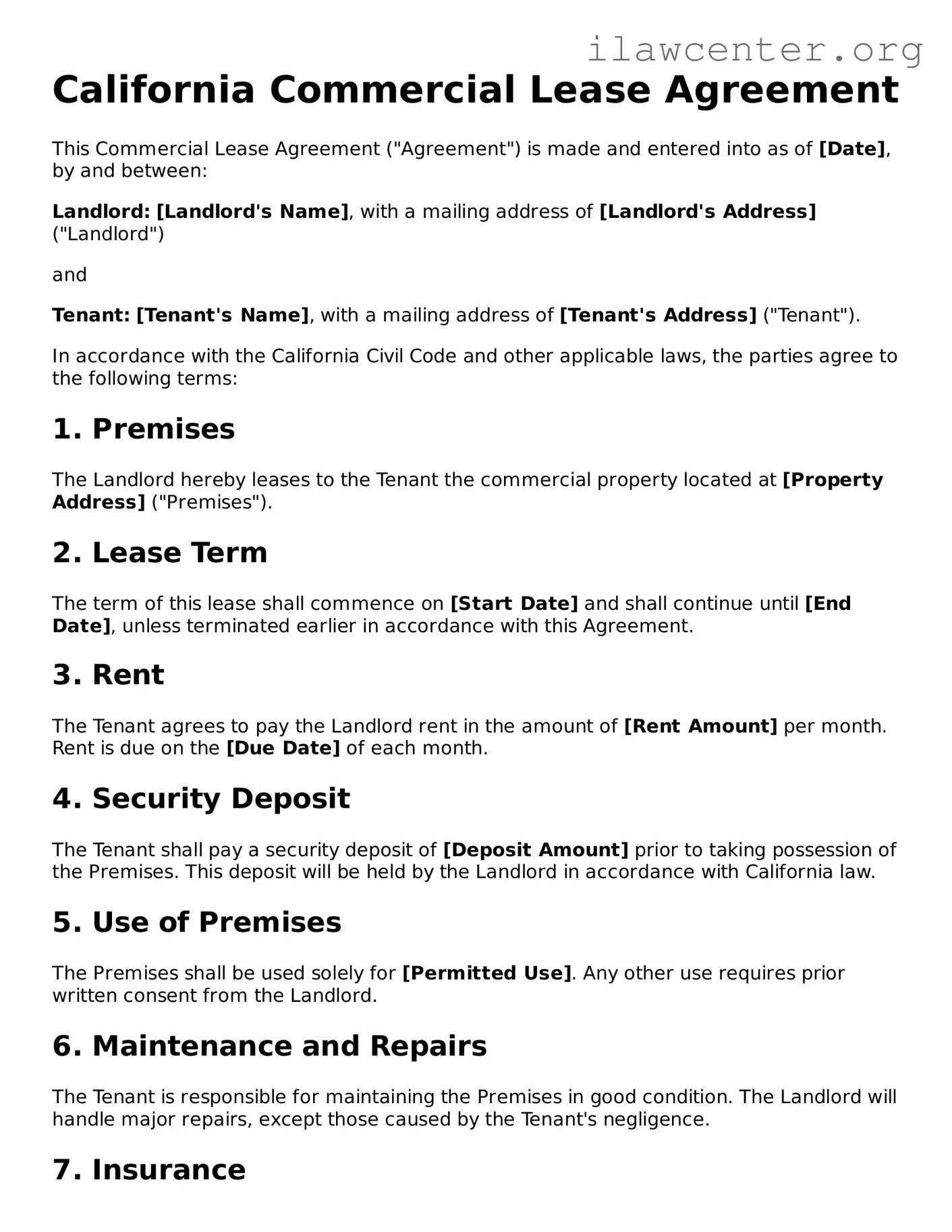
California Commercial Lease Agreement Preview

California Commercial Lease Agreement

This Commercial Lease Agreement ("Agreement") is made and entered into as of [Date], by and between:

Landlord: [Landlord's Name], with a mailing address of [Landlord's Address] ("Landlord")

and

Tenant: [Tenant's Name], with a mailing address of [Tenant's Address] ("Tenant").

In accordance with the California Civil Code and other applicable laws, the parties agree to the following terms:

1. Premises

The Landlord hereby leases to the Tenant the commercial property located at [Property Address] ("Premises").

2. Lease Term

The term of this lease shall commence on [Start Date] and shall continue until [End Date], unless terminated earlier in accordance with this Agreement.

3. Rent

The Tenant agrees to pay the Landlord rent in the amount of [Rent Amount] per month. Rent is due on the [Due Date] of each month.

4. Security Deposit

The Tenant shall pay a security deposit of [Deposit Amount] prior to taking possession of the Premises. This deposit will be held by the Landlord in accordance with California law.

5. Use of Premises

The Premises shall be used solely for [Permitted Use]. Any other use requires prior written consent from the Landlord.

6. Maintenance and Repairs

The Tenant is responsible for maintaining the Premises in good condition. The Landlord will handle major repairs, except those caused by the Tenant's negligence.

7. Insurance

The Tenant must maintain general liability insurance covering the Premises. Proof of insurance must be provided to the Landlord upon request.

8. Termination

Either party may terminate this Agreement by providing [Notice Period] written notice to the other party. Reasons for termination include:

  • Failure to pay rent.
  • Violation of lease terms.
  • Mutual agreement to terminate.

9. Governing Law

This Agreement shall be governed by the laws of the State of California.

10. Signatures

By signing below, both parties agree to the terms outlined in this Commercial Lease Agreement.

Landlord Signature: ___________________________ Date: ________________

Tenant Signature: ___________________________ Date: ________________

PDF Form Characteristics

Fact Name Description
Governing Law The California Commercial Lease Agreement is governed by California state law, specifically the California Civil Code.
Purpose This form is used to outline the terms and conditions of leasing commercial property in California.
Parties Involved The agreement typically involves a landlord (lessor) and a tenant (lessee), both of whom must be identified in the document.
Lease Duration The lease duration can vary and should be clearly stated in the agreement, including any renewal options.
Rent Payment Terms Details regarding rent amount, payment schedule, and acceptable payment methods must be included in the lease.
Maintenance Responsibilities The agreement should specify the responsibilities of both parties regarding property maintenance and repairs.

Instructions on Utilizing California Commercial Lease Agreement

Filling out the California Commercial Lease Agreement form requires careful attention to detail. This document outlines the terms and conditions of the lease between the landlord and the tenant. Proper completion of the form is essential for establishing a clear understanding of the responsibilities and rights of both parties.

  1. Begin by entering the date at the top of the form.
  2. Provide the full name and address of the landlord.
  3. Enter the full name and address of the tenant.
  4. Specify the property address that is being leased.
  5. Indicate the term of the lease, including the start and end dates.
  6. Detail the amount of rent, including the payment schedule and any late fees.
  7. List any security deposit requirements, including the amount and conditions for return.
  8. Outline the permitted use of the property, including any restrictions.
  9. Include any maintenance responsibilities for both the landlord and tenant.
  10. Specify any additional terms or conditions that apply to the lease.
  11. Ensure both parties sign and date the agreement.

After completing the form, both the landlord and tenant should retain a copy for their records. This ensures that both parties have access to the agreed-upon terms throughout the lease period.

Important Facts about California Commercial Lease Agreement

What is a California Commercial Lease Agreement?

A California Commercial Lease Agreement is a legal document that outlines the terms and conditions under which a landlord rents commercial property to a tenant. This agreement typically includes details about the rental amount, lease duration, property use, and responsibilities of both parties.

What types of properties can be leased with this agreement?

This agreement can be used for various types of commercial properties, including office spaces, retail stores, warehouses, and industrial sites. Each property type may have specific considerations that should be addressed in the lease.

How long is a typical commercial lease?

The duration of a commercial lease can vary widely. Common lease terms range from one year to five years, but longer leases are also possible. The length often depends on the type of business and the needs of both the landlord and tenant.

What are the key components of a commercial lease?

A typical commercial lease includes the following key components: the names of the landlord and tenant, property description, lease term, rent amount, payment due dates, security deposit details, maintenance responsibilities, and termination clauses. Each of these elements plays a crucial role in defining the relationship between the parties.

What is the security deposit, and how much is it?

The security deposit is an amount paid upfront by the tenant to protect the landlord against potential damages or unpaid rent. In California, there is no set limit on the amount for commercial leases, but it is common for landlords to request one to three months' rent as a security deposit.

Can the lease be modified after signing?

Yes, a commercial lease can be modified after it has been signed, but both parties must agree to the changes. It’s essential to document any modifications in writing to ensure clarity and avoid disputes in the future.

What happens if the tenant needs to break the lease early?

If a tenant needs to break the lease early, they may be subject to penalties as outlined in the lease agreement. This could include forfeiting the security deposit or paying a fee. It’s important to review the lease terms regarding early termination to understand the potential consequences.

Are there any restrictions on how the property can be used?

Yes, the lease will typically specify how the property can be used. For example, a retail space may have restrictions on the type of merchandise sold. Tenants should ensure that their intended use aligns with the lease terms before signing.

What should I do if there is a dispute between the landlord and tenant?

If a dispute arises, the first step is to review the lease agreement for guidance. Many leases include a dispute resolution process. If necessary, mediation or legal action may be pursued, but it’s often best to try to resolve issues amicably first.

Can I sublease the commercial property?

Subleasing may be allowed, but it typically requires the landlord's approval. The lease agreement should outline the conditions under which subleasing is permitted. Tenants should always seek consent from the landlord before entering into a sublease arrangement.
Common mistakes

Filling out a California Commercial Lease Agreement can be a daunting task. Many people make common mistakes that can lead to misunderstandings or legal issues down the line. One frequent error is not clearly defining the lease term. It’s crucial to specify the start and end dates. Leaving this information vague can create confusion about when the lease actually begins and ends.

Another mistake is overlooking the details of the rental payment structure. Rent should be clearly stated, including the amount, due date, and acceptable payment methods. If these details are not explicitly outlined, it may lead to disputes over payment expectations.

Many individuals also fail to address maintenance responsibilities in the lease. It’s important to clarify who is responsible for repairs and maintenance. Not doing so can result in unexpected costs and disagreements between the landlord and tenant.

Additionally, people often neglect to include clauses related to termination and renewal. Clearly outlining the conditions under which the lease can be terminated or renewed is essential. This helps both parties understand their rights and obligations if they wish to end or extend the lease.

Another common oversight is not including a provision for alterations or improvements to the property. Tenants may want to make changes to suit their business needs, but without proper permission outlined in the lease, they could face penalties or be required to restore the property to its original condition.

Lastly, many individuals do not take the time to review the entire agreement before signing. This can lead to agreeing to terms that are unfavorable or not fully understood. It’s always wise to read through the document carefully and seek clarification on any confusing points before finalizing the lease.

Documents used along the form

When entering into a commercial lease in California, various forms and documents may be necessary to ensure a smooth transaction. Each document serves a specific purpose and helps protect the interests of both the landlord and tenant. Below is a list of commonly used forms alongside the California Commercial Lease Agreement.

  • Letter of Intent (LOI): This document outlines the preliminary terms of the lease agreement. It serves as a starting point for negotiations and is not legally binding.
  • Commercial Lease Addendum: An addendum can modify or add specific terms to the original lease agreement. This is useful for addressing unique circumstances or requirements.
  • Personal Guarantee: This document is often required from business owners to guarantee the lease. It holds the individual personally responsible for fulfilling the lease obligations if the business fails.
  • Security Deposit Receipt: This form acknowledges the receipt of the security deposit from the tenant. It details the amount and conditions under which the deposit may be withheld or returned.
  • Tenant Application: Landlords may require potential tenants to complete an application. This form collects necessary information for credit and background checks.
  • Property Condition Report: This document records the condition of the property before the tenant moves in. It helps prevent disputes over damages at the end of the lease.
  • Lease Assignment Agreement: If a tenant wishes to transfer their lease to another party, this agreement outlines the terms of the assignment and the responsibilities of all parties involved.
  • Sublease Agreement: A sublease allows a tenant to rent out part or all of the leased space to another party. This document specifies the terms and conditions of the sublease arrangement.
  • Notice of Default: This form is used by landlords to notify tenants of a breach of lease terms. It outlines the specific issues and provides a timeframe for resolution.

Understanding these documents can help both landlords and tenants navigate the complexities of commercial leasing in California. Proper documentation ensures clarity and can prevent misunderstandings throughout the lease term.

Similar forms

  • Residential Lease Agreement: Similar to a commercial lease, this document outlines the terms under which a landlord rents a residential property to a tenant. Both agreements specify the rental amount, duration of the lease, and responsibilities of each party.
  • Sublease Agreement: This document allows a tenant to rent out a property they are leasing to another party. Like a commercial lease, it details the terms of the rental and requires the original landlord's consent.
  • Rental Agreement: Often used interchangeably with a lease, a rental agreement can be for short-term rentals. Both documents define the rental terms, although rental agreements may be more flexible regarding duration.
  • Commercial Purchase Agreement: This document is used when a buyer agrees to purchase commercial property. Similar to a lease, it outlines the terms of the transaction, including price and contingencies.
  • Property Management Agreement: This document details the relationship between a property owner and a management company. It shares similarities with a lease in that it outlines responsibilities and obligations related to the property.
  • Joint Venture Agreement: Used when two or more parties collaborate on a business project, this document can include terms related to property use, similar to how a commercial lease outlines terms for property usage.
  • Real Estate Option Agreement: This document gives a potential buyer the right to purchase property at a later date. Like a lease, it specifies terms and conditions, including price and duration of the option.
  • Lease Purchase Agreement: This combines elements of a lease and a purchase agreement, allowing a tenant to lease a property with the option to buy. It shares similarities with a commercial lease in its structure and terms.
  • Tenancy Agreement: This is a broad term that encompasses both residential and commercial leases. It establishes the rights and responsibilities of both the landlord and tenant, similar to a commercial lease.
  • License Agreement: This document allows one party to use another's property under specific conditions. While it is not a lease, it shares similarities in defining usage rights and obligations.

Dos and Don'ts

When filling out the California Commercial Lease Agreement form, it's important to approach the task with care. Here’s a list of what to do and what to avoid:

  • Do read the entire agreement carefully before filling it out.
  • Do provide accurate information for all parties involved.
  • Do clarify any terms you do not understand with a professional.
  • Do keep a copy of the completed agreement for your records.
  • Don't rush through the form or skip sections.
  • Don't use vague language or terms that could lead to misunderstandings.
  • Don't ignore deadlines for submission or signatures.
  • Don't forget to check for any required attachments or additional documentation.

Misconceptions

Understanding the California Commercial Lease Agreement can be challenging. Here are four common misconceptions that often arise:

  • All commercial leases are the same. Many believe that all commercial leases follow a standard format. In reality, each lease can vary significantly based on the specific terms negotiated between the landlord and tenant.
  • Only the rent amount is negotiable. Some people think that only the rent is open for negotiation. However, many other terms, such as maintenance responsibilities, lease duration, and renewal options, can also be discussed and modified.
  • Signing a lease means you cannot make changes. It is a common belief that once a lease is signed, no changes can be made. In fact, amendments can often be negotiated and added to the lease as long as both parties agree.
  • Commercial leases are always longer than residential leases. Many assume that commercial leases must be for longer terms than residential leases. While commercial leases can be longer, they can also be quite short, depending on the needs of the business and the agreement between the parties.

Key takeaways

When dealing with the California Commercial Lease Agreement form, it is essential to understand several key aspects that can significantly impact both landlords and tenants. Below are some important takeaways to keep in mind:

  • Understand the Terms: Familiarize yourself with the specific terms and conditions outlined in the lease. This includes the duration of the lease, rent amount, and any renewal options.
  • Review Maintenance Responsibilities: Clarify who is responsible for maintenance and repairs. This can prevent disputes later on and ensure that both parties know their obligations.
  • Negotiate Rent Increases: Discuss any potential rent increases during the lease term. Understanding how these increases will be calculated is crucial for financial planning.
  • Examine the Use Clause: Pay close attention to the use clause, which specifies how the property can be used. Ensure that your intended use aligns with what is permitted in the lease.
  • Consider Termination Conditions: Be aware of the conditions under which the lease can be terminated. Knowing the exit strategies available can provide peace of mind.
  • Seek Legal Advice: It is often beneficial to consult with a legal professional before signing the lease. They can help clarify any confusing terms and protect your interests.

By keeping these points in mind, both landlords and tenants can navigate the complexities of the California Commercial Lease Agreement more effectively.