Attorney-Verified  Divorce Settlement Agreement Document for California

Attorney-Verified Divorce Settlement Agreement Document for California

The California Divorce Settlement Agreement form is a legal document that outlines the terms and conditions agreed upon by both parties during a divorce proceeding. This form addresses various aspects, including property division, child custody, and support obligations, ensuring that both individuals understand their rights and responsibilities. To facilitate your divorce process, consider filling out the form by clicking the button below.

Article Guide

When navigating the emotional and often complex process of divorce, one crucial document stands out: the California Divorce Settlement Agreement form. This form serves as a comprehensive outline of the agreements made between both parties regarding various aspects of their separation. It typically addresses key issues such as the division of property and debts, child custody arrangements, child support, and spousal support. By clearly detailing these agreements, the form helps ensure that both parties have a mutual understanding and can avoid potential disputes in the future. Filling out this form accurately is essential, as it becomes part of the court record and can significantly impact the final judgment. Understanding its components can empower individuals to make informed decisions during a challenging time, paving the way for a smoother transition into post-divorce life.

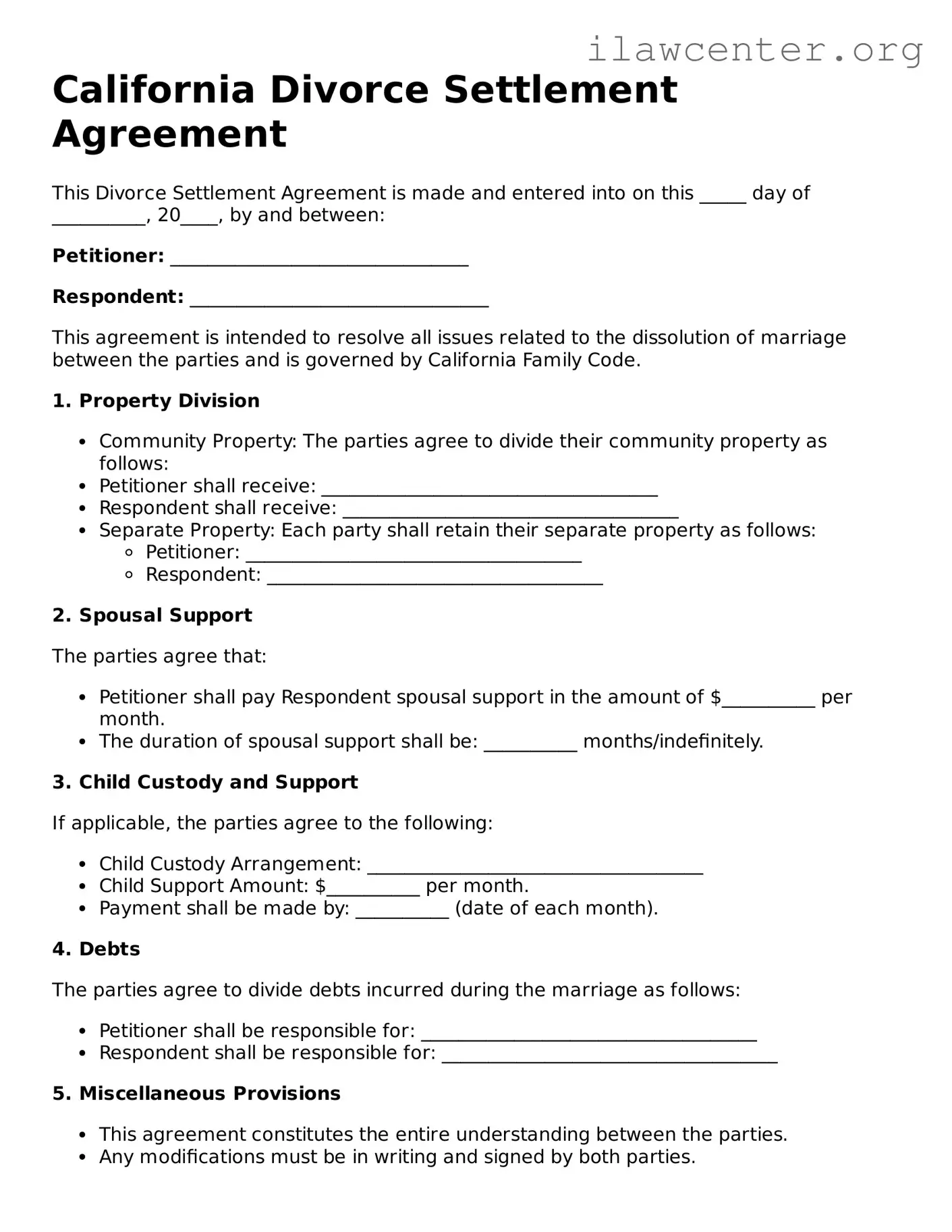
California Divorce Settlement Agreement Preview

California Divorce Settlement Agreement

This Divorce Settlement Agreement is made and entered into on this _____ day of __________, 20____, by and between:

Petitioner: ________________________________

Respondent: ________________________________

This agreement is intended to resolve all issues related to the dissolution of marriage between the parties and is governed by California Family Code.

1. Property Division

  • Community Property: The parties agree to divide their community property as follows:
  • Petitioner shall receive: ____________________________________
  • Respondent shall receive: ____________________________________
  • Separate Property: Each party shall retain their separate property as follows:
    • Petitioner: ____________________________________
    • Respondent: ____________________________________

2. Spousal Support

The parties agree that:

  • Petitioner shall pay Respondent spousal support in the amount of $__________ per month.
  • The duration of spousal support shall be: __________ months/indefinitely.

3. Child Custody and Support

If applicable, the parties agree to the following:

  • Child Custody Arrangement: ____________________________________
  • Child Support Amount: $__________ per month.
  • Payment shall be made by: __________ (date of each month).

4. Debts

The parties agree to divide debts incurred during the marriage as follows:

  • Petitioner shall be responsible for: ____________________________________
  • Respondent shall be responsible for: ____________________________________

5. Miscellaneous Provisions

  • This agreement constitutes the entire understanding between the parties.
  • Any modifications must be in writing and signed by both parties.
  • This agreement shall be governed by the laws of the State of California.

IN WITNESS WHEREOF, the parties have executed this Divorce Settlement Agreement as of the date first above written.

______________________________
Petitioner Signature

______________________________
Respondent Signature

______________________________
Date

PDF Form Characteristics

Fact Name Description
Purpose The California Divorce Settlement Agreement form outlines the terms agreed upon by both parties regarding the division of assets, debts, and other matters related to the dissolution of marriage.
Governing Law This form is governed by the California Family Code, which provides the legal framework for divorce proceedings in the state.
Mandatory Use While not mandatory for all divorces, using this form is highly recommended for couples seeking to settle their divorce amicably and efficiently.
Filing Requirement The completed form must be filed with the court as part of the divorce proceedings to ensure that the settlement is legally recognized.
Modification Once filed, the terms of the agreement can only be modified by mutual consent of both parties and with court approval.

Instructions on Utilizing California Divorce Settlement Agreement

After gathering the necessary information and understanding the requirements, the next step involves filling out the California Divorce Settlement Agreement form accurately. Completing this form is essential for formalizing the terms of the divorce settlement between the parties involved.

  1. Begin by downloading the California Divorce Settlement Agreement form from the appropriate court website or obtaining a physical copy from the local courthouse.
  2. Fill in your name and contact information at the top of the form. Include your spouse's name and contact information in the designated section.
  3. Provide the date of marriage and the date of separation. Ensure that these dates are correct as they can impact various aspects of the settlement.
  4. Detail the division of property. List all assets and debts, indicating which party will receive each item. Be clear and specific.
  5. Address child custody arrangements if applicable. Specify the custody type (joint or sole) and visitation rights, if any.
  6. Outline any child support obligations. Include the amount and frequency of payments, along with any provisions for medical expenses or educational costs.
  7. Include spousal support terms if relevant. State the amount, duration, and conditions under which support will be paid.
  8. Review the form for accuracy. Ensure all sections are completed and that the information provided is correct.
  9. Sign and date the form. Ensure that your spouse also signs it if required.
  10. Make copies of the completed form for your records and for your spouse.

Once the form is filled out, it will need to be filed with the court. Depending on the circumstances, a hearing may be scheduled to finalize the divorce settlement.

Important Facts about California Divorce Settlement Agreement

What is a California Divorce Settlement Agreement?

A California Divorce Settlement Agreement is a legal document that outlines the terms of a divorce between two parties. It typically includes details about property division, child custody, child support, and spousal support. This agreement is crucial as it helps both parties come to a mutual understanding and can prevent future disputes.

How do I create a Divorce Settlement Agreement?

To create a Divorce Settlement Agreement, both parties need to discuss and negotiate the terms of their divorce. It’s important to be open and honest about your needs and expectations. Once an agreement is reached, it should be drafted in writing. While you can use templates available online, it’s often beneficial to have a lawyer review the document to ensure that it meets legal requirements and protects your rights.

Do I need a lawyer to file a Divorce Settlement Agreement?

While it is not mandatory to have a lawyer when filing a Divorce Settlement Agreement, it is highly recommended. A lawyer can provide valuable guidance, help you understand your rights, and ensure that the agreement is fair and legally binding. If both parties are in agreement and comfortable with the terms, some choose to proceed without legal representation.

What happens if we cannot agree on the terms?

If the parties cannot agree on the terms of the divorce, they may need to go to mediation or court. Mediation involves a neutral third party who helps facilitate discussions and negotiations. If mediation fails, the case may go to court, where a judge will make decisions regarding property division, custody, and support based on the evidence presented.

Can a Divorce Settlement Agreement be modified?

Yes, a Divorce Settlement Agreement can be modified, but there are specific conditions that must be met. If circumstances change significantly—such as a job loss, change in income, or a significant change in the needs of the children—either party can request a modification. However, the request must be filed with the court, and the other party must be notified.

How do I file the Divorce Settlement Agreement with the court?

To file the Divorce Settlement Agreement with the court, you will need to complete the necessary forms and submit them to the appropriate family court. It’s important to check with your local court for specific filing requirements and procedures. After filing, the court will review the agreement, and if everything is in order, it will be approved and become part of the official court record.

Common mistakes

Filling out the California Divorce Settlement Agreement form can be a daunting task. Many individuals make mistakes that can complicate the divorce process. One common error is failing to provide accurate financial information. This includes income, expenses, assets, and debts. Omitting or misrepresenting these details can lead to disputes and may affect the final settlement.

Another mistake often made is neglecting to address all relevant issues. The agreement should cover child custody, visitation, spousal support, and property division. Leaving out any of these critical components can result in misunderstandings and future legal complications.

People sometimes overlook the importance of clarity in their language. Ambiguous terms can lead to different interpretations, which can cause disputes later on. It is essential to be as clear and specific as possible when describing agreements and obligations.

Many individuals also fail to consider tax implications of their agreements. Certain decisions, such as how to divide retirement accounts or property, can have significant tax consequences. Consulting a financial advisor or tax professional can help avoid unexpected liabilities.

Additionally, some people do not properly complete the signature section. All parties involved must sign the agreement for it to be legally binding. Failing to do so can render the document ineffective and lead to further complications.

Another common oversight is not including provisions for future changes. Life circumstances can change, and it is wise to include terms that allow for modifications in the future. This foresight can save time and legal fees down the road.

People may also underestimate the importance of reviewing the agreement thoroughly. Rushing through the process can lead to mistakes that may be difficult to rectify later. Taking the time to read and understand every section is crucial.

Some individuals do not seek legal advice when needed. Even if the divorce seems amicable, consulting a legal professional can provide valuable insights and help ensure that all aspects of the agreement are fair and legally sound.

Lastly, failing to keep copies of the finalized agreement is a mistake that can lead to confusion. It is essential to retain a copy for personal records, as well as to provide copies to relevant parties, such as financial institutions or legal representatives.

Documents used along the form

When navigating the divorce process in California, several forms and documents may accompany the Divorce Settlement Agreement. Each of these documents serves a specific purpose and helps ensure that all aspects of the divorce are addressed. Below is a list of commonly used forms that may be relevant.

  • Petition for Dissolution of Marriage: This document initiates the divorce process. It outlines the basic information about the marriage and requests the court to end the marriage.
  • Response to Petition: If one spouse files a petition, the other spouse must respond. This document acknowledges receipt of the petition and states the respondent's position regarding the divorce.
  • Financial Disclosure Declaration: This form requires both parties to disclose their financial information, including income, expenses, assets, and debts. Transparency is crucial for equitable division of property and support.
  • Child Custody and Visitation Agreement: If children are involved, this document outlines the custody arrangement and visitation schedule agreed upon by both parents.
  • Child Support Order: This form specifies the financial support one parent will provide to the other for the care of their children. It includes the amount and frequency of payments.
  • Spousal Support Order: Similar to child support, this document details any financial support one spouse will provide to the other after the divorce, including the amount and duration.
  • Property Settlement Agreement: This agreement details how the couple will divide their assets and debts. It is an essential part of the divorce settlement.
  • Judgment of Dissolution of Marriage: Once the court approves the divorce settlement, this document finalizes the divorce and outlines the terms agreed upon by both parties.

Understanding these documents can facilitate a smoother divorce process. Each form plays a significant role in ensuring that both parties' rights and responsibilities are clearly defined and agreed upon. It is advisable to approach these forms with care and attention to detail.

Similar forms

  • Separation Agreement: This document outlines the terms agreed upon by both parties during a separation. Like a Divorce Settlement Agreement, it addresses issues such as property division, child custody, and support payments.
  • Child Custody Agreement: This document specifically focuses on the custody arrangements for children. It details living arrangements, visitation schedules, and decision-making responsibilities, similar to the custody provisions in a Divorce Settlement Agreement.
  • Property Settlement Agreement: This agreement deals with the division of assets and debts between spouses. It serves a similar purpose as the property division section of a Divorce Settlement Agreement.
  • Marital Settlement Agreement: This document is often used interchangeably with a Divorce Settlement Agreement. It covers the same topics, including spousal support, asset division, and child support.
  • Prenuptial Agreement: While created before marriage, this document outlines the financial arrangements and expectations for each party. It can influence the terms of a Divorce Settlement Agreement if the marriage ends.
  • Postnuptial Agreement: Similar to a prenuptial agreement, this document is created after marriage. It addresses financial matters and can be referenced in a Divorce Settlement Agreement.
  • Consent Order: This is a court order that formalizes an agreement between parties. It can include terms related to child custody and support, mirroring aspects of a Divorce Settlement Agreement.

Dos and Don'ts

When filling out the California Divorce Settlement Agreement form, it's important to approach the process carefully. Here are some key things to keep in mind:

  • Do read the entire form thoroughly before starting. Understanding each section will help you fill it out correctly.
  • Don't rush through the process. Take your time to ensure all information is accurate.
  • Do provide complete and honest information. Transparency is crucial for a smooth settlement.
  • Don't leave any sections blank unless instructed. If a section doesn't apply, write "N/A" to indicate it.
  • Do double-check your calculations. Mistakes in financial information can lead to complications later.
  • Don't forget to sign and date the form. An unsigned form may be considered invalid.

Following these guidelines can help ensure that your Divorce Settlement Agreement is filled out properly and efficiently.

Misconceptions

When navigating the California Divorce Settlement Agreement form, individuals often hold misconceptions that can lead to confusion. Here are five common misconceptions:

  • 1. The form is only for couples with children. Many people believe that the Divorce Settlement Agreement is only necessary for couples who have children. In reality, this form is relevant for any couple seeking to formalize the terms of their divorce, regardless of whether children are involved.
  • 2. Once signed, the agreement cannot be changed. Some individuals think that once they sign the Divorce Settlement Agreement, it is set in stone. While it is a binding document, parties can modify the agreement if both spouses agree to the changes and follow the proper legal procedures.
  • 3. The form covers all financial issues automatically. There is a misconception that the Divorce Settlement Agreement automatically addresses all financial matters, such as debts and assets. However, it is essential for both parties to explicitly outline these details within the form to ensure clarity and avoid future disputes.
  • 4. Legal representation is unnecessary. Many believe that they can fill out the Divorce Settlement Agreement without legal help. While it is possible to complete the form independently, having legal representation can provide guidance and ensure that the agreement meets all legal requirements.
  • 5. The agreement is only necessary for court approval. Some individuals think that the Divorce Settlement Agreement is only needed for court approval. In fact, this document is crucial for both parties to understand their rights and obligations, even if they do not plan to go to court.

Understanding these misconceptions can help individuals navigate the divorce process more effectively and ensure that their rights are protected.

Key takeaways

When navigating the California Divorce Settlement Agreement form, it's essential to keep several key points in mind. This document plays a crucial role in finalizing your divorce and addressing various aspects of your life post-divorce. Here are some important takeaways:

  • Understand the Purpose: The Divorce Settlement Agreement outlines the terms of your divorce, including asset division, child custody, and support obligations.
  • Complete All Sections: Ensure that every section of the form is filled out accurately. Incomplete forms can lead to delays or complications in the divorce process.
  • Be Clear and Concise: Use straightforward language to describe your agreements. Clarity helps prevent misunderstandings between both parties.
  • Consider Future Needs: Think about how your agreements will affect your future. For example, child support amounts may need to be adjusted as circumstances change.
  • Seek Legal Advice: Consulting with a legal professional can provide valuable insights. They can help you understand your rights and ensure that your agreement is fair and enforceable.
  • File with the Court: After completing the agreement, submit it to the court for approval. This step is crucial to make your divorce settlement legally binding.

By keeping these points in mind, you can navigate the Divorce Settlement Agreement process with greater confidence and clarity.