Attorney-Verified  Land Purchase Agreement Document for California

Attorney-Verified Land Purchase Agreement Document for California

The California Land Purchase Agreement form is a legal document that outlines the terms and conditions for buying and selling real estate in California. This agreement serves to protect both the buyer and seller by clearly defining the responsibilities and expectations of each party involved in the transaction. To ensure a smooth process, it’s essential to fill out this form accurately and completely—click the button below to get started!

Article Guide

In the dynamic landscape of real estate transactions in California, the Land Purchase Agreement form plays a pivotal role in facilitating the sale and purchase of land. This essential document outlines the terms and conditions agreed upon by both the buyer and the seller, ensuring that each party understands their rights and obligations. Key components of the agreement include the purchase price, payment terms, contingencies, and the timeline for closing the transaction. Additionally, the form addresses any disclosures required by law, such as environmental concerns or zoning regulations, which can significantly impact the buyer's decision. By clearly delineating the responsibilities of each party, the Land Purchase Agreement helps to mitigate disputes and foster a smoother transaction process. Understanding this form is crucial for anyone looking to navigate the complexities of land acquisition in California, providing a structured approach to what can often be a daunting endeavor.

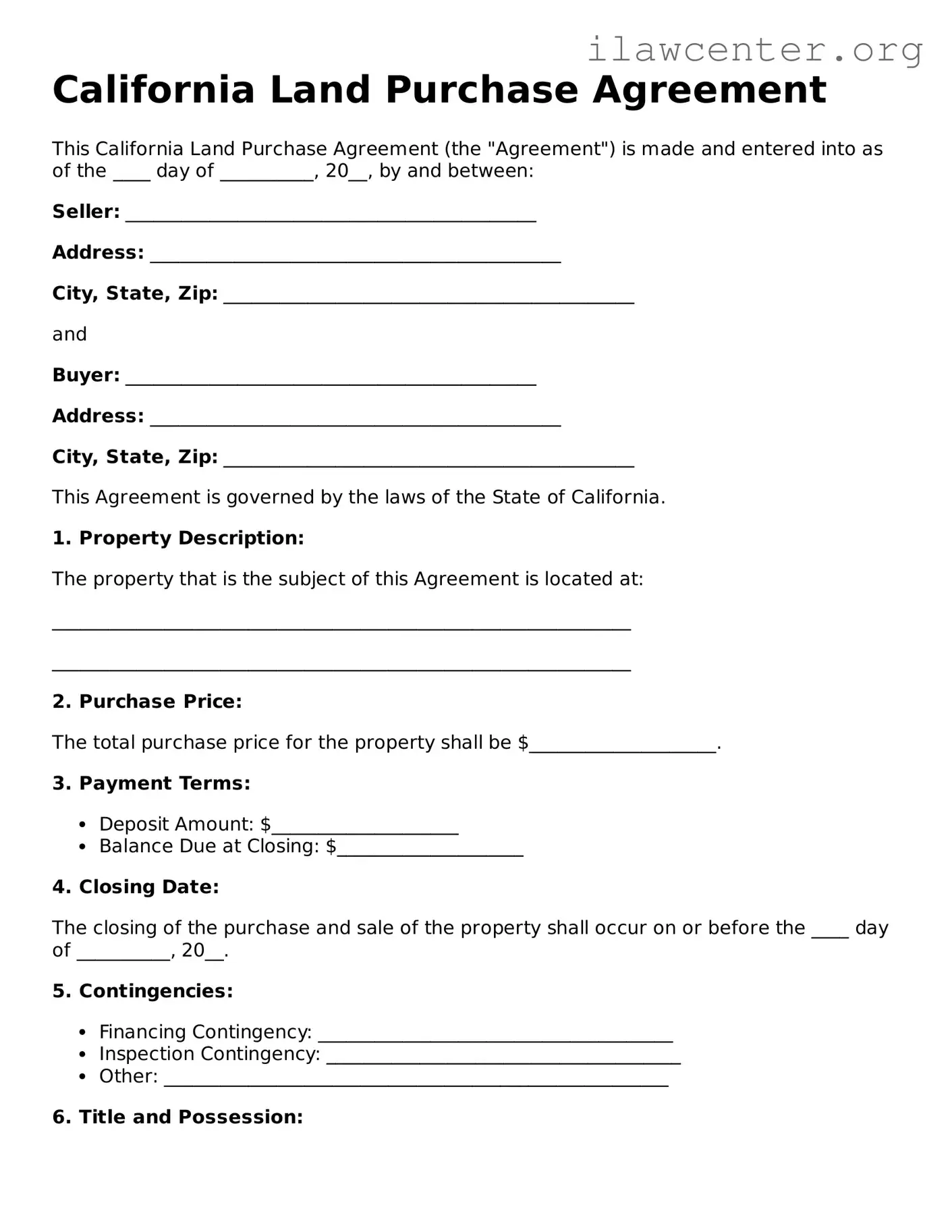
California Land Purchase Agreement Preview

California Land Purchase Agreement

This California Land Purchase Agreement (the "Agreement") is made and entered into as of the ____ day of __________, 20__, by and between:

Seller: ____________________________________________

Address: ____________________________________________

City, State, Zip: ____________________________________________

and

Buyer: ____________________________________________

Address: ____________________________________________

City, State, Zip: ____________________________________________

This Agreement is governed by the laws of the State of California.

1. Property Description:

The property that is the subject of this Agreement is located at:

______________________________________________________________

______________________________________________________________

2. Purchase Price:

The total purchase price for the property shall be $____________________.

3. Payment Terms:

  • Deposit Amount: $____________________
  • Balance Due at Closing: $____________________

4. Closing Date:

The closing of the purchase and sale of the property shall occur on or before the ____ day of __________, 20__.

5. Contingencies:

  • Financing Contingency: ______________________________________
  • Inspection Contingency: ______________________________________
  • Other: ______________________________________________________

6. Title and Possession:

The Seller agrees to convey good and marketable title to the Buyer at closing. Possession of the property shall be delivered to the Buyer on the closing date.

7. Default:

In the event of default by either party, the non-defaulting party may pursue all remedies available under California law.

8. Governing Law:

This Agreement shall be governed by and construed in accordance with the laws of the State of California.

9. Signatures:

IN WITNESS WHEREOF, the parties hereto have executed this Agreement as of the day and year first above written.

______________________________

Seller's Signature

______________________________

Buyer's Signature

______________________________

Date

PDF Form Characteristics

Fact Name Description
Governing Law The California Land Purchase Agreement is governed by California state law.
Purpose This form is used to outline the terms and conditions of a land purchase in California.
Parties Involved The agreement typically includes the buyer and the seller as the main parties.
Property Description A detailed description of the property being purchased must be included.
Purchase Price The total purchase price for the property is clearly stated in the agreement.
Deposit Requirements The form outlines any deposit required to secure the purchase.
Closing Date A specific closing date for the transaction is usually included.
Contingencies The agreement may include contingencies that must be met before closing.
Signatures Both parties must sign the agreement to make it legally binding.
Dispute Resolution The form may specify how disputes will be resolved, such as through mediation or arbitration.

Instructions on Utilizing California Land Purchase Agreement

Completing the California Land Purchase Agreement form is an important step in the property buying process. After filling out the form, it will need to be reviewed and signed by all parties involved to ensure a smooth transaction.

  1. Obtain the California Land Purchase Agreement form from a reliable source.
  2. Begin by entering the date at the top of the form.
  3. Fill in the names and addresses of both the buyer and seller in the designated sections.
  4. Provide a detailed description of the property being purchased, including the address and any relevant parcel numbers.
  5. Specify the purchase price in the appropriate field.
  6. Indicate the amount of the deposit, if applicable, and the terms of payment.
  7. Outline any contingencies that may apply, such as financing or inspections.
  8. Include the closing date, which is the date when the transaction will be finalized.
  9. Review the entire form for accuracy and completeness.
  10. Sign and date the form where indicated, and ensure the seller does the same.

Important Facts about California Land Purchase Agreement

What is a California Land Purchase Agreement?

A California Land Purchase Agreement is a legal document that outlines the terms and conditions under which one party agrees to sell a piece of land to another party. This agreement includes details such as the purchase price, payment terms, and any contingencies that must be met before the sale can be finalized.

Who typically uses a Land Purchase Agreement?

Both buyers and sellers of land in California use this agreement. Buyers want to ensure that their rights are protected and that they understand the terms of the purchase. Sellers use it to formalize the sale and protect their interests throughout the transaction.

What are the key components of a Land Purchase Agreement?

Key components include the names of the buyer and seller, a description of the property, the purchase price, payment terms, contingencies, and the closing date. Additionally, it may include provisions for inspections, disclosures, and any warranties or representations made by the seller.

Is a Land Purchase Agreement legally binding?

Yes, once both parties sign the agreement, it becomes a legally binding contract. This means that both the buyer and seller are obligated to adhere to the terms outlined in the document. If either party fails to comply, the other may have legal recourse.

Do I need a lawyer to create a Land Purchase Agreement?

While it is not legally required to have a lawyer draft a Land Purchase Agreement, it is highly recommended. A legal professional can help ensure that the agreement complies with California laws and adequately protects your interests.

What happens if the buyer fails to secure financing?

If the buyer cannot secure financing, the agreement may include a contingency clause that allows them to back out without penalty. However, if no such clause exists, the seller may have the right to retain the buyer's deposit or pursue other legal remedies.

Can a Land Purchase Agreement be modified after it is signed?

Yes, a Land Purchase Agreement can be modified after it is signed, but both parties must agree to the changes. Any modifications should be documented in writing and signed by both the buyer and seller to ensure clarity and enforceability.

What is the typical timeline for closing a land sale?

The timeline for closing a land sale can vary, but it typically ranges from 30 to 60 days after the agreement is signed. This period allows time for inspections, financing, and any necessary paperwork to be completed.

Are there any specific disclosures required in California?

Yes, California law requires sellers to provide certain disclosures to buyers, including information about the property's condition, any known defects, and any environmental hazards. These disclosures help buyers make informed decisions before finalizing the purchase.

What should I do if I have disputes regarding the Land Purchase Agreement?

If disputes arise, it is advisable to first attempt to resolve the issue through open communication between both parties. If that does not work, mediation or arbitration may be options. As a last resort, legal action may be necessary to enforce the terms of the agreement.
Common mistakes

Filling out the California Land Purchase Agreement form can be a straightforward process, but many people make common mistakes that can lead to complications down the line. One of the most frequent errors is failing to provide accurate property descriptions. A vague or incomplete description can create confusion and disputes later. It’s essential to include the correct address, parcel number, and any relevant details that clearly identify the property being purchased.

Another mistake is neglecting to specify the purchase price clearly. While it may seem obvious, leaving this section ambiguous can lead to misunderstandings between the buyer and seller. Both parties should agree on a precise amount and ensure it is prominently stated in the agreement. This clarity helps prevent any potential disagreements during the transaction.

Buyers often overlook the importance of including contingencies in the agreement. Contingencies are conditions that must be met for the sale to proceed. For instance, a buyer might want to include a contingency for obtaining financing or completing a satisfactory inspection. Without these provisions, buyers may find themselves locked into a deal that doesn't meet their needs.

Inadequate signatures are another common pitfall. All parties involved in the transaction must sign the agreement for it to be legally binding. Sometimes, individuals forget to sign or fail to include the date of their signature. This oversight can render the agreement invalid, leading to complications in the sale process.

Additionally, many people neglect to review the terms of the agreement thoroughly. It’s crucial to read every clause and understand the implications of the terms being agreed upon. Rushing through this process can result in accepting unfavorable conditions that could have been negotiated or avoided.

Another frequent error is failing to include necessary disclosures. California law requires sellers to disclose specific information about the property, such as known defects or issues. Buyers should ensure that these disclosures are included in the agreement to protect their interests and avoid surprises after the purchase.

People also often forget to include the closing date. This detail is vital as it sets a timeline for the transaction. Without a specified closing date, parties may have different expectations, which can lead to frustration and delays.

Lastly, not seeking legal advice can be a significant mistake. While the form may seem straightforward, real estate transactions can be complex. Consulting with a legal professional can provide valuable insights and help ensure that the agreement is filled out correctly and protects your interests.

Documents used along the form

When entering into a land purchase agreement in California, several other forms and documents may be needed to ensure a smooth transaction. Each of these documents serves a specific purpose and helps protect the interests of both the buyer and the seller. Here’s a list of commonly used forms that complement the California Land Purchase Agreement.

  • Disclosure Statement: This document informs the buyer about any known issues with the property, such as structural problems or environmental hazards. Transparency is key in real estate transactions.
  • Title Report: A title report shows the legal ownership of the property and any liens or encumbrances. It helps ensure that the seller has the right to sell the property.
  • Purchase Offer: This is the initial offer made by the buyer to the seller. It outlines the proposed purchase price and terms of the sale.
  • Counteroffer: If the seller does not accept the initial purchase offer, they may respond with a counteroffer. This document outlines the seller's terms and conditions for the sale.
  • Escrow Agreement: This document outlines the terms of the escrow process, where a neutral third party holds funds and documents until the transaction is complete.
  • Deed: The deed is the legal document that transfers ownership of the property from the seller to the buyer. It must be recorded with the county to be effective.
  • Closing Statement: This statement details all financial transactions involved in the sale, including costs, fees, and the final amount the buyer must pay.
  • Home Inspection Report: Buyers often request a home inspection to assess the condition of the property. This report can reveal issues that may need to be addressed before the sale is finalized.
  • Loan Documents: If the buyer is financing the purchase, various loan documents will be needed. These include the loan application, promissory note, and mortgage agreement.
  • Affidavit of Title: This document is a sworn statement from the seller confirming their ownership of the property and that there are no undisclosed claims against it.

Having these documents in place can help streamline the process of buying land in California. Each one plays a vital role in ensuring that the transaction is fair and legally sound. It’s always a good idea to consult with a real estate professional or legal advisor to ensure that everything is handled properly.

Similar forms

  • Purchase Agreement: Similar to a Land Purchase Agreement, this document outlines the terms and conditions for buying a property. It includes details like the purchase price, closing date, and contingencies.
  • Real Estate Sales Contract: This contract serves a similar purpose, detailing the sale of real estate. It specifies the responsibilities of both the buyer and seller, ensuring clarity in the transaction.
  • Lease Agreement: While primarily for renting, a lease agreement can share similarities with a land purchase agreement, particularly when it includes an option to buy the property at the end of the lease term.
  • Option to Purchase Agreement: This document grants the buyer the right to purchase the property at a later date. It outlines the terms under which the buyer can exercise this option, similar to a land purchase agreement.
  • Deed: A deed transfers ownership of property from one party to another. It complements the land purchase agreement by formalizing the transfer of title once the sale is complete.
  • Title Report: This document provides information about the property’s ownership history and any liens or encumbrances. It is often referenced in a land purchase agreement to ensure clear title.
  • Disclosure Statement: Sellers may provide this document to inform buyers of any known issues with the property. It is crucial for buyers to understand potential problems before finalizing the purchase.
  • Closing Statement: This document summarizes the financial aspects of the sale at closing. It details all costs, fees, and credits involved, ensuring both parties are clear on the final financial obligations.

Dos and Don'ts

When filling out the California Land Purchase Agreement form, consider the following guidelines to ensure a smooth process.

Things You Should Do:

  • Read the entire agreement carefully before filling it out.
  • Provide accurate and complete information about the property.
  • Include all necessary details regarding the buyer and seller.
  • Consult with a real estate professional if you have questions.
  • Sign and date the form where required.

Things You Shouldn't Do:

  • Do not leave any sections blank unless instructed.
  • Avoid using abbreviations or shorthand that may cause confusion.
  • Do not provide false information, as it can lead to legal issues.
  • Refrain from making changes without proper documentation.

Misconceptions

When dealing with real estate transactions in California, misunderstandings about the Land Purchase Agreement form can lead to confusion and potential issues. Here are six common misconceptions:

  1. It is a legally binding document from the start.

    Many believe that simply signing the Land Purchase Agreement makes it legally binding. However, this is not always the case. The agreement often requires additional conditions to be met, such as the completion of inspections or financing arrangements.

  2. All terms are negotiable.

    While many terms can be negotiated, not all are flexible. Certain legal requirements and standard practices must be adhered to, which can limit the scope of negotiation.

  3. The form is the same for all types of properties.

    This form may vary based on the type of property involved, such as residential versus commercial real estate. Each type has specific considerations that can affect the terms included in the agreement.

  4. Once signed, the buyer cannot back out.

    Buyers often think that signing the agreement locks them in. However, most agreements include contingencies that allow buyers to withdraw under certain circumstances, such as failing to secure financing.

  5. It does not require legal review.

    Some individuals assume that the Land Purchase Agreement is straightforward enough to forgo legal review. In reality, having an attorney review the agreement can help identify potential issues and protect the buyer's interests.

  6. All parties must sign the same document.

    Many think that all parties involved must sign a single copy of the agreement. In practice, it is common for parties to sign separate copies, as long as all signatures are collected and the terms are consistent across documents.

Understanding these misconceptions can help individuals navigate the complexities of real estate transactions more effectively.

Key takeaways

When it comes to filling out and using the California Land Purchase Agreement form, there are several important considerations to keep in mind. Here are some key takeaways:

  • Understand the Purpose: The California Land Purchase Agreement is a legal document that outlines the terms and conditions of the sale of real estate. It serves to protect both the buyer and the seller.
  • Provide Accurate Information: Ensure that all information entered into the form is accurate and complete. This includes details about the property, the parties involved, and the sale price.
  • Review Contingencies: Pay attention to any contingencies included in the agreement. These are conditions that must be met for the sale to proceed, such as financing or inspections.
  • Consult with Professionals: It’s advisable to consult with a real estate agent or attorney before finalizing the agreement. Their expertise can help clarify any uncertainties.
  • Signatures Matter: Make sure all parties involved sign the agreement. An unsigned agreement may not be enforceable, so this step is crucial.
  • Keep Copies: After completing the agreement, keep copies for your records. Having a signed copy can be important for future reference or disputes.