Attorney-Verified  Lease Agreement Document for California

Attorney-Verified Lease Agreement Document for California

A California Lease Agreement form is a legally binding document that outlines the terms and conditions between a landlord and a tenant for renting residential or commercial property. This form serves to protect the rights of both parties while clearly defining obligations, payment terms, and other essential details. To ensure compliance with California laws and to facilitate a smooth leasing process, it is important to fill out the form accurately.

Start your leasing journey by filling out the form below.

Article Guide

When renting a property in California, having a solid lease agreement is crucial for both landlords and tenants. This essential document outlines the terms of the rental arrangement, ensuring that everyone is on the same page. Key components of the California Lease Agreement include details about the rental property, the duration of the lease, and the amount of rent due each month. Additionally, it covers security deposits, maintenance responsibilities, and rules regarding pets or smoking. By clearly defining the rights and responsibilities of both parties, this form helps to prevent misunderstandings and disputes down the line. Understanding these major aspects of the lease agreement can make the renting process smoother and more transparent for everyone involved.

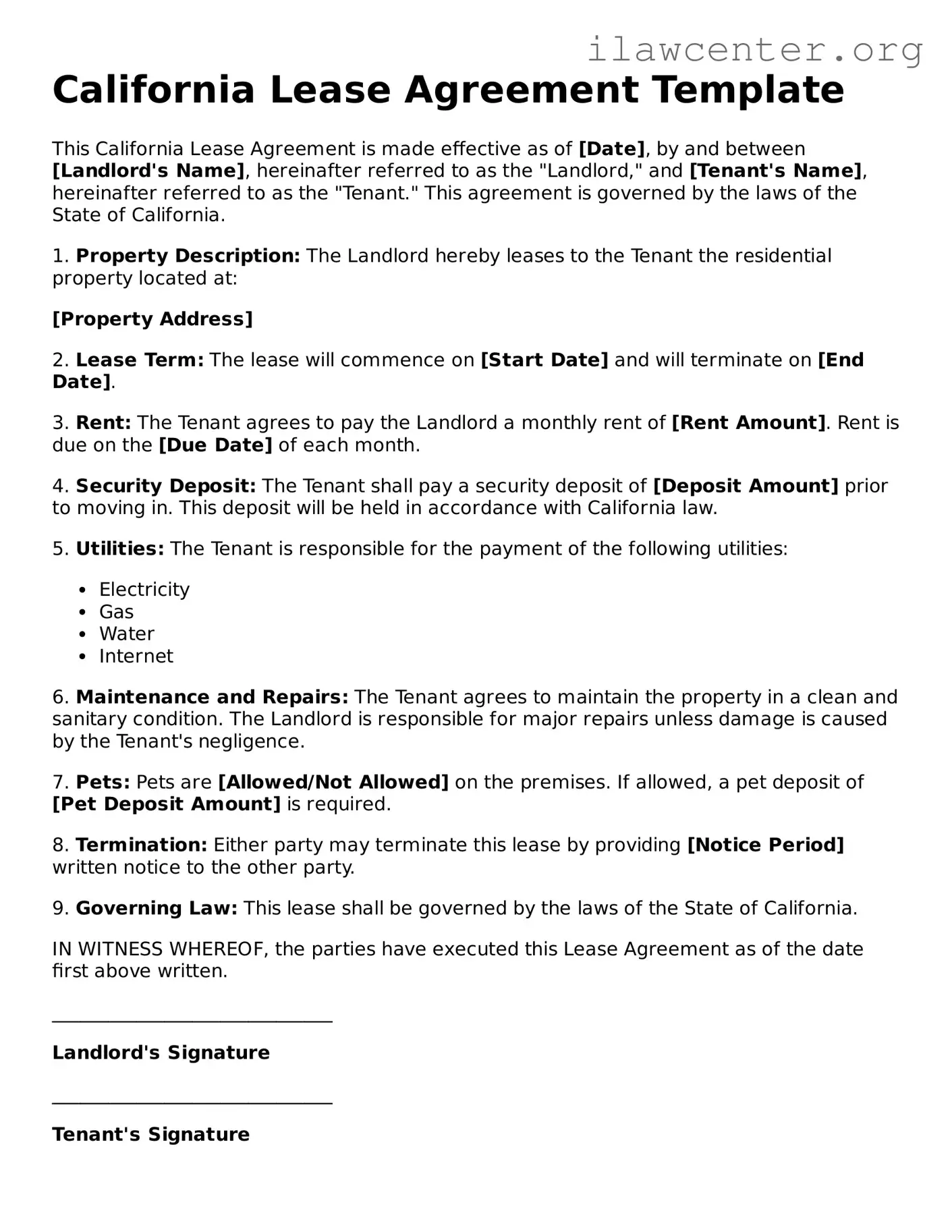
California Lease Agreement Preview

California Lease Agreement Template

This California Lease Agreement is made effective as of [Date], by and between [Landlord's Name], hereinafter referred to as the "Landlord," and [Tenant's Name], hereinafter referred to as the "Tenant." This agreement is governed by the laws of the State of California.

1. Property Description: The Landlord hereby leases to the Tenant the residential property located at:

[Property Address]

2. Lease Term: The lease will commence on [Start Date] and will terminate on [End Date].

3. Rent: The Tenant agrees to pay the Landlord a monthly rent of [Rent Amount]. Rent is due on the [Due Date] of each month.

4. Security Deposit: The Tenant shall pay a security deposit of [Deposit Amount] prior to moving in. This deposit will be held in accordance with California law.

5. Utilities: The Tenant is responsible for the payment of the following utilities:

  • Electricity
  • Gas
  • Water
  • Internet

6. Maintenance and Repairs: The Tenant agrees to maintain the property in a clean and sanitary condition. The Landlord is responsible for major repairs unless damage is caused by the Tenant's negligence.

7. Pets: Pets are [Allowed/Not Allowed] on the premises. If allowed, a pet deposit of [Pet Deposit Amount] is required.

8. Termination: Either party may terminate this lease by providing [Notice Period] written notice to the other party.

9. Governing Law: This lease shall be governed by the laws of the State of California.

IN WITNESS WHEREOF, the parties have executed this Lease Agreement as of the date first above written.

______________________________

Landlord's Signature

______________________________

Tenant's Signature

PDF Form Characteristics

Fact Name Description
Governing Law The California Lease Agreement is governed by the California Civil Code, specifically sections 1940-1954.
Parties Involved The agreement typically involves a landlord (lessor) and a tenant (lessee).
Duration Lease terms can vary, but common durations include month-to-month or fixed-term leases (e.g., one year).
Security Deposit California law limits the security deposit to two months' rent for unfurnished units and three months' rent for furnished units.
Rent Control Some cities in California have rent control laws that may affect how much rent can be charged and how often it can be increased.
Disclosure Requirements Landlords must provide certain disclosures, such as information about lead-based paint and mold, to tenants.
Termination Notice For month-to-month leases, a landlord must provide a 30-day notice to terminate the agreement.
Repair Obligations Landlords are generally responsible for maintaining the property and ensuring it is habitable.
Late Fees California law allows landlords to charge late fees, but they must be reasonable and specified in the lease agreement.

Instructions on Utilizing California Lease Agreement

Completing the California Lease Agreement form is an essential step in establishing a rental relationship. This document outlines the terms and conditions between the landlord and tenant, ensuring both parties understand their rights and responsibilities. To fill out the form correctly, follow these detailed steps.

  1. Start by entering the date at the top of the form. This indicates when the agreement becomes effective.
  2. Fill in the landlord's name and address. This information should include the full name and the complete address where the landlord can be reached.
  3. Next, provide the tenant's name and address. Ensure that the tenant's full name and current address are accurately recorded.
  4. Specify the property address where the rental will take place. This should be the complete address of the rental unit.
  5. Detail the lease term. Indicate whether the lease is for a fixed term (e.g., one year) or month-to-month. Include start and end dates if applicable.
  6. Enter the rent amount. Clearly state how much the tenant will pay each month and when the payment is due.
  7. Outline the security deposit amount. This should reflect the sum the tenant must pay upfront to secure the rental.
  8. Include any additional terms or conditions that are relevant to the lease. This might cover pet policies, maintenance responsibilities, or restrictions on alterations.
  9. Both parties must sign and date the form. Ensure that the landlord and tenant sign in the designated areas to make the agreement legally binding.

Once the form is filled out and signed, both the landlord and tenant should retain a copy for their records. This ensures that each party has access to the agreed-upon terms should any disputes arise in the future.

Important Facts about California Lease Agreement

What is a California Lease Agreement?

A California Lease Agreement is a legally binding document that outlines the terms and conditions between a landlord and a tenant for renting residential or commercial property in California. This agreement details important aspects such as the duration of the lease, rent amount, security deposit, and responsibilities of both parties. It serves to protect the rights of both the landlord and the tenant by clearly defining expectations and obligations.

What key elements should be included in a California Lease Agreement?

Several essential components should be included in a California Lease Agreement. These elements typically encompass the names of the landlord and tenant, the property address, the lease term (whether month-to-month or fixed-term), rent amount and payment due dates, security deposit details, maintenance responsibilities, and rules regarding pets or smoking. Including these details ensures clarity and helps prevent disputes in the future.

How long is a typical lease term in California?

The length of a lease term in California can vary. Most residential leases are either month-to-month or fixed for a specific duration, commonly ranging from six months to one year. A month-to-month lease allows for more flexibility, as either party can terminate the lease with proper notice, usually 30 days. Fixed-term leases provide stability for both the tenant and landlord but require adherence to the agreed-upon duration.

Are there any specific laws governing California Lease Agreements?

Yes, California has specific laws that govern lease agreements. The California Civil Code outlines various regulations regarding security deposits, rent control, eviction processes, and tenant rights. For instance, landlords cannot charge more than two months' rent for an unfurnished unit and three months for a furnished one as a security deposit. Familiarizing oneself with these laws is crucial for both landlords and tenants to ensure compliance and protect their rights.

What happens if a tenant wants to break the lease early?

If a tenant wishes to break the lease early, they may face penalties as outlined in the lease agreement. Generally, the tenant is responsible for paying rent until a new tenant is found or until the lease term ends, unless the landlord agrees to release them from the lease. It is advisable for tenants to communicate openly with their landlord and review the lease terms to understand their options and any potential consequences.

Can a California Lease Agreement be modified after it is signed?

Yes, a California Lease Agreement can be modified after it is signed, but both parties must agree to the changes. Any modifications should be documented in writing and signed by both the landlord and tenant to ensure that the changes are enforceable. Verbal agreements may not hold up in a legal dispute, so it is always best to have any modifications clearly outlined in writing.

Common mistakes

Filling out the California Lease Agreement form can be straightforward, but many individuals make common mistakes that can lead to complications. One frequent error is failing to include all necessary parties. Both the landlord and tenant must be clearly identified. Omitting a party can create confusion about responsibilities and rights.

Another mistake is neglecting to specify the rental amount and payment terms. Clearly stating the rent amount, due date, and acceptable payment methods is essential. Without this information, disputes may arise over payments.

People often overlook the importance of detailing the lease term. A lease should specify whether it is month-to-month or for a fixed term. Not doing so can lead to misunderstandings about when the lease ends.

Some individuals forget to address security deposits. The lease should outline the amount of the deposit, conditions for its return, and any deductions that may be taken. This prevents potential conflicts when the lease ends.

Another common error is not including maintenance responsibilities. The lease should clarify who is responsible for repairs and maintenance. This clarity helps avoid disputes later on.

Inadequate information about utilities is also a frequent mistake. The lease should specify which utilities are included in the rent and which are the tenant’s responsibility. This ensures that both parties understand their obligations.

People sometimes fail to mention any restrictions on property use. If there are rules about pets, smoking, or subletting, these should be clearly stated in the lease. This helps set expectations for tenants.

Another error is neglecting to include the terms for lease termination. It is crucial to outline how either party can terminate the lease, including notice requirements. This can prevent misunderstandings when one party wishes to leave.

Some individuals do not take the time to read the entire lease agreement. Skipping over sections can lead to missing important clauses that affect rights and responsibilities. Always review the entire document carefully.

Lastly, failing to sign and date the lease is a common oversight. Both parties must sign and date the agreement for it to be legally binding. Without signatures, the lease may not be enforceable.

Documents used along the form

When entering into a rental agreement in California, several additional forms and documents may be necessary to ensure that both landlords and tenants are protected and informed. These documents serve various purposes, from outlining responsibilities to providing legal protections. Below is a list of commonly used forms that complement the California Lease Agreement.

  • Rental Application: This document collects information from potential tenants, including employment history and references, to help landlords assess suitability.
  • Credit Check Authorization: A form that allows landlords to obtain a tenant's credit report, providing insight into their financial reliability.
  • Lead-Based Paint Disclosure: Required for properties built before 1978, this form informs tenants about the potential hazards of lead-based paint.
  • Pet Addendum: This document outlines the rules and regulations regarding pets on the property, including any additional deposits or fees.
  • Move-In Inspection Checklist: A tool used to document the condition of the property at the time of move-in, protecting both parties from disputes later.
  • Notice to Enter: A formal notification that landlords must provide tenants before entering the rental unit for maintenance or inspections.
  • Security Deposit Receipt: This receipt provides evidence of the security deposit amount paid and outlines the terms for its return.
  • Lease Renewal Agreement: A document that outlines the terms for extending an existing lease, including any changes in rent or conditions.
  • Termination Notice: This form is used by either party to formally notify the other of the intent to terminate the lease agreement.

Each of these documents plays a crucial role in the rental process, helping to clarify expectations and obligations. By utilizing these forms alongside the California Lease Agreement, both landlords and tenants can foster a transparent and harmonious rental experience.

Similar forms

A Lease Agreement is a crucial document in real estate transactions, but it shares similarities with several other important documents. Understanding these can help you navigate your rights and responsibilities as a tenant or landlord. Here are six documents that are similar to a Lease Agreement:

  • Rental Agreement: Often confused with a lease, a rental agreement typically covers a shorter duration, such as month-to-month. It outlines terms for renting a property without the long-term commitment of a lease.
  • Sublease Agreement: This document allows a tenant to rent out their leased space to another party. It includes similar terms and conditions as the original lease, ensuring that all parties understand their rights and obligations.
  • Property Management Agreement: This document is between a property owner and a management company. It details how the property will be managed, including leasing terms, maintenance, and tenant relations, resembling a lease in its structure and purpose.
  • Commercial Lease Agreement: Used for business properties, this agreement outlines terms specific to commercial use. Like residential leases, it covers rent, duration, and responsibilities but is tailored to business needs.
  • Tenancy Agreement: This is another term often used interchangeably with a lease. It defines the relationship between a landlord and tenant, covering similar terms like rent, duration, and rules for living in the property.
  • Eviction Notice: While not a leasing document per se, an eviction notice is a legal document that can stem from a lease violation. It outlines the reasons for eviction and the required steps, reflecting the legal obligations established in a lease agreement.

Understanding these documents can empower you in your rental journey, ensuring you make informed decisions and uphold your rights.

Dos and Don'ts

When filling out a California Lease Agreement form, it's important to approach the task with care. Here’s a list of things to keep in mind to ensure a smooth process.

  • Do read the entire agreement carefully. Understanding all terms and conditions is crucial before signing.
  • Don't leave any sections blank. Incomplete forms can lead to misunderstandings or disputes later.
  • Do provide accurate information. Ensure that all personal details, including names and addresses, are correct.
  • Don't rush through the process. Take your time to review each section and clarify any doubts.
  • Do ask questions. If something is unclear, reach out to the landlord or property manager for clarification.
  • Don't ignore additional terms. Pay attention to any addendums or special clauses that may be included.
  • Do keep a copy of the signed agreement. Having a record of the lease can be helpful in the future.

By following these guidelines, you can help ensure that the lease signing experience is straightforward and beneficial for both parties involved.

Misconceptions

Many people have misunderstandings about the California Lease Agreement form. Here are four common misconceptions:

  • All lease agreements must be in writing. While it is highly recommended to have a written lease, California law allows for oral agreements in certain situations. However, having a written document provides clarity and can help prevent disputes.
  • Landlords can charge any amount for a security deposit. In California, there are specific limits on security deposits. For unfurnished properties, the maximum is two months' rent, and for furnished properties, it is three months' rent. Landlords must adhere to these limits.
  • Lease agreements are the same as rental agreements. Although both documents serve similar purposes, they are not the same. A lease typically covers a longer term, often one year, while a rental agreement is usually month-to-month.
  • Tenants have no rights once they sign a lease. This is not true. Tenants retain rights even after signing a lease. They are protected by various laws regarding habitability, privacy, and the return of security deposits, among other things.

Key takeaways

When filling out and using the California Lease Agreement form, consider the following key takeaways:

  1. Understand the Basics: Familiarize yourself with the essential components of the lease agreement, including the rental amount, duration, and responsibilities of both the landlord and tenant.
  2. Be Clear on Terms: Clearly define terms such as security deposits, maintenance responsibilities, and rules regarding pets or subletting to avoid misunderstandings later.
  3. Review Local Laws: California has specific laws regarding lease agreements. Ensure that your lease complies with these regulations to protect both parties.
  4. Document Everything: Keep a copy of the signed lease agreement for your records. This documentation will be vital in case of disputes or misunderstandings.
  5. Consider Legal Advice: If you have questions or concerns about the lease, seeking legal advice can provide clarity and ensure that your rights are protected.

By following these guidelines, you can navigate the leasing process with confidence and ease.