Attorney-Verified  Loan Agreement Document for California

Attorney-Verified Loan Agreement Document for California

The California Loan Agreement form is a legal document that outlines the terms and conditions of a loan between a lender and a borrower. This form serves to protect both parties by clearly detailing the loan amount, interest rate, repayment schedule, and any collateral involved. To get started on your loan agreement, fill out the form by clicking the button below.

Article Guide

The California Loan Agreement form is a crucial document that outlines the terms and conditions of a loan between a lender and a borrower. This form serves as a binding contract, ensuring that both parties understand their rights and obligations. Key components typically include the loan amount, interest rate, repayment schedule, and any collateral required to secure the loan. Additionally, it may specify the consequences of default and the process for resolving disputes. By clearly detailing these aspects, the form aims to protect both the lender's investment and the borrower's interests. Understanding the nuances of this agreement is essential for anyone involved in a lending transaction in California, as it provides a framework for accountability and transparency.

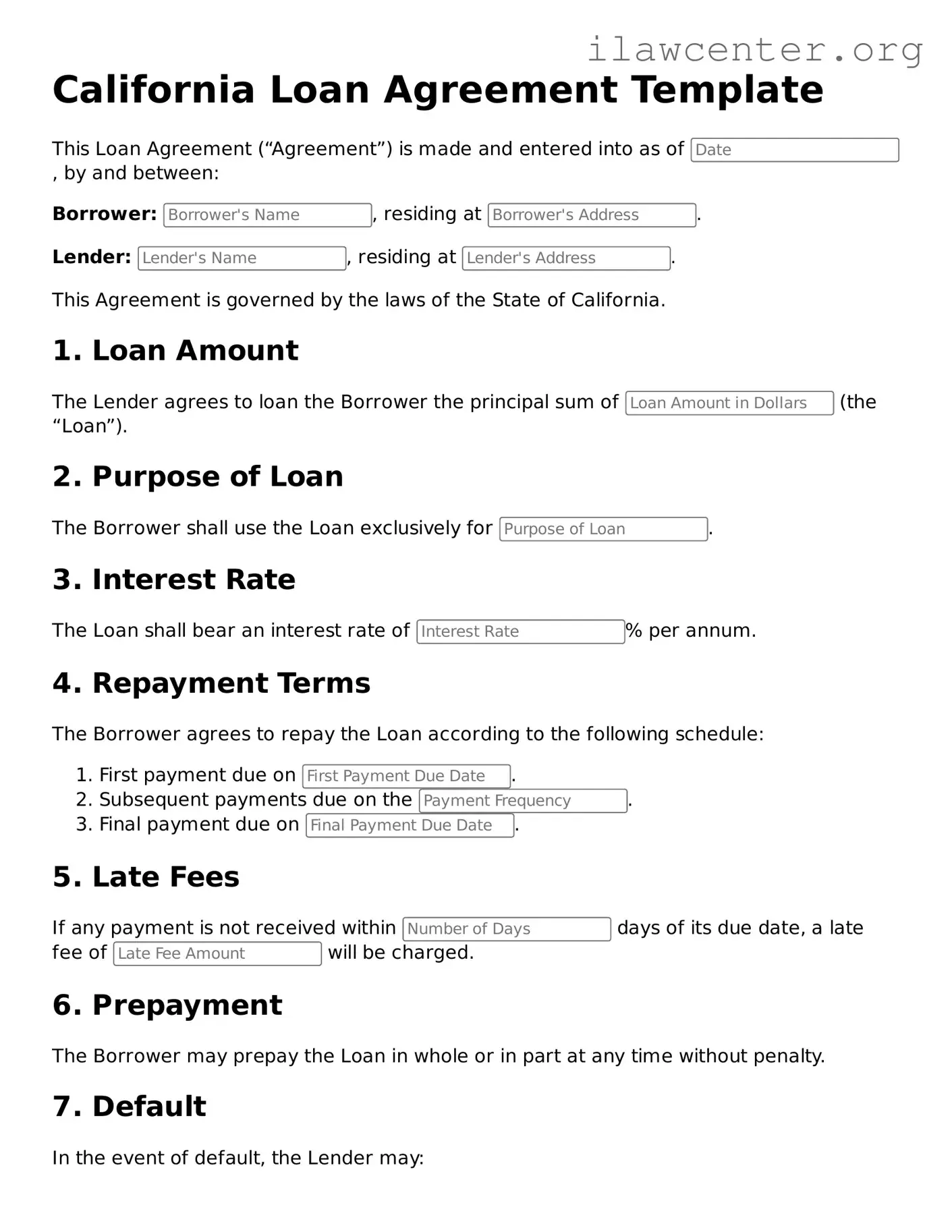
California Loan Agreement Preview

California Loan Agreement Template

This Loan Agreement (“Agreement”) is made and entered into as of , by and between:

Borrower: , residing at .

Lender: , residing at .

This Agreement is governed by the laws of the State of California.

1. Loan Amount

The Lender agrees to loan the Borrower the principal sum of (the “Loan”).

2. Purpose of Loan

The Borrower shall use the Loan exclusively for .

3. Interest Rate

The Loan shall bear an interest rate of % per annum.

4. Repayment Terms

The Borrower agrees to repay the Loan according to the following schedule:

  1. First payment due on .
  2. Subsequent payments due on the .
  3. Final payment due on .

5. Late Fees

If any payment is not received within days of its due date, a late fee of will be charged.

6. Prepayment

The Borrower may prepay the Loan in whole or in part at any time without penalty.

7. Default

In the event of default, the Lender may:

  • Demand immediate payment of the entire unpaid balance.
  • Take any legal action necessary to collect the amount owed.

8. Governing Law

This Agreement shall be governed by and construed in accordance with the laws of the State of California.

9. Signatures

By signing below, both parties agree to the terms and conditions outlined in this Agreement.

Borrower Signature: _________________________

Lender Signature: _________________________

PDF Form Characteristics

Fact Name Details
Definition The California Loan Agreement form outlines the terms between a lender and a borrower for a loan.
Governing Law This form is governed by California state laws, specifically the California Civil Code.
Parties Involved The form includes sections for both the lender and the borrower to provide their information.
Loan Amount The specific amount of money being borrowed must be clearly stated in the agreement.
Interest Rate The agreement should specify the interest rate applicable to the loan.
Repayment Terms Details on how and when the borrower will repay the loan are included in the form.
Default Conditions The form outlines what constitutes a default and the consequences that follow.
Signatures Both parties must sign the agreement to make it legally binding.
Amendments Any changes to the agreement must be documented and agreed upon by both parties.

Instructions on Utilizing California Loan Agreement

Filling out the California Loan Agreement form is an essential step in establishing the terms of a loan. This process requires careful attention to detail to ensure that all necessary information is accurately provided. Once completed, the form will serve as a formal record of the agreement between the lender and the borrower.

  1. Begin by entering the date at the top of the form.
  2. Fill in the names and addresses of both the lender and the borrower. Ensure that all names are spelled correctly.
  3. Specify the loan amount clearly. Double-check the figures to avoid any mistakes.
  4. Indicate the interest rate that will apply to the loan. This should be clearly stated and easy to understand.
  5. Outline the repayment terms, including the duration of the loan and the payment schedule. Be specific about when payments are due.
  6. Include any additional terms or conditions that both parties agree upon. This could cover late fees, prepayment options, or collateral details.
  7. Sign and date the form. Both the lender and the borrower must provide their signatures to make the agreement official.
  8. Make copies of the completed form for both parties' records.

Important Facts about California Loan Agreement

What is a California Loan Agreement form?

A California Loan Agreement form is a legal document that outlines the terms and conditions of a loan between a lender and a borrower within the state of California. This form typically includes important details such as the loan amount, interest rate, repayment schedule, and any collateral involved. By clearly defining these terms, both parties can avoid misunderstandings and ensure a smooth transaction.

Who needs to use a Loan Agreement form?

Anyone who is lending or borrowing money in California should consider using a Loan Agreement form. This includes individuals, businesses, and organizations. Whether it's a personal loan between friends or a business loan, having a written agreement helps protect both parties. It establishes clear expectations and provides a reference point in case of disputes.

What should be included in a California Loan Agreement form?

A comprehensive Loan Agreement form should include several key components. First, it should state the names and contact information of both the lender and borrower. Next, it should specify the loan amount and the interest rate. Additionally, the repayment terms, including the schedule and method of payment, should be clearly outlined. If applicable, the agreement should also detail any collateral securing the loan. Finally, it’s wise to include provisions for default and any applicable fees.

Is a Loan Agreement form legally binding?

Yes, a properly executed Loan Agreement form is legally binding in California. Once both parties sign the document, they are obligated to adhere to its terms. However, for the agreement to be enforceable, it must meet certain legal requirements, such as being in writing and signed by both parties. It’s advisable to consult with a legal professional to ensure that the agreement complies with all relevant laws and regulations.

Common mistakes

When individuals fill out the California Loan Agreement form, they often overlook critical details that can lead to complications later on. One common mistake is failing to provide accurate personal information. Names, addresses, and contact numbers must be precise. A simple typo can lead to significant misunderstandings or delays in processing the loan.

Another frequent error involves the omission of necessary financial details. Borrowers sometimes neglect to include their income sources or fail to disclose other outstanding debts. This lack of transparency can raise red flags for lenders, potentially jeopardizing the approval of the loan.

Inadequate understanding of the terms is also a prevalent issue. Some individuals sign the agreement without fully grasping the implications of interest rates, repayment schedules, and fees. This lack of comprehension can result in unexpected financial burdens down the line.

Moreover, individuals often forget to read the fine print. Important clauses regarding default, prepayment penalties, or collateral requirements may be hidden within the text. Ignoring these details can lead to unpleasant surprises after the loan is secured.

Another mistake involves not providing the required documentation. Lenders typically request specific documents to verify income and creditworthiness. Failing to submit these documents can result in delays or even denial of the loan application.

Some borrowers make the error of assuming that the terms are negotiable without first discussing them with the lender. While some aspects of a loan agreement can be adjusted, approaching the lender with a lack of preparation can weaken one’s position.

Additionally, individuals sometimes miscalculate the loan amount they need. Borrowers may either request too much, resulting in unnecessary debt, or too little, which may not cover their needs. Careful budgeting is essential to avoid this pitfall.

Another common oversight is neglecting to clarify who is responsible for fees associated with the loan. Understanding whether the borrower or the lender will cover certain costs can prevent misunderstandings later on.

Furthermore, some individuals fail to consider the impact of their credit score on loan terms. A low credit score can lead to higher interest rates or unfavorable terms. Awareness of one’s credit standing is crucial before entering into a loan agreement.

Finally, borrowers often forget to keep copies of the signed agreement. Having a personal record of the terms and conditions is vital for future reference. Without this documentation, resolving disputes can become significantly more challenging.
Documents used along the form

When engaging in a loan agreement in California, several additional documents often accompany the primary Loan Agreement form. These documents serve to clarify terms, protect the interests of both parties, and ensure compliance with legal requirements. Understanding these forms is essential for a smooth transaction.

  • Promissory Note: This document outlines the borrower's promise to repay the loan. It includes details such as the loan amount, interest rate, repayment schedule, and any penalties for late payments. It is a legally binding contract that provides the lender with security.
  • Security Agreement: If the loan is secured by collateral, a security agreement is necessary. This document specifies the collateral being used to secure the loan and the lender's rights to it in case of default. It protects the lender's investment by giving them a claim to the collateral.
  • Disclosure Statement: This document provides borrowers with important information about the loan terms, including fees, interest rates, and any potential risks. It ensures that borrowers are fully informed before they commit to the loan, promoting transparency in the lending process.
  • Guaranty Agreement: In some cases, a guarantor may be required to back the loan. A guaranty agreement outlines the guarantor's commitment to repay the loan if the borrower defaults. This adds an extra layer of security for the lender, especially in higher-risk situations.

In summary, these documents play a crucial role in the loan process in California. They help to define the relationship between the borrower and lender, establish security, and ensure that both parties understand their rights and obligations. Being aware of these forms can help prevent misunderstandings and legal issues down the line.

Similar forms

The Loan Agreement form shares similarities with several other financial documents. Each serves a distinct purpose but often includes comparable elements regarding terms, conditions, and obligations. Below is a list of seven documents that are similar to the Loan Agreement form:

  • Promissory Note: This document outlines a borrower's promise to repay a loan, detailing the loan amount, interest rate, and repayment schedule, much like a Loan Agreement.
  • Mortgage Agreement: In this document, a borrower pledges real property as collateral for a loan. It includes terms similar to those found in a Loan Agreement, such as payment terms and default conditions.
  • Security Agreement: This agreement establishes a security interest in personal property as collateral for a loan. It contains terms that mirror those in a Loan Agreement regarding obligations and rights of both parties.
  • Lease Agreement: Although primarily for renting property, it includes terms about payment obligations and conditions for default, similar to a Loan Agreement.
  • Credit Agreement: This document outlines the terms of a credit facility, including interest rates and repayment terms, paralleling the structure of a Loan Agreement.
  • Debt Settlement Agreement: In this document, parties agree on terms to settle a debt, often detailing payment plans and obligations, akin to the terms found in a Loan Agreement.
  • Personal Loan Agreement: This agreement specifies the terms of a personal loan, including interest rates and repayment schedules, closely resembling a Loan Agreement.

Dos and Don'ts

When filling out the California Loan Agreement form, it's essential to approach the task with care. Here’s a list of things to keep in mind:

  • Do read the entire form carefully. Understanding each section ensures that you provide accurate information.
  • Don't rush through the process. Taking your time can help prevent mistakes that may lead to complications later.
  • Do provide all required information. Omitting details can delay the approval process or result in rejection.
  • Don't use vague language. Be specific in your descriptions to avoid confusion and misinterpretation.
  • Do double-check your figures. Ensure that all financial amounts are accurate and clearly stated.
  • Don't forget to sign and date the form. An unsigned form may be considered incomplete and invalid.
  • Do keep a copy for your records. Having a copy can be helpful for future reference or in case of disputes.

By following these guidelines, you can help ensure that your Loan Agreement is completed correctly and efficiently.

Misconceptions

When it comes to the California Loan Agreement form, several misconceptions can lead to confusion. Understanding these can help borrowers and lenders navigate the process more effectively.

  • It is a one-size-fits-all document. Many believe that the California Loan Agreement form is universally applicable. In reality, it should be tailored to fit the specific terms and conditions of each loan.
  • All loans require a formal agreement. Some people think that all loans must be documented with a formal agreement. While it's advisable for larger loans, smaller personal loans may not require a written contract.
  • Verbal agreements are just as binding. A common misconception is that verbal agreements hold the same weight as written ones. In most cases, a written agreement is crucial for legal enforceability.
  • Only lenders need to sign. It's often assumed that only the lender's signature is necessary. However, both parties should sign the agreement to acknowledge their acceptance of the terms.
  • The form is only for personal loans. Some people think the California Loan Agreement form is limited to personal loans. In truth, it can be used for various types of loans, including business and commercial loans.
  • Once signed, it cannot be changed. There is a belief that the terms of a loan agreement are set in stone once signed. Modifications can be made, but they typically require both parties to agree and sign an amendment.
  • Legal advice is unnecessary. Many borrowers think they can navigate the agreement without legal counsel. Seeking legal advice can provide valuable insights and help avoid pitfalls.

By dispelling these misconceptions, individuals can approach the California Loan Agreement form with a clearer understanding, ensuring a smoother borrowing or lending experience.

Key takeaways

When filling out and using the California Loan Agreement form, keep these key takeaways in mind:

  • Clear Identification: Make sure to clearly identify all parties involved in the loan agreement. This includes the lender and the borrower, along with their contact information.
  • Loan Amount and Terms: Specify the total loan amount and outline the repayment terms, including interest rates and payment schedules.
  • Signatures Required: Both parties must sign the agreement. This step is crucial for the agreement to be legally binding.
  • Review for Accuracy: Before finalizing, review the document for any errors or omissions. Ensuring accuracy helps prevent disputes later on.